




Richard Weihe – Sea Of Ink
Posted 8th October 2012
Category: Reviews Genres: 2000s, Art, Biography, Historical, Philosophy, Spiritual, Translation
2 Comments
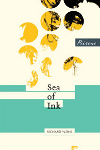
Describing the self without words.
Publisher: Peirene Press
Pages: 100
Type: Fiction
Age: Adult
ISBN: 978-0-9562840-8-2
First Published: 2003
Date Reviewed: 1st October 2012
Rating: 4/5
Original language: German
Original title: Meer der Tusche (Sea of Ink)
Translated by: Jamie Bulloch
Bada Shanren was born in luxury but chose to abandon said luxury for the robes of a monk. Inspired by his father and taught by the abbot he begins to paint, learning about himself and the world in a unique way as he does so.
A mixture of fact and fiction, Weihe’s chaptered novella spans almost an entire life in a very short time. Whilst the background is given to the reader as a non-fiction account, and non-fiction it is – the story of the Manchu conquest of China – the rest is a mostly imaginary tale of Shanren’s life. For what Weihe includes in his narrative is the sort of content you do not find in biographies: detailed thoughts and a tale that is as artistic in its written style as it is in its subject.
And there is a large amount of detail in this book; indeed just like art, it is varied, some details existing as part of the narrative, others being more about structure of subtext. A great deal consists of a subtle philosophy – sentences, ideas – often not discussed and simply just put out there, so to speak. And on the other hand there is, for example, a difference in the written style of the military non-fictional section compared to the fiction – the non-fiction reading rather like a set of bullet points without the bullet points themselves, and the fiction flowing more like the water that plays such a big part in Shanren’s life. If the non-fiction feels stilted, the fiction is liquid prose and beautiful.
The philosophy concerns art, first and foremost, but is inevitably linked to life in general. Often poetic, it draws from a pool that seems a blend of regular worldly philosophy and classical Chinese sayings, the result being highly interesting.
For me as a painter the value of the mountain is not in its size, but in the possibility of mastering it with the paintbrush. When you look at a mountain you are seeing a piece of nature. But when you paint a mountain it becomes a mountain. You do not paint its size, you imply it.
What is particularly intriguing about Shanren, at least in the way Weihe presents him, is the link between the self and the way the painter continually changes his name. Weihe himself, in the afterword, speaks of the artwork being a representation of the painter. Whilst it may not always be the case, there often seems a match of one style or atmosphere to the paintings and the name Shanren goes by at the time. He changes his name to suit the place he is at in his journey to master technique, his art, and the answers to his abbot’s questions.
As an additional point the reader may find the parallel between Shanren’s life and the life of Siddhartha Gautama, The Buddha, rather poignant. Like The Buddha, Shanren has an epiphany of sorts and decides to leave his wife and son in order to live simply with a spiritual aim. And like The Buddha – although Shanren does in fact seek a new wife after he realises his diversion from the path set by his ancestors – he comes to a spiritual awakening. The two figures shared a basic understanding of the world through Shanren’s following of the way of life created by The Buddha.
To read Sea Of Ink is to have a history lesson, art lesson, and language lesson at once. Jamie Bulloch’s translation seems at one with the original text, a good substitute where the original cannot be read. Weihe has included a lot of information and yet when reading it does not feel at all so. And the additions of the paintings themselves is a boon that allows Weihe to describe the method of painting in a way that means the reader can literally follow the brush. This written technique may at times feel overused, but it is an intriguing concept nonetheless.
If you are guided by human feelings you will easily lose your way, a wise saying went, but if you are guided by nature you will rarely go wrong.
Sea Of Ink, about art in its many forms, transcends the usual notions of appeal; it is far from restricted to those who have an interest in its most obvious aspects.
Sea Of Ink was originally written in Swiss German, and was translated into English by Jamie Bulloch.
I received this book for review from Peirene Press.
Related Books
None yet
Thomas More – Utopia
Posted 29th August 2012
Category: Reviews Genres: 1510s, Philosophy, Political, Social, Theological
Comments Off on Thomas More – Utopia

Utopia may not be Utopia, but does that matter?
Publisher: N/A (I read Penguin’s version)
Pages: N/A
Type: Fiction
Age: Adult
ISBN: N/A
First Published: 1516
Date Reviewed: 10th August 2012
Rating: 4.5/5
Please note that the version I read was translated by Paul Turner (from the original Latin).
Utopia is a work of fiction, however it does overlap with reality and depending on the edition you read the editor and/or translator may or may not have included a couple of letters that sound very much like true correspondence. The plot is simple and detail is everything: More meets his friend Peter and Peter introduces him to Raphael, a man who has lived in the New World. Raphael spends time conferring upon the friends the knowledge he has learned from the country, and discusses his convictions that life in Utopia is fairer than Europe and that Europe ought to use Utopian society and politics as an ideal to aspire to. Filled with references to Plato, the conversation is seemingly an attempt by More to preach his suggestions for a different system of government and living.
The book is quite a feat, yet whether or not the author himself knew just how much of a feat it was, and would remain to be, is a subject that would require a differing style of writing to a review; one can assume he knew something of it as Wolsey had made him publish it under the name of William Rosse1. Utopia is at once a product of its time and ahead of its era. Although some of the topics it addresses fall solely in the realm of the late medieval/early modern period, the vast majority are relevant today in a rather scary fashion. Indeed More is so accurate in his ruminations of structures that continue, even now, to be used in the (western) world, that he would be well placed were he to sit in the British House Of Commons tomorrow.
More’s book contains a lot of thoughts that successfully appeal to both a minority of people in his day – or maybe they were a majority? Who really knows what the common person thought? – and to us in our 21st century world. There are “discussions” on subjects such as capital punishment for burglary:
“We’re hanging them all over the place,” he said, “I’ve seen as many as twenty on a single gallows. And that’s what I find so odd. Considering how few of them get away with it, why are we still plagued with so many robbers?”
“What’s odd about it?” I asked – for I never hesitated to speak freely in front of the Cardinal. “This method of dealing with thieves is both unjust and socially undesirable. As a punishment it’s too severe, and as a deterrent it’s quite ineffective. Petty larceny isn’t bad enough to deserve the death penalty, and no penalty on earth will stop people from stealing, if it’s their only way of getting food. In this respect you English, like most other nations, remind me of incompetent schoolmasters, who prefer caning their pupils to teaching them. Instead of inflicting these horrible punishments, it would be far more to the point to provide everyone with some means of livelihood, so that nobody’s under the frightful necessity of becoming first a thief and then a corpse.”
Here More, through his character Raphael, speaks out against the fatal punishment meted out to thieves. More points out that a great many of the thieves apprehended are poor and that they are not in a situation where they can act upon the fact that thieves are executed. And More quite rightly suggests, although at least in the western world he can be happy that such extreme measures no longer exist even if jail applies to both, that there being no difference in punishment for a thief as for a murderer does not change the way a thief will behave; indeed a thief may as well have been a murderer in the 1500s.
And when it comes to bringing up the youth of society, More’s words are seemingly even more political than before as what he says is incredibly relevant to Britain today, as 21st century Britain struggles with crime which many link back to unemployment and few opportunities in both childhood and adulthood. More remarks:
“You allow these people to be brought up in the worst possible way, and systematically corrupted from their earliest years. Finally, when they grow up and commit the crimes that they were obviously destined to commit, ever since they were children, you start punishing them. In other words, you create thieves, and then punish them for stealing!”
If you do not help people to get out of their poor backgrounds they will have no way to get onto the career ladder, to make money legally. And, to go back to a 1500’s issue, how can stealing money equate to a death sentence? Both are against the Ten Commandments and surely murder is worse than stealing.
More doesn’t leave it there – he goes on to explain why there are these issues in the first place. What is interesting is that he speaks out against the way the church would take land for its own use and how the begging for alms by monks would effectively leave less money available for true beggars – this being interesting because More was himself a strong Catholic. One could liken his thinking to that of Erasmus, who also spoke out against the church whilst remaining one with it. Yet it is interesting how these two writers, More and Erasmus, were effectively giving a prior warning to their readers about the Reformation action that was to come, being people who remained loyal whilst others who spoke out fell out of love with Catholicism and became Protestants.
As a last look at examples of how More’s work fits so well into our world may we consider the information he provides that it is the expense of raw materials, created by a greedy government, that caused many people to be out of work?
It is interesting and ironic how some of the items More discusses were to happen so soon after publication. These are the references to the men employed by government turning against that government – this is what the New Model Army did in the 1600s, the turning point towards England becoming a republic for that short time – and the use, by a king, of ancient laws that everyone had forgotten, in order to raise money – exactly what Charles I did to fund his fight against the afore-mentioned NMA. So uncanny are these discussions, so spot-on in their warning, that it’s hard to believe that More was writing five monarchs previous when the country was, if not completely, better settled.
As to be expected in our modern society, though the book may have great relevance, it is difficult to agree with everything More is saying. Indeed there are observations made about Utopia that prove quite disagreeable, such as that the “mentally deficient” (read “mentally disabled”) ought to be laughed at whilst being looked after – because that is the right way to communicate with them if one is nursing them. This by itself is typical of views at the time, but what makes it particularly difficult to accept is that it is comes before a paragraph that urges acceptance of the physically deformed and ugly (read “physically disabled or deformed”) because such deformities are not their fault. Whilst one could perhaps surmise that the phrase “mentally deficient” is More’s way of saying “those who haven’t bothered to try to improve their intellect”, the fact is that coming straight before a statement about the physically disabled does very much suggest that More is speaking of the mentally disabled, and this is a point on which the translator of the text agrees. The only thing that truly suggests More is talking of intellect-by-choice is that he says those who are physically deformed did not choose to be so, thus possibly inferring that the mentally deficient are their opposites – because which mentally disabled person has had a choice over whether or not they are mentally disabled? It is not their fault, just as it is not a physically disabled person’s fault. However, a fact trumps all these charges to single this piece out as prejudice by More – physically disabled people were more understood; the mentally disabled, for a very long period of time, were simply viewed as mad or strange with no real studies conducted to find out what was really going on. With a physical disability, even doctors of the 1500s would have recognised a limp, a wounded arm, or an inability to move, as a medical issue.
Then there is the idea of religious tolerance. Through the fictional Raphael, More announces that Utopia is home to a variety of religions and that the citizens are free to believe in what they will – then he says that everyone goes to church and kneels before the priest. Unfortunately here, in our modern eyes, More is but confirming his own beliefs, firstly by the use of the word “church” – a Christian term – and secondly because people of differing religions should not be made (as you soon realise that Utopia is in fact more akin to an apocalyptic dictatorship than heaven) to use one priest and one all-encompassing service, at least not as their sole form of community worship. And if beliefs are allowed to be different, then the prayer More details makes no sense as it talks about a “true religion”. “More was intolerant of all dissident opinion,” wrote the historian Joanna Denny2. Whilst Denny was incredibly biased against More, it cannot be denied that More’s own words back her up.
But these negatives in no way set the modern reader back, for later on comes such comments as this one on the elderly poor:
Having taken advantage of them throughout the best years of their lives, society now forgets all the sleepless hours they’ve spent in its service, and repays them for all the vital work they’ve done, by letting them die in misery.
It seems 1500s Britain was as notorious as the 21st century version in its care of the older generation – a quick bit of research on the part of anyone not acquainted with the UK system will find that the above quotation could quite easily have been taken from a leaflet about the current non-treatment of the aged population.
So we have a book that was ahead of its time whilst being a product of its time, that is philosophical and political – almost dangerously political given that More was the friend of the oft-cited tyrant Henry VIII – and is eternally relevant. But what we don’t have, and this is intriguing given that the very word “utopia” is in our dictionaries thanks to More’s usage of it, is a particularly Utopian society. Utopia the country, for all More’s debate – albeit that More does criticise it from time to time – is in fact more deserving of the terms undemocratic, unfree, police state, and lots of other words beginning with “un” that end in a description that brings to mind strict governmental control. The Utopians have free time every day, but they live in regimental housing, eat at certain times in huge communal dining halls, have one set of clothes, and if they fall out of line at all, are punished by slavery or enforced celibacy. These falls include premarital sex (understandable given More’s religion, but surely a Utopian society would simply suggest the couple get married since they obviously have a connection) and disobedience to one’s husband – children must confess to their parents, wives to their husbands, but there is no mention of whom a husband confesses to. There is no money because the country produces enough for everyone, which sounds idyllic, until you learn that there is in fact money in the country because they collect it to pay other armies to go to war for them. Indeed their whole process of war is abhorrent, for all its notions of peace.
So Utopia is not Utopia, and even More supports this conclusion. Whether or not he intended to be ironic in this way cannot be fully known, especially as a lot of what he pronounces is so good. But surely there is a case to be made in favour of More being intentionally ironic in order to show that even the best places on earth can get it wrong in some aspects. Maybe he just wanted to create a slighter better place than England, if Turner is correct.
What, then, was More definitely trying to do here? It would not be wrong to say that he wanted to use his exalted position in court and society to try and influence people to change Britain into the way he felt it ought to be. And whilst this would have been the case for any number of individuals, one cannot help thinking that a lot of what More said would have been very good to implement. Was More in part preparing the way for the burgeoning Protestantism that was happening in Europe? This is possible but rather unlikely given that More produced a diatribe of Martin Luther’s views that, according to secondary sources, included plentiful swear words – clearly More was not as tolerant as he suggests in his fiction; yet he could still have wanted to change things somewhat. The one thing that can be said for certain is that whilst More liked Henry VIII he saw a great many things that were not particularly savoury in his friend and doubtless would have been happy had Henry read the book and introduced to his court some of the suggestions. Sadly considering that Henry would not have been amused by much of the content, and given that the monarch passed on books he was given for others to read instead of him, that was very unlikely to happen.
There is so much in Utopia to discuss, which is remarkable for such a short book. More never wastes a moment, giving only a few sentences to background set ups, and his various references to Plato, combined with the detail and constant stream of information provided, only stands to further the idea that More is attempting to emulate to a degree the great ancient philosopher’s work. Such is the content in Utopia that you are bound to find both items you agree on and items you disagree on, and plenty for debate. To ask whether it is a good book is irrelevant in the usual way – as pure fiction a plot solely of discussion is horrendous – but apply the “philosophy” label to it and suddenly you are in the correct territory.
Utopia forces you to think about the past, the present, and the future – what you like about your country and its past and how far your society has come since times long gone. Whilst it may be concentrated on Britain/Europe and contrasted with a mythical Native America, much of it can be applied to the world at large, both historically and in relation to our modern era. In terms of philosophical debate, to use an extremely bad pun, the more the better.
1 Denny, J. (2004) Anne Boleyn, Britain, Piatkus, p.102.
2 ibid., p.171.
Related Books


Subscribe to this site via email and you’ll receive 3 posts a week. If you use Gmail, you may find the posts are stored in your ‘social’ or ‘promotions’ tab.
Lynne McTaggart – The Bond
Posted 25th August 2011
Category: Reviews Genres: 2010s, Philosophy, Science, Social, Spiritual
Comments Off on Lynne McTaggart – The Bond

We’re all individuals, but is this the right way to think all the time?
Publisher: Free Press (Simon & Schuster)
Pages: 228
Type: Non-Fiction
Age: Adult
ISBN: 978-1-4391-5794-7
First Published: May 2011
Date Reviewed: 25th August 2011
Rating: 4.5/5
McTaggart suggests everyone should work together in mind, body, and spirit, rather than subscribing to the Western idea of individuality. She uses evidence from experiments, research, and current ways of life, to back up her point.
The Bond is quite simply fascinating. A few days after I’d accepted it for review I wondered what I’d got myself into, seeing the similarities with self-help books, but The Bond is like no self-help book I’ve come across. It throws subject after subject at you and yet it never feels like you’re being forced to accept its purpose – which of course is actually what McTaggart is looking to do, to change your thoughts – and which is why it works well. Ironically, a few hours after finishing it, an advert on the television was telling me that there were several different shampoos to choose from a specific brand because “you’re an individual”. The timing was, to use a word being widely supported by all and their grandmother, epic.
Although we classify everything in the universe as separate and individual, individuality, at the most rudimentary level, does not exist.
McTaggart uses the following array of subjects to back up her suggestion, and here I will use a list to make it easier to read:
- Quantum Physics – all particles influence each other.
- Biology – how we react and live with everything is of more importance than our genes in determining our health.
- Astro Physics – the movement of the moon and sun affects our activity (morale, spending habits, mental stability, and so on).
- Neuroscience – how our brain uses the same part to observe as to act and how that creates a relationship between people, as we understand what we see by thinking of ourselves in that same position.
- Philosophy
- Psychology and anthropology – generosity contrasted with selfishness, the way different cultures view things differently, unfairness in life.
- Mathematics – probabilities and the results of experiments.
- Present-day work – charities, volunteers.
And she looks at Sociology, which is a blend of a few of the above – how, for example, an interdependent community will have less health issues resulting in death than a society where people are lonely and isolated. Thus Japan has a lower heart disease rate than America despite so much smoke intake, and America has a high rate because of the idea of self and the individual.
Often what McTaggart suggests are things that have always been obvious to the public at large but dismissed by the medical profession – that our environment and what we do determines our fate. Thus the fact that women who go on the pill for years are more likely to get breast cancer than if they hadn’t – information easily found on Internet forums, where the number of women questioning whether their long usage of the drug has been the cause is high. And as McTaggart says, the links found between HRT and breast cancer have caused scientists to recommend it’s end. McTaggart’s research in this and various other areas of health adds up to the fact that our genes can be altered throughout our lives by outside influence.
Sadly, there are other experiments that are the stuff of common sense (for example if you’re surrounded by happy people you’re more likely to be happy than if your happy friends live away) and it reminds you of how many such experiments are pointless, unnecessary because any member of the public could tell you it, and costly – when there are so many really worthy things in the world the money could be spent on. This is a comment on the world at large rather than McTaggart.
Something that is quite funny, when you remember all the arguments in the world between religious people and scientists, is what McTaggart says about scientists finding that life may be controlled by something that is difficult to identify and locate, an ephemeral thing. There is a great possibility that they have scientifically found God.
If we are essentially at the mercy of the slightest move of the sun and its activity, their [the scientists Chizhevsky and Halberg] work stands as a giant refutation of our misplaced belief in ourselves as masters of the universe – or even of ourselves.
But there is something that truly grates about McTaggart’s book and that is the number of experiments on animals described. It’s not that she quotes them, because everyone knows it goes on, it’s that she does it as though it’s just another part of science. It is rather difficult to read pages of an otherwise brilliant and humane book that is filled with experiments on animals – involving but not limited to giving electrical shocks to create cases of epilepsy, and holes being driven into scalps in order that electrodes be fitted to brains – without feeling some revulsion for the author’s plan. It seems rather hypocritical to be all for working together with nature while getting excited over information gleamed from torturing rats, especially as she mentions the laws against testing on humans for ethical reasons.
Yet McTaggart’s book is a treasure trove for anyone interested in the academic subjects she discusses, and, with even just a minor awareness of them and minimal interest it is easy to fly through the pages. And she provides some good life lessons and food for thought.
The Bond is recommended, wholeheartedly, because of the many benefits a person can get from it. Be ready for a hefty, but very good, read.
I received this book for review from the author thanks to Pump Up Your Book.
Related Books



J B – Zor
Posted 13th June 2011
Category: Reviews Genres: 2010s, Philosophy, Science, Spiritual
Comments Off on J B – Zor
The story of how advice and philosophy can be skewed when people view them in the way that suits them; and that when the teaching and the person come together it can produce results.
Publisher: (self-published)
Pages: 268
Type: Fiction
Age: Adult
ISBN: 978-1-4528-9540-6
First Published: 2010
Date Reviewed: 13th June 2011
Rating: 5/5
A “contented” John first meets Zor when the latter fends off a couple of verbally abusive strangers, simply by not reacting. John is stunned, and even more so when Zor tells him what happened from a different point of view. Now John finds Zor at the bar he frequents, the man arriving on seemingly random occasions. John has problems, but beyond that believes things are as good as they will get – which isn’t very good but something he accepts. Zor has advice, but John must first work out whether it’s better not to trust him.
Although the book is fiction, it is steeped in non-fiction. Zor is similar to Plato in that there is a discussion, but the discussion is about true themes. Thus it blends both categories. Another element that moves it away from fiction is the referencing. You are able to enjoy this book as a story, but if you are intrigued by the topics covered and wish to read about them in more detail, Zor himself provides the titles of books you may want to seek.
Depending on what ideas you have thought about, or been exposed to, before, you may find the basics of the book rather straightforward, or mind-blowing. And because of the subject, even if you’ve encountered the subjects before you can still appreciate them for the power they hold. What’s interesting is that Zor is at once a good introduction to gaining happiness, and a deeply advanced look into things. The themes move from philosophy to spirituality to science (Quantum Physics) while at the same time switching back and forth. The science in particular is in depth, but even if, like this reviewer, you are a little stumped by all the science, J.B. brilliantly describes where the philosophy meets science and the two are related. And he claims something that most people believe can never happen – that spirituality and God can sit comfortably with science – giving ample evidence and food for thought.
And food for thought is here in abundance. The thing about philosophy is that it gives advice, which you could say is like a self-help book, but unlike your typical self-help book, it’s comparatively difficult to mock it’s worth. There is too much in Zor to discuss it all in a review, so here I will choose a few topics to include and/or talk about.
“Instead of being pro-peace, they become anti-war. Instead of trying to increase a positive they choose to decrease a negative. It is that very concentration that attracts more negative energy.”
“The times were not better, you were.”
“A child is beaten by a parent, who was criticized by a spouse, who was disrespected by a co-worker, who was yelled at by a manager, who was subjected to road rage by a stranger, who was given the wrong order at a coffee shop.
Who would ever believe the wrong amount of sugar in a cup of coffee fifty miles away, could cause a child to be beaten?”
That last quotation could be viewed as a bold stance to take, but one aspect you have to remember is that it takes this kind of thinking to truly sort issues out. The quote can easily be backed up by the fact that many people say they won’t treat their children as their parents treated them [the new parents]. This is often in an attempt to break a cycle where an issue has continued down through the generations because of one person’s negativity, if not simply to make someone’s life happier – for example a person receives no love from a parent because the parent doesn’t know how to love them because they never received parental love themselves. The cycle has continued and somewhere it should be stopped.
Negativity being passed on is just one of the themes discussed in Zor that are part of the overall topic of conquering negativity. The smallest things to one person can change the entire life of someone else.
Something that worries many people is their partner cheating on them, but in worrying about it aren’t we pushing it to happen? Because if it happens then we will feel content that we were right, correct? And in pushing it to happen we are focusing on the negative. If we focus on it happening then the way we act towards the person is only going to push them towards doing it – we will be too needy or too criticising. If we focused on how to keep ourselves happy, and thus them happy, perhaps it wouldn’t happen so much. We recognise the potential for someone to cheat, but if we recognise also, and just as much, the potential of them being faithful, we will be happier. How can we expect someone to be faithful if we do not treat them with happiness and create ourselves as points of happiness that they want to be with? Of course this isn’t a foolproof method, but if everyone did it we would see less problems. And by speaking collectively, using the word “we”, the idea becomes stronger, it becomes personal, and therefore we have more of a reason to want to conquer it.
Zor’s method for being happy is rather simple, really, although keeping it up is very difficult. Due to the subject and reasons for the book it would not be a spoiler to say that Zor advocates thinking positively at all times and in place of negative thoughts to think of something positive. John goes home to his wife and moans about work. That gives her something negative to think about, and this negativity unconsciously repels them from each other – who wants to be with someone who makes them feel negative, reminds them of bad things? They go to bed at different times and don’t talk. When John does what Zor advises he goes home, speaks of only the positive parts of his day and asks his wife about hers. This makes them have a good conversation, which ultimately means they spend time together. Their love life reaps the benefits.
And that is something very important to know about this book, when I say, “when John does what Zor advises”. J.B. discusses philosophy; a lot of people would not accept the kinds of things he talks about. And if he’d made John into a vacuum, a person who sucked up everything Zor said without thought, the goodness of the book would have been lost. Instead J.B. has created a very cautious character, one who borders on self-righteous, and lets him remain this way for most of the book. Even when John finds that the advice he does take on board works, he still remains a sceptic.
The last topic that I would like to mention is the one surrounding John’s reason to do what changes him so much. Zor says that one needs to have the right motivation for the action, not just the right idea, for it to work.
It is obvious that J.B. had much in mind to say, and his information and advice has been written very well – there is never too much (unlike this review), there is never too little, and he goes into more detail the further you get into the book so that you’re able to get used to ideas beforehand. Like most books that speak of similar themes you must be willing to open your mind to different viewpoints, but, and this is also like many similar subject books, you will not find your own opinions a victim unless you decide they are going to be.
Zor successfully gives the reader advice on how to take control of their lives on a happiness level, making ripples that extend to others as a result. You may already know what it takes, but often hearing it confirmed makes all the difference between wanting to carry it out and actually carrying it out. The book combines important teachings with a well-thought-out narrative and an easy-to-read style. It’s not too long, it’s not too short, and would provide both for people wanting an introduction to the themes and people with years of reading behind them.
Where self-help books spend ages telling you how to be happy, J.B. tells you straight away and all you need is willing.
I received this book for review from the author.
Related Books


