

Duane W Roller – Cleopatra
Posted 26th January 2012
Category: Reviews Genres: 2010s, Biography, Domestic, History, Political
1 Comment
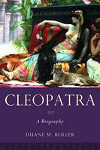
The propaganda presenting her as a seductress spread during her downfall, so are we in the 21st century victim of ancient history’s machinations?
Publisher: Oxford University Press
Pages: 156
Type: Non-Fiction
Age: Adult
ISBN: 978-0-1953-65535
First Published: 2010
Date Reviewed: 21st January 2012
Rating: 4/5
Roller gives us a biography of Cleopatra formed solely of information gathered from primary sources, in an attempt to give a true picture of the queen.
This is a very academic text, the sort that is useful for quoting in essays. As Roller presents only the information available to us from primary sources there isn’t all that much to record (indeed the page count is a reflection of this – don’t assume it’s a case of little effort), but the upshot is that you know the vast majority of the book is factual. What speculation there is is based on different interpretations by historians, and problematic passages in the ancient sources. Roller discusses why and how sources are likely to be biased or unbiased.
She was said to take an almost sensuous pleasure in learning and scholarship, an intriguing variant on her best-known alleged attribute.
Roller’s goal is, in fact, twofold. One is to present the story of Cleopatra as shown through the ancient sources available. The second is to debunk the “myth” of Cleopatra as a seductress, by showing what she was really like. The first he does brilliantly, in fact an element of the book that might otherwise be considered an issue – the lack of information for some parts of the queen’s life – is accounted for simply by Roller’s admission that there is no information to be had. It is very sobering and rather refreshing to read a book dedicated to providing the facts. Indeed the only speculation Roller provides is speculation based on biased sources, which is interesting, and sometimes quite fun, to read.
However the second goal is, ironically, not as well met. Roller’s goal is to dispel the myth of the seductress, but through the content he examines, both those written by her admirers and those biased against her, one can’t help but see a queen who was, yes, very intelligent and a good politician, but who also knew how to use the charms available to her as a female to get what she wanted.
And, in the case of the legendary carpet episode, Roller says quite firmly that Cleopatra did not enter Caesar’s presence in a bed sack, yet later on speaks of it as a great possibility, including precedents of its having happened before.
From page 7:
She did not approach Caesar wrapped in a carpet.
From page 61:
There is a certain credibility… because a name is provided… On the other hand, it is almost a demeaning way for the queen of Egypt to appear before the consul of the Roman Republic… Yet the bedsack device may have been common at the time…
While Roller’s determination to portray the truth is admirable, saying one thing without leniency and then saying something later that makes it possible, however great or small a possibility, isn’t very good.
There is a lot of information that isn’t about Cleopatra so much as her court, but considering the scant source material available to Roller, this is excusable, and it aids Roller in showing us who she was when the source material is silent.
Anyone interested in reading this book, which would form a very good basis for further study, should note that the appendices after the last chapter are well worth the read. One wonders why they were not included in the main text, especially as the last chapter ends without a proper conclusion.
There are flaws in this biography, and you are likely to feel slightly under whelmed by the lack of knowledge, but as factual history books go, Cleopatra isn’t bad at all.
Related Books
None yet.
Glynis Ridley – The Discovery Of Jeanne Baret
Posted 10th January 2012
Category: Reviews Genres: 2010s, Adventure, Biography, History, Science, Social
1 Comment
Women in the 1700s weren’t supposed to join expeditions, but rules are made to be broken.
Publisher: Broadway (Random House)
Pages: 249
Type: Non-Fiction
Age: Adult
ISBN: 9780307463531
First Published: 2010
Date Reviewed: 5th January 2012
Rating: 4/5
In eighteenth century France, a poor herbalist was able to change her life by, firstly, becoming the lover of Commerson, a prominent botanist, and secondly by following him onto a ship that would take them around the world in order to gain knowledge of the new lands being discovered. To join the ship, Jeanne had to pose as a man and this led to both happiness at being able to see what few before had seen, and utter wretchedness as she strove to keep her identity concealed. Ridley presents Jeanne’s story, or at least as much as is known, introducing readers to the woman that science forgot.
Here we have perhaps the only book that details Jeanne, and while it cannot always be reliable – for reasons that will be discussed in due course and doesn’t necessarily equate to a bad thing – the information it provides is of great value and interest. Indeed you need not have a passion for social history or even science in order to enjoy it as most of it revolves around the voyage and there is a lot about the finding of new lands, meaning that there is something here for many. And it means that although Ridley rarely sways from her main subject, when she does it is fascinating in its own right.
There is plenty to devour on maritime activity, and all the hilarity that the mixture of hardened scurvy-ridden sailors sharing space with curly-wigged nobility brings. A good basic knowledge of plant collecting is here too as well as information about the initial meetings between Europe and the Americas. Ridley grants the reader insight into both sides of the story, including primary source material from the French and the thoughts of the native populations in, for example, Tahiti. And reading about the way the French, in their insecure position as travellers by sea, treated the islanders, is often a nice respite from all the information we have about the atrocious treatment that happened after colonisation.
As the theme is of a woman going round the globe at a time when women were nothing, there are a lot of mentions of gender differences as seen from Ridley’s perspective. As a woman herself, Ridley tends to give the full view, which is always interesting. Depending on the gender and opinions of the reader they may find her harsh, correct, or completely brilliant.
Copus asked his [male] guests if any man could identify the herb. None could, and all agreed the tasty addition to the salad must be some newly introduced exotic. Calling in the kitchen maid to see what she might say on the matter, Copus watched the surprise on his guests’ faces as the woman announced the “unidentifiable” herb to be parsley.
[…]
Ordinary women know what plants look like in the field and in the kitchen, while supposedly educated male scientists know only what they are told.
[…]
In an age of crude woodcut illustrations that only served to obscure identification… even the best [reference books] were inadequate as field guides.
In fact the reader is very much included by Ridley as she employs an intriguing interactivity – describing how a person might find a place today, meaning how the place has changed. By doing this she inevitably draws parallels, which give you pause for thought.
Ridley makes use of evidence and generally tells you where her information comes from, despite a lack of footnotes. However sometimes what she says, or, moreover, her point of argument, is difficult to follow because it becomes mixed in with everything else. It is understandable that when a person writes on a subject they know well, they are not going to explain everything because it may appear to them obvious, but there are a few places where more detail would have been of great benefit. There are also many many mentions of how far, or rather how not far at all, peasants would travel from their homes during their lifetime. This is an issue by itself, but it’s also an issue when the author concludes that Jeanne would have met Commerson when she was away from home and he also. Unfortunately it sounds just as romantised as the ideas of others that Ridley dismisses.
Yet this is where we come to the major point. There is a great deal of speculation in the book. And although Ridley is generally good at saying what is factual and what is not, there are times when it’s not obvious. Now there are two schools of thought here. One is that it is bad to spend a book speculating. However two is that if there is little evidence surrounding a person but an author feels the need to introduce them to the world, then speculation can be forgiven. It’s not as though Ridley is talking about, say, Louis XIV, of whom there is lots of information – she is talking about someone who is interesting for being the first woman to travel the globe but, for reasons of gender equality as well as there simply being no records, remains someone whom we can never know all that much about unless new evidence comes to light. As Ridley is not suggesting she has new evidence, indeed Ridley’s goal is transparent – that of an informer – the speculation must be viewed more favourably and seen as a positive rather than a hindrance.
The work Ridley has done could spawn a new burst of research, thus hopefully less reason for probabilities, and indeed in the afterword Ridley says that since publication a plant has been named after Baret at last.
It is up to the reader, of course, to come to their own conclusions. It’s far from an easy book to continue at times as the content often sounds archaic for the behaviours of humans back then, but the vast amount of information is worth its weight in gold (which is a lot more than can be said for the results of the expedition).
Ridley has done Baret a great service and if further research proves that some declarations are false then so be it – Ridley has propelled Baret back where she should be.
I received this book for review from Crown Publishers, Random House.
Related Books
Richard Rex – The Tudors
Posted 4th October 2011
Category: Reviews Genres: 2000s, Biography, Domestic, History, Political, Social
2 Comments

‘Defender of the Faith’ was more than just a motto given by the Pope. You also had to have faith in your successor’s ability (or willingness) to have children.
Publisher: Amberley Publishing
Pages: 203
Type: Non-Fiction
Age: Adult
ISBN: 978-1-4456-0280-6
First Published: 2002
Date Reviewed: 26th September 2011
Rating: 4/5
The Tudors were an intriguing bunch of people. Strong-minded and self-righteous often, they caused much joy and much sorrow. Obstinate when it came to the succession, they tended to leave their counsel with plenty of work to do in wondering who should be next up for the crown and whether or not so-and-so was a good choice. Yet there is little doubt that what they did is still worthy of being so famous, or rather infamous, today. Rex gives a quite broad and detailed account of those five people, from the man who wasn’t really in a position to be king, to the woman who refused to provide for the future of the dynasty.
Rex sets out with a couple of goals. He says his mission is to write from the royal perspective, and that his book is for readers rather than academics. The first he succeeds in doing completely – what social information there is in the book is there because it needs to be there to set the rest in context, and it truly is a book about the dynasty rather than anything else. The second is more difficult to rate. The book is humorous – Rex presents the facts while allowing himself and his readers to have a good laugh in places where people were a bit silly. But this humour is quite okay considering that Rex is clearly passionate about his subject; knowing all that he does it’s fine to have a laugh now and again. The humour is what makes it a book for readers, along with the obvious influence of David Starkey, who is a historian Rex admires. However there are a lot of extra details on aspects such as taxation, war, and money in general, and while this is interesting it does move the book more into the realm of academia. There are times when the book is like those you read for study purposes, and indeed the information included is written in a way that makes it perfect for university essays.
Henry Parker… an old-fashioned aristocrat who often bestowed upon his sovereign the fruits of his limited literacy skills…
Like all historians, Rex has his opinions, but he is very good at presenting several arguments and telling you why they could be possible and why not. Obviously he tends to lean towards his own thoughts, so for example after he has covered the possibility of Elizabeth’s having a sexual affair with Robert Dudley, it is mentioned no further. Something that is also intriguing is that he tells you where different theories have stemmed from, and why they have been discounted in modern times, or why they are continually believed. He refers to a range of different types of primary sources and the book itself, at least this edition, is full of pictures of these written and artistic sources. This visualisation of the sources, however, could have been better handled by whoever decided where they should be placed. There are a lot of them in the chapter on Elizabeth and although it makes you feel like you’re reading very fast (because the sources often take up most of the page) it breaks up the text in a way that disrupts the reading experience. This reviewer must also mention the pages of colour images in the book as she found them rather strange – they are copies of originals, however whether they are the originals or not she cannot say as in many places the colours of people’s eyes have been changed.
In the preface Rex says that he hasn’t worried too much about references, and he hasn’t, preferring to simply leave the vast majority to the further reading section. While this does help the flow of the book, it means that if you want to find out exactly whom he has referenced you may need to do a bit of research. What this lack of references does mean, though, is that Rex escapes the trap that many others fall into of unintentionally (or intentionally, if we consider G W Bernard) moaning about his fellow historians. In fact Rex tends to lump groups of people together in a loose way rather than point anyone out, except of course people of the past, which is the starting point of his polite disinclination to favour opinions that do not match his own.
The act included a declaration that it was treason for a woman to marry the [aging] king if she had had premarital sex. As the Imperial ambassador caustically observed, this rather narrowed the field.
There is a chapter for each of the monarchs, though anyone seeking to learn about Henry VIII’s wives in detail, or the ‘reign’ of Lady Jane Grey should understandably not expect to gather much information from this book. Rex has defined his book as one of rulers, so there is little about, for example, Henry VIII’s brother Arthur.
On first glance, The Tudors appears to be a quick introduction into each of the monarchs between 1485 and 1603, but when you read it you discover that it is in fact rather in depth and a sometimes hefty read. True, as Rex says himself, most of the content is general Tudor knowledge, but it is the way that it is presented and the afore mentioned depth that make it worth a read no matter how much you already know.
It is definitely written by an academic, and it is definitely written by someone with a sense of humour. The Tudors is a very good starting or continuing place for anyone interested in the dynasty.
Related Books




Antonia Fraser – Marie Antoinette: The Journey
Posted 19th September 2011
Category: Reviews Genres: 2000s, Biography, History, Political, Social
1 Comment
The phrase ‘let them eat cake’ has created a false impression.
Publisher: Phoenix (Orion Books)
Pages: 546
Type: Non-Fiction
Age: Adult
ISBN: 978-0-7538-1305-8
First Published: 2001
Date Reviewed: 18th August 2011
Rating: 4/5
Marie Antoinette was the ill-fated Austrian bride of her cousin, Louis XVI of France. Fraser documents her life from the cradle to the grave and the legacy she left.
The book is very well written and the narrative runs quicker than many fiction releases. If this were fiction it would be magnificent. Fraser describes events with good detail, uses plenty of primary sources for quotations, and when she comes to the executions of the family she succeeds in showing how horrific and unjust the situation was.
Fraser presents Marie Antoinette as the unlucky victim of political manoeuvrings by Europe’s dynasties and a scapegoat of the French Revolution. But she does it whilst remaining objective, no matter the fact that her writing positively impresses upon the reader her overall opinion of the Queen as a good woman. She never speaks negatively of Marie Antoinette, but she does allow for those stereotypes that are grounded in truth to stay; for example the idea that Marie Antoinette was uneducated – Fraser presents not a woman unwilling, rather a woman disadvantaged by a male-orientated society. So you have a queen who had wit and was a great entertainer, but was uneducated and an obvious mismatch for her academic husband. Yet she was a lady of common sense who was strong in her own right.
That Marie Antoinette struggled to balance her responsibilities is examined on various occasions. Being told that she was an ambassador for Austria by her mother, she had to also remember that she ought to allow French society to change her. Such instruction would be difficult for anyone, and certainly in our present day much smaller things are hard enough, but as Fraser illustrates it would have been all the more so for Antoinette given her lack of education and her love of her family.
Fraser provides the evidence that was given at Antoinette’s trial, having already examined each piece to destroy any idea of its being true. She does this well, leaving no reason why the reader should think otherwise. The reason why it’s believable is that the author has already described Antoinette’s personality and life, and indeed the book ends with a look back at what was said before. Fraser doesn’t deny that Marie Antoinette didn’t help herself by spending lots of money on friends and on entertainment, but she also reminds you that money was also spent on trying to live more frugally, or at least as frugally as the Queen of France could.
And it is this desire to live more like the common person that gets lost under the burdens of the revolution and thus needs to be remembered. Fraser recounts many occasions where not only did Marie Antoinette wish to dress simply or act the role of a common servant in theatre, but she was truly concerned for the everyday man, especially when it came to children. What she lacked in education and political opinion, she made up for in domesticity, wanting nothing more than to look after her children herself and caring when the offspring of peasants were in a bad situation.
This adds up, successfully for Fraser, to a woman who made the best of what she could with the disadvantages afforded to her. A person lacking in a mother’s love but not lacking in a mother’s criticism, feeling guilt at not being pregnant when it was not her fault, and used to the company of her siblings and an aristocratic way of life was never going to be perfect Queen material.
The big downfall of the book is Fraser’s fixation on her idea that the Swiss Count Fersen and Marie Antoinette must have had a sexual relationship. So relentlessly pursued is this idea that one could say that the most pressing reason Fraser had for her book was to write a story of some-what forbidden love. What makes Fraser’s determination so peculiar is that for the first third or so of the book she continually expresses how content Marie Antoinette and Louis were, that even if they weren’t in love, there was a strong devotion there. The transition between her saying this and speaking of affairs is sudden. From the sources Fraser has provided there is simply not enough evidence to say for certain that this affair happened and that Fersen’s admiration for Marie Antoinette and vice versa ever transformed into fornication. It is possible, yes, but as it is not definite, and as it is quite obvious Fraser is having dreamy thoughts that she should have used in a piece of fiction rather than historical biography, her constant claims are, as Henry VIII would say of his marriages, null and void.
Fraser is well read, that is obvious, and in the main her words are easily acceptable. For the most part she is objective, and where she is not she is at least transparent. Marie Antoinette is a compelling book that deserves a read by anyone interested in the period or the queen herself, just be aware that it was written by a romanticist.
Related Books