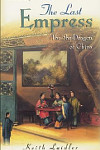
Keith Laidler – The Last Empress
Posted 17th May 2013
Category: Reviews Genres: 2000s, History, Political, Social
3 Comments
When a woman dared to tread.
Publisher: Wiley
Pages: 270
Type: Non-Fiction
Age: Adult
ISBN: 978-0-470-84881-4
First Published: 2003
Date Reviewed: 22nd November 2012
Rating: 3.5/5
Please note that whilst the title of the book may suggest another woman had ruled in China before Ci Xi, Laidler himself makes no mention – thus it should be noted that there had been another Empress to rule China, Wu Ze Tian (also called Wu Zhao), between the years 690-705. Please also note that due to the different methods of transliterating Chinese into English, I have included the two most, in my opinion, used. (Any discrepancies are my own as I used my own knowledge to transliterate the method not used in the book.)
Laidler presents a biography of the Empress Ci Xi (Xu Xi/Tzu Hsi) from teenager to death, looking at how she managed to defy tradition to become the ruler of China and the ways in which she kept that power in the face of opposition.
The Last Empress is a difficult book to define. At once very detailed politically, it misses out a lot of information that would have been of use, yet what it does include is incredibly interesting and Laidler’s style makes for an easy read.
Ci Xi is surely a fascinating character to learn about (though it should be noted that for reasons unknown Laider has called her by her clan name – don’t let that fool you into thinking she was the only Yehonala at court). The way she came to power, her confidence and intelligence, the punishments she meted out to her enemies, and her lack of emotion for many of those in her care – Laidler makes sure that he provides a balance and includes discussions of why she became such a despot. Whilst admitting that her lust for power was unquenchable, Laidler questions her background and how being a woman, and at that a woman forced to become an emperor’s concubine instead of marrying the man she loved, would have given rise to a vengeful spirit, a woman with no love for the dynasty she had been brought to serve.
And this is key to what makes Laidler both accessible and hard to dispute – he may have his own views, but seldom are these included subjectively. Laidler’s work is incredibly unbiased, he damns and glorifies both sides, always presenting the various arguments and possibilities, and succeeds so well in his goal that the reader will have a tough time working out where his loyalties lie beyond his loyalty to introduce Ci Xi to his reader. Indeed all evidence points to him being completely objective. Such a method of writing is a relief when you consider that many books err more on one side than another, creating discomfort when the reader does not agree with the author’s views.
Unfortunately, however, Laidler’s writing is marred by a lack of referencing. Sometimes this is literal – he doesn’t reference any source at all, leading it to seem as though he wrote all the facts when he of course did not – and otherwise there is just a simple lack of footnotes. Both issues are a major drawback as they bar further study into the sources and limit the knowledge the reader can gain into what Laidler has researched, what is common knowledge, and what he took from elsewhere – is what you’re reading true or made up, and how much is speculation? (From the way it’s written all speculation appears to be what is obvious speculation – the rumours recounted by Laidler.) It also means that on many occasions where quotations are included, there is no way of finding out the original source of the work, beyond the name of the speaker. The only upside of this marring is that the work is largely chronological and there is no major aim to convince the reader of a certain idea, meaning, at least, that one will not be able to cite Laidler as the source for reasons of debate. It does mean that Laidler’s work has little value for the student, which given the overall lack of importance given to Chinese history in western academic institutions is disheartening.
Poor editing and some bad writing join the source work. Sentences sometimes make no sense or are unfinished. Despite, or maybe due to, the easy style, phrases such as “had been begun” seem to have slipped through the net, and there are far too many errors. In fact it is as though no proofreader were employed at all. The extent to which grammatical and spelling errors flourish means that any actively engaged reader, wanting to make notes and copy sections, will likely have to edit the text themselves, and the writing on occasion reads as though written by a person with scant knowledge of the English language.
Laidler writes a great deal about the naval warfare between the Europeans who wished to trade according to their own customs, and the Chinese who wanted to keep their traditions. In the main this means that the reader not only develops knowledge of the Empress herself, but of the context surrounding her reign and the reasons she was the last empress. However sometimes Laidler does go off on a tangent in ways that don’t apply to his main subject, resulting in pages that suggest the author was perhaps more interested in military history than the woman who took charge. This is not a huge issue, but it does mean that there are gaps left in Ci Xi’s life where it would have been sensible to either concentrate more on the ruler or, if such is the case, simply let the reader know that there is little known about the empress at that particular point in time.
Because for all his fair treatment of Ci Xi, and the approach that suggests a writer unbiased about gender, Laidler also leaves out aspects of Ci Xi’s power that would have added much to his work. Whilst explaining that Ci Xi’s rise in power over her husband was due to her sexual prowess, and including an explanation for how a woman confined to a world devoid of intact men might improve certain muscles – emphasis here on ‘might’, for there is no evidence that she did – Laidler neglects to discuss the issue any further. And considering it is apparent that Ci Xi retained her place as favourite for reasons other than abilities in the bedroom, there is a seeming lack of information in general. It is not detrimental, but it does suggest that Ci Xi’s rise was predictable, which given her time was not the case. And although there was a prophecy that a woman of Ci Xi’s clan would conclude the dynasty, speculation is of course no good basis for argument. What does seem to be reality is that no one really knows how Ci Xi came to power; that really ought to have been highlighted.
Hearing one lady holding forth on the evils of foot-binding, she pointedly asked if the European practice of binding women’s waists in whalebone corsets was not similarly barbaric.
Laidler does succeed in demonstrating how familial and social tensions created problems for China when it was faced with the invasive forces of the Europeans. Setting the backdrop of the stereotypical dynastic court that believed itself invincible, the author shows how tradition which was otherwise sustainable fell flat when confronted by the opposing beliefs of other countries. He gives a lot of time to Kuang Hsu (Guang Xu), the impotent boy Ci Xi chose (for the very fact he could not sire children) as heir to her dead son, and the ways in which, upon reaching majority, the now emperor tried to balance what he knew to be the iron will of his aunt with his own views of cultural and political reform. This not only means that Kuang Hsu is given a prominent place in the biography, but also that Laidler can adeptly reveal how Ci Xi changed her opinions on tradition and foreign powers – which is particularly interesting when placed alongside the way she manipulated tradition for her own ends.
And what is endlessly interesting is how this most powerful ruler of the wrong gender, of little status, and hated by so many, was able to take over a dynasty, a people, and keep that power for so long that her actions gave her reformist enemies exactly what they wanted.
Laidler’s book may not be in anyway polished but it provides a basis for further reading. Yet a basis it is, due to the speculation and content choices.
Related Books

Tom Reiss – The Black Count
Posted 22nd October 2012
Category: Reviews Genres: 2010s, Biography, History, Political, Social
9 Comments

After slavery came acceptance in France, which allowed something remarkable to happen.
Publisher: Crown (Random House)
Pages: 330
Type: Non-Fiction
Age: Adult
ISBN: 978-0-307-38246-7
First Published: 18th September 2012
Date Reviewed: 19th October 2012
Rating: 4/5
Reiss details the life and career of the novelist Alexandre Dumas’s father, General Alex Dumas, born of a white French father and black African mother, who led armies during the French Revolution.
The Black Count is a remarkable book that details what can be learned from previously unpublicised sources to introduce to the world a fantastic soldier whom history had forgotten due to later racial prejudice. A rather long book for the sources used, Reiss provides ample context in which to set Dumas’s trials and happiness. This context can sometimes be a distraction as there is a great deal of it, perhaps too much, and it often goes off on a tangent. It is brilliant for the overall history and especially the history of abolition, but doesn’t quite match the premise of the book, which is to tell Dumas’s story.
However what is provided inevitably ends up trumping any arguments for premise; Reiss has given the history of slavery, abolition, general life, and the journey from acceptance back to intolerance. Whilst books about the period will include information about freed slaves and otherwise, the coverage and particular angle the writer takes puts them to shame. Instead of simply detailing, Reiss gets to the heart of his subject, discussing such aspects as the aristocratic day-to-day lives of free mixed-race citizens of the Caribbean and how accepting pre-Napoleonic France was of such citizens when they arrived in Europe. The author opens the door to a world that the modern world in general does not know nearly enough about, and it is surely important that these facts, as they relate to our present day, are provided for general consumption. In fact, the first few chapters themselves are so detailed as to render a several week course in colonial slavery somewhat superfluous. Reiss even includes the irony that came with a society suddenly finding their fashions being lauded by ex-slaves, feeling the need to be meticulous in their rules concerning the ban of such fashion in the colonies.
When, years later and by then a war hero, he lost his lackey in a storm at sea, he would find himself in a true predicament: facing enemy attack was one thing; arranging his own clothes was quite another.
Reiss provides all the knowledge he can about General Alex Dumas, the hero of wars who single-handedly won battles whilst living in a racially liberal world. He, Reiss, goes back and forth between sources to surmise the most likely story and, crucially, includes excepts from Dumas’s letters that only serve to further what is said – Reiss’s conclusions and suggestions are the understandable product of reading primary source material. The writer makes pauses for thought no concern, there is no reason not to believe what Reiss says. Dumas is the family man, the freedom fighter who unwittingly becomes a victim of his side’s success, and a true humanitarian. Despite what later goes against him, his aims remain strong and well meant: a republic for the equality of all.
The cautious reader may wish to know whether or not a prior acquaintance with the novelist Dumas’s works are necessary for comprehension. At first it seems so, but although he may not say it, Reiss has made his biography accessible and details all the literature references needed. He repeats information when new facts are to be added. Also included are quotations from (the novelist) Alexandre Dumas’s own memoirs, and these are treated with respect whilst being analysed for what they are – Reiss explains that the son idolised the father and thus although his words are used, they are acknowledged to be biased when other sources present opposing material.
Reiss refers to himself throughout the book, and it feels very natural. The references are there to demonstrate the discovery and usage of sources, and also to better describe to the reader present-day situations, such as the difficulty in gaining access to a vault. It’s a unique way of writing, more often used in documentaries, but due to the overall style, it works. As for the style it is readable, casual. Reiss himself says at the end that he wanted to avoid making his work particularly academic. However there are some occasions when it doesn’t quite seem right, such as references to a modern person in order to provide an illustration readers will understand. It doesn’t work because the people chosen are not universal, and thus the handy metaphor can be lost.
Reiss has an evident enthusiasm for his subject, yet remains objective. Indeed considering the sources he presents it is incredibly difficult to see Dumas as anything other than who Reiss presents him to be. There is some bias, however, and obvious personal opinions – for example Reiss dislikes Marie Antoinette, who he describes as “frivolous” and “fierce Austrian music snob that she was”, and leaves it like that without elaborating. Yet he achieves his basic aim, to introduce to the world General Alex Dumas. The book may be lacking in Dumas detail, but it is difficult to put that down to the author himself. The availability of sources and the likelihood of their destruction means that Reiss has undoubtedly made the best job of anyone yet, if indeed anyone else has tried. Such a work and research are to be commended for the valuable information they have uncovered for study.
With The Black Count, Reiss has done his job. May others now extend it and let it set an example.
I received this book for review from Crown Publishers.
Related Books


Robin Shulman – Eat The City
Posted 28th September 2012
Category: Reviews Genres: 2010s, Domestic, Food, History, Social
6 Comments

Are you sure farming is rural?
Publisher: Crown (Random House)
Pages: 301
Type: Non-Fiction
Age: Adult
ISBN: 978-0-307-71905-8
First Published: 2012
Date Reviewed: 17th September 2012
Rating: 4/5
Shulman presents the often deceptively small groups of people who defy the notion of modern urbanisation to grow and produce their own food in the heart of New York City. Covering both traditional gardening and industrial manufacture, Shulman illustrates how history has moved from one extreme to the other and back again, showing that whilst such production may seem shocking to those who live unknowingly amongst it, it is actually part of how New York City first came into being.
Eat The City is a rather in-depth look at those who produce food, both en masse and in small quantities. It spans a range of tastes and traditions, including both solids and liquids. Each food in question is given its own section as Shulman recounts visits to the individuals who make it and refers back to historical records to detail how things used to be done. But far from the historical parts being all about the economic and culinary history, Shulman also looks into family history to explain how those she visits and interviews are culturally linked to the foods they produce.
And for the most part such a method of storytelling works well; the present flows into the past and back again and one feels that they know the individuals assessed as well as Shulman herself. Indeed it is only when right in the midst of the book that the method feels a little overused and you start to wonder whether more time ought to have been spent on the present, regardless of the fact that Shulman aptly describes the manufacturing and growing process. Yet this is more a case of retaining interest than writing style as the book requires the history – it is simply that having the book split into sections and the same method of writing being employed each time becomes wearing. For this reason the book can favour a dip-in approach so that the report doesn’t become heavy. The presence of the history fits Shulman’s aim – present-day is incredibly intriguing, but the context and reasoning even more so.
There is a good mix of vegetables and animals accounted for. The first half of the book favours natural, unaltered, produce, with the second half full of industrial manufacture and traditional methods that have been tainted by modernity, for example fishing. Shulman’s section on fishing is a particularly favourable addition because the entirety of it highlights the dangers of the practise. Whilst you are shown that it is possible to farm organically and safely in the city, fishing has inevitably been literally tainted by the chemicals that are dumped into the surrounding waters. For an overall subject that presents hardship and hard work but with resounding success, the section on fishing is difficult to read because of the knowledge Shulman brings to the table. And it is all the more harrowing given that whilst many poor people are fishing for mercury-filled fish, there are others who have the money to eat well but are unknowingly feeding themselves and their family poison.
Shulman brings the era of Atlantic slavery into the section on sugar, detailing not just the history but how the work has been passed down so that even now the successors of the African slaves grow cane. The difference being, of course, that their gardens are the result of choice. This is just one instance of immigration adding to the workings of the city, as detailed too are the Arab Jewish wines and Caribbean vegetable growers. Shulman’s book is a fantastic look at how a city is shaped by everyone who lives there, be they natives, invaders, or otherwise, and how it is impossible to separate such cultures when everything has become mixed together to become one mass society and way of life.
It must be said that the book is not apologetic. If the beginning sections invite the interest of vegetarians then the latter ones will put them off, and there are interviews on both sides of the GM debate. There are inclusions from newspaper articles on political decisions and overturning when the common man did not meet the specifications of those on high, as well as the disagreements within neighbours of those who wanted land for food and those who opposed it. And there is the ever-imposing divide between man and machine, the foodie and the real estate company, as well as the man and the Industrial Revolution. Because food production, even today, is considered backwards when urbanisation is forwards.
There is not really much to be said in disagreement to the way the book has been written. To be sure there are too many lists, wherein Shulman provides all the different elements of a particular system and the number of commas is at least a dozen over several lines, and there is the instance of a misquotation of Apollo 17 moon walker Eugene Cernan as having said “man oh Manischewitz” when he simply said “Manischewitz”, but these are meticulous points.
If ever there was an interesting tale to be told about a place that appears to be the height of urbanity, then this is it. For the European who can only view the city via Friends, the film The Devil Wears Prada, and Google’s Streetview, New York is perhaps the ultimate in urban business areas with a few residential neighbours thrown in. Indeed whilst what Shulman says may shock the average American citizen (and that in itself is a supposition) the impact will likely be greater on the onlooker.
Eat The City is a unique and inspiring exploration of an idyllic way of life, both surviving and being newly imported into a place that is not assumed to be appropriate for it. It does this whilst including a host of people who are from different walks of life and who have different goals. The traditionalist, the hobbyist, the entrepreneur and the capitalist – Shulman brings them all together as one movement: the everyday citizen, be he rich or poor, who just wants to have a hand in the way his food is produced and bring back production to a local level.
I received this book for review from the Crown Publishing Group.
Related Books

Joanna Denny – Anne Boleyn
Posted 7th September 2012
Category: Reviews Genres: 2000s, Biography, History
2 Comments

It’s all well and good to be positive about your subject, but you can’t let it allow you to be hateful to all opposition, especially when the opposition is long dead.
Publisher: Piatkus
Pages: 327
Type: Non-Fiction
Age: Adult
ISBN: 978-0-74995-051-4
First Published: 2004
Date Reviewed: 5th September 2012
Rating: 3/5
Denny presents us with a biography of Anne Boleyn, the first wife to be executed by Henry VIII. Claiming to reveal the truth and to be unique, Denny recounts Anne’s life from young lady-in-waiting to Queen facing death.
The author begins well. Although she may be wrong about her book’s uniqueness – other historians such as Eric Ives had already produced detailed biographies – her overall purpose includes the sadly true snippet that Anne was vilified in her lifetime. She also says, “tradition has presented us with a totally unconvincing one-dimensional picture”, suggesting that she will work through this ‘picture’. And she does.
Denny provides good background context. Throughout the book she makes much use of the accounts of the Spanish ambassador, Eustace Chapuys, but cautions the reader, saying that Chapuy’s English was poor and he could only rely on spies. Likewise Denny debunks popular ideas to good effect, for example she points out that if Anne was truly as unattractive as Nicholas Sander described, she, Anne, would never have captured and held Henry’s attention for over a decade. Sanders was the person who gave us the idea of Anne being a witch with six fingers – with all Henry’s superstitions and worries, Denny’s points stand to reason, especially when you consider that Henry refused to sleep with Anne of Cleves because she looked like a horse. Yes, the description there was Henry’s own.
Something that is vastly in Denny’s favour is the way she backs up her statements. Even when she is using questionable opinions she adds a reference for where she found the information or a reference that aids her in making her point. This system enables her to bypass an issue found in many non-fiction works – unlike other writers, when Denny writes something that sounds overly romantic or fictitious, such as saying “Anne thought…” or “it was an exhausting journey” there is always a reference, in these cases state papers or the accounts of Anne’s friends. Work like this is utterly refreshing and it’s nice not to have to read such assertions with a sceptical mind.
The points that Denny makes are quite often simply fascinating, and whilst her unnecessary hatred of some of the leading players is cause for complaint (to be discussed later) this scorn of hers yields some particularly interesting facts, such as Catherine of Aragon’s silence over the issue of her virginity, silence that she kept up until Henry planned to divorce her. Intriguing too is the surprise of the Pope’s that, given Henry’s conviction that his marriage to Catherine was unlawful, he [Henry] hadn’t just gone and married Anne already. Henry was certainly an anomaly in his family when it came to scruples, as his sisters didn’t have many – Denny remarks that Margaret sought and won a divorce on similar grounds to her brother and that Mary had married the bigamist Charles Brandon without batting an eyelid.
In regards to Catherine of Aragon’s sudden revelation, to the court, of her virginity, it is interesting that this was a second concept she’d hidden from Henry, as Denny remarks on an earlier event when Catherine had pretended she was pregnant. Denny’s point is that Henry must have remembered this “pregnancy” when Catherine showed the decree of virginity, but what is truly captivating is the fact that Catherine pretended to be pregnant at all. Pretence you can understand of a woman who is aware she is considered responsible for producing heirs, but pretence would lead to sex being suspended, sex that could have made her truly pregnant.
Here it would be appropriate to discuss the overall way in which Denny portrays Catherine. Unfortunately no allowances can be made because there aren’t any – Denny hates Catherine with a passion and it is clear that her [Denny] love for Anne means she sees Catherine as a she-devil. The author does later provide a couple of quotations in evidence but isn’t it ironic that one of those references is not included in the bibliography? Plowden, who is not described and could be either a primary or secondary source for all this book is concerned, called Catherine arrogant, stubborn, and bloody-minded. This description is not enough, it is like a get out of jail free card that Denny snitched from another player, and it does not stand to reason.
The second quote is a better-known source and intriguing. Given that Catherine was Spanish and aligned her interests with Spain, it is rather telling for Denny’s conviction that the source is the Spanish ambassador, Campeggio. The man said:
“I have always judged her [Catherine] to be a prudent lady, [but] her obstinacy in not accepting this sound council does not please me.”
Compelling; but the problem with Denny’s use of this source is that Campeggio speaks of a single event, Catherine’s refusal to become a nun – which would have ended the Great Matter (Henry wanting a divorce) – and her insisting that her case went to Rome. It would have ultimately been in Spain’s interests for Catherine to become a nun as the Pope was having a difficult time with Henry; Campeggio’s words could easily be the result of in-the-moment frustration. Though this is all as much speculation as Denny’s own, the difference is that Denny gives decorum and other possibilities the cold shoulder, making herself quite the wretched writer.
Like mother, like daughter: Denny hates the youthful Mary, Catherine’s heir, as much as Catherine herself. Because of her love for Anne, Denny on occasion puts on rose-tinted glasses when viewing Henry’s actions, to the effect that she overlooks some terrible behaviour by the King towards his daughter. A prime example of this is Denny’s statement that refers to Mary’s refusal to acknowledge herself as a literal bastard, illegitimate on the grounds of Henry’s discomfort in his first marriage.
“Henry had been irritated… by her unnatural hatred.”
Here Denny calls “unnatural hatred” the anger of a daughter for a father who has treated her and her mother with distain, casting her mother aside, denying their marriage, and forcing the daughter to live away from her mother. Henry’s actions caused Mary a lot of stress. There was nothing unnatural about Mary’s hatred at all, indeed her refusal to comply with Henry’s requests was the very natural response of a girl whose father repeatedly demonstrates that he despises her.
There are two possible birth dates cited for Anne, with a few years between them. Historians have given varying reasons as to which is the more likely, but Denny’s reason is a little off. She says that since Henry preferred women to girls the older birth date must stand. But Henry did like girls – he courted and married the 15-year-old Catherine Howard when he was in his 50s.
Accounts by Chapuys, one of the Spanish ambassadors, are included throughout the book. Denny says we must take his words with a pinch of salt because he didn’t speak English and had to rely on spies, that he never met Anne. This is commonly accepted – Chapuys can’t be trusted. But when it comes to opposing evidence, Denny takes Chapuys’s word over Jane Dormer’s as to Anne’s true birth date. She takes Chapuys’s words, “that thin old woman”, as good evidence, yet Chapuys was surely being derogatory, his words are hardly nice and he despised Anne. Dormer didn’t like Anne either, but at least her words are neutral.
And in relation to Anne’s birth date, Denny says that Anne wouldn’t have bemoaned lost youth and chances of marriage if she was only in her mid-twenties. Yet mid-twenties was considered old, especially when it came to marriage.
Denny takes a very romantic view of parent-child relationships. Of the letter by Anne to her father that talks of love and obedience, Denny says that this demonstrates closeness. But in those days it was usual for such things to be written, so while it’s possible, the letter is not compelling evidence.
So Denny is struck with a hatred of Spain as well as a sort of semi-romantic notion not unlike the literal romantic notion of Fraser when dealing with Marie Antoinette and Count Fersen. Whilst it is not a case of Denny being wrong, per se, her presentation of her thoughts being undeniably correct is an example of a possible lack of interest in opposing evidence due to her convictions of Anne’s goodness. Denny has all the qualities of a historian and a fine debater but lets her bad qualities take over.
Anne Boleyn is a good book to read if you want interesting additional information. It also offers some alternative interpretations, but the reader will have to wade through malicious slander to find it, and there is a lot more of it than could be covered in a review. There is plenty of content in the book that could be used as research for other work but due to the nature of it one should be sceptical of using Denny’s opinions in any academic debates.
Related Books

David Starkey – Henry: Virtuous Prince
Posted 4th February 2012
Category: Reviews Genres: 2000s, Biography, History
2 Comments

Aiming at the goal rather than the sidelines is the best way to go.
Publisher: Harper Perennial (Harper Collins)
Pages: 370
Type: Non-Fiction
Age: Adult
ISBN: 978-0-007-24772-1
First Published: 2008
Date Reviewed: 29th December 2011
Rating: 3/5
Starkey presents to his readers the youthful Henry VIII – a man totally at odds with the tyrant he would become – in the first part of a process to show us the two very different people who came to be one king.
Starkey is a very learned man, and he quite obviously knows Henry VIII like the back of his hand. He has a talent for humour and his research is of great worth. The problem is that he has written a book the contents of which are more suited to a speculative essay. The way he has come up with elements that are ideas is no good for a book that is supposed to be factual. It is fascinating, granted, but the work is by and large pure speculation. Starkey does not base many of his ideas on evidence – which is a must when writing history – and when he does reference the work of someone else the details of the source are not thorough.
There are far too many probablys, maybes, likelys – so instead of a good account of Henry’s youth we have a lot of guesswork. And anybody can write a book on their ideas, especially if, like Starkey, they don’t feel the need to provide some sort of evidence.
Similarly, like with Philippa Gregory’s The Other Boleyn Girl, there will be many people not already well read about Henry VIII (or, in Gregory’s case, Anne Boleyn) and they will likely consider Starkey’s work true without question. While Starkey may not be vicious towards his subject, unlike Gregory, it just does not bode well. And there is the rather awkward subtle inclusion of the fact that he supports the idea of Richard III killing the princes in the tower and presents these opinions as facts.
But the more pressing thing about this book is that it does not follow in the path set out in the introduction. In the introduction Starkey says that the book is solely about Henry and that any references to other people will only be employed if they serve the purpose of explaining further the character of the second Tudor monarch. Yet the vast majority of the book chronicles the lives and ancestry of Henry VII and Henry VIII’s friends, in a way that does not link back enough to the development of the man himself. Small passages provide ideas, but they are strictly ideas as has already been discussed, and it would seem that Starkey forgot, very soon into the proceedings, that his book was supposed to be about Henry VIII. Indeed this book would be more appropriately titled Henry VIII And His Court. To use a word made infamous by Starkey, he probably got put off by Alison Weir having already written such a title.
Starkey needs to remember that he cannot simply write whatever he wants. He has a duty to both his subjects and readers, and while in regards to the former his speculations may have been accepted with mirth, for the latter that duty has been forsaken for indulgence.
And considering that readers cannot provide indulgences, and neither could Henry’s Papacy-hating Anglican church, Starkey should think again before pursuing his next inquiry with the same tactic.
Related Books