




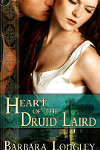
Barbara Longley – Heart Of The Druid Laird
Posted 9th November 2011
Category: Reviews Genres: 2010s, Fantasy, Historical, Paranormal, Romance
Comments Off on Barbara Longley – Heart Of The Druid Laird
Where love doesn’t just get your average definition of a second chance.
Publisher: Carina Press (Harlequin)
Pages: 235
Type: Fiction
Age: Adult
ISBN: 978-1-4268-9227-1
First Published: 19th September 2011
Date Reviewed: 16th October 2011
Rating: 3.5/5
Sidney and her friend Zoe work and live together, but neither of them would ever have guessed that they had done similarly before. That’s until Dermot MacKay and his men turn up at their shop. Dermot is immortal, born in the fifth century, and trying to break out of his eternal existence. He knows that the key to doing this is finding the reincarnated soul of his wife. But even if Sidney’s shop holds fantastical items, it’s going to be difficult to get her to believe him and even more difficult to leave the long life he had previously wanted to get away from.
Heart Of The Druid Laird is a book that encompasses many genres, some better than others, to deliver a well-written romantic novel. However, it does start rather quickly, and the reader looking primarily for historical content should know that it’s the fantasy element that is the focus.
It can be a little weird how quickly Sidney’s friend, Zoe, accepts everything, indeed it takes less than a couple of days for her to be spouting information as though she has known it forever, and while that is in part true for the nature of her soul’s journey, a quick reminder of the contents of the women’s shop, largely presented as New Age, shows that she would be quite open to it, even invite it. Of course this leads into the whole idea of reincarnation – the reader who believes only in what can be explained may have to suspend belief in order to enjoy it.
The first half of the book is very enjoyable. The genres weave in together well, the imagery is good, the dialogues too. Sidney isn’t easily swayed by Dermot, even when she finally accepts his story. She doesn’t miraculously fall suddenly in love with him: when she has sex with him it is from pure lust, which the reader can easily recognise. For love to work the reader needs her to transition slowly, but for lust nothing needs work except chemistry, which the characters have in bounds. And even when Sidney starts to acknowledge her feelings, she doesn’t suddenly lose the plot – she remains strong, stubborn, and independent throughout. But this last clause is where the book rapidly begins to fall apart as the chapters continue on – although it is understandable that Sidney would become afraid at what might lie ahead she becomes incredibly soppy. Maybe the reader can accept some of that due to the repetition of the idea that she’s been looking for The One, but because the change happens so swiftly, and she was so strong before, it does affect the satisfaction you find in the novel. And as much as the first episodes with the fae can be acknowledged, when the entire story becomes wrapped up in fantasy and everything comes down to something so easily upturned, no matter whether or not you always knew that it came down to the fae, it becomes lacking.
However the characters are in the main very good and the story well plotted. Longley seems to have had a solid idea of where she was headed from the start, everything is tied up nicely and all the questions that you could ask that are directly related to the text are answered. Longley makes a stellar effort with the accents, even if at times some words don’t fit in, and she clearly knows her stuff.
The world-building is excellent, and even though this reviewer is more attuned to the Tudor period, what she knows of the early AD years ran alongside Longley’s creations. And Longley isn’t happy with just her two chosen time periods, she includes in her interior design Elizabethan furniture too. Longley is certainly a fan of history and this positively exudes from her work.
The sex scenes are brilliant – they are not crass, the word choice is regular, and because of this they are hotter than your standard fare. It’s easy to believe in both the couples in this book. However when Sidney worries about contraception and then lets Dermot off, and he, after they’ve had sex, says he couldn’t have kids anyway, there may be eyebrows raised. Sidney didn’t know he couldn’t have children until after the act, so she shouldn’t have let him get on with it after an almost frivolous suggestion for protection on her part. And if this man came from the fifth century… well even people with no knowledge of the period know that those who lived before, often especially those in power, tended to favour fornication and had no idea about sexual health. Maybe a disease would die a swift death in an immortal body, but the idea would surely have crossed Sidney’s mind. Or at least it should have.
While Heart Of The Druid Laird may not quite meet expectations is isn’t far from the mark and is certainly worth the time it takes. People after a bit of mystery will find it here, there’s a drop of angst for those who wish it, and those wanting some history will be pleased that Longley goes back to the past to provide the full story. If Dermot has been waiting over sixteen hundred years for his life to get somewhere he ought to be proud of his narrator’s presentation.
I received this book for review from Carina Press.
Related Books
Julie Kagawa – The Iron Daughter
Posted 7th October 2011
Category: Reviews Genres: 2010s, Fantasy, Romance, Science Fiction
Comments Off on Julie Kagawa – The Iron Daughter

When things aren’t as fantastical as before, it can get a little dull.
Publisher: Mira Ink (Harlequin)
Pages: 395
Type: Fiction
Age: Young Adult
ISBN: 978-0-7783-0446-3
First Published: 2010
Date Reviewed: 19th July 2011
Rating: 3/5
Meghan’s back in faeryland, held captive by Queen Mab. But defeating the Iron fey wasn’t as easy as killing the king, and when the Sceptre of Seasons, a vital element in keeping the mortal world in check, goes missing, there’s only one group of people that could have taken it; and only one human, a prince, an elf, and a cat, who know who they need to find.
The Iron Daughter is the second book in Kagawa’s faery series, and although it begins well and indeed ends with a lot of promise, the main bulk of the book suffers from the same bad quality that Torment and New Moon do – pressure to keep the series going as long as possible. It’s not a bad book, per se, but it does rumble along down paths that you know it could have done without, and loses the true fantastical atmosphere that The Iron King had.
The most obvious issue is with the reiterating of what happened before. Yes, it is useful sometimes to reiterate an event that happened in the previous book in a series, it can help those who might be reading the books in a different order to feel they know what’s going on, but there is a subtlety to doing it right and unfortunately Kagawa has made a mess of it. Instead of giving a few brief words on events at the start of the book, Kagawa gives a summary that lasts for most of the first chapter and then, throughout the rest of the book, continually has Meghan explaining events in great detail unnecessarily. It all seems rather like the author had a word count to fill and when the going got tough she filled it with repetition instead. A reader doesn’t want to be nearing the end of the book still being “reminded” about what happened in the last one, they want instead to be reading a climax.
There are the usual revelations that aren’t really revelations, like Meghan being surprised that Ash doesn’t actually hate her and was only pretending to be harsh in order to save her (this isn’t a spoiler since it’s at the start of the book and obvious from page one to any reader worth their salt), and a lot of time spent on things that could have been given a sentence rather than a whole chapter – this is different to the repetition issue and concerns things like shopping.
Kagawa references a lot of popular media to illustrate what she is trying to say, and although it dates the book and means that it may be difficult for future readers to understand, you can see why she has done it and it does amply explain why Meghan wants to be home – because her life is so full of films and music and therefore the technology that is not compatible with the faery world. But there needed to be more research for things like theatre where she talks about The Phantom of the Opera being a play – which it was originally, following on from the book, but when she mentions organs, it is clear that she is talking about the musical, and few people would refer to this musical as a play.
So the book goes on and on, tripping up on additional plot points and taking forever to get somewhere. Just when you think the characters are going to move on to the next part of the story, someone says they’ve hurt themselves, or an enemy comes along and kidnaps them all, and it simply comes across as forced. About 75% of the book could have been stripped away and the result would have been a very good novel, if short.
The romance is as angsty as ever, and strong, and joyfully I can report that Ash, the hero, doesn’t leave Meghan for very long. In that way, the cover of my copy which pronounces it the next Twilight was wrong. In fact this book and the series as a whole is nothing like Twilight except for the elements of love triangle and high school. The set-up itself, of the bad guys not having been eliminated in the first book, is as acceptable a format as ever in literature, and although Meghan can be very weak at times, she does make an effort when she can. There wasn’t any reason why this book couldn’t have been as good as the first, The Iron King.
But it is just so under whelming.
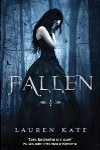
The potential for the third book, The Iron Queen, is good, and hopefully Kagawa will return to the fantastically magical feel that she created for The Iron King. Thankfully The Iron Daughter isn’t so bad that it will put a reader off from continuing the series, because the relationship between Meghan and Ash is worth following; but for all the glitter on the cover, this book contains little of the glamour to merit it not being looked over in favour of a fast track to the third book.
Related Books


J K Rowling – Harry Potter And The Philosopher’s Stone
Posted 28th September 2011
Category: Reviews Genres: 1990s, Fantasy
Comments Off on J K Rowling – Harry Potter And The Philosopher’s Stone

Secondary School has never been so eventful.
Publisher: Bloomsbury
Pages: 217
Type: Fiction
Age: Childrens
ISBN: 978-0-747-53274-3
First Published: 1997
Date Reviewed: 6th September 2011
Rating: 5/5
Harry Potter is famous, but he doesn’t know it yet. Instead he lives in emotional poverty in the cupboard under the stairs of his uncle and aunt’s house where he’s constantly picked on by his voluptious cousin, Dudley. He also doesn’t know that these days are soon to be over as in actual fact he belongs in a society where magic is everything. His parents didn’t die in a car crash, and the reason for their death may not have disappeared at all.
Not much can be said now that hasn’t been said about this book. And indeed even though I enjoyed it less this time than I did when I was a child, it would be wrong to rate it lower because after all it was written for children, and I enjoyed it immensely as a child. Rowling’s imagination and the concepts she comes up with are brilliant and the lessons she imparts should surely put paid to those who bemoan the use of magic in children’s literature.
Something that is much emphasised in the book is the fact that school bullies tend to be those who have the most to lose. Rowling explores bullying extensively through the characters of Draco Malfoy, who always gets his comeuppance, and Harry’s cousin Dudley, who gets what he had always deserved (even if being given a pig’s tail wouldn’t happen in the real world). The fact that Rowling places Neville Longbottom, portrayed as weak and easily frightened, in brave and heroic Gryffindor, should give anyone who’s ever doubted themselves reason to rethink their self-image.
Although the book follows the well-trodden path of good versus evil to good triumphing it is not your standard fantasy, being more of a Pratchett novel than a Tolkien. This means that there is far more time to discuss what is going on rather than talking about sights, as well as more time to craft a vivid world full of great differences. And while you couldn’t really say that the book is a comedy, the laughs are top-notch and very inventive.
The mixing of the world of the wizards with the real world has been given a lot of thought. Both exist together in the same space, and so there aren’t that many occasions when stereotypes can be fulfilled completely, because everyone has to keep the magic away from the regular humans, or Muggles as Rowling calls, well, us, the non-magical readers.
The characters are strong as are the principles as is the world building as is the writer.
It’s Harry Potter, enough said.
Related Books

Lee Carroll – Black Swan Rising
Posted 16th September 2011
Category: Reviews Genres: 2010s, Fantasy, Paranormal, Romance
2 Comments

Vampires and fairies take the demons down one by one.
Publisher: Bantam Books (Random House)
Pages: 417
Type: Fiction
Age: Young Adult
ISBN: 978-0-553-82557-2
First Published: 2010
Date Reviewed: 15th September 2011
Rating: 3.5/5
Please note that Lee Carroll is a name for the husband and wife team, Lee Slonimsky and Carol Goodman, and thus when I reference Carroll I am alluding to the both of them.
Garet Jones was just a jeweller when she stepped into an antiques store that she later found didn’t actually exist. The owner gave her a box, wanting her to open it, but when she looks inside it weird things happen. However it’s not so much the box at this time, but those who seem out to destroy the city that is on her mind. And who is in the right, the vampire or the fairy king?
Black Swan Rising is a mass of different ideas, stories, cultures, and time periods put together in one book, and while the first half is relatively weak and relies far too much on contemporary elements, the second half is rather special and moves away from reality to become a proper fantasy. Drawing on tales as far apart as Dracula and Swan Lake, Carroll builds a story that will see an ordinary girl take on the extraordinary.
A lot of work has been done to make the book up-to-date so that things from our era – such as Twitter, the usage of LOL on the Internet, and IPhones – are mentioned, and while it makes the book accessible to teenagers it grants the book a very short shelf life. There are also times where the contemporary just does not work, for example when a bad guy is about to unleash evil and this gets compared to a particular basketball player. It may be humorous in its own way, but it jolts you out of the story for a moment especially if you’ve never heard of the player before, which you don’t want happening when you’re speed-reading to find out what’s going to ensue.
For the most part the fantastical elements are those well-used by a lot of contemporary paranormal fantasy writers, and so many similarities can be drawn with books such as The Iron King, Jasmyn, and The Forbidden Game. However there comes a point where a true originality takes over and it is stunning. Carroll uses physics to a good extent in the book, and episodes, such as the one in the water, are quite simply excellent. So too is a later episode on land that is in a way related.
The writing is strictly okay. Garet uses the word “though” far too often, and Carroll could do with using a thesaurus instead of using the same word several times over on one page. The romance is also just all right, because the set up is rather yucky; the idea of someone being with a person who’s already slept with the family tree isn’t very nice.
It is the maturity of the latter stages of the story that make it a worthwhile read, because the writers haven’t been afraid to shock and write material that is gritty, evil, and sometimes downright disgusting yet very good – for this last one I refer to the conclusion of the water episode, it put me off my food but I couldn’t stop reading it.
It is also the concoction of history – factual, legendary, and fiction – with fantasy which makes Black Swan Rising end well and make it a book in which you are truly looking forward to the sequel. That Carroll used an older heroine – Garet is twenty-six – means the story moves a lot quicker because there is more knowledge of the world in advance; and there is a good state of confusion for the reader at the end, where you know enough, but not all, and are therefore happy to want to read on.
Black Swan Rising isn’t perfect by any means, but although it shares a great deal with other books, there is a real sense that this is just to help set some ground before it flies off in a new direction in the next book. And if it does, more power to it.
It may take a while to get into it but if you throw caution to the wind, as Garet does, you shouldn’t be disappointed.
I received this book for review from Transworld Publishing, Random House.
Related Books


Julie Kagawa – The Iron King
Posted 19th July 2011
Category: Reviews Genres: 2010s, Domestic, Fantasy, Romance, Science Fiction
Comments Off on Julie Kagawa – The Iron King
A brilliant illustration of what is happening as we embrace technology and forget our dreams. Because it isn’t all about the fantastical.
Publisher: Mira Ink (Harlequin)
Pages: 355
Type: Fiction
Age: Young Adult
ISBN: 978-0-7783-0434-0
First Published: 2010
Date Reviewed: 19th July 2011
Rating: 4.5/5
Meghan has never been popular owing to her family’s relative poverty. She is also not particularly happy as her mother often neglects her, her stepfather reacts as though he genuinely forgets she exists, and her real father disappeared when she was six. But she does have a brother and her best friend, Robbie. Yet four year old Ethan says there are monsters in his wardrobe, and Meghan keeps seeing things that aren’t really there – or are they? And come to think of it she doesn’t really know who Robbie is. When Ethan is taken by the monsters that truly were in his wardrobe, Meghan finds herself on a quest to the world of the Fey to save him. Everything she’s ever known is viable to change.
The Iron King is a piece of fiction that, like many other works being published in this era, successfully blends the current trends in young adult literature with a strong lesson for life. There is a high school, there are cranky parents, but Kagawa is focused on the faery world she has created. As soon as she can get Meghan out of our own world, she does.
The initial journey through the world is very quick and definitely seems rushed but the reader shouldn’t be put off because it slows down sufficiently once Kagawa reaches the main storyline. The world is well developed and magical, if you’ll pardon the pun, the differences between the Winter Court and Summer Court, the two opposing imperial domains, making for a broad reading experience that enables the place to be utterly engrossing. And the book uses elements from different beliefs about faeries to create a diverse land. There are many different creatures, there is the idea that faeries die when humans stop believing in them, and there are fragments from classic works such as Alice’s Adventures In Wonderland and the plays of Shakespeare.
The characters are the usual fare for young adult literature – a kind of love triangle, a good guy, a bad guy – but the heroine is difficult to stereotype because she is neither weak nor strong. She has the capacity to get on your nerves at times, but you can’t say that she doesn’t try to fight, and does.
The book is at once a true fantasy and technologically futuristic. It deals with the idea that our dreams create fairies and that as our dreams change to those of technology, and logic brings an end to faith, then the creations change to suit. Thus the book holds a powerful message: although technology is good – and Kagawa never suggests we abandon it, the heroine keeps hold of her iPod throughout – the proposal is that we should not forget the magic that is nature and all the happiness it can grant us. Where nature is colourful, technology is more often monotone and where nature brings true happiness, technology helps us achieve, but we are constantly having to ask if it makes us happy. Indeed one could say that with the advent of social networking and the demise of the requirement to meet people in person in order to communicate, we are missing out on the happiness contact with others can bring.
The cautious reader should be aware that there are a few references to sex that are rather explicit and sadistic in nature owing to the darkness that the author presents the faery world to be. The romance in the book is chaste, but the fey enjoy taunting humans sexually in a way that a younger reader may find frightening simply because of the descriptions. This explicitness speaks for Kagawa’s approach overall, she is not afraid to include horrific images when appropriate and, apart from Meghan’s weak episodes, doesn’t shy away from being straight with you.
Ultimately what happens while reading is that the idea we have that there can be too much technology is re-enforced, because nobody wants a techno fairy over the sparkling beautiful things we think of now, do they? The difference between adults and children is incorporated – where children have the freedom to imagine whatever they wish and believe in what they will, there are faeries; where adults cease to believe because it is considered childish, but believe in science, there is a creativity that can be harmful if left unwatched. Forget the faeries, it’s a very important issue in our world in general.
Of course a book that deals with faeries that are under threat was never going to be more emotionally invested in the Iron fey than the original fey, and throughout the book, while the reader roots for the originals, you can’t help but remember that yes, life was okay without some of the technology (medicinal advances are very important), and that we got by without it.
But perhaps the most pressing lesson is that we should simply keep believing. Kagawa is not saying we should always believe in fairies but that maybe we should keep an open mind, or at the very least consider the possibility of other phenomena. There are plenty of supernatural things in the world that different people believe in but that science cannot prove, because it is beyond the realm of science at this time. And just because science cannot prove something does not mean that something does not exist. We know this anyway, because of life, and faith, and also because science can get it wrong. But sometimes we need reminding.
Kagawa’s book uses the usual formula but creates something different from it. In this way the book will appeal to those looking for your standard paranormal young adult literature and also those specifically interested in faeries. It succeeds in being both a good read and a verdict on how we manage our creativity. And, like all good young adult literature, it does it without preaching.
I waited many months before picking up The Iron King, although I had seen it everywhere and been intrigued by the set-up. And although it wasn’t quite as fantasy-based as I’d expected, the reality of it made its mark. Very highly recommended to fans of fantasy, history, steam punk, social issues, domestic relations, angst, and romances. The crossover value of this book is extensive.
Related Books


