




Mary Stewart – Stormy Petrel
Posted 20th September 2013
Category: Reviews Genres: 1990s, Domestic, Mystery, Social
8 Comments
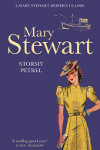
Of strangers and birds.
Publisher: Hodder
Pages: 143
Type: Fiction
Age: Adult
ISBN: 978-1-444-71507-1
First Published: 1991
Date Reviewed: 20th September 2013
Rating: 3.5/5
Rose, a tutor at Cambridge, wanted a holiday somewhere quiet so that she could work on her writing. Coming across an advert for a metaphorical ivory tower, she made her way up to a Scottish island. It’s peaceful, there are few residents, and the cottage is two miles walk from the village. Perfect. Until someone unlocks the back door and says that it’s their home.
Stormy Petrel is a novel that is as quiet as its heroine would have liked, whilst sporting a mini mystery. A blend of cosy mystery and straight forward travel, the book is perhaps at its best in its descriptions of Moila, the imaginary island in the Hebrides.
Because the descriptions have the ability to sweep you away. Stewarts’ creation is fantastic, and in many ways it’s a pity that Moila does not exist, even if similar places do in reality. The writing is soft, almost dreamy, and incredibly readable. The edition this reviewer read was full of editing mistakes but given the time between the first publication and our current day it is difficult to become too ‘taken’ by it.
It must be said that there is little action in the book. This is suggested by the overall set up, the length of the novel, and Stewarts’ writing style, but it is easy to let yourself get carried away – and one shouldn’t. The book lies firmly in the realm of the comfort read and provides a leisurely way to spend an afternoon. The mystery is fair enough but it does not last the length of the book, nor is it particularly satisfying.
The book is most suited to those with a love of the outdoors and nature. It will also please those who enjoy books about writers. Rose discusses her writing a lot and also delves into the process; this book presents a fantasy for anyone who enjoys writing in any way.
The outdoors is almost a character in itself. It is not personified (as some authors like to create characters from nature, houses, and so forth) but it plays perhaps the biggest role in the book. The wildlife is important, and the midges are there constantly (initially this seems over the top, but Stewart has a plan).
The major issue with the book is the use of convenience. Whilst Rose does speak of convenience in novels, the way Stewart goes on to use it as the author takes the element too far. Instead of being simply sweet, the continual use can become irritating. The lack of mystery in a book that initially promises it is not such a bad thing, but the convenience difficult to read.
Stormy Petrel is a comfy novel that is perfect for a rainy day complete with blankets and a hot cup of tea. It may be set in summer, but the weather and the setting suit a dreary autumn day well. Just don’t become too invested in the story.
Related Books

Martin Wagner – Deutschland
Posted 18th September 2013
Category: Reviews Genres: 2010s, Domestic, Psychological
1 Comment

Will you make the right choice?
Publisher: Pinter & Martin
Pages: 151
Type: Fiction
Age: Adult
ISBN: 978-1-905177-66-0
First Published: 6th September 2013
Date Reviewed: 9th September 2013
Rating: 5/5
Sam and her brothers are staying at their grandparents’ for the summer holidays, and when oldest sibling Tony gets bored he prefers subjecting his sister and brother to somewhat nasty games, often dangerous. Sam doesn’t like it and worries about the effect on young Jeff, but she hasn’t the confidence to stick up for what’s right. Kate, their aunt, gets through boyfriends like there’s no tomorrow, always managing to ruin the relationship. This time, with a holiday booked for her and her newest boyfriend, who has lasted 2 months so far, things will be different. And then there is Richard, the step-grandfather who has sent a letter and ordered a package sent from his homeland to England. He’s not sure he should be showing it to anyone.
Deutschland is a fantastic short book that deftly combines the lives of three sets of people, albeit that they are related, to create a solid overarching study. Focusing on the themes of free will and choice, the book jumps back and forth between Sam, Richard, and Kate in a way that few authors master.
This is down to the suspense in the stories (‘stories’ here means the particular version of the few days for each character). Each story rests on an element of suspense so that the reader does not feel disappointed when the focus shifts – you want to read about Kate, yes, because her story is intriguing and you can see that there’s the possibility she’s going to ruin yet another relationship and you want to see what happens, but you want to find out what Richard is hiding just as much. And likewise with Sam and her brothers. What is especially interesting is that the stories by themselves are very much in the genre of the short story – separated they are concentrated character and theme studies that may or may not conclude perfectly and may end a little ambiguously – but due to the linking and the family ties the stories also work as one novel. This is perhaps the strongest aspect of the book, the strength in the structure and storytelling.
But the use of themes is up there, too. It may take a while for the reader to work out that this isn’t your standard story to get lost in, that there is a particular concept that Wagner hopes you’ll take away. The ending of the book is the most obvious sign, but as you read through the chapters (a couple of pages each) it’s easy enough to identify them. Every character in the book has a choice to make – sometimes it is one bigger choice, for others it’s a combination of multiple decisions that will align later on – and there is very much a sense of free will, too. This second theme is a little blurred, so to speak, not so obvious, but the atmosphere of the stories and choices are not adequately described by the word ‘choice’ alone.
As for the writing it fits the ‘literary fiction’ category and is rather lovely. It is at understandable and intriguing odds with the contents, and there is much attention to detail. The book has a grittiness to it, a certain darkness that affects each story, but if the cover is quite alarming rest assured that there is no horror or gore in it. The characters are written well enough that despite the short time you spend with them you feel you know them as well as you would in a 400 page novel, and there is a lot of mileage remaining in the book after you finish it and think about how different choices could have helped/destroyed the week or so it is focused on.
Deutschland is a fine novel that is sure to be loved by anyone who likes a bit of suspense with their top-notch writing.
I received this book for review from Pinter & Martin.
Related Books
None yet
Anya Von Bremzen – Mastering The Art Of Soviet Cooking
Posted 13th September 2013
Category: Reviews Genres: 2010s, Domestic, Food, History, Memoir, Political, Social
4 Comments

Rations versus cuisine.
Publisher: Crown (Random House)
Pages: 294 (324 including recipes)
Type: Non-Fiction
Age: Adult
ISBN: 978-0-307-88681-1
First Published: 12th September 2013
Date Reviewed: 7th September 2013
Rating: 4/5
Von Bremzen chronicles the culinary history of Russia from the 1910s to the present day, interspersing it with political and social history as well as her own.
Mastering The Art Of Soviet Cooking is an intriguing book that blends to a smooth mixture memoir, history and, of course, food. Set up as a project between the author and her mother to visit each decade of Russia’s history via a meal, the book soon devolves into an overall look at the way food was used and consumed in the USSR.
There is a lot of general Russian history in the book, and it will ‘work’ best for the reader if they approach it already familiar with the beginnings of the Soviet Union. Whilst Von Bremzen explains a lot of the reasons for various choices and so forth, she does not introduce the initial change itself. Beyond this, the history is very well described and the reader will come away with a good amount of knowledge about the role of food in Russia.
Well described, too, is the food itself. Due to the limits present in writing about meals (in other words you are of course only reading about the food without tasting or picturing it) it may not be as memorable as the rest of the content, but Von Bremzen’s success is necessarily in the way she links food to the regime itself. For example she explains how the regular person ate, and then details what those who said ‘everyone is equal’ ate.
It is hard not to become fond of Von Bremzen’s family. As the author’s mother played a part in the creation of the book, this is whom you are likely to be most fond of, especially as Larissa comes across as the sort of person you wish would grace more books. Von Bremzen’s mother saw the reality in situations at a young age, so in her daughter’s story you get to see both versions of the history – what it looked like and what it was, and you get this from day one rather than in hindsight. Von Bremzen’s childhood antics are fun, but it is undoubtedly Larissa who steals the show.
The recipes described are contained at the back of the book, and due to their placement the not-quite-concluded final narrative chapter feels strangely fine. In any other book the lack of a conclusion would be a negative, but it really doesn’t matter here and just goes to show that history is still in the making. Indeed if Von Bremzen had left it just a few more years, a whole other decade would have had to have been included.
The one potential downside is the writing style. Von Bremzen has chosen an extremely colloquial language that on many occasions can be difficult to understand. (This is separate to her use of Russian words which is of course a completely different matter – and everything is translated.) In some ways the text reads as though it were a casual speech rather than a book. Slang words and phrases are used, such as ‘cheapo’ (‘cheap’ is never used), aka, and ‘egg thingies’.
The writing has the potential to be a drawback, as does the amount of political history if the reader is expecting food all the time, but overall Mastering The Art Of Soviet Cooking is an informative book with a fascinating cast of real characters. The recipes are introduced well with enough prior information on them for anyone intrigued to want to give them a go, and there is a fair amount of humour and personality in the book.
A good introduction to Russian food history, Mastering The Art Of Soviet Cooking is likely to appeal to anyone who likes the idea of a meal and memoir mix.
I received this book for review from Crown Publishers.
Related Books
None yet
Margaret Mitchell – Gone With The Wind
Posted 9th September 2013
Category: Reviews Genres: 1930s, Domestic, Drama, Historical, Political, Romance, Social
9 Comments

Beware your attitude.
Publisher: N/A
Pages: N/A
Type: Fiction
Age: Adult
ISBN: N/A
First Published: 1936
Date Reviewed: 28th August 2013
Rating: 5/5
Scarlett O’Hara is vain, ignorant and arrogant, and is proud to be so. She steals other girls’ sweethearts and does whatever she pleases. Her rebellious nature suits her very much – until the north wages war against the slave-owning south. Suddenly she finds herself looking after people she does not like and being forced into roles she couldn’t care less about. She needs money, she needs food, but she most certainly does not need Rhett, the man in whom she met her match.
Gone With The Wind is the epic story of the early life of a woman ahead of her time, against the backdrop of the American Civil War. Comprising a great many pages, the book is just as much about society as it is Scarlett, and it provides information about the period in general.
It’s probably best to talk of Scarlett first, before anything else. Scarlett is selfish and always out for money, but it is difficult to say she is altogether bad. Going against the grain, she is a confident and intelligent woman (at least in some respects), and takes what she wants with little thought for others. She is hampered by her society’s views about women, and this, to the modern reader (and indeed likely Mitchell’s contemporaries, too), makes her easy to relate to, in that ahead-of-her-time way. Not so good is the way she views herself, beauty over everything, and how she steals the attention of men from every other girl. Of course there is a lot to be said about the fact the men could have been more faithful to their women, but there are nevertheless times when Scarlett manipulates a situation to the extent that the man can do nothing about it.
Undoubtedly Scarlett’s biggest issue is her lack of understanding for others. Intelligent in business matters, she is nevertheless ignorant when it comes to people’s feelings. She loves a bookish, academic man, but does not understand his nature and sees nothing foreboding in this. Even Rhett Butler, the hero, is a mystery to her.
As for Rhett, he is selfish and manipulative, too, but he possesses an element Scarlett does not that leads him to care when others are genuinely nice to him. And unlike Scarlett he learns from his mistakes. The two have near explosive chemistry, and for this it is a pity they do not share more episodes together than they do. The relationship provides much needed relief, via its modernity, to the stuffy historical society.
Mitchell’s writing of Scarlett enables the reader to see the bad side of society, and how people would act towards someone who didn’t fit the accepted mould. What is interesting here, however, is that ultimately dignity and goodness prevails. Yes, it’s bad that society washes its hands of Scarlett as Scarlett, for all her selfishness, does have a very hard time during the war and does offer to help others, but Mitchell shows that if her heroine would just be nice when she ought, she would be accepted. And she wouldn’t necessarily have to change her nature to do it. She would be accepted back into the fold – society values honesty and loyalty beyond all else – and whilst it may seem silly that it preferred ill health to ill-gotten wealth, the community was strong and helped one another. The reader can understand Scarlett’s desire for money, but it isn’t long before the reader equally understands society’s feelings towards her, too.
Inevitably one cannot think of the community without bringing Melanie into the picture. Melanie is the complete opposite of Scarlett. Quiet, supposedly and perhaps truly oblivious, but strong at heart, Melanie wins support that Scarlett can not understand. The good thing about Melanie is that the reader can always be assured that there is more than meets the eye – which is particularly interesting as Mitchell never really lets you into Melanie’s head.
A lot of the reason why Gone With The Wind is so long is due to the amount of history included in it. Truly there is a great deal and it may prove frustrating to the reader who is more interested in the characters. Not only does Mitchell place her characters in the south at the time of war, whole pages are filled with descriptions of what was going on. In a way it’s necessary, as Scarlett is not interested in the war and therefore you learn little about it when Mitchell focuses on her. The only issue is that the detailing slows the narrative down substantially.
Yet the information provided about the effects of war is worth its weight in gold. As the book is told from the southern perspective, all talk of evil slave ownership is confined to the northerners. This enables Mitchell to concentrate on those southerners we view as in the wrong. Mitchell’s characters are, in the main, good to their slaves, and Mitchell shows how true loyalty and affection between slaves and owners could arise. Of course this is idealistic and there were many more families that were cruel, but the light that shines on this other side of the story is somewhat revelatory, and it is always important to consider the other side.
And consider it Mitchell does. The author shows how many couldn’t understand the ‘problem’ the north had with slavery, and whilst the southern characters do see their slaves as childlike, there is a caring atmosphere surrounding them. In Mitchell’s story, house slaves are part of the family, the field hands are to be looked after.
It’s poignant that Mitchell explores the thoughts of the north. They wanted abolition, but when it comes down to it, the northern women Scarlett meets are incredibly prejudice of the ‘darkies’ and would never consider hiring them due to a lack of trust. This is contrasted by Scarlett’s stating that the darkies were good at their old jobs. What Mitchell infers is the lack of understanding both sides had of each other. And she puts the north under scrutiny, showing how they were all for blacks voting and setting them free – in many ways because they wanted to humiliate the southerners. It is interesting that despite abolition no true respect occurs and the darkies are manipulated still, if in a different way.
But perhaps the most interesting aspect about the book, from a historical perspective, is the exploration of the views of the slaves for one another. Mitchell demonstrates the hierarchy that existed between people who were, at heart, in the same situation. She shows how snobbishness grew in those who worked in houses towards the ‘field-niggers’. Her narrative of the field hands being those who joined the northerners supports the constant theme of loyalty amongst the house slaves. For example Scarlett’s servants remain with her, free but technically shunning freedom. They even show contempt for freed slaves, seeing themselves as more respectable and intelligent. And, to further comment on the north’s lack of care for the slaves, many freed people returned to their owners.
Now this is interesting, because the context supports the idea that uneducated and poor, a slave would rather be looked after and owned than have to learn to fend for themselves. But what it shines a light on is the way the northerners let people go without really thinking about them. Because whilst those first Africans who landed in America knew another way of life, working for white masters was all these newer generations knew. Of course it inevitably transpires that those who owned slaves look like the ‘good guys’ in this book, but in a way it is hard not to see Mitchell’s point that abolition could have been conducted in a far better manner.
Mitchell puts her black characters in a fine light. In fact the only negativity is stereotypical of the role no matter the person’s colour, for example Scarlett’s Mammy’s strictness towards children. Talking of Mammy, the reader should be aware that dialogue is written in accents that, due to issues in transliterating, can sometimes be hard to decipher.
So to the war. Due to Scarlett’s choice to remain ignorant, a lot is glossed over, even if Mitchell does spend sections telling you what was happening ‘abroad’ at the time. The book is both rose-tinted and horrific, and Mitchell has no qualms in discussing uncomfortable subjects.
Gone With The Wind is a book that deals with many themes, least not the ignorance and misunderstanding that accompany vanity and selfishness. It is often poignant, often humorous, and certainly very long. And as much as it could be said that it could have been shorter, it can’t be said that Mitchell was careless – there is real reasoning behind the length of the text, and Mitchell wants her reader educated.
Gone With The Wind presents a heroine who is hard to like but is far from being an anti-heroine. It presents a woman who is aptly detailed and criticised by her author when required, and lauded when expected. Its classic nature whilst being historical fiction in itself creates ample opportunity for discussion, as you’re getting the 1936 perspective of the 1860s war. And its lessons about love and the self are eternal.
Scarlett O’Hara is as memorable as they say, and Mitchell’s work a masterpiece.
Related Books
None yet
Julie Kagawa – The Iron Queen
Posted 21st August 2013
Category: Reviews Genres: 2010s, Domestic, Fantasy, Romance, Science Fiction
2 Comments

The first was good, the second bad; the third is rather special.
Publisher: Mira Ink (Harlequin)
Pages: 358
Type: Fiction
Age: Young Adult
ISBN: 978-0-778-30479-1
First Published: 25th January 2011
Date Reviewed: 23rd June 2013
Rating: 4.5/5
The battle for the Nevernever isn’t over. Called back from exile, Meghan is ordered by King Oberon to slay the new Iron King as the Nevernever loses ground and faces ultimate defeat. Together with Ash, Puck, and the cat Grimalkin, it’s up to the mortal to save fairyland from the burgeoning power of technology.
If we consider that the previous book in this series, The Iron Daughter, was but a filler, then The Iron Queen picks up from where The Iron King left off, bringing back the wonderment present at the start of the series. Kagawa is back on target and it must be said that whilst she doesn’t make the most of all the opportunities created by her stunning premise (technology threatening traditional imagination) she has certainly stepped up her game.
Meghan, the half-human heroine, is stronger this time and is becoming quite the powerful character. Though still silly at times, for example she says a trip was a waste of time despite being given an item deemed necessary by someone in the know, and seeming to never have seen a musical notation despite having a musical father, she has surely come into her own, being now rather bearable, it could be said, for most readers. Her kindness towards the Iron fey is at once surprising and utterly understandable – Meghan is very much a person of both the old world and the new, seeing the possibility of both co-existing whereas the older realm of course see the Iron world as the destruction of mankind.
In a style instantly recognisable as typical of fantasy storytelling, Kagawa creates another force of evil for the older fae to fight. And whilst there are romantic scenes a plenty, there are few occasions where deep discussions go on too long during battles – in other words the pacing and placement of dialogue is realistic.
Kagawa has reintroduced the epic nature of her story and her usage of Shakespeare’s work is an obvious foundation which she never strays from. The story looks into the dark side of fairytales but there is little to shock or feel uncomfortable about as it’s more a basic backdrop.
Being that Meghan is from our world and Puck has lived there a long time, the contemporary vocabulary and slang fits perfectly. It may jolt you out of the story for a moment but you soon remember that this is far from a case of Kagawa simply seeking to emulate your typical teen story, here the wording is appropriate. It also reminds you that humanity is never far from Meghan’s thoughts.
Meghan isn’t quite the leader you might expect, a somewhat indecisive and stubborn girl in love, but then given the title of the book you knew what to expect anyway. And it must be said that in the case of this series, the titles letting you know the subject of that particular book isn’t as much of a spoiler as you would have thought at the start.
One of the themes of the series is loyalty, and here it is used more than before. A lot of lore is employed to make a comparison between faery and our world, for example to show how Meghan wouldn’t feel for the lack of marriage in the realm, and to some extent Kagawa demonstrates how even the dark faery world can have its trust and vows. This is of course shown through the continuing romance between Meghan and Ash (readers may be happy to hear that Kagawa isn’t going to insist on continuing the triangle) and whilst Kagawa lets the relationship take on a fantastical atmosphere – of the knights and chivalry sort – she doesn’t shy from introducing contemporary views to the book, either.
So there is little time spent on the actual premise of technology taking over traditional dreams (meaning the logistics of it), which would have made an even better book, but it can’t be said that The Iron Queen isn’t a good book. Because it is a very good book.
Read The Iron King, skip The Iron Daughter, and move onto The Iron Queen. The characters will not always delight, and the incessant eye-rolling is… incessant, but the overall atmosphere might just create that magic for you that the fae surely hope for.
Related Books


