Suzanne Collins – Mockingjay
Posted 4th August 2014
Category: Reviews Genres: 2010s, Angst, Political, Science Fiction, Social
7 Comments

The beginning of the beginning.
Publisher: Scholastic
Pages: 436
Type: Fiction
Age: Young Adult
ISBN: 978-1-407-10937-4
First Published: 24th August 2010
Date Reviewed: 3rd August 2014
Rating: 4.5/5
Katniss was rescued, Gale helped her mother and Prim to safety, and now everyone who could flee has left District 12. District 13 is more controlling than they would’ve thought, but it’s a lot better than the torture Peeta is almost certainly facing. The president of 13 believes that now is the time, even if they’ve Katniss when they’d prefer Peeta.
Mockingjay is the final book of The Hunger Games trilogy and is a tough call. On one hand the difference between this and the previous books is welcome – we couldn’t really have yet another Hunger Games because Collins was admittedly pushing her luck somewhat in Catching Fire. (I think Alice’s comment sums it up well, for all I enjoyed that book.) On the other hand the book being so different means that you will possibly find it less interesting or at the very least not what you were expecting. For starters Mockingjay takes Peeta away from us for a long time. This of course affects everything and whilst the remainder and his treatment are realistic, the mood is changed.
The pace is still there and if you rushed through the first two you’ll likely rush through Mockingjay, but whereas the first two were fast because you wanted to know what would happen and because the books pulled you along, here the pace is only down to the first point. Mockingjay is fast because having read the others you just want to find out how it will end.
This lack of interest (it’s a perfectly fine amount of interest when considered on its own; very lacking when placed in the context of the trilogy) is in part to do with the inevitable comparisons with other dystopian novels and films. The rebels that are everywhere, the underground city not unlike Zion from The Matrix, the samey-ness of love triangles that Collins books had previously just about stayed away from. The book is been-there-done-that. It’s like any sci-fi video game and whilst there were comparisons to Battle Royale before, this time the comparisons are numerous.
I’m not going to discuss the ending in any way as I have too much to say to fit in a review (a further thoughts post is forthcoming), but I will point out that many people will be disappointed. I actually think it’s better to know that disappointment is a possibility because you may then like it more.
The issue with Mockingjay is that it doesn’t satisfy. You want a final book to be triumphant whether it ends well or not and this one just isn’t the send off it could’ve been.
As said, however, the book is good on its own. Katniss remains the reluctant heroine and the battles are strong. The mental workouts are good, more for Katniss than the reader this time, but Collins does run with the thought of ‘remember who the enemy is’, keeping Katniss focused on what’s most important. The prelude to the end is really very good and it could be argued that it’s even better for the ambiguous finale. In essence, there is an ending but the part you truly want to know about is left unanswered. This is important – Collins leaves it up to you. Perhaps you’ll decide that ultimately who the true enemy was isn’t what matters, and if so you’ll see another layer to the story.
District 13 is controlling, necessarily so – but it’s edging close to the control in Panem. This is also something to think about. In order for there to be freedom, some liberties must be given up – this Collins says… or does she? Certainly the start of the end suggests that no matter what, those in Panem will never free.
There are cameras in this one as there were in Catching Fire; the cameras of the rebels. Collins shows that even those doing the reporting are often part of the war, suggesting that it’s more important to actively take on a role – a hero may be considered best safe, but that won’t offer the best outcome.
Mockingjay is very good, it’s just not excellent. And in many ways, Katniss does not get to choose.
Read it – you should end the series – but be aware of the issues.
Related Books


Ai Mi – Under The Hawthorn Tree
Posted 18th July 2014
Category: Reviews Genres: 2000s, Angst, Historical, Political, Romance, Social, Translation
3 Comments
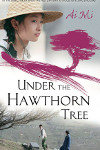
First love – a time to worry.
Publisher: Virago
Pages: 352
Type: Fiction
Age: Adult
ISBN: 978-1-844-08703-7
First Published: 2007
Date Reviewed: 18th July 2014
Rating: 3/5
Original language: Mandarin Chinese
Original title: 山楂树之恋 (Shan Zha Shu Zhi Lian – Hawthorn Tree)
Translated by: Anna Holmwood
Jingqiu’s family has been written off as the lowest of the lowest. Landowners, in the time of Mao they are hated. Jingqiu works hard to provide for her mother and sister and sees her future as one of inevitable manual labour. She would hope to return one day. On a field trip, as a writer for the new school textbooks, she meets Old Third, the so-called foster brother of her teacher’s family. He’s obviously not as poor as Jingqiu – there would be issues if they became more than friends.
Under The Hawthorn Tree is a book that starts very well and offers much to those interested in the history, but slowly descends into what is to all intents and purposes stupidity.
The stupidity can be found in Jingqiu’s choices. She is a fair enough character and works more than is healthy so that her family has money, but she declines all offers of support and legitimate ways to get around her situation. The love interest, Old Third, has much to offer and asks for nothing in return; he wishes Jingqiu out of danger. Jingqiu rejects his money and puts her life on the line working in factories that use poison and taking on heavy lifting duties that could kill her. Perhaps it is meant to be endearing, but instead it comes across as silly and selfish. It’s a miracle the character survives at all.
Some, only some, of Jingqiu’s concerns are valid. She worries about being seen with Old Third in a society that will reject her if they believe she’s lost her virginity out of wedlock. She worries about her family’s already low status. But by and large her worries don’t hold water. There are the constant musings on what people are referring to (metaphors and innuendo). Jingqiu’s innocence is believable up to a point, but it’s hard to believe that by 25 she still dismisses those happy to clarify matters and to be the only person (seemingly, at least) in her home town who has not learned anything. Personal experience doesn’t enlighten her, either. Sex itself is one of the few things that is discussed openly in the city, at least enough that everyone knows a good amount, everyone except Jingqiu.
Jingqiu’s love isn’t believable. She goes through some motions, and perhaps it is down to the lack of knowledge, but it’s hard to phantom that one day she won’t fall in love for real and relegate Old Third to a crush. Old Third loves her, that is certain, by Mi does not present the love on Jingqiu’s side very well.
The writing is hit and miss, however because we’re talking of a translation, it’s hard to say for definite whether or not the repetitive words and juvenile phrasing is down to the author or the translator’s choices. (The translator is Anna Holmwood.) It is safe to say that the translation needed editing, because you’d expect errors in the original text to have received some sort of mention, if just to clear the translator’s name.
What’s good about the book is the pace – it’s quick and easy to read – and the history. Beyond the silliness there is a lot of interesting information, and it’s localised to Jingqiu’s community. You can learn much from this first-hand account, albeit fictional, and its status as a best-seller (it was adapted for the screen, too) goes some way towards informing you about how much you should believe. Jingqiu may not be devoted to Mao but she refers to the rules and texts enough that you see how people were affected.
As an insight into the history it’s not bad, but you shouldn’t pick up Under The Hawthorn Tree expecting to be wowed. If you are, all well and good, but most likely you’ll be happy to move on.
Related Books
None yet
Irène Némirovsky – Fire In The Blood
Posted 9th July 2014
Category: Reviews Genres: 2000s, Angst, Domestic, Social, Translation
3 Comments

Passion before everything – even love.
Publisher: Vintage (Random House)
Pages: 151
Type: Fiction
Age: Adult
ISBN: 978-0-099-51609-5
First Published: 2007
Date Reviewed: 30th June 2014
Rating: 4/5
Original language: French
Original title: Chaleur du Sang (Blood Heat)
Translated by: Sandra Smith
Silvio sees his relatives a fair amount, as well as the various other people of his village. Their lives are full of intrigue, but as for himself he is boring and set in his ways. He would tell you this himself; he used to be far more active, travelling around the world. Now others can live life.
He does indeed sound dull, doesn’t he? Némirovsky’s Fire In The Blood is a slow read that ambles on, being everything about everybody else until the conclusion.
The book is very short; an afternoon read. It spans many seasons, switching suddenly, which has the effect of illustrating both how monotonous Silvio’s life is, and how long people willing live unhappily. It’s not as literary as Suite Française, in the way that there are fewer themes to study, and it is a step down from the masterpiece, its length suggesting what its nature is. Considered on its own, however, it’s not bad at all.
Silvio is boring (repeated because this is something you will be thinking constantly as you remember Lockwood and the accompanying wish that another had told that tale) but this allows his narration to be good. He never gets distracted. There are few themes in this book, understandably. Passion. Love. There is the sense of a question – how/when do we break the cycle started long ago, of children following in their parents’ mistaken footsteps? Némirovsky looks at why people do what they do, which, given the time in which she lived, is inevitably caught up in appearances, marrying for money and marrying because it is expected and so forth. And she looks at how people can give up when things don’t go according to plan. She looks, too, at pretence, at faux normality, and at how a change on either person’s upkeep of pretence can bring everything crashing down. In this Némirovsky makes you question all you’ve read so far, beckoning that desire to want to read the book again because no matter what former ideas you had, you’re going to want a second look at that series of events.
Short but not sweet, Fire In The Blood is relatively untaxing but a fair choice of reading material. It may not be Némirovsky’s best but when her best exceeds all else, anything a little less is quite fine enough.
Related Books

John Green – The Fault In Our Stars
Posted 7th July 2014
Category: Reviews Genres: 2010s, Angst, Romance, Social, Spiritual
14 Comments
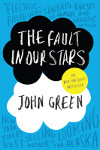
There is life in cancer.
Publisher: Penguin
Pages: 311
Type: Fiction
Age: Young Adult
ISBN: 978-0-141-34563-5
First Published: 10th January 2012
Date Reviewed: 30th June 2014
Rating: 5/5
Hazel has cancer. She’s not likely to ever be in remission but she’s able to live a fuller life than she had with illness so far. At the support group her mother insists she goes to she meets Augustus, someone who matches her in wit and thought. He’s lost a leg but is in remission, and although things will always be difficult, the two teens begin to fall in love.
The Fault In Our Stars is every bit as good as you’ve heard. Green’s writing is very unique and rather excellent, no matter that he has a few novels already under his belt. The book moves far away from the idea of pity, allowing you to see reality.
Green writes teenagers very well and the dialogue seems true to life. There has been no attempt to make the book beautiful – this is no literary feat and frankly it would suffer if it was. To be sure it’s a particular type of writing (this reviewer took a good few pages to get used to it even though she liked it), and it may not appeal to everyone. This is perhaps the only possible issue – where everything is so fresh and specific the book may put readers off by it’s technical nature.
Putting that aside, however, the characters are fantastic. These are teens of a particular personality. They use ‘big’ words, often to excess, and there are so many subjects covered as metaphors and evidence for otherwise simple conversations, it’s unlikely you will know all of them. The sheer life implied by the way the characters act just goes to emphasise how awful it is that we have these diseases that kill. They are simply two fictional people, but they represent a great many more, real, people.
The metaphors are many. A particularly prominent concept throughout is of cigarettes and the potential to kill. Augustus disgusts Hazel when he takes a cigarette from his pocket, but he explains the theory behind his action, that something that kills, stripped of the power to kill by his failure to light it, is not a threat. There are semi-subtextual ideas, such as Hazel’s naming transition, changing what she calls her boyfriend, and there is the controversial scene in Anne Frank’s house in which the teenagers cause a stir.
There is, as you may expect, a lot of humour. You are meant to laugh. You are meant to have a good time. You are not meant to pity, but you are of course meant to feel. There is the sadness – of course there is, you may say, but the point here is that because it’s balanced by the humour and normality, it is all the more powerful.
A special mention must be made of the novel Hazel loves, that she passes on to Augustus. It forms a big part of Green’s book and contains a great many concepts and metaphors. Does it signal what will later happen in the book? The scenes with the author of this book within a book remind you that sometimes life sucks, and it can continue to suck even when it’s already reached the lowest of lows.
Metaphors, concepts, themes. These, apart from the C word, are what The Fault In Our Stars is about. Green wants you to get to the heart of the matter and knows that often, subtlety is the best way. The book gets you thinking, analysing as though it is literature set for class discussion, and will leave you considering it for days.
Both a fast read and a slow burner, The Fault In Our Stars will change you by way of making you think. It’s not out to change the way you approach disease (or even, it could be said, disability). At least not obviously.
Think. Consider. Laugh. Cry. There is a fault in the stars, but it isn’t Green’s book.
Related Books

Helene Wecker – The Golem And The Jinni
Posted 27th June 2014
Category: Reviews Genres: 2010s, Angst, Domestic, Fantasy, Historical, Social
9 Comments

In Britain, the book is changed from ‘jinni’ to ‘djnni’, but as ‘jinni’ is more well-known and I can think of no good reason for what is so minor a change, I will be using ‘jinni’.
Who needs Aladdin?
Publisher: Blue Door (HarperCollins)
Pages: 484
Type: Fiction
Age: Adult
ISBN: 978-0-007-48017-3
First Published: 1st April 2013
Date Reviewed: 25th June 2014
Rating: 5/5
In the 1890s, Chava is created with spells and awoken on a ship bound for New York. But when her master dies she is alone and the intelligence and curiosity that were instilled in her come to the surface in ways not intended. She is found by a Rabbi who takes her in and gets her a job at a bakery. Across the city a tinsmith cleans his neighbour’s flask and awakens a jinni who has been confined to human form; from a choice of names the jinni picks Ahmad as he can no longer say his own name. Both golem and jinni must find their way, alone, and possibly with each other.
The Golem And The Jinni is a fine historical fantasy about freedom and acceptance, wrapped in delicious writing with a few notes on racial tolerance. It is one of those rare works you can truly get lost in. It’s not epic in the adventure or time-span stakes, but the term applies all the same.
Wecker’s command of language is what you would expect of an established author. The Golem And The Jinni doesn’t feel like a début, even if you could of course suggest that some of its finesse is owing to the editor. It’s hard to point to something in the specifics; it’s the entire package that is special.
The book is technically historical fantasy, more than technically, but in many ways it is more the plain historical. Chava and Ahmad are of course fantastical characters and no doubt Wecker had a great time creating them, but nevertheless their reason for being, as such, does seem to be more about the difference they can provide, the obvious contrast to the rest of the world that a simple human-only story could not. Yes, it’s possible that the characters could have been substituted with humans, but in that case the themes would not have been so successful in what they were employed to show. In a way it’s the fantastical itself that ‘makes’ the themes – the fantasy adds to the setting and language, and illustrates in a unique way the issue of freedom, of agency.
In creating a golem, Wecker can look at social mobility, individual agency, and women’s issues of the time, far better than she could have with even the most fearless of 19th century human women. Somewhere along the line a woman would have been caught up short, or heckled, derided, unless Wecker wished to make a crime novel heroine, and using a golem bypasses that problem. Of course Chava is still restricted, but it’s more a case of wanting to fit in, of having to fit in, and as she moves away from that notion so can Wecker look at things in more detail.
This isn’t to say that the lives of the period’s women is the biggest theme, because Chava, as a golem, is somewhat exempt. But it is part of the larger theme of freedom and creating your own life and destiny. Ahmad was trapped, and remains so – he longs to be free. Chava’s never known any different, but as he teaches her, you see her flourish, ironically flourishing in a role that is the antithesis of the one she is supposed to be living. In this way, Wecker also explores the concept of choice and what being unrestricted can do for a person. Furthermore, both represent constraints, Chava’s being invisible – society’s rules, not always relevant. Ahmad’s obvious and omnipresent – not society’s but due to society’s fear and the power that comes when someone exploits that fear. The golem and jinni balance each other out.
We see the lack of freedom in Sophia, a human who meets the jinni. Sophia shows us the more ‘human’ (as much as he can be) side of Ahmad, but she also provides a contrast to Chava, being a woman who wants to define her own life but is unable to, versus Chava’s reservations but ultimate prime position. The character is one of a few that illustrate the restrictions society placed on women, and the way they were treated.
There is a little of race and emigration, too, though this is in the background for the most part. That said, Chava and Ahmad’s actions explore the positives to be gained from connecting with others from outside our own cultural spheres.
It should be noted that the book isn’t solely about the mythical, that there are sections about various people, and the humans are given just as much space. These people are those particularly affected by the golem and jinni in some way – a lover, a past acquaintance, a person affected by an issue falling in the fantastical realm of the otherwise factual world. These sections allow us to observe the period and cultural relations. They allow you to witness the stark differences in fortune, placement, and sometimes, luck.
Whether or not you work out the twists shouldn’t affect your enjoyment. Talking of twists, however, the ending is very well plotted. All questions are answered, in a particularly intriguing way. They are answered simply and quickly (this is the end, after all) yet there remains a subtlety to them, something that enables them to be revealed clearly, yet in a way that doesn’t get you racing to finish the book. It’s a slow burner and you are meant to be able to enjoy each answer before moving on.
The Golem And The Jinni is, simply, a magnificent book. Beautifully written, magical both in character and temperament, and a tale that is fairly long already but one which you’ll wish was even more so, it has a lot to offer. And it keeps on giving, even though the jinni would prefer it not to.
Related Books