




Rosy Thornton – The Tapestry Of Love
Posted 26th September 2010
Category: Reviews Genres: 2010s, Domestic
Comments Off on Rosy Thornton – The Tapestry Of Love
Moving to the mountains may be the idea for someone seeking lone time but it’s not necessarily the case that that time will remain.
Publisher: Headline Review (Hodder)
Pages: 339
ISBN: 978-0-7553-4556-4
First Published: 2010
Date Reviewed: 22nd September 2010
Rating: 3.5/5
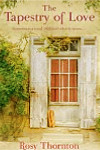
I’d been wanting to read The Tapestry Of Love ever since I first saw the cover; the photo was beautiful and the historian in me was captivated by the word “tapestry”. So when I received an email from the author, offering it to me for review, I could only say yes.
After several years as a divorcee, Catherine decides to up sticks and move to an almost deserted area of France, buying a house complete with orchards and beehives. She comes to love the area and it’s people and makes use of her skills in sewing and tapestry to aid the homes of those around her. But a few events may later give her cause to rethink her life and work out what she really wants.
I generally have a really hard time getting into stories from the first page, and even though it happens a lot – that I’m disconnected for a few turns of the leaves – I’ve never got used to it and let it be. So I was happy when, upon opening Thornton’s book, the first sentence wasn’t just good, but very good.
Thornton begins her tale with “Never in her life had Catherine Parkstone imagined so many sheep”, which provides so much information straight away; we have the main character’s name, and a good sense of her location. We also have reason to read on. The story is split into three parts and Thornton uses this event of moving sheep again, in the second part, to illustrate the change in Catherine’s mind, how she’s adapting to her new lifestyle.
And it’s in writing that Thornton excels. She has chosen a relaxing story for which she can concentrate more on that often recounted point “don’t tell, show” and goes into meticulous detail about Catherine’s location so that it’s impossible not to be able to imagine it perfectly. The book is slow moving, the kind of slowness that enables you to feel you can really spend your time on it and take it all in. It demands your attention when describing but otherwise you’re very much permitted to pull up a chair to the table of Patrick Castagnol and nibble at the cheese provided with homemade wine. Because of the book’s setting and Catherine’s employment there is also a lot to learn for someone unknowable in arable farming (such as myself) and likewise much enjoyment for those who perhaps spend their own time working the land.
Not exactly surprising, considering the book’s title, there is a lot of information here about tapestry. Being more of a knitter than a sewer I must admit that for me sometimes the details became too much but for another they would be a delight.
There is a big difference between the scenes outside and the scenes taking place at one of Catherine’s neighbours’ houses. It is outside where the descriptions take president – the information about weather, the growing of the crops, the time to reflect by oneself. Inside it is all about dialogue, social interaction. This means that you are likely to prefer one lot of scenes to the other but because both are given equal time this is never a problem.
Something which took me a while to realise is why there were so many descriptions, because in places I did find the book easy to put down. I realised that it is where Catherine is on her own that she is reflecting on her surroundings and although that might be obvious it occurred to me that when I am alone I will often do the same, thinking the same things as I did the last time I was alone, looking out the window to judge the way the clouds are moving. Catherine’s thinking and Thornton’s descriptions serve to show how one has time to think about things like this when alone and even more so in a place where life is less busy. Looking at it from where I live I had to remember to change my mindset and remember how life is slower in the countryside.
And so when Catherine is invited to dinner the descriptions give way to dialogue. The host of secondary characters are great to read about, there is a similarity between them due to livelihood but each bring their own personality to the story. When Catherine’s family turn up on the pages there is that complete difference shown between rural life and city chaos and I can’t but wonder how much Thornton has brought her own experiences into the book because she writes it all so well.
Love, you say? Indeed, there is love in this book and it runs subtly throughout the story for the most part, but it’s discernible to the reader.
In writing The Tapestry Of Love, Thornton has presented the perfect story for a rural dweller and a challenge of sorts for a citizen of the city being that the latter must leave their faster-paced life at the cover of the book and take off their shoes before entering. It is a really rural book that will appeal to anyone seeking a getaway without the air-travel price tag, and a way of becoming completely absorbed in an idyll.
Beware if you’ve been considering escaping to the country. This book will give you ideas aplenty.
I received this book for review from the author.
Related Books
None yet
Katherine Webb – The Legacy
Posted 15th September 2010
Category: Reviews Genres: 2010s, Historical, Social
Comments Off on Katherine Webb – The Legacy

Every family has their secrets, their problems, but not every family’s secrets are entwined.
Publisher: Orion Books
Pages: 422
ISBN: 978-1-4091-1716-2
First Published: 2010
Date Reviewed: 29th August 2010
Rating: 3.5/5
Beth and Erica have moved to the manor owned by their extended family, to sift through their grandmother’s belongings and ready the house for a potential buyer. But neither of them knew that when they got there they would find their childhood friends right where they left them, and they didn’t know the history of the great-grandparent who had caused their grandmother so much pain. Beth and Erica have not been back since two years after the disappearance of their cousin, and Beth has never been quite the same in the twenty-odd years in between, but now there’s a chance to find out what happened, both to their cousin and to the great-grandmother who so upset her own dynasty.
The Legacy is an incredibly long book. The narrative is split into two parts, past and present, each chapter being one or the other so that they are told back-to-back. At times the stories run parallel so that while Caroline travels in America in the past, Erica is discovering, in the present day, those events that occurred.
Webb has constructed an interesting story but unfortunately, although you can understand the issues the characters have, the people that populate her pages are lacking. They are not bad by any means but because the novel follows a simple pattern to many others, and shares the same basic storyline as so many before it, the characters fall flat of expectations. Caroline is very much a product of her time but it is still frustrating to read about her because you’d hoped she would be different. Some of her decisions are difficult to read about, so while she may have been a worthy candidate for her time she is unworthy of all that is given to her. Erica and Beth, Dinny too, are very average. There is nothing to recommend them to memory. The problem is that they are mostly there to further discovery but they’ve been given an ample amount of the book and so while there is plenty of space for them to develop there is little reason for them to do so. Although there are two secrets involved in the book, one historical one modern, the emphasis is on the historical so their fictional lives have been created for Caroline’s tale.
It is Caroline’s life that’s in the spotlight, and it’s this that is most interesting, but a rival to that interest has to be the location of the modern section of the story. As such this is also a rival to Erica’s narration. The wonderful thing about The Legacy is that the modern part is set at Christmas but often reflects on summer; this makes the book perfect for any weather, any season. It has all the recommendations of a summer read and all the recommendations of a winter one. I was very comfortable reading this novel while the rain poured and the sun shone in equal measure.
The locations picked are so far apart that it spurs the narrative on, so that where the modern characters may lack substance and the historical ones goodness, there is a constant need to read the book. Caroline lived in America before she came to England, in the hot, dry, hardly-cultivated lands of Oklahoma, and while Webb is not adept at character development she excels at location description. It’s all too easy to get lost in the landscape so that when you pull yourself away the heavy rainfall outside your window is a shock.
Lamentably, one of the two secrets is too predictable, in fact I realised the twist by a quarter of the way in. Whether or not this was intended by Webb I cannot decide because in a way it is painfully obvious, but the fact that the book carries on digging through ideas before coming out and telling you the secret itself leads me to think it was meant to stay secret. Because it was so obvious and because so many people will guess it like I did (it is that obvious that I can say that for sure) it puts a bad light over the book. All those pages to work out what the reader already knows; and it’s not like there is an interest to be had in reading about how the characters work it out because it’s not like the story is your average well-researched and forensic-riddled mystery.
Webb has thrown noticeable satirical and observational remarks into the book. She comments on the pushy quality of organisations to get you to join and the oft-acknowledged situation of Britain’s Prince Charles. These bring in some very up to date points of conversation for the reader to ponder on and allow for a sort of participation you wouldn’t generally expect in a novel.
But Webb’s style of writing is baffling. She often closes a sentence of dialogue with a full stop rather than the usual comma and then the “he said” part which makes working out who’s said what or done what very confusing. She also uses peculiar sentence structures that have a similar effect. There’s a good story behind the words but digging through them to get to it is difficult.
The Legacy takes a long time to tell a short story and while it’s a nice pastime there isn’t enough to recommend it to memory. It really is a very average book.
Related Books

Catherine Ryan Hyde – Second Hand Heart
Posted 19th August 2010
Category: Reviews Genres: 2010s, Spiritual
1 Comment

The general idea may be to let the past go, but sometimes memories can be the making of us.
Publisher: Black Swan (Random House)
Pages: 446
Type: Fiction
Age: Adult
ISBN: 978-0-552-77662-2
First Published: 16th September 2010
Date Reviewed: 18th August 2010
Rating: 5/5
Vida would have died without a heart transplant, in fact she’s been waiting to die all her life. Now, at 19 years old, she gets her chance when a woman is killed in a car accident. But what about that woman, or more so what about the husband the woman left behind? Maybe he shouldn’t have contacted Vida, but it’s done now – and is it possible Vida remembers things she’s never experienced?
Please note that the first part of the book, up until Vida has her operation, contains a lot of graphic descriptions of surgery. Should you wish to, skipping over it shouldn’t cause any problems in your understanding later.
My initial thoughts, as I waded through the first lot of pages, was that this was going to be a boring book. Admittedly I was reading this novel straight after having finished If I Stay and it was only recently that I also read Before I Fall, so the theme of being at death’s door wasn’t as compelling as it could have been; but the difference between those books and Second Hand Heart is that Ryan Hyde takes her story beyond the place where the others end. If we are to assume that those two books ended on a positive note then Second Hand Heart is like the continuation of what happens afterward.
I have quite a lot to say about the main character, Vida, as my feelings about her changed over the course of the book, and it was in a different way to how my feelings for characters have been known to change before. The first thing had just as much to do with Ryan Hyde. Vida is a brilliant storyteller, she speaks as you would imagine a teenager to speak, and it’s so much a case of her telling you rather than the collective “reader”. There is no trace of an author writing Vida’s diary, the way it’s written it really is as though the girl is real and wrote the pages herself. Now this isn’t to say that Vida will be as articulate as you would think a nineteen year old would be, and at first this is confusing. But when you learn how sheltered Vida was, and how she would have been put on a kind of pedestal by her worried mother, it makes sense. Vida’s never lived, and this she freely admits, offering her lack of education along with it.
Later on I started to get annoyed with Vida. Her mother told Richard how her daughter could be intense at times – but it didn’t help. Vida is intense and that’s understandable – she wants friends, she wants to know the world – but she crossed the line when it came to Richard. And not by loving him, because that was out of her control, but by contacting him too much when he needed space. A person in love can often feel the need to be with their beloved but Vida was well aware that the love she felt stemmed from the love Lorrie had felt and so should have backed off a little. Indeed she had something important to tell Richard, but it could have waited.
Lastly I came to terms with the fact that Vida was annoying and let her be. I was open to a change when she started becoming the person she will surely have been post-book, and began to feel better about spending so much time in her theoretical presence. There is no doubt about it, heck the amount I’ve just written is proof enough – Ryan Hyde has written a fantastic character who comes to life in a way that few other authors manage.
Richard, lovely as he is, is more a regular character, and he develops in a way similar to many another. But this is a good thing because it allows Vida to be the focus. This isn’t to say that Richard is unworthy, far from it, in fact it becomes the case that his transitions are just as important, but there is that difference there that is difficult to explain but very much needed.
The book deals with love, unsurprisingly, but not so much romantic as familial love and love for oneself. Actually, I’m including the love aspect in this review just so that I can introduce you to the following spot-on quotation:
I’m beginning to see that point about love you made when I first met you. Maybe it’s less like a valentine heart and more like a real one. Like maybe if you give somebody your heart it’s this bit gnarly muscle of a thing that’s not always too pretty to look at.
I’m going to make an incorrect assumption and then add the other side of the opinion to balance it out and cover all angles for debate. First, this book isn’t really about Vida, or Richard. It’s about the woman who died, Lorrie. In this sense Richards thinking behind his decision to give her heart up for transplant was right – Lorrie keeps on living through others, more so than she ever would have had she been buried complete.
Second, this book has everything to do with Vida and Richard, and it is about them finding themselves and their lives through the woman who died. Lorrie’s death didn’t just mean one person lived, it meant lots of people lived and found themselves in a position of change. Vida, her mother, Victor, Esther (who possibly wouldn’t have done what she’d wanted to do) and in a way, Richard. Richard learned to live without Lorrie, even if the best situation would’ve been that he didn’t have to.
There’s a part of me that embraces the first and another part the second. The second may be the correct one, but the first is equally compelling a thought, if not more so than the second. What will be your thoughts?
The school of thought is that everyone in life makes an impact of some sort, but more and more nowadays we worry about the size of the impact we will make; Ryan Hyde mentions this by having Richard donate organs to combat that reason. But ultimately she reminds us that we take what we can in memory and use it to make our own lives better. It may be a nice thought to try and keep someone alive and make them known to everyone, but few will be remembered for as long as the human race exists.
Second Hand Heart is a fantastic life discussion that has been superbly woven into a relatively slow-moving story. The desert setting is stunning but it wouldn’t have held up the book on it’s own, it’s the theme and characters that are most prominent. Because of the theme the book is drenched in the heat it gives off and it’s easy to become lost in it, and that’s just as well because not only is this a very good book, it’s an important one too.
I received this book for review from Transworld Publishing, Random House.
Related Books
Sasha Blake – The Wish
Posted 13th August 2010
Category: Reviews Genres: 2010s, Chick-Lit, Thriller
1 Comment

Some dreams push it a little too far.
Publisher: Bantam Books (Random House)
Pages: 436
Type: Fiction
Age: Adult
ISBN: 978-0-553-81916-8
First Published: 19th August 2010
Date Reviewed: 11th August 2010
Rating: 3/5
From the look of the cover, Blake’s The Wish looks like the Chick-Lit of Chick-Lit, so I was very surprised when it was more about getting away from money and living a normal life.
Lulu loves Ben, the son and heir of an entrepreneur. Ben just wants to get away from it all and in knowing Lulu he has found that there is a better life to be had than the one he lives. Ariel, Ben’s sister, wants more attention from her parents for all the good work she does, indeed she wants what Sunshine has, only for more virtuous reasons. Frank has a brilliant business – and he doesn’t know it, but it’s all down to his wife. And Sofia, his wife, has, does, and will stop at nothing to be the very best. Because being the most revered person is the most important thing in the world. Which is what Bessie believes too, even if you have to do one of the most hideous things ever in order to achieve it.
There are three levels to the book. Level one: money, pure and simple. The casino owners have it and they want more of it. Level two: getting away from money. Money isn’t the greatest element of life and is a poor, nay empty, substitute for love, family, and happiness. Level three: money. The filthy rich may have other things in mind but those who stray are often already too caught up to leave it.
The plot is completely character-driven. Blake tells the story through the eyes (though in the third person) of most of each of the main, and some of the secondary, characters. She could have got away with limiting the number of people she used because to be honest some of the characters favoured, although important in their own way, are all to similar to one another, and because there are so many people they overlap in the stories too many times. A couple of the more interesting characters (read: of difference status and mind) are dropped altogether soon after their introduction and while their purpose may have been amply served the difference in them would have enlivened the story further.
One of the themes is family. Frank Arlington dotes on his daughter, but when she jumps ship and goes to work as a stripper for a rival company he lets her get on with it. The Arlingtons have money but Frank knows that there are more important things like that and that his daughter should wallow in what she’s done because he had treated her fairly. Ariel wants her father to give her a promotion and goes to the rival when he doesn’t. It’s a bitter period of familial estrangement that’s wholly needed in a place where money has slyly replaced relationships.
Relationships are more important to these people than they realise. The core of the story rests in the decisions Sofia made when desperate to gain status. She never wavers, yet the person directly involved in her decisions does. Bessie was perhaps worse than Sofia, but she realises her mistakes, even though it’s too late (this is something you learn early on and thus not a spoiler).
I am undecided as to whether the book’s cover is a stroke of genius or a hindrance. On picking the book up I expected money, diamonds, shallow and narrow-minded people and while the book has plenty of all of those thing I was most definitely not expecting to read anything about war.
Yes, war. War has quite a lot to answer for in the character of Sofia. You wonder if she would have been the same person had she not experienced what she had. Certainly she learned the value of family, but at the same time she possibly learned that some people were expendable.
The problem with The Wish is that it is predictable and not unique. It’s a story that’s been told hundreds of times ever since casinos opened. Fortunately, Blake’s discussion of relationships and inclusion of money-driven yet not money-focused characters keeps the book above the water. She knew that she could use her story to provide a lesson to her readers but knew that she was limited by this same story from going too far without changing the genre and plot completely. I say that within the confines she has done very well. It will be interesting to see how, if she so chooses, Blake will continue on this theme in the future.
I received this book for review from Transworld Publishing, Random House.
Related Books


Stephenie Meyer – The Short Second Life Of Bree Tanner
Posted 12th June 2010
Category: Reviews Genres: 2010s, Fantasy
1 Comment

Just when you thought the series couldn’t be commercialised any further…
Publisher: Atom
Pages: 178
Type: Fiction
Age: Young Adult
ISBN: 978-1-907410-36-9
First Published: 5th June 2010
Date Reviewed: 12th June 2010
Rating: 1/5
Bree, the vampire introduced in Eclipse for all of a few pages, is given a fair few more pages for her back-story. We get to hear about the week or so before she was destroyed and some extra information on the reasons for the battle that took place between Victoria’s minions and the Cullens.
Did we really need this book? Although Meyer says in her foreword that she wanted to tell this story so that we might feel for Bree as she does, the whole work was a totally unnecessary release, and I say that as someone who quite enjoyed the series. To read the foreword shows how Meyer has been changed from a woman who wanted to write stories into a powerhouse for making money and, I would take a guess, that although Meyer may be enjoying her money it’s the film studios and book publishers that are behind it. Meyer herself has even provided the fact that there were others behind this book when she talks about her editor.
The whole deal with the Twilight saga, Meyer has been keen to express, is that the romance is paramount – the vampirism isn’t so important. Bella’s story is central – why then a spin off that bares no relevance to any of the previous novels? If the saga revolved around vampires and their world it would make sense, but it doesn’t. More to the point perhaps is the fact that this book doesn’t have a point, its story is worthless and there is nothing to read it for. Readers love the characters in Twilight; they swoon over Edward and envy Bella – so what is there in this new book to take away? The story doesn’t go anywhere; it’s just an account of a vampire living with some other vampires in the days leading up to the battle. It even includes pages about battle training – those pages are completely irrelevant because we already read lots about battle training in the original saga where, in addition, it was more interesting. And Meyer wants us to feel for Bree even though, as she says herself, we know she dies at the end anyway.
The idea for this book was conceived during the writing of Eclipse (no doubt originally by the publishing house staff who made Meyer think she’d thought of it first) and although that’s better than it having happen after Breaking Dawn (and therefore even more obviously a money-making device) it just doesn’t sit well. Asking us to feel for Bree is akin to asking us to feel for an extra in a movie when he comes out of a shop with a battered sandwich. We never noticed him because he was background scenery and we’ll never see him again, so who cares about the sandwich? Ironically Meyer discusses how she never noticed Bree the first time round (in the first edit of Eclipse) because she was focused on Bella. She should have thought through that properly, as she should have also the idea that no fictional perspective is trivial.
The one thing this book has going for it is the cover – like the four other novels, it’s absolutely gorgeous. The same can’t be said about the writing. When I wrote about Twilight I described how Meyer’s writing was solid and how she could change for the better the language skills of our children. Well I’m withdrawing that notion – this novella is awful. And what are all these “all” sentences? “We all were out in the sun” and the like crop up constantly – has Meyer never been introduced to the less clunky and ultimately better structure of “we were all out in the sun”? The foreword itself is a mess.
No doubt about it, this book will be put forward for filming and another young actress pushed into the spotlight and stereotyped for the rest for her career because she’s not as old as Robert Pattinson, who had the foresight to sign on for other films. The publishers will keep raking it in and preying on love struck teenagers, no matter whether or not the teenagers are appeased by the story of yet another girl who was able to come into close contact with Edward.
The Short Second Life Of Bree Tanner is overpriced and superfluous. It’s as unrelated to the saga as that man and his damned sandwich, which have now been rained on and we still couldn’t care less.
Related Books


