




Bianca Zander – The Girl Below
Posted 4th March 2013
Category: Reviews Genres: 2010s, Angst, Domestic, Magical Realism, Mystery, Paranormal, Psychological
2 Comments
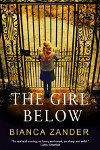
Returning to childhood when memories seem wrong.
Publisher: Alma Books
Pages: 308
Type: Fiction
Age: Adult
ISBN: 978-1-84688-235-7
First Published: 19th June 2012
Date Reviewed: 28th February 2013
Rating: 4.5/5
After ten years in New Zealand and twenty years away from home overall, Suki has returned to London hoping to get back to being who she was; but it’s not going to be that simple. Friends have moved on and no one wants her staying with them, but when she returns to her old apartment block she discovers her family’s neighbour, Peggy, still lives there. She might have found some stability with Peggy and the woman’s daughter, but Suki finds herself haunted by the air-raid shelter that used to be in the garden, no longer there, and what happened the night she descended the stairs.
The Girl Below is a compelling novel, equally driven by characters and plot, that is perhaps best described as realistic magical realism. Mostly consisting of thoughts but having an element that suggests the otherworldly, the book focuses on the reasons a person’s life can spiral completely away from what they had intended, and the need to recover from it when it’s not been a positive factor.
Aiming for detail, Zander tells her story by way of a duel plot line – Suki describes her former life and what is happening in the present. Unlike many stories with such a structure, Zander’s tale invites, perhaps, an equal amount of interest in both storylines, meaning that whilst you inevitably want to get on with the story and find out what happened, there isn’t that ingredient part and parcel of many books where one era is more interesting than the other. There is no divide between the two periods, perhaps because they are not so far apart compared to other books. And the number of characters that inhabit both eras mean you don’t feel like you’re reading two stories.
‘Who am I and how can I be me again?’ is the theme, with Suki’s constant nocturnal travels, in the present day, taking her back to that night she could have died in the flooded air-raid shelter. Because of her parents’ style of living and her father’s choices there has been much for Suki to understand. Whilst understandable, Suki’s character may prove difficult for some, however her actions fit the time period. She does think some thoughts which seem odd for her age, yet this is the first sign of the issues of the book. And as Suki discovers more she realises her childhood memories may not be correct.
The problem with The Girl Below is that whilst Zander wraps some of the plot points up in that dark, complex, and not-quite-obvious-but-fully-implied way that authors of magical realism do, a good half or so of all the questions you have are never answered or referred to at all. You could make guesses of course, but there is scant evidence or reasons for which to back those guesses up, and unfortunately these lost points are some of the most intriguing, the ones most likely to have kept you up at night to find out the truth.
It is for this reason that Suki’s development is stilted at the end. The author has Suki tell you, if not in so many words, that she understands now, but there is not enough showing for the reader to know why. And so abundant are Suki’s strange thoughts, for example that a statue is real, that there really needed to be explanations rather than very very vague suggestions. Suki’s sexual decisions needed more time, too, especially as they are taboo. It’s a case of feeling that the author wants you to be able to relate to Suki without giving you the information you need to know. The reader has to get used to an anxious, childishly scared, and unmotivated person, without a full discloser. It would have also been good to have further insight into Peggy’s grandson, Caleb, who presented an interesting addition to the tale but, whether to illustrate Suki’s anxiety or otherwise, has the focus on his behaviour somewhat diminished in the end.
And this is a pity because overall the book is fantastic and with more attention paid to reasoning it would have been a triumph. The pace is steady, the plot and atmosphere spooky, and there are plenty of times where, for the magical realism, you wonder if you’re reading a suspenseful scene (this wondering itself causes the suspense). One can work out a lot about Suki in the realm of possibility, but it’s not enough.
Writing-wise the book is on the whole very good. The author switches between contemporary British language and some rather old fashioned slang. Zander’s skills as a journalist shine through and it’s obvious she’s brought her own story of the immigrant to the table.
So the difficulty comes, then, in explaining why in general this is a superb book and why you should want to read it. Perhaps the best way to recommend it is to say that in choosing this book you are choosing to be scared, choosing atmosphere over story. Certainly you have to be willing to use the untied threads as a springboard for your own imagination. This book will, without a doubt, divide opinion. It will cause many people to wonder at the fact of a seemingly incomplete manuscript being published, whilst yet providing a satisfactory way to spend reading time. Maybe you will come to a conclusion that trumps all others, the issue is there is absolutely no way of knowing if you are anywhere near correct.
Still, I got the thing open, and propped up the sash with a hardback Dickens omnibus from Harold’s schoolboy collection. With much trepidation, I leaned a little way out. the night air was still but also sultry, humid. With one eye on Dickens – his long-windedness holding fast – I leaned out a bit further and dared to look down.
The Girl Below is unfinished, but brilliant.
I received this book for review from Alma Books.
Related Books
None yet.
Nancy Bilyeau – The Chalice
Posted 27th February 2013
Category: Reviews Genres: 2010s, Drama, Historical, Paranormal, Political, Romance, Social, Theological
6 Comments

An attempt to end the Reformation.
Publisher: Orion Books
Pages: 427
Type: Fiction
Age: Adult
ISBN: 978-1-409-13309-4
First Published: 28th February 2013
Date Reviewed: 26th February 2013
Rating: 4/5
Joanna Stafford, ex-novice at the dissolved Dartford priory, is trying to get used to the secular life. But when her cousin visits the town and it becomes apparent that his wife wishes to continue the proceedings of the prophecy Joanna heard from Elizabeth Barton1, the novice has a choice to make. Does she refuse, and live in danger of those who wish Protestantism gone, or does she agree to work towards the deposition of the formidable Henry VIII?
The Chalice is a cleverly written novel that looks at the effects of the dissolution on those it impacted the most, and provides a semi-plausible and well-implemented reasoning for much of the happenings during the time between Jane Seymour and Anne of Cleves.
Considering the success of the book historically, it makes sense to discuss what does not work first. Whilst the secondary and “background” characters are factual, the main characters have been created by Bilyeau to varying effect. Some are mostly there to provide knowledge and opinions of the period – for example, although Brother Edmund is of importance to Joanna, his value to the reader is surely as a source of social information. Bilyeau’s creations may not always fit into the history entirely but their stories are woven into the factual events enough; it is less a case of pausing for thought, more a case of pausing for wonderment.
However Joanna herself is a complex and difficult character. She changes her mind constantly and although one can understand her hesitation and continuous worry there is something not quite right about it. One day she will adamantly be against something, the next very much for it, and she continually backs out when she’s already come too far.
Indeed whilst Joanna is a much-needed representation of the stricken Sister, she is perhaps too much an example of the stereotypical weak woman. Seeing that Joanna is supposedly well-read and strong in other ways it does cause confusion. An otherwise wise woman who suddenly decides to reveal her background whilst undercover is incomprehensible. She doesn’t think about how her actions will ruin careful planning and makes for an incredibly bad agent. Strange also is Joanna’s dislike of admirers when she constantly leads them on.
But however odd these factors are, they do not mean that Joanna is a bad character overall. As suggested she is a good source for learning about the affects of the Reformation and has been placed into the factual history with care.
All this usage of history is what sets Bilyeau’s book on a pedestal. The author never lets her own ideas come in the way of truth, and instead of pulling the reader away from it she finds the gaps where she can insert her characters so that they don’t disrupt. Bilyeau will take a snippet, for example the exact way an ambassador discovered information (which historians do not know), and pitch her characters as the sources. It is for this reason that even the most vigilant of readers, those on the lookout for liberties taken, should be able to relax. Bilyeau may not be the only author to value accuracy, but her method is rather unique and completely satisfying. She even supplies a reason for Henry VIII’s impotence in his later life – unnecessary really, but still absolutely gripping.
Whilst the premise rests on mystery and spying, the book does not move with any speed; it drifts along comfortably, taking its time. In the hands of another author this might have been a negative aspect, but Bilyeau’s focus on social history and detailing the setting mean that whilst you want to know about the intrigue, you are happy just to wait. And you can rest safe in the knowledge that Bilyeau will reveal all.
The Chalice is the book for those who love Tudor nobles but are bored with life at court (your average Tudor noble would have welcomed this book). It may be repetitive at times (everyone always says “no, no, no!”) but on the whole it is a very, very good book. Whilst officially a sequel it can be read by itself as the references to The Crown are detailed enough, and perhaps most importantly it gives a much needed voice to the victims of the changed society.
A superior novel of the dissolution and attempted restoration, The Chalice will delight readers of historical, spy, and perhaps even Christian fiction.
1 The nun, or “Holy Maid” of Kent. Barton prophesied the death of Henry VIII if he married Anne Boleyn, and was killed for it.
I received this book for review from Historical Fiction Virtual Books Tours.
Related Books


Speaking to Nancy Bilyeau about the Joanna Stafford trilogy, The Blue, and Dreamland (spoilers included)
Charlie Place and Nancy Bilyeau discuss the lifestyle of Dissolution-era nuns, using a website’s ‘contact me’ form to great success, there being more relics than there were items, using your family’s name in your work, and the grand amusement parks and luxury hotels of New York’s past.
If you’re unable to use the media player above, this page has various other options for listening.
Shannon Stacey – All He Ever Dreamed
Posted 22nd February 2013
Category: Reviews Genres: 2010s, Domestic, Romance
Comments Off on Shannon Stacey – All He Ever Dreamed

Meet the last male Kowalski.
Publisher: Carina Press (Harlequin)
Pages: 180
Type: Fiction
Age: Adult
ISBN: 978-14268-9462-6
First Published: 21st January 2013
Date Reviewed: 25th January 2013
Rating: 3.5/5
Josh Kowalski is fed up of running his family’s guest house, feeling that life is passing him by whilst his siblings are free to do whatever they want. There are plans to put the house on the market but before that can happen the housekeeper has a relapse and her pneumonia returns. Her daughter Katie, Josh’s long-time best friend, moves in to help out. Katie has been in love with Josh for as long as she can remember, and knows Josh sees her only as a friend. But will living together change that, and what happens if Josh’s wanderlust never goes away?
All He Ever Dreamed is the sixth book in Stacey’s Kowalski series, and the third to focus on the families who live in Maine. Like the rest of the books there is a strong element of familial bonds however in this case much of it comes not from the Kowalskis themselves but rather from Katie’s mother, Rose, who is almost part of the family herself. This does mean, therefore, that the usual family element is somewhat lacking – it’s a case of being a fine story in a fine context if viewed by itself, but if viewed as part of a series it inevitably pales in comparison to, say, Yours To Keep, which featured the New Hampshire branch of the Kowalskis and included all the children. Stacey does make up for this somewhat by populating Josh and Katie’s story with friends, however because they are secondary characters they are not as developed and it may be difficult for the reader to bond with them.
The relationship between Josh and Katie is strong enough, even if it does simply repeat Sean and Emma’s to an extent (both books include cohabitation – the first for pretense, this one for the upkeep of a lodge). Stacey has done a good job creating characters who are a good fit, as well as making Katie an extended family member. It does seem odd, at times, that Rose and Katie are so integrated, because the New Hampshire stories are so confined to blood ties, but it’s not completely out of place; it allows Josh to have his own romance without the difficulty of having to change the entire atmosphere of these books by making him go on a journey to look for a girlfriend. At the same time, however, the convenience of it all does make it obvious that this will be the last Kowalski book unless Stacey bucks the trend and writes books about the sisters in the family.
The story may be predictable, and that predictability quite acceptable given that a big part of the success of these books lies in the reader being able to settle down with something they know well, but the story does seem too easy. Josh’s wanderlust is confined to a short space of time and he doesn’t go particularly far; in the end you can’t help but feel it was just a waste of time – indeed he went on about leaving so much that the short time he’s away seems a bit of a joke. Of course it allows for him to be with Katie, which is what the book is all about, but “easy” is the word. His mental conflict, what was supposed to be so important and the catalyst in his development as a person is relegated to a short trip and constant contact phone calls with his family. From the moment they get together, Katie rightfully worries that if Josh stays he will later blame her for making him feel pressured, but in the end Josh doesn’t really have a choice of where to be, even if he says he does. Unfortunately the author can tell you anything, and the character can tell you anything, but in reality Josh would not be completely happy with the choice he makes.
The chemistry between Josh and Katie is good. Perhaps because Stacey spends an ample amount of time documenting their history as friends and the lead up to their relationship – as well as the issues that arise from wanting to keep the friendship – the characters feel all the more right for each other and there is no need for over the top demonstrations of feelings. Stacey sets the background so well that she is able to write the story as though you’ve been reading about the characters for years – romance and dating is unnecessary, for example – and whilst this might make the narrative less exciting it can’t be said that it doesn’t work and doesn’t portray reality1. The reader may also find some interest in the age difference – Katie is three years older than Josh.
Rose, like Kat in Yours To Keep (more similarities arise the more you think about it) has her own romantic storyline to keep her busy. It works better than Kat’s did (even if Kat’s wasn’t bad, per se) though it does pull the focus away from the main couple and, due to Stacey’s way of writing it does have an element of “so what” – in other words Stacey doesn’t give you enough reason to care. However it’s not a negative point because of the emphasis placed on Rose’s role at the lodge and in Josh’s life.
Yet for all the convenience and “lack of Kowalski” in Josh and Katie’s story, the book is a success. It is indeed due to the fact that it is one of a series that this book feels unsuccessful – when viewed as an individual “product” it is as strong as the next strongest novel. Josh’s monotonous life may seem boring but how many people get to be constantly on the move? As such, his life is a reflection of millions of others. If the other Kowalski men are fantasies, then Josh is perhaps the real guy next door, the man who would truly exist in reality. In fact it is the very times he mirrors other romantic heroes successfully that, due to his character, actually seem unrealistic, for example his sudden noticing of Katie being a woman when surely there was ample opportunity prior to their cohabitation. Indeed it could be said that it is the melding of the “traditional” Kowalski alpha male with this realistic unsettled-being-settled man that is the cause for a lot of the book’s issues. A very interesting point to consider.
All He Ever Dreamed may not be the best book in the series, but it is far from a bad book. Timings may be out but the relationship is as strong as any and the difference in story allows Stacey to explore new lives within the same context. And whilst it may be obvious that this may be the last book, it can’t be said that this show of winding down isn’t appropriate.
You’ve read about every other son and his amazing life; now read about what happens to the one who holds the fort to allow it all to happen.
1 Primary source for this statement: my own relationship which was the same best-friends-to-lovers-and-everyone-knew-it-would-happen, if just on a much shorter time scale to Stacey’s characters.
I received this book for review from Carina Press.
Related Books


Pam Jenoff – The Ambassador’s Daughter
Posted 18th February 2013
Category: Reviews Genres: 2010s, Angst, Domestic, Historical, Political, Romance, Social
3 Comments

Love and war. They change everything.
Publisher: Mira (Harlequin)
Pages: 376
Type: Fiction
Age: Adult
ISBN: 978-1-848-45203-9
First Published: 29th January 2013
Date Reviewed: 13th February 2013
Rating: 3/5
Margot, a German Jew, has spent the war (WW1) living abroad with her father whilst he works at universities. She has a fiancé who went to war but when he returned wounded, Margot decided to stay with her father. She loves Stefan, but not enough, and feels trapped by the idea of marrying him. In Paris, where her father has moved to attend the conference for the treaty at Versailles, she meets Krysia, a woman very different to her who urges her to be her own person in this new world. But because of Krysia, Margot is found by Ignatz, and when Margot meets Georg Richwalder, from the German delegation, she is no longer able to live her life through her own choices.
The Ambassador’s Daughter is a book that looks at the confusion that came with the war and its end, the way the world changed, and the way that a person was able to remake themselves accordingly. Focused on the main character, the war provides the context and backdrop for Margot’s decisions, but it also allows Jenoff to look at the effects of war in general.
The only issue with these two topics being placed together – a historic war and the trials of a young woman – is that one was always going to be used less than the other, and while it’s not bad, per se, that Jenoff chose Margot, it does mean that there is space for further problems.
The main problem with The Ambassador’s Daughter is the main character. Whilst it is in no way necessary to have a character a reader can like, Margot’s constant worries, repetitious thoughts, and poor choices make her rather unrealistic. It is true a person might be indecisive and worry, especially in times of war, but the fact of the first person narrative makes the tale complex for the wrong reasons; if written in the third person Margot may have come across very differently.
The war being considered very little unfortunately makes Margot seem self-absorbed. She is often oblivious to what people have said, even when it is paramount, and does not see what is staring her in the face. When there is hope and a real chance, she pushes it away. The era was not good for women but her father’s support for her education, even if he wished to see her settled, would have made for a stronger sense of reason and fight, if not strength itself.
So the plot is confusing and there are many points that are not expanded. This does mirror, however, the confusion of war and thus makes it difficult to say with confidence that Margot is unreasonable. Her religion, her relative wealth, her father’s position in the world, would have in reality made for a tricky situation, especially when her mother’s death is included in that mix. It’s the fact that Margot never really saw the war that makes her self-absorption so difficult to accept.
Apart from Margot there are some very well developed and poignant characters. Georg, emotionally wounded but striving to stay strong, provides a brilliant contrast to Margot’s indecision; Stefan, for all his misplaced loyalty, is understandable and if anything this makes Margot’s choices worse. Her father is a different story. Revelations in the book may make the reader’s feelings for him change, or at least create a reason for reassessment.
The book is full of lies; lies between the characters, lies towards the reader, indeed it could almost be said that the theme of the book is lies. By themselves they may be considered too numerous. When looked at generally, these are actually clever devices, drawing everything together in their deception and showing that the war might be over but nothing will ever be the same.
There are some plot points that may be considered too convenient. Jenoff deals with the result well, and in fact in at least one place there is a great show of not using it to get to an easy situation, however it does still detract from the book.
Whilst the writing is, overall, rather good, there are a number of Americanisms that do not fit. Margot uses terms such as “gotten” and “fall” (as in autumn). Considering she has spent years in England and never speaks of America except when referring to another’s discussion, the terms are out of place. There is also the matter of research and the usage of objects not yet invented.
However for all this, The Ambassador’s Daughter is not all bad. The romance is lovely, if spoiled by Margot’s indecision, and the focus on Germans is interesting. Looking at the Treaty of Versailles from the point of view of the everyday German provides much food for thought, and learning about the aftermath for the common person is interesting in general. The characterisation of Georg is so fantastic it could keep the book going even if Jenoff had everyone suddenly break into song.
The exploration of change after war, the way people were practically forced to change, is wonderful. The varying nature of the characters and the different ways they cope or choose to move on provides plenty of food for thought. And whilst it is difficult to write off Margot’s anxiety with this statement, Jenoff never gives the reader any need to feel that they must like the narrator.
The detailing may be misplaced and interesting threads lost to oblivion, but there is much to take away from this book. It will not suit everyone; it will likely divide opinion and cause contention for its structure and lack of adherence to history, but it is far from bad. The Ambassador’s Daughter has many flaws, but the ideas it imparts are appealing.
I received this book for review from ED Public Relations.
Related Books


Becky Aikman – Saturday Night Widows
Posted 8th February 2013
Category: Reviews Genres: 2010s, Domestic, Memoir, Science, Social, Spiritual
4 Comments

Life after death. A great life.
Publisher: Crown (Random House)
Pages: 334
Type: Non-Fiction
Age: Adult
ISBN: 978-0-307-59043-5
First Published: 22nd January 2013
Date Reviewed: 31st January 2013
Rating: 5/5
Aikman tells the story of life as a widow; first being dumped from the stereotypical support group, and then her quest to create a new sort of group – one focused on remaking lives and finding oneself in new experiences. She gathers five women of similar ages together and each month for a year they try something new – a spa, a cooking lesson, and lastly a grand holiday. Along the way they learn to live with their new lives and to love again. Interspersed with this main story are those of the days each woman lost her husband, Aikman’s discovery of new love, and information about research into grief.
Saturday Night Widows is a fantastic book with fantastic characters. It’s safe to say that if this were fiction, these women would be on book-lover’s lists everywhere and this is testament to how wonderful they are and how well Aikman writes. Rather than focusing on loss and grief, Aikman looks at the positives, the second chance at life and the chance to remake oneself – whilst grief is included, this is a book about happiness and triumph.
From what Aikman says, it appears that apart from wanting to simply conduct an experiment, Aikman may have envisaged a book from the very start; that is perhaps the reason why the memoir is insightful, helpful for those going through grief, and just simply a good book in general.
One of the most important themes of the book is the way both outsiders and the women themselves relate to widowhood and death, for example when Aikman wished to hire staff at an art museum to conduct a tour about remaking lives, the manager phoned her with ideas for art focusing on death. Aikman details how people can be overly helpful or say the wrong things, whether in innocence or because they feel the time for mourning should be over, and she explains (often in the context of her friends) why these things are bad.
Important too are the issues with blending families – two newly-single parents coming together when children are in the mix – which includes Aikman’s own issues with being a stepmother to a girl who didn’t want a stepmother. Whilst the women in the group are of similar ages their children are not, and this allows for a broad assessment of complications, and, of course, achievements.
And considering the ages of the women – the youngest 39, the oldest 57 – there was no easy acceptance of death as there might have been in old-age. With a variety of reasons for the deaths, including sudden death and suicide, the women present a detailed look at grieving and coping.
Dawn didn’t know anything about lotus blossoms when he gave her the photograph six months before he died. She asked him why, of all the glorious sights in the wild, he had chosen this image of a lotus, rooted in an inky swamp, for her. “It is because a lotus blossom will grow and perfume and flower,” he said, “even in the muck”.
Everyone made that same contented sound that Dawn had uttered before. We got it, all right. All of us – Denise, Dawn, Marcia, Lesley, Tara, me – we were blooming in the muck.
Wonderful is the way Aikman presents the women, how they leap off the pages, as colourful and positive in print as they’ve become in real-life. The presentation to the reader is a remaking in its own way as you grow to love them and know them rather well.
The one thing that might divide readers is the focus on experiments. There is quite a lot of exploration into scientific research and trials that can at times seem rather careless (the trials themselves that is, rather than Aikman’s retelling). Aikman details the women as though they are an experiment and this can make them read as children sometimes rather than friends. True, the group was an experiment of sorts, and Aikman, a reporter by trade, speaks of how she took her tape recorder to meetings and lead them in a way, but it can subtract from the friendliness and healing aspects of it all. One could say that to Aikman these women were subjects, but as you read on it is clear she is one of them just as much as any other. Yet all this is understandable because of Aikman’s job as a reporter, and, it must be said, it’s also quite a boon to the book because of the unique angle it takes and the information it offers to anyone wishing to look into it as a subject.
A great deal of credit must go to Aikman’s writing style, the way she mixes accounts of the monthly meetings with memories of the past and what is happening in the present. The book would likely not suffer if it were just focused on the meetings, because it is a strong thread as it is, but these three aspects and time periods mean that the book is so varied and detailed (even without straying from the main theme) that it is difficult not to want to keep reading. There is never a dull moment where nothing happens. If this is a prime example of Aikman’s work then the newspaper she worked at has surely lost a fabulous employee.
Saturday Night Widows has a vast appeal. Undoubtedly a book for women who have also lost their husbands, the work has a general interest aspect to it as well as being a likely candidate for a book about women that would interest a male audience, too. Filled with memorable people who you will find yourself continuing to root for beyond the last page, the book is an example of looking adversity in the eye without suggesting that grief is anything but awful to get away from. Sad, happy, contemplative, funny, and sentimental without dwelling too long (indeed this is the group’s aim), and written by a true talent with plenty of experience in the craft, Saturday Night Widows is one to look out for on any night of the week.
I received this book for review from Crown Publishers.
Related Books
None yet.


