




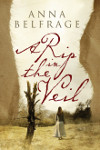
Anna Belfrage – A Rip In The Veil
Posted 22nd March 2013
Category: Reviews Genres: 2010s, Domestic, Fantasy, Historical, Political, Romance, Social
8 Comments
Don’t forget your toothbrush.
Publisher: (self-published)
Pages: 370
Type: Fiction
Age: Adult
ISBN: 978-1-780-88242-0
First Published: 1st August 2012
Date Reviewed: 20th March 2013
Rating: 3/5
Alex was pulled back in time, and all she was doing was heading to a presentation. Landing in the countryside, the 1600s version of where she was when her car stopped, she meets Matthew. Matthew is on the run from jail and agrees to help Alex, intrigued by her looks and story. Alex has family in the 21st Century, but there’s something about Matthew, and soon, despite the hardships that await her in Stuart Scotland, she might start to wonder whether the idea of returning is the opposite of what she wants.
A Rip In The Veil is a time travel novel with a twist. Here we have a woman who has fallen back in time to land in the Scottish Commonwealth, meeting a man who is on the run, and later trying to discover what happened to her mother.
Belfrage has done a good job of using her characters and plot to detail the time periods and their differences. Where others might info-dump she has Alex tell Matthew about what will happen in his own lifetime in order to help him understand what is happening. Belfrage has created a character that knows enough of history that means she doesn’t freak out when events occur – she does worry, because anyone would in the situations – but she has the knowledge and modern methods of, for example, fighting, to last the day.
The issue is that the characters aren’t developed enough. They are stereotypical and it would be difficult to describe them well if you were asked by an interested party. Alex is a career woman, has a child she didn’t want, knows some history, and has a multi-cultural background, but beyond that there is little to say. And the case with Matthew is similar.
This would actually be okay if the plot was not full of holes – because it’s obvious that Belfrage wanted a plot-driven book and there is nothing wrong with that. But there are major issues with the plot, such as Alex, someone who is otherwise very aware of how unhygienic 1600s Scotland is (she is always wishing for a toothbrush, understandably) beginning a sexual relationship with Matthew without any mention of STDs or contraception. One can assume that Matthew may have only been with one other woman before, but the way Belfrage presents Alex leaves no room for unprotected sex. And there is a lot of sex and lust in this book. Indeed there is also the issue of Alex saying how much she loves John, back in the 21st Century, whilst she lusts after Matthew. That can happen, but in this case it does not add up.
And for all her knowledge, Alex isn’t good at accepting the differences that come with being in Matthew’s era. She rallies against some occurrences, as would any woman from a modern western society, but some of her arguments, considering the way she is otherwise, sound at best impolite. And when you’ve a career woman not finding a problem with the relative boredom of a woman’s lot in the 1600s, it doesn’t come across well. Neither does the agreement to burn and give up the possessions that have accompanied her in time travelling. But that’s the issue; Belfrage is very good 50% of the time detailing time differences in regards to characters, and completely forgetful the other 50%. She’ll constantly highlight changes, and then has Alex tell Matthew she thinks she pregnant a few weeks before she suddenly realises she’s pregnant, for example.
The writing is okay, and Belfrage is able to use both old styles of speaking and, of course, modern day slang. However there is this odd element employed where every character tends to end questions with “no?”, as though using broken English. It works for the truly foreign characters, but is out of place and distracting otherwise.
The mystery of Alex’s mother is compelling, even if the sections on the men involved are less so. The violence is extreme and repetitive but it doesn’t stop the story moving forward. But reading the book, it can be difficult not to feel like the premise and various ideas were not taken advantage of. A lot more time could have been spent on Alex’s thoughts of home, especially as she is presented as so modern, and after the initial set up has been established, the characters in the 21st century are abandoned where they could have provided a good balance and more intrigue.
A Rip In The Veil has a great premise and a lot of unique ideas, and for all the issues it is difficult not to want to keep reading. But it must be noted by the prospective reader that threads are left hanging and the unrealistic can take precedent (besides the concept of time travel). It is the start of a series, so there is the possibility that Belfrage may fill in these holes later on.
I received this book for review from the author.
Related Books
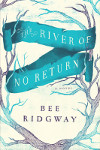
Anne O’Brien – The Forbidden Queen
Posted 20th March 2013
Category: Reviews Genres: 2010s, Angst, Historical, Political, Romance, Social
7 Comments

The prelude of the Tudor dynasty.
Publisher: Mira (Harlequin)
Pages: 607
Type: Fiction
Age: Adult
ISBN: 978-1-848-45215-2
First Published: 1st March 2013
Date Reviewed: 8th March 2013
Rating: 3.5/5
Katherine of Valois, neglected by her parents, is chosen to become the wife of England’s Henry V, bringing the claim to the French throne with her. But Henry is focused on wars and the young Queen’s infatuation does nothing to interest him. At the King’s death, Katherine is not expected to remarry, but that means little when you’re 21 and have never known love.
The Forbidden Queen is O’Brien’s endeavour to bring into the spotlight the grandmother of Henry VII and illustrate the plights of medieval queenship. Drawing both on factual evidence and speculation, she crafts a tale to suit both fans of history and readers looking for romance.
Katherine herself can be a rather annoying and ignorant character, but it is difficult to fault her for a long time due to the background context O’Brien has written (the childhood neglect has neither been confirmed or dismissed by historians so O’Brien’s usage is fair). Considered by themselves, Katherine’s actions are childish, not thought through, and fully of naivety. They are the sorts of actions that readers of strong female characters deplore. However, given Katherine’s childhood – the lack, no, complete absence, of parental care, the punishments and particular upbringing – whilst she may irritate there is a sound reason for it. Indeed O’Brien doesn’t simply list the elements of the childhood and then move on, she provides the details necessary for the reader to understand Katherine’s continuing desperation for love and all the anxiety and bad choices that go along without.
But there comes a limit to how much of the same will work in one book. Over the course of the novel Katherine makes the same mistakes time and time again, quite literally repeating herself. Some have factual basis, but most do not, and whilst the romantic choices are based on speculation that has been passed down through the ages, it was up to O’Brien to fill in the gaps with events that are interesting rather than more of the same. It feels at times as though you’re reading the book a second time, and a lot of it could have been cut out without loosing anything important. The repetition of Katherine and all the mistakes do start to become difficult to understand as the book continues. Despite the background context it is difficult to believe that after a decade of life in England and at court, the Queen would not have learned a thing or two.
Katherine’s inner thoughts are highlighted in italics but she repeatedly ignores the voice of reason and does not understand others’ concerns. She is relentlessly anxious in her repetitive thoughts – angst is the element of the day – and as the book is told in the first person the reader is never given an opportunity to see things from another point of view. This means that whilst there are wars going on, and undoubtedly issues in England due to her son not yet attaining his majority, you do not hear about it, even though it would have surely been in her mind.
Yet because you are stuck in Katherine’s head, there is ample opportunity to get a feel for how it must have been for those who were wronged, and how laws and politics could affect even the most powerful, or in this case simply highest, of women. Locked as she is in her weakness, Katherine rarely puts her heart into rebellion, easily giving up, but through her continual isolation it is possible to draw a picture of what it must have been like for the many other women who suffered similarly. In this way the book will prove interesting to those who feel dowager queens have been forgotten by literature.
And it must be said that Katherine’s utter ignorance creates the perfect situation to educate the reader about society and court expectations for foreign brides. There is also the difference, even if not great, between a mother’s teaching and expectations compared to how the future husband expected his wife to behave. O’Brien demonstrates how a lot of the marital and sexual distances in history might have been shortened had women been brought up to be bold.
The romances in the book enable O’Brien to explore how politics ruled over emotions and how nobles suffered for their riches. They are viewed from the diplomatic angle Katherine must see, except on those occasions when passions triumph over regulations. Understandably the men in the book are secondary characters, even when they are Katherine’s lovers, and O’Brien has moulded them to suit her story.
Liberties are taken but not to extremes, basic anxiety is backed up by context, and the examination into the affects of a mad father and (speculated) debauched mother is undertaken with aplomb.
The Forbidden Queen is admirable for its desire to bring Katherine to the fore, and it’s not a bad book on the whole. But without a solid focus or interesting developments, there isn’t much to recommend Katherine, herself, to memory. If you are looking for romance, however, you may have come to the right place, and the inclusions of well-loved elements will likely keep you reading.
I received this book for review from ED Public Relations.
Related Books
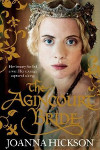
Kate Forsyth – Bitter Greens
Posted 15th March 2013
Category: Reviews Genres: 2010s, Angst, Fantasy, Historical, Romance, Social, Theological
10 Comments

Re-tellings can be just as just as masterful.
Publisher: Allison & Busby
Pages: 491
Type: Fiction
Age: Adult
ISBN: 978-0-7490-1362-2
First Published: 20th March 2012
Date Reviewed: 14th March 2013
Rating: 5/5
Charlotte-Rose is banished to a convent after causing one too many scandals at the court of Louis XIV. It’s a terrible punishment, but she manages to befriend an old nun who tells her the story of a girl who was kept in a tower by a witch. But the witch has her own story to tell, dark and full of despair, and Charlotte-Rose, not always in the garden with Soeur Seraphina, has much time to look back on her old life, too.
Bitter Greens is an utterly fantastic retelling of Rapunzel, blended together with the factually-based story of the woman who wrote down the version we know today. Not at all suited for children, Forsyth’s book is an incredibly dark account and far more stupendous.
The novel is a constant succession of details, complexity, and magnificence. Set in France and Italy, Forsyth doesn’t simply introduce the reader to the history, the life at court and beyond, she soaks you in it. She adeptly demonstrates the hypocrisy of a Catholic court where people had many lovers, and shows that, for all its glamour, the court was a place of extreme cruelty. Indeed the book can be hard to read at times, gritty and depressing as it is, because Forsyth never holds back, she details sexual abuse, gang rape, murder, torture – in fact given the amount of it you could be forgiven for thinking it gratuitous. Unfortunately it cannot be said that it is – whilst Forsyth’s characters, other than Charlotte-Rose and some of those at court, are fictional, the horrors surely echo real life. It has been said on many occasions, especially recently, that fairy tales are in fact dark and cruel, but it’s easy to gloss over that darkness and look at all the glitter and magic. Forsyth reminds you what is behind that glare that blinds you to the truth.
The storytelling is exceptional. Even when the story is repetitious (and given the routine life at a renaissance convent and the sheer boredom of being shut in a tower for months, that is going to happen) it manages to keep its pace. Forsyth fills the pages with such detail and intriguing thought (her characters think of everything and are strong enough to recommend them to memory) that entire chapters may pass before you realise you’re still reading about the same dull life of Rapunzel (here called Margherita).
And Forsyth weaves the magic in beautifully. For a while she almost teases you – will there be true magic or will it be more of a metaphor? – and when it does arrive it is the sort of magic that fills childhood stories, yet the book never looses its darkness or the adult atmosphere. Forsyth invites you to leave reality behind and embrace all the stories that are ‘supposed’ to be denounced upon maturity. And it is every bit as thrilling as it was as a child, only now it also includes the necessary ingredients to keep you hooked as an adult.
It should be noted that there is a lot of social and religious history in the book. Charlotte-Rose lived in a time of Inquisition, when Louis XIV decided to revoke the tolerance afforded to Protestants. It is surely to Forsyth’s good fortune that Charlotte-Rose’s story aligned with this religious persecution as it allows the purely fictional elements to be ensconced in the history, sounding as true as it could ever sound. If the vast majority of men and women under suspicion as witches were innocent, then the author examines those few that could have feasibly made magic their career. And she looks at the known wise-women who were frequented for love potions and curses as well as for abortion and medicines, using fiction to wonder at the possibility of there being true magic assigned to them.
The social history includes a lot of inequality on various levels, for example class and gender. Forsyth shows how weak the position of women was and explores the strengths and intelligence of women to a point where you might just ask yourself why these clever (and sometimes understandably manipulative) women didn’t simply turn on their men. In other words, you could use this book as a study of women’s history, because it has information and both fictionalised and factual accounts in abundance. Examined too are, of course, the convents, where women were thought to be independent. Forsyth demonstrates that this was the case, but only to a degree, due to both male dominance outside the walls and the female hierarchy and bullying inside. A convent could be freeing, but also a death sentence.
It will not surprise you to hear that general sexuality issues are explored as well, with all the prejudices and biases history has provided it.
Lest you wonder where Forsyth could have possibly fitted any characters other than cardboard cut-outs into this, given all the time taken by issues and magic, let us consider the women at the heart of the three narratives (the narratives being Charlotte-Rose, Margherita, and the witch Selena Leonelli). As you may have expected, they are written superbly well. Strong in the face of adversity, cunning and clever, and just simply captivating, for all their strife there is reason to look forward to returning to each of their stories; the book switches back and forth between the tales. Margherita might give you pause, but is it not a case of her being too young and innocent? Selena is an evil witch, but is her own story not heartbreaking? And as scandalous as Charlotte-Rose could be understood to be, is she not just a force of independence and free will?
The romances and secondary characters are all interesting. Forsyth employs few curtains – there is a lot of sex in this book – and perhaps one of the elements that is most obvious to take away with you is the thought that worse than hate is indifference. This indifference being that of Louis XIV, a man so self-absorbed that the terminal illnesses of others were considered inconveniences, things not to be allowed to interfere with the King’s wishes. Talking of men, perhaps most interesting is the way Forsyth includes many instances of men being dominated themselves, by other men. A man was an independent, able to do what he liked in a way no woman could, but add hierarchy and family into the mix and suddenly a man was a prisoner of tradition and society not so unlike all women. Not as horrific, certainly, but still a pawn in the games of influence and pride. Incidentally, of men, Forsyth’s version of Rapunzel’s prince is a brilliant example of bringing mundane reality to fairy tales.
The ending could be considered convenient until you remember that the book is purposefully fantastical by its very nature. It might be less than expected but at the same time it is far from disagreeable, and by the end of all the terror, you’ll likely welcome it.
Having used up a lot of the most laudatory words in the English language, this review is going to have to have a moment of repetition: Bitter Greens is a masterpiece. A mix of history, fantasy, romance, and, let it be said, horror, it is completely worthy of your time. If you want a final recommendation, let this be it: if you don’t want to miss the book that might end up being your favourite of the year, you’ll want to read it, and soon.
I received this book for review from Allison & Busby for Historical Fiction Virtual Author Tours.
Related Books
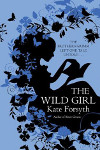

Manisha Jolie Amin – Dancing To The Flute
Posted 13th March 2013
Category: Reviews Genres: 2010s, Domestic, Philosophy, Social, Spiritual
8 Comments

If laughter is the best medicine, music is very close behind.
Publisher: Alma Books
Pages: 290
Type: Fiction
Age: Adult
ISBN: 978-1-84688-238-8
First Published: 2012
Date Reviewed: 21st January 2013
Rating: 3.5/5
Kalu doesn’t remember his early childhood. Living on the streets he takes any job he can get and has made several friends of the people who live in the town he found himself in. But Kalu has a gift for music and when he meets a healer who helps him with the wounds on his foot he’s not quite prepared for the offer the healer makes. A famous now-reclusive musician for a brother, the healer knows that he can help Kalu achieve his potential and give him a home. But it’s up to Kalu to decide if it’s for him, and wrapped up in his indecision are all the friends in the town who he would have to leave behind.
Dancing To The Flute is an intriguing novel that focuses on music and the way it changes people, both as a passion/career and a way of helping others in whatever ails them. Looking at Kalu but also involving the stories and lives of others, Amin seeks to provide an introduction to India, its music and culture, and proposes an artistic way of dealing with problems.
Amin writes in an interesting manner that begs inspection. The style is simple, reflecting Kalu’s age and nature, however the writing is not childish in any way. There is magic in it, a flow that makes it easy to read, the very sort that is appealing as a bedtime story – even if the content is not for children. Indeed, in regards to Kalu, there are times when the writing style more aptly describes Kalu and his friends than do the words themselves.
Most of this can be attributed to Amin’s decisions and artistry, but furthering that the writing has a certain atmosphere that ties neatly into the Indian culture presented. The slow pace, the peaceful nature of the writing – music aside – and the way the words drift along match the idea of “Indian time”1 where the pace of life is slower and things may take longer but everything is done well all the same.
There are gaps in time – the book is more a series of scenes than a flowing narrative – and whilst it is not a bad element, it does suggest that the author wanted to speed things up, to get through Kalu’s days quicker and to the end of the book sooner. This makes sense given that Kalu’s days as a student are somewhat monotonous, but it means that it may be hard for the reader to keep up with the changes that come with growing up, and it is hard to keep a hold on what is happening with the other characters, too.
This links in to a problematic aspect of the book, and that is the way the character of Kalu is presented and written. Amin seems to not be sure exactly of who her character is. When Kalu talks it is easy to gain an insight into him, as a child especially, however when Amin goes back to narration what she says confuses the picture and changes Kalu’s personality and feelings. It is difficult to truly immerse yourself when the main character is not developed in this key way, and sometimes there is even cause to wonder whether Kalu is truly passionate about music.
Whilst this issue does happen on occasion to other characters, for the most part they are well drawn and consistent. Malti in particular is a brilliant character, and the way Amin portrays the confident happy girl followed by the quiet sad woman is rather wonderful. Indeed at first it may appear as if Amin has simply changed Malti’s personality to fit the tale, but this is far from the truth. Where the older Malti is concerned, Amin at first denies the reader important information. The author provides clues but doesn’t spell it out until later on, giving the reader a chance to look at things from an outsider perspective before being informed as to the truth. It’s a very interesting method of storytelling and demonstrates just how much care and attention such situations require. Malti’s story is perhaps the best part of the book and whilst it may seem convenient to use Kalu’s gift in solving it, it fits the theme of the book and brings an atmosphere to it that may be puzzling at first but makes sense the more you read.
The book’s strength lies in the message, of music being an aid and of helping others in the way that best suits their needs rather than one’s own. Apart from the general narrative, Amin includes tales from Hindu mythology and people not included in Kalu’s life to further illustrate the power of music and in particularly the power and importance of music in India’s cultures and religions. She uses the famous musician of her story to relay facts about Indian raags at the beginning of each part of the book, and the book itself is thus structured to mirror this musical style. This means that the book does not conform to the usual build up and climax that many books contain, but moves along a different format, so to speak. To be sure there are climaxes but they are included in a way that allows the music to take precedent.
Dancing To The Flute may have its problems, but the music and the way it affects the people in the book make up for a lot. Incorporating Indian words followed by their English counterparts, the novel is a good choice for those who want to learn about language and culture without feeling lost (assuming the reader does not speak any Hindi, of course). The story could have been more developed but the sentiment is there all the same. Dancing To The Flute will appeal to those interested in culture, music, India, and the trials of life.
1 A concept introduced to this reviewer by an Indian, which the reviewer realises may not be used across the board.
I received this book for review from Alma Books.
Related Books
None yet.
Gayle Forman – Where She Went
Posted 8th March 2013
Category: Reviews Genres: 2010s, Angst, Romance, Spiritual
5 Comments
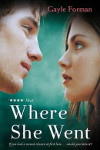
If, to save their life, you tell someone that you’ll leave, what happens if you didn’t quite mean it?
Publisher: Definitions (Random House)
Pages: 264
Type: Fiction
Age: Young Adult
ISBN: 978-1-849-41428-9
First Published: 2011
Date Reviewed: 13th December 2012
Rating: 5/5
It’s three years since Mia walked out of Adam’s life, after she’d woken following the car crash that killed her family and left her in a coma. She never told him why she left him, and since then Adam has been a mess. It’s of no consequence that he’s now an A-lister with groupies and actress girlfriends aplenty, all he ever wanted was Mia, and when he walks past a theatre and sees that she’s playing a concert that evening, he can’t help himself.
Where She Went is the powerful sequel to Forman’s bestseller, If I Stay. This time narrated by Adam and set within an 18 hour period, it looks at what happens when people struggle to regain themselves and the harm that a lack or, rather, change, in communication can do to a relationship.
Although the “action” does take place in a short time, there are many flashbacks. However unlike in other cases, it doesn’t feel as though Forman should have set the book over a longer period – the flashbacks are natural and there is nothing superfluous. Each one demonstrates an important aspect of Adam and Mia’s relationship, or gives the reader information about a particular moment.
There are secondary characters, but apart from the flashback chapters, these people all remain minor. The spotlight is entirely on Adam, even when Mia is there. In fact, being told from Adam’s perspective, Mia even sometimes seems a secondary character herself as you only know what she tells Adam. With Adam you get every ounce of raw emotion.
“You were so busy trying to be my saviour that you left me all alone.”
And whilst what’s going on in Adam’s head is crucial except during times when Mia’s pain trumps it, it’s the dialogue that takes the book into award-winning territory. Forman has a talent for dialogue and characters that is remarkable. The dialogue is realistic, powerful, angsty, and the author knows exactly what the reader wants to hear about and hands it over. You may have to wait to know everything, but your waiting feels the same as Adam’s, you feel the same irritation he does whilst Mia babbles on about things that don’t matter, impatient to cut to the chase and learn her side of the story. And there are many times when the reader might wonder if Forman really will let you know, or whether she’ll allow Mia to walk off into the night and leave you to comfort Adam by the wayside, all the while crying yourself.
In an industry where, as of late, italics tend to be overused, Forman is an exception. She uses italics to excess, but due to her writing style it works where if anyone else would have written this book it wouldn’t have. Instead of becoming an annoyance, Adam’s constant usage of emphasis in his thoughts and conversation only serve to make his pain more obvious, and therefore to draw the reader in. The emphasised words always sound natural and they are spot on – there is never an emphasis on the wrong word. And the emotion and impact is ever more likely to hit the reader so that the lines between story and reality become blurred.
Incidentally it should be noted that Forman has written lyrics for Adam’s band, which are used throughout the story and complied at the end. The detailing and relevance of them shows just how much extra effort went into the book.
The development of the characters is of the utmost importance, and Forman continues what she started previously, making the characters so alike, in both situation and interests, but different enough that they could be strangers. In a way, they are. But they still think similarly and their thought processes mean that they’ll see things the same, then differently, and then the same, in a way that suggests that they ought to be together always – and not in that stereotypical romantic fashion. They are one, but they are also individuals.
Spirituality and hope forms part of the story, the way that Mia has come to accept the physical loss of her family, but has kept their memories alive in her heart. It aids the story a little but mostly stands for a person trying to live once alone, and moving forward whilst keeping that link to the past.
For all you do hear from Mia, there could have perhaps been more information about why she left Adam and what happened afterwards. Adam discusses his successive relationships, for example, but Mia’s past is more ambiguous. A good guess could be made, but if the guess were correct some further reasoning would have added even more to the story.
It is difficult to describe how much this book has the potential to affect the reader, how it may be one of those stories that brings you to tears. Even if it isn’t as powerful for some, the style is such that most if not all should at the very least be able to appreciate it. Forman’s talent for storytelling and creating characters transcends the need for perfect prose – though her prose is far from average.
Where She Went is a fantastic sequel and although it would be difficult to enjoy without having read If I Stay beforehand, the power that exists on those pages would have a certain impact no matter whether you are already familiar with Adam and Mia or not.
Related Books


