





What’s In A Name 2016 – Gateway Post
Posted 1st January 2016
Category: What's In A Name Genres: N/A
1 Comment

Happy new year! This is the gateway post for What’s In A Name 2016 which is now in its eighth year. Below are the links to the pages for each category, as well as the wrap up page. As you read and review your chosen books, add the review links to these pages so that everyone can follow the progress and find out what’s being read for the challenge.
If you’re seeing this post and wishing you’d signed up, never fear, you can sign up at any time (right up until late December if you want to!) The sign-up page includes all the rules and information you need to know. If you don’t want to review your books that’s okay, just leave a comment on the appropriate page instead.
I declare this challenge officially open!
The page for a country
The page for an item of clothing
The page for an item of furniture
The page for a profession
The page for a month of the year
The page for a title with the word ‘tree’ in it
The page for your wrap-up links (or to leave a comment to say you’re finished)
Merry Christmas 2015
Posted 18th December 2015
Category: Miscellaneous Genres: N/A
11 Comments

The Worm Hole will be on a break for Christmas and New Year. I’ll be posting my December reading round up and all the What’s In A Name category posts on the 1st January, and will be back fully on the 4th. I’ll likely be on Twitter and plan to spend more time commenting on other blogs in the next few days.
Merry Christmas, happy holidays, and a happy new year to you all!
Next Stop Procrastination #8
Posted 16th December 2015
Category: Next Stop Procrastination Genres: N/A
1 Comment

This photograph was taken by Brandon Warren.
It’s Christmas, let’s go all out. This is Next Stop Procrastination: the mega edition.
An Oxford student looks at how many requests to drop books from courses deal with works that are about oppressed groups that need to be read.
The Pool looks at the age-old question of how to find the time to read which was inspired by this longer piece on the same subject.
The Millions on prolific outputs and problems.
The meaning of literary pilgrimages.
On Denver’s Tattered Cover bookstore.
Ever wish you could live in another period? This couple wished it so much they’ve decided to live it as best they can.
Timing is everything: Slate looks at a British writer whose book could have hit the big time.
Meike Ziervogel, author of Kauthar discusses being both a writer and publisher.
Shaina looks at the recent McDonalds books for Happy Meals and asks if there is a wrong way to encourage reading.
An argument as to why the Amish lifestyle shouldn’t be used in inspirational fiction.
“My reading experience is not your reading experience.”
When author Clare Dunkle was doing research for her book, she came across a lot of information about Emily Brontë’s novel.
There are lots of tips on how to sell your book out there, but these from a bookseller are particularly good.
Including a new word to me: on the perils of authorial parochialism.
We’ve marginalia and summaries, and now we’ve literary annotations.
Those non-fiction stories that sound a little too like fiction? It’s a business, says The Millions.
Simply a good article on Alcott’s most famous novel.
Delilah explains why self-promotion as an author doesn’t work and then lists some self-promotion that does work. Yes, she has noted the irony.
Amazon have opened a physical book store. Book Riot visited it.
When popular fiction isn’t popular. Oh, and there’s no such thing as a fake reader.
Miranda writes about her search for a character she could relate to as a young tomboy.
Grounds may be better than instant, but using them means you’ve waste to consider. What should you do with the remnants of your coffee?
I gave it one round whilst working and just that made me sleepy: the breathing exercise that may put you to sleep in a minute.
Have you any links to share?
Sunjeev Sahota – The Year Of The Runaways
Posted 14th December 2015
Category: Reviews Genres: 2010s, Commentary, Political, Social, Spiritual
2 Comments

The modern British version of the American dream.
Publisher: Picador (Pan Macmillan)
Pages: 466
Type: Fiction
Age: Adult
ISBN: 978-1-447-24164-5
First Published: 15th June 2015
Date Reviewed: 7th December 2015
Rating: 3/5
Ranjeev’s father is ill and despite his claims to the contrary, cannot work any more. The family, once fairly high up in society, find themselves nearing poverty. Avtar’s family is in need of money too, especially as his brother has to keep studying. Tochi’s family was killed in a gang war, their low caste status meaning they were hunted. The three men decide to take a risk and travel to England. Then there’s Narinder, the British Sikh who married Ranjeev because she felt called by God to help those in need. Britain may be said to offer better options, but as the men find, it’s not quite the opportunity they were led to believe.
The Year Of The Runaways is a long novel of job searches, spiritual searches, pain and suffering. It is more of a report than a story, the ending is a bit of a rush job, and it can be as arduous to read as the characters’ lives are to live.
There is a lot, and I mean a lot, of Punjabi in this novel. I’m not the best person to comment on this as I can speak a fair amount of Hindi (similar enough to Punjabi for me to have understood the majority of it) but anyone who knows only or less than how to say ‘hello’ in the language is going to be stumped, often. It’s an interesting situation because on the one hand it’s nice not to have a running translation commentary, which I think anyone could understand – those who speak the language don’t have to read everything twice and those who don’t speak the language don’t have to feel the language, being translated, is rendered pointless – but there is no glossary and only one or two translations for paragraphs of text. I would say that a small amount can be figured out from the English replies Sahota writes, but most cannot and you can’t always Google the words because everyone transliterates differently (I myself had many light bulb moments when I realised, for example, that ‘beita’ was ‘beta’ – an obvious example, but you see what I mean).
If you understand the language or are able to get past it, there is the general writing to consider. It’s mostly good but there’s some clunky phrasing and sudden uses of very colloquial terms in amongst the otherwise literary text.
As said, the book is a novel of job searches. Not much happens beyond the cycle of job search, fast food and construction work, losing the job, searching for another, getting harassed, and hiding from the authorities. Is it true to the real life situation? It would seem so, but it doesn’t make for a very good story when you’re talking over 450 pages and a non-ending. As far as the ending is concerned the story just suddenly stops, in the sense that you flip over the page to keep reading and find only a blank one, an epilogue tagged onto the end of the book, set a year or so into the future. The epilogue doesn’t fit the rest of the book and contains the most rose-tinted of rose-tinted scenes.
What is good in The Year Of The Runaways are the discussions of caste, wages, and treatment of the underclass – if we can call them that. The men find themselves at the mercy of others who share their ethnicity but have been in England most of if not their entire life, as well as at the mercy of each other. They are nobodies both figuratively and in the sense that they have no honest paperwork. They get less than minimum wage because of the catch-22 – they can’t complain because they’ll be deported and their employers can pay them as little as they want because it’s all under the radar.
Indian caste divisions apply to England – the low-caste Tochi, a chamaar (‘leatherworker’) is viewed as below the rest of the men even when he’s the one doing fairly well for himself and they are practically on the streets. This said, the man who is high-born doesn’t understand why that fact doesn’t have any sway in his treatment; he becomes the lowest of the lowest as far as living conditions are concerned. Throughout Sahota does not say anything, he lets his words, his stories, do the talking, and even then it is subtle. It’s a ‘take what you will’ method of storytelling and as such there are bound to be many views and interpretations as to what he is saying and what’s important. Sahota has said that his book owes a lot to those he’s met, the stories of NRIs in the UK.
In regards to Sahota’s fairly journalistic stance, it could be said that it doesn’t quite do what it ‘should’ be doing. You might expect a book about illegal immigration to show you there are reasons for it, that these people ought to be where they travel to and the residents of that country should welcome them. Sahota does this but only a little. Tochi, the chamaar, goes to England because his family have been killed, his auto-rickshaw has been destroyed, and he is being hunted because of his caste. His presence in England poses a question: shouldn’t he be a refugee? In many ways Tochi is the definition of the sort of immigrant host nations look for: he works hard and would surely look for a job for which workers were sorely needed if it weren’t for his status as an illegal. Sahota doesn’t look into refugees, the book doesn’t go into the process, but he is the character you are likely to remember most.
If you take away the issue of immigration and focus solely on the social issues, the book seems stronger. It has more going for it. The discussions of caste and money and religion, in a largely objective manner, are very detailed. Sahota shows both sides of the stories, for example, Narinder’s devotion that may look a bit much on occasion – certainly to those around her – but is built on true belief and love – and then her lessening belief as she sees the horrors in the world and cannot understand why God would bring so much misery. In this way you see that glimmer of a different viewpoint as she sees herself, a believer who can trust that god will help her fairly well-off self, contrasted with others who are not so lucky. The caste issues show that it can be easy to find help and help is available, but only if the classes match and that sometimes success, in this case financial, is of no matter – sometimes even no success is better than success.
In this way – the success or no success – Sahota also comments on the way people are sent abroad to help their families – not just the way it happens but the way one person is compelled to put themselves at risk and the way there’s no certainty. Considering the characters he writes we can assume he is making the point that sometimes it’s not needed, and it’s not that he’s saying it simply shouldn’t happen, it’s that he’s asking if all Randeep goes through, for example, is worth it. Is Randeep’s plight as a homeless man, is what Avtar goes through that requires urgent care, okay when placed against their family’s wishes to get to England, to have money? Now Sahota isn’t saying it isn’t, he isn’t saying that, no, this is not okay and it shouldn’t happen, because he’s included the other side, Tochi’s need to be in England – what the author is asking is that things be given more thought. And likely they are given a lot of thought, but Sahota is pressing the idea because of the tales he has come across. Like my analogy at the start of this review, he’s suggesting that the idea of going abroad isn’t what it seems, it’s not the gold mountain those who immigrated to America thought America would be… or at least that’s what the book says up until the ending.
To go back to the ‘should be doing’ debate and to look at that ending, the other characters besides Tochi are in that grey area. Randeep, high-born, is sent on a marriage visa so that he can get a good job and keep his family in the luxury they’re accustomed to. He is the one Sahota gives the most hardship to, once in England, but the ending (it’s difficult to call discussing it a spoiler) does kind of ruin it, leaving the character ultimately learning little or at least learning nothing that Sahota thinks important to impart. Narinder, Randeep’s visa wife, is the one who learns the most but it’s a bit too subtle and her section of the ending is strange. The other character, Avtar, who sells his kidney and gets a student visa, shows the desperation and a will to be himself and do well whilst trying to balance the hopes of his family. It’s the families that push their sons on, the sons living in dire straits whilst their relatives, by comparison, are wealthy. And then Randeep gets his planned divorce and brings his family over, Avtar gets the medical help he needs and throws college away for good, and there are no questions as to the horrors of the men’s lives whilst their families waited for them. Surely in real life something would be said, but Sahota’s ending is a dream world in which the men are suddenly in high-powered jobs with no telling of how they got there. Narinder and Randeep are free of their marriage but they applied for a divorce just days after a suspicious inspector visited which would’ve surely made the inspector even more suspicious. It is this gap in the narrative that would’ve made the book excellent had it been included – the drudgy of work and running is important but it’s not the be all end all of it.
To briefly sum it up, The Year Of The Runaways is okay but it’s not compelling enough for the length it is and requires a great amount of your attention due to its reliance on extreme subtlety. It’ll be your background book, so to speak, that one you’re reading alongside a slew of others.
I received this book at the Young Writer of the Year award blogger event.
Related Books
None yet
Gift Giving And ‘Have You Read That Book Yet?’
Posted 11th December 2015
Category: Chit-Chat Genres: N/A
2 Comments
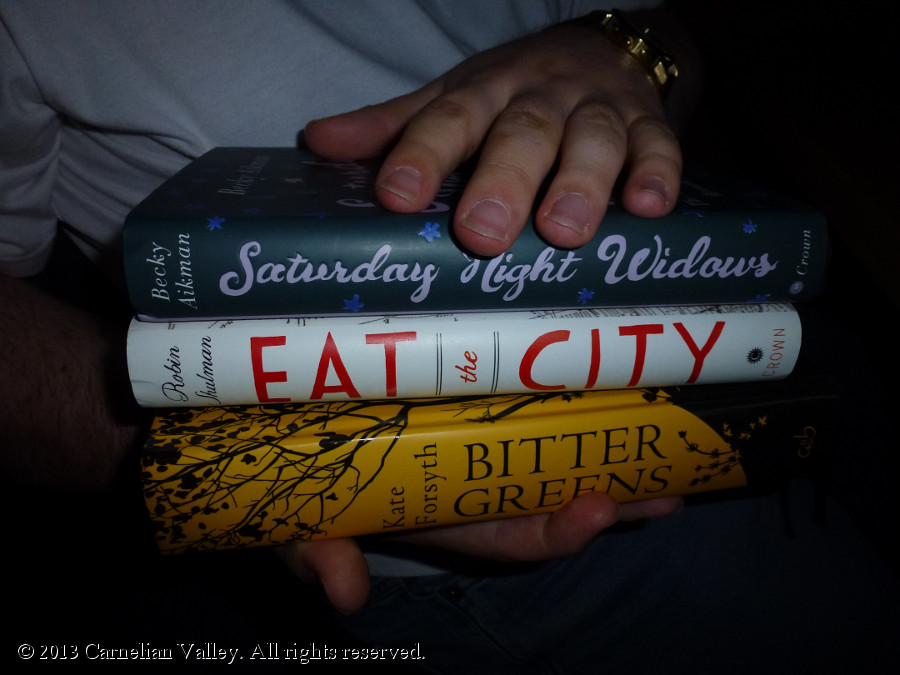
A timely post today, inspired by this article about the question ‘Have you read the book yet?’ I wanted to write my own take on how to deal with the issue, if it can be called an issue.
There are two parts of the tale and they both come under the umbrella question, what do you do? – What do you do when someone asks you if you’ve read the book they gave you and you haven’t, and what do you do when you’re the gift giver? It’s easy enough when you’ve read the book, at least to some extent – it’s difficult when you’ve read the book and didn’t like it – but pretty uncomfortable when you haven’t. I’d put bets on the likelihood that the book you haven’t read is the one you weren’t expecting, specifically a book you’d never heard of that may not have tickled your fancy. That surprised ‘oh’ sound that fades to silence pretty quickly.
I’d place another bet, too – you’ve given books yourself and asked about them. Perhaps you don’t do it any more because you’ve learned from personal experience that it’s awkward, but you’ve done it at some point. And perhaps you no longer ask but you take surreptitious looks towards the person’s bookshelf when they’re not looking, not that that would give you any answers. I know I have. I know I do.
I no longer ask people if they’ve read the book I gave them yet. I figure they’ll tell me if and when they do and that the lack of those words is answer enough. It may make things more comfortable than if I asked, though it’s never going to be completely comfortable. That book is an elephant in the room, you can stay silent all you want but both of you will be thinking about it. But it’s easier to be quiet. It’s easier to not make someone try and find the words to explain why they haven’t, especially when you both know it may not have been a good fit. Only give a friend a book you loved if you genuinely think they’ll love it too.
The last person I gave a chapter book to was heavily pregnant at the time. (Chapter book as opposed to fun, short, books because the actual last book I gave her was the timely Go The F*** To Sleep – hopefully appropriate, too… she’s not told me if she’s read it yet.) Being heavily pregnant is excuse enough but regardless I’d have been silly to think she’d get to it soon even though I knew she might well be reading books up to the last minute. I gave her a book that I loved that I realised, through discussion of favourite genres, she would likely enjoy and she’ll get to it when she gets to it. Similarly she’s not asked me about the book she gave me that I’d mentioned I was interested in, and knows I’m a blogger and editor. We continue to converse on books and from my point of view at least there isn’t an elephant in the room (there’s a baby instead, a lovely one, I might add.)
Unless it’s a book that’s on the person’s wishlist it’s probably best not to ask. I got someone a book I reckoned they’d like because it seemed in keeping with their interests. I hadn’t and haven’t read it but it was pretty popular upon release, enough information for me to make a fair call. I’m sure they’ll tell me if they do read it but considering I wasn’t one hundred percent sure anyway, I am staying well clear of that question. At this point I’m almost hoping they never read it.
Taking an unintentional tip from a relative, reference books and coffee table books may be the way to go. More pictures, less writing, no book of the sort that needs lots of attention or reading cover to cover. I’m a recent recipient of Abandoned Places which features awesome photographs of that derelict, cliff-edge, hotel and Tatooine from the Star Wars films. Generalised reference books work well.
I’m glad the person who gave me book #40 when I’d only read up to book #7 hasn’t asked me if I’ve read the book yet. And I’m thankful that the person who gave me the next book in the series I was reading gave it to me just before I started reading the copy I already had because it was a superb gift regardless of the duality and I wanted to show them I appreciated it. It’s one of the most thoughtful, effort-full, gifts I’ve ever received.
I find blogging provides its own easy answer – ‘no, I haven’t read it; I have to get through my review copies first.’ To which you add the requisite hand gesture to show how tall your pile is and increase the height by half again if it’s not large enough to be an acceptable excuse. That last joke aside, it’s not a lie – book blogging pretty much ensures you have an extensive list of books to read and may well involve an inability to change the order round. Unless you say it in a bad tone of voice, blogging is an acceptable answer to those who know about your hobby, and whilst it may surprise others it might just result in an interesting conversation. I expect authors saying they’ve still research books to get through works in a similar fashion.
What do you do about the question? And have you any stories to share?


