





“Anyone Who Claims Not To Like Reading Just Hasn’t Found The Right Book Yet”
Posted 20th July 2016
Category: Chit-Chat Genres: N/A
9 Comments

I found this exact phrasing here, though of course it’s a well-known thought. Slightly controversial, too. I thought we could have a discussion.
(Speaking of the particular phrasing, the word ‘claims’ suggests the person can’t believe it. This is also the case with ‘just’ and ‘yet’ – it’ll happen eventually for the hypothetical non-reader; they’ll start reading at some point.)
My thought is that it’s easy for a reader to say such a thing because it’s their (and my, your) hobby. It can be hard to see why others dislike it. Personally, whilst I do see both sides I must admit that I once found it difficult to be friends with a person who said they had never read a book. Ever. Admittedly – again – this person and I just weren’t suited overall but the idea they’d never tried to read a book was hard for me to get my head around. I’m not sure I believed they’d truly never read a book, ever, but on that occasion, at least, it proved a deal breaker. At that point in my life, my teen years, I could be friends with someone who wasn’t a reader but a person who had never read a book at all and had no plans to change that was a bit too foreign.
But, this said, as said, I see both sides. The case for it not being true – that a person just hasn’t found the right book – is simple. Reading is an activity like any other. Some like it, some don’t. And I think in the majority of cases, when a person says they don’t like reading, it’s the physical act they’re referring to. The silence, the solitude, maybe the form of the written word itself. The person on the other end of this statement, the reader, is baffled because they’re thinking more of the escape and stories. Readers like the physical act but the most pervasive part is surely the story. And the most pervasive reason to not be a reader is surely dislike of the physical act. tories are like films. Many who don’t like reading do like films, or plays, or music, or games.
A person might not be good at reading, therefore they dislike it. To read would be to slog, a chore when they could be doing something fun. This brings us to the other side of the argument, that the statement is true – there’s such a range of books out there; genre, age, reading level. We could say a person who doesn’t like reading because they find it hard just hasn’t found a book at their level… but then if the person is dyslexic, for example, that might mean a book with a story too young for their age.
Audiobooks? Not all readers listen (I rarely do), so we couldn’t exactly give credence to that as an option; same with graphic novels.
It really depends. We can’t just say ‘yes’ or ‘no’ but we can’t discount the possibility that there’s a book out there for everyone. It’s one of those per person deals – it depends on personal situations.
I disagree with the statement myself because reading, whilst lauded and important, is a hobby – at least in the context of the statement. And the fact it’s deemed unnecessary (when placed against food, water, shelter) puts some people off.
Your thoughts?
Ayelet Gundar-Goshen – One Night, Markovitch
Posted 18th July 2016
Category: Reviews Genres: 2010s, Comedy, Commentary, Historical, Political, Translation
2 Comments
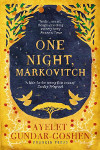
History, war… and humour?
Publisher: Pushkin Press
Pages: 365
Type: Fiction
Age: Adult
ISBN: 978-1-782-27163-5
First Published: 2012; 15th June 2015 in English
Date Reviewed: 27th May 2016
Rating: 5/5
Original language: Hebrew
Original title: לילה אחד, מרקוביץ (Markovitch, Layla Echad) (Markovitch, One Night)
Translated by: Sondra Silverston
Yaacov Markovitch has an unremarkable face. No one really notices him. His friend, Zeev Feinberg has an amazing moustache that everyone knows about. The friends enlist in a programme designed to rescue Jewish women from Germany, to bring them back to the homeland and whilst Zeev has no issues with the idea of divorcing a wife – he has a girlfriend who smells of oranges – Yaacov finds himself married to the most beautiful woman he’s ever seen, a woman who wants nothing to do with him and will ignore him in the years that follow.
One Night, Markovitch is a funny yet poignant book (‘poignant’ is on the cover; it’s perfect) about all sorts of things related to the self as well as war and the effects of it on people’s lives. It’s one of those books that is solid throughout and very special.
The humour is mostly laugh out loud and very well timed – never too much, never something you forget. The book is peppered yet it would be difficult to label it a complete comedy because it’s anything but stereotypical. I’m going to have to share a quote:
“Are you excited about the journey to Palestine?”
That she would be excited about their marriage was something he dared not expect, but he hoped that the excitement she felt at the proximity of the Holy Land would project a bit onto the means of her reaching it, that is, onto him.
“Definitely. I’ve read a great deal about the oranges.”
Here Bella Zeigerman stopped speaking, and Yaacov Markovitch decided happily that his wife, like him, was a fan of agricultural literature. On the narrow, crowded bookshelf in his house in the village, next to the writings of Jabotinsky, stood all sorts of guides – the mother of wheat and how to improve species, how to plough and plant grain, how to graft a tree without causing pain. Bella Zeigerman knew how to recite Gothe, but it is doubtful that she would be able to memorize, with the same degree of success, the list of insects that threaten to destroy grapevines. When she mentioned oranges, it was because she recalled a line from the Hebrew poet’s poem [she is in love with his work] that had been published in the newspaper.
Humour is found in Sonya’s eyes, which are a couple of millimetres too far apart to be pleasing. It’s found in the way she stands on the shore yelling curses at the long-gone Zeev Feinberg who will return in time. It’s found in Zeev Feinberg’s moustache. And it’s found in some of the ‘lad-ish’ humour – this is in no way a women’s fiction book.
For a while it’s simply history and humour and then there comes a point where the mood is more sombre, the humour sensitive, almost, and whilst it’s not quite that because the story turns ‘sensitive’ on its head, whilst the war trickles in from the beginning, there is a turning point wherein it becomes the focus.
Gundar-Goshen mixes in some politics. The book deals with the beginnings of WWII, its situation for German Jews, whilst also dealing with the Arab-Israeli conflict, in which the Jews, their people persecuted in Germany, are in turn persecuting Arabs. Yes, it’s quite a bold statement. German Jews are fleeing Berlin before the major onslaught and in Israel, their ancestral land, they are in a good place. Gundar-Goshen does not say anything directly about the issues, the conflict betweens these conflicts, but there’s a flicker of an opinion.
This isn’t to say the wars are particularly detailed, however. For the most part they are in the background – Zeev Feinberg held an Arab by the throat today but now we’re seeing him at home with his children. The subtext is key. It spills out of the text – this conflict is everyday, a regular happening, and it’s in the ‘minor’ details like Zeev’s day that we see the horror of it.
Amongst this is the shock. It hits a few characters, informs their lives, but one in particular is commented on – Rachel Mandelblum. When in Germany – which she left for Israel, promptly ceasing to speak German, adopting Hebrew instead – Rachel experienced the horror of a murder, a skull being cracked. She can not escape the sound, it haunts her every day. Gundar-Goshen blends this specific horror into the humour of Rachel’s present situation, her pretending not to understand German, being not unhappy but no more than content living with the random butcher who proposed marriage when he saw her in the street. (She had no reason not to agree so she followed him home and had his child.)
The naming, whether cultural or not I’m not sure, is in a first-name-surname form every time. Rather than simply filling pages, it adds to the humour, though I can’t say why exactly.
The translation bares a strong sense of being true to the original. It’s an American translation, definite western words that are most certainly the choices of the translator rather than a choice based on how the text reads, but it’s by no means a bad text. It flows, it translates jokes into a western context for English speakers to understand… you know you’ve got a good translation when it doesn’t stand out.
The ending’s an interesting one for the way Gundar-Goshen refers to the audience, breaking the fourth wall (though there is, throughout, a feeling of that anyway) saying that, hey, she’s about to jump in time, but this is what happened in the interim she’s skipping, and it isn’t much, and this is why she’s had to do it, and so on. There are many books that jump in time for no reason – Gundar-Goshen’s explanation is a blessing.
One Night, Markovitch is superb. It’s fun, it’s serious with good reason and to good effect – it’s just a solid book all round.
Related Books
None yet
“At The End Of A Story Or Novel, You Do Not Want The Reader Thinking”
Posted 15th July 2016
Category: Chit-Chat Genres: N/A
7 Comments

This photograph was taken by aptmetaphor.
This statement can be found here. When I read it, I couldn’t but strongly disagree and whilst I tried to think whether I was wrong, if emotions are always so important in the way suggested (you want the reader feeling instead), I couldn’t say I feel it is so.
What do you think of this? To me there are too many points against it, all falling under a couple of umbrellas, so to speak. Whilst emotions are important, there are too many cases wherein making the reader think at the end is crucial to the success of the story.
Chief to me is obviously the ambiguous ending. An ambiguous ending can aid a book’s longevity and give the reader something to think about. My thought is why on earth should that be a bad thing, or at least inferior to emotions themselves? It concerns comprehension, which the writer could perhaps see as something that detracts from the story (if seen in its academic state) but moreover it gets us talking and often ensures a lasting engagement. In this case, the statements – logic is emotion’s enemy; disarm the reader of logic and make them feel – are problematic because you can have an emotional ambiguous ending that requires logical thinking.
An ending that has to be thought through does not necessarily equate to a lack of emotion. When you have to think through an ending to understand it, the process itself can deliver a series of punches or smiles. Endings about emotions are good, but they aren’t the only way.
What do you think?
Books Picked Up On A Whim
Posted 13th July 2016
Category: Chit-Chat Genres: N/A
5 Comments
Here is a citation: this post was inspired by Lori’s post in which she diverts from the subject to compile a list of books about New England (it’s worth a read). Lori’s post was in turn her offering for a meme created by Brandy. In addition, Jessica’s own post following Brandy’s meme includes some excellent recommendations.
I hope I’ve got that right!
I’ve picked up quite a few books on a whim in my time, more so before I started blogging when it was harder to find recommendations. Split roughly between the time before the Internet was a thing and the few years before I started writing here, I tended to go by subject, popping into Waterstones or one of the bargain indies we used to have and heading first for the young adult section and then various others. (What I love about bargain bookshops is the way they just pile up the books with no organisation – it can be frustrating but there’s no better way to find books you wouldn’t have heard of otherwise. Jessica’s post reminded me of The Works – a book/art supply chain we have in the UK which tends to have tons of books stacked under tables, disorganised on shelves, and piled high on tables. It doesn’t feel like a bookshop because the decoration is art-focused, but it’s an awesome place to find random books.)
I’ve decided to talk about books I got on a whim that I’ve since read because other than a brief tale of how I got them, there’s not much else to say about the unread ones. I’ve also stuck to books I’d never seen before that I picked up on the same visit I encountered them.


Anchee Min: Empress Orchid – I remember being drawn to this book because it was about Chinese history and my school education had never looked at China… or Africa, or America, or anywhere other than Europe or the Arab-Israeli conflict, actually – thank god for university and books. I’d actually had enough of modern history by this point but that the book was about China, and an empress at that, was enough of a difference to sway me. I loved it. This is the book that started me on the Chinese history studies I’ll likely never finish. I went on to read Keith Laidler’s biography, I have Jung Chung’s biography ready, and I’ve read around the subject, too. A random choice had a big impact.
Jennifer Donnelly: A Gathering Light – I understand this has become semi-lauded, if I can use that mash-up of words. I liked the sound of it and read it in the year I started blogging. It was okay but not quite as compelling as I’d expected.
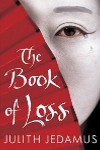
Julith Jedamus: The Book Of Loss – I got this from a cut-price store that was closing down; I may have been young enough that I didn’t realise how cringey it would be to remark to the cashier that I couldn’t believe I’d just found this place and how awful it was that it was closing down. It’s difficult to find reviews and references to the author online and I believe it’s out of print – it promises much but doesn’t deliver.
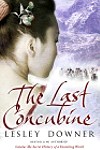


Lesley Downer: The Last Concubine – One of my first adult books, you can see the pattern. It’s a fair read and I’ve been circling Downer’s second book for years.
Lisa Jewell: A Friend Of The Family – And this was my very first adult book. I had been old enough, not that my parents censored my reading, to read adult books for a while but I’d stuck to YA because adult books just didn’t appeal – the covers were all dull. The day I got this book was the day I decided I should step up and give one of those dull-looking adult books a go. The cover was standard for the time and I felt mature picking it up. It turned out to be a fair enough read and started me off on my Lisa Jewell phase – for a few years afterwards I bought her new releases and gobbled them up. It came to an end when I decided I’d had enough samey main characters and was bored of Jewell’s usage of ‘retard’ in every one.
Madeleine Thien: Certainty – The cover was pretty, the book was small in size (mass market paperback) and the summary sounded nice. A completely random book; one I didn’t like.


Maile Meloy: Liars And Saints – Another dull adult cover choice. I do know that I never told my parents what it was about because there was a lot of sex in it. I’ve spoken of this book many times over the years I’ve been blogging; the theme work is excellent. I’ve read it three times now and had to get a second copy when I lent it to a family friend who I believed was going to read it overnight but instead took it back home with her; I gave it a year before I realised if I didn’t get another copy soon it might go out of print – the sequel/spin-off, though admittedly not well received, was in that state.
Sheila O’Flanagan: Someone Special – This book took a long time to read; it was 500 pages, which I felt similarly about then as I do 900 pages now. It’s all right; nothing special, ironically, but perfect for summer.
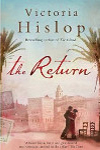
Victoria Hislop: The Return – I expect many of you know this book and more know of Hislop in general. As you can imagine, this turned out to be an excellent whimsical decision.
Whenever I pick up a book on a whim, I worry, but thinking about these books I realise that whilst it may be a snap decision, whimsical book choices are at least 50/50 – there is always a very real chance you will like the book and the possibilities for broadening your horizons aren’t to be sniffed at. As we see many times, for instance in the recent revival in the blogging world of the work of Barbara Comyns, and all those excellent Persephones, the most unknown, random books can be transformed by our picking them up. I very much believe a book diet rich in random choices is important. Even when the book isn’t so good, the act of discovering it can be a boon in itself. And in our days of so many recommendations and publishers going on about book discovery, we need to make time for random choices.
What books have you picked up at random and what’s the story behind your acquiring or borrowing them?
The Character Progression Of Far From The Madding Crowd’s Gabriel Oak
Posted 11th July 2016
Category: Further Thoughts Genres: N/A
3 Comments
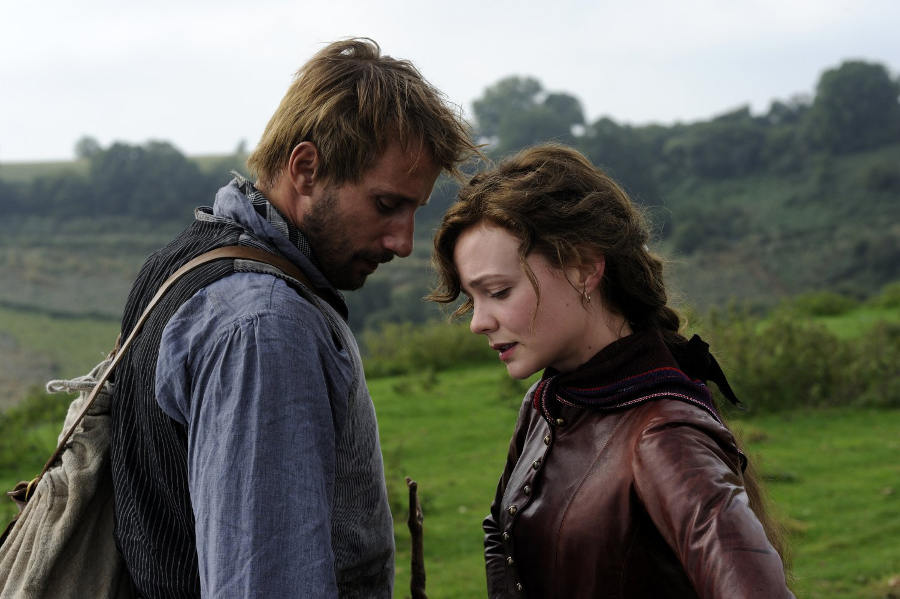
Screen shot from Far From The Madding Crowd, copyright © 2015 Fox Searchlight.
This will be in part a character analysis.
Whilst Bathsheba Everdene is strong-willed and against marrying… unless it involves a particular soldier, I always felt that had Gabriel Oak understood who Bathesheba was, he would have gained her hand sooner. Hardy’s plot, with its three suitors, of course stands on its own but to me part of the idea of it is that there’s time for Gabriel to learn.
Whilst Bathsheba’s own learning – her progression from someone quite selfish and thoughtless to someone who knows actions have consequences – is forefront, throughout the book Gabriel’s progression trickles along steadily in the background. Gabriel begins as a person who sees a pretty woman (and wants to give her a lamb because “I thought she might like one to rear; girls do”) and becomes someone who understands that, actually, Bathsheba is competent enough even if she requires his help. He understands that she’s equal to him, an individual. Hardy is all about women having more liberty and he places this into his plans of the progression for his male characters. Bathsheba may be selfish and frivolous, he’s saying, but she’s a person deserving respect and you men after her heart and farm should think so, too.
Gabriel is Bathsheba’s constant. He sticks around when she spurns him, pushing aside his love for her and mollifying himself with friendship. Unlike Boldwood, who becomes obsessive in his desire, Gabriel defers to Bathsheba’s decision about him and offers help and safety. Boldwood, and Troy as it so happens, offer instability.
We know from the start that Gabriel is likely to win Bathsheba over by the end due to his presence at the start of the novel and Hardy’s way of describing him. As I said a while back, we are supposed to like Gabriel Oak – Hardy writes about him in a way that ensures we do.
Gabriel meets Bathsheba, if we can call it a meeting, when she passes through his field. He sees her admiring herself in a mirror and offers to pay her passage through the gate, receiving not so much as an acknowledgement of his presence in return. He has a good head on his shoulders – whilst another employee notes her beauty, Gabriel notes her vanity.
It doesn’t stop him loving her, however. Perhaps it’s her nature that he likes the most – not the vanity but her independence. Gabriel is there when Bathsheba is riding astride the horse, there when she lays back on the animal to continue her journey in a very casual fashion. What would Boldwood have made of her then? Troy would perhaps quite like it… or he’d be indifferent. Gabriel, it seems as we continue reading, seems to see someone to admire, if not always (she does make some bad choices!) then often. Though Bathsheba may be vain and selfish and frivolous, we can see that, not unlike the case of Rhett Butler and Scarlett O’Hara, she meets her match in the unlikely Gabriel.
Does Gabriel test the waters a bit? To go back to that lamb incident, after having seen her on the horse, he still takes her a lamb on that ‘girls do’ premise. At this point, with his knowledge, it seems almost ingenious of him to offer her a lamb but perhaps in this he’s appealing to the vain woman, the frivolous Bathsheba who likes pretty things. Maybe she’ll like the lamb as much as she likes herself.
Gabriel also, we can assume, looses out to other men because of his weakness and silly idea – it’s okay if Bathsheba doesn’t love him, he says, as long as he loves her. He is in many ways like Bathsheba herself when she falls for Troy.
Whilst Boldwood sees Bathsheba’s frivolity, and Troy her strength but all too quickly her weakness also, Gabriel knows what lies beneath all that. Perhaps he can see the future, perhaps it’s just that Hardy’s intimating the future to us and therefore we can ascribe that notion to Gabriel, but it certainly can seem as though Gabriel is just biding his time.
Gabriel ‘lets’ Boldwood continue his own passion; he doesn’t get jealous. He also ‘lets’ Bathsheba fall in love with Troy without too much opposition; his active opposition only occurs when Bathsheba goes to find Troy in her scared-she’ll-loose-him state. Gabriel has seen through Troy and tries to stop her going but she is too far gone in her anxiety to listen to him and, like Boldwood, somewhat obsessed. What if Troy finds someone else? she’s thinking. In becoming a worrier, Bathsheba becomes someone Troy dislikes.
“I want someone to tame me; I am too independent and you would never be able to, I know,” Bathsheba had said to Gabriel. This section, near the beginning and again bringing to mind the later Scarlett O’Hara, can be seen as illustrative of what Gabriel later aspires to be. It’s never said, Hardy only ever shows it, but in becoming more protective and proactive on the farm, Gabriel becomes this tamer of Bathsheba. He likely won’t tame Bathsheba as much as she suggested – we see in her submission to Troy her weakness, a sort of wish fulfilment; Bathsheba becomes tameable to Troy and thus boring to him. By the time she accepts Gabriel, she has, we can assume, come to see the relative power in equality and Gabriel’s new proactive and strict-whilst-protective nature is now more relevant. He’ll ‘tame’ her, as she wants, but without her having to submit herself as she did to Troy – we can assume that after the book ends, Gabriel’s presence, guidance, will limit her frivolity without changing her nature too much. Hardy suggests it’s Bathsheba’s frivolity that’s the problem, not her independence, and indeed her statement was more a reflection of her knowledge of social norms, and perhaps a bit sexually suggestive, too.
After not listening to Gabriel, going after Troy, and marrying the man, Bathsheba’s farm is at stake – a storm’s on its way and Troy has persuaded all the farmhands to get drunk. This, the beginning of the action in the book, that latter section which I personally think fantastic, starts with Gabriel’s literal battening down of the hatches all by himself. He can see the storm coming and, not taken in by Troy and being stronger in character than the rest of the men, is sober and working to out-wit the winds. He manages it; somewhat surprisingly there is no commotion later, Hardy doesn’t choose to create a quarrel and Bathsheba, still a little in love with her husband, helps Gabriel but says nothing to Troy. This is the start of the game changer – Bathsheba and Gabriel working together to save the produce, Gabriel being there when Troy isn’t, confirming her need for him. She had always needed him, always asked him to stay on as an employee whenever he said he was leaving, but here she starts to see the problems with her husband in context – there’s an immediate contrast between him and Gabriel.
Gabriel is there when Troy fakes his death and there to see the man return. Boldwood destroys himself, not that there was any chance he’d gain Bathsheba’s hand, and again there’s Gabriel, now in a position to propose a second time with real knowledge of the woman he loves. Could we say Gabriel changed for Bathsheba? I think we could to some extent. He changed in his attitude towards her, but not in his overall baring. Bathsheba hadn’t noticed many of Gabriel’s good traits and time needed to continue for her, too, to start to see him. They both changed. Love at first sight doesn’t always work, says Hardy; look at Troy and then Gabriel. But he continues: love will conquer if it’s true. Love has to be based in reality. No ‘taming’ when you want independence, no running after someone who isn’t interested (no matter what other books say), no catching someone before they go off with an old flame. Reality, respect, time.
Gabriel does what Boldwood won’t – he waits, properly. And his waiting, full of proactive work instead of looking at the phone, so to speak, pays off. But it only does so because Bathsheba wants it too.


