





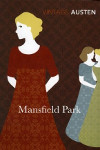
Jane Austen – Mansfield Park
Posted 26th May 2014
Category: Reviews Genres: 1810s, Domestic, Social
13 Comments
Controversially yours.
Publisher: N/A (but I’d wager Vintage’s a good one)
Pages: N/A
Type: Fiction
Age: Adult
ISBN: N/A (Vintage’s is 978-0-099-51186-1)
First Published: 1814
Date Reviewed: 8th May 2014
Rating: 3.5/5
Fanny moved to Mansfield to live with wealthy relations and now, at eighteen, she’s very much settled and happy, despite being the family’s errand girl and companion. When the Crawford siblings enter their society, Fanny is suspicious – they don’t seem to be people her cousins should be associating with, and as the days continue she worries for her cousins’ futures. Many say she’s wrong about the Crawfords. Is she?
Mansfield Park is a lot quieter, so to speak, than Austen’s other novels, and quite different overall.
The major difference is Fanny – she may prove a difficult heroine to like. Part of this is due to Austen not giving the reader (at least it seems so – maybe the little was enough in the day?) information as to the Crawfords’ natures, instead letting Fanny’s feelings do the talking. This isn’t very successful as Fanny can, for the lack of information, seem over-the-top. Fanny is quiet and confident but she is often in the background and sometimes quite literally. And not at all in that theatrical way where the person at the back is the stronger person. Although Austen details her, it never really feels like she is the main character.
To the modern reader, Fanny may be difficult to relate to. Her scruples in regards to theatre seem silly and overboard today, and where Mary Crawford is slightly ahead of her time, Fanny is very much of her time.
Referring back to Austen’s lack of detailing, in the case of Mary, the ‘bad’ traits are more obvious – Mary wants to marry someone of equal or more wealth than her, and she doesn’t want to marry a clergyman. This is interesting to consider, given that wanting someone of equal wealth wasn’t exactly uncommon at the time, nor seen as bad, and it’s not particularly glaring today, either. It could be said that not wanting to marry a clergyman is simply personal taste.
It is more in the case of Mary’s sudden shifts in affection that the bad traits lie. Austen’s presentation of Henry leads you to realise that he likes women, with emphasis on the plural, but it can come across on occasion as the case of a boy who is happy in the presence of girls and to have the opportunity to have a preference, that he hasn’t before been given the chance to really think about what and who he wants. Certainly Henry reads more the immature boy than the noticeably deceitful man, and Mary’s opinion that he would change, well, there’s the feeling that she could be right.
Despite Fanny and the somewhat dubious plot, there is a lot of laugher to be had in reading the book. There is a specific section during which you could consider Austen had realised there was a lack of joy in her story and decided that had to be remedied.
The ending of Mansfield Park is very quick and the author moves away from dialogue to give you a summary of events. The reader may feel short-changed by this, however Austen does say of a specific aspect that readers all consider timing differently and so you are left to decide on timing yourself.
Quieter, with a heroine who does little and with not much in the way of story, Mansfield Park is a very different Austen, but worth reading nonetheless. Certainly it is the novel most set in its time.
Related Books


Johanna Lane – Black Lake
Posted 19th May 2014
Category: Reviews Genres: 2010s, Angst, Domestic, Political, Social, Spiritual
5 Comments

Moving home is often disruptive, but not quite as much as this.
Publisher: Little, Brown (Hachette)
Pages: 212
Type: Fiction
Age: Adult
ISBN: 978-0-316-22883-1
First Published: 20th May 2014
Date Reviewed: 19th May 2014
Rating: 5/5
Marianne locks herself and Kate in the ballroom. Marianne may seem mad but it soons becomes apparent that there’s more than meets the eye, for the ballroom is stale and she won’t leave the building, and something has obviously happened to Philip.
Black Lake is a stunning début, a novel with a purposefully spoiled plot that explores the effects of displacement on a person.
If you have ever visited a historical country estate knowing that the reason you’re able to be there is an owner’s lack of money, this is a book for you. In Black Lake, the house of Dulough is somewhere between a character in itself and a catalyst. Lane looks at the various ways an extreme version of moving home can affect people based on how they feel about the place and how much knowledge is provided or kept from them. We see John, inheritor of a house without the funds to pay for it, upset at the prospect of government involvement but with the will that comes with calling the shots (as much as you can once papers have been signed). We see Marianne, his wife, a woman from a humble background who took a while to get used to the idea of not making the dinner and living away from the city but who is now happy, proud of her home, and under the impression that her children will always have that home. And we see the children, in particular Philip, who understandably has trouble with the new literal boundaries and the idea visitors can use his bedroom whilst he no longer can himself.
Lane shows us the differences. On the surface it seems that Marianne is the most affected, and it can be easy at first to think that the children will get used to things. But Lane shows how children can be affected by the smallest elements of change and how adults are slow to realise this when it happens. For example, take the defining moment – Philip telling a tourist that he’ll get his food for free because it’s his house and finding that he does actually need to pay. Lane handles Philip’s sections with care and the way she relays information is just as telling – Philip shows upset but never tears, and it is in this that the confusion of a previously happy child is shown.
Talking of Philip’s narrative, Lane has chosen a particular format for her story. She begins with the near-end, goes back in time, includes a long ‘never before seen’ account, before leaving the reader with a slightly opened-ended last page which infers much but confirms nothing. The third-person narrative switches between John, Philip, and, later, Marianne. A couple of chapters are written as descriptions from no one’s view in particular. It is written in the sort of literary style that is often prefaced with ‘nothing really happens’, and the style is likely to interest many. Something, many things, do happen, but Lane’s slow-moving seemingly dull writing is very deceptive. You’ll note, whether during or after having finished reading it, that there’s a layer of boredom to the book, yet what happens is anything but boring. It’s interesting to compare this illusion to the way the ‘government’ sees their semi-acquisition of the house. Having replaced the furniture and having prepared scripts for tour guides that are untruthful, it’s easy to imagine that the defining moment in the family may be passed over by the new staff, and not included. The Campbell family is of little importance now that the house can be enjoyed by the public and it’s ironic that the new, true, shocking fact in the family history would be glossed over or left out. Or, maybe, as can be the case, made overly vivid and expanded upon for money.
At the heart of the novel, more than the moving, is communication. John thinks Marianne has gone mad, but once you read her account, even before then, you see the lack of knowledge the aloof country man has of his social city girl. Perhaps if John spent time with her and discussed the money issues, the necessary transition might have been easier, or, if two heads are better than one, another option for upkeep might have presented itself. John’s secrecy is the main issue here, but one could also consider the difference between adults’ and children’s’ methods of coping and their knowledge of each other.
To be sure, in choosing to read Black Lake you have to be in the mood, or just open to, a book that has much to say whilst making you wonder if anyone cares. Black Lake is character-driven entirely, and the lack of emotion on the surface does mean that it requires your attention.
Black Lake is a magnificent study and story of family and upheaval. Fill up the teapot and get a whole place of biscuits ready, because this relatively short book is going to consume your afternoon.
I received this book for review from the publisher.
Related Books
None yet
Elizabeth von Arnim – The Enchanted April
Posted 12th May 2014
Category: Reviews Genres: 1920s, Domestic, Spiritual
11 Comments

Just one day out of life. It would be, it would be so nice1.
Publisher: Penguin Modern Classics
Pages: 219
Type: Fiction
Age: Adult
ISBN: 978-0-141-19182-9
First Published: 1922
Date Reviewed: 9th May 2014
Rating: 4/5
Mrs Wilkins likes the sound of a castle in Italy, a month’s holiday, and after much badgering enlists a relative stranger, Mrs Arbuthnot, to join her. Deciding they should make it cheaper, they interview and then invite two others. Away from society, away from routine, away from their husbands, the castle is great idea. But from the start things don’t go quite to plan. Caroline got there before the initial two holidaymakers, and has planned the meal times. Mrs Fisher has taken over the nicest sitting room. Mrs Arbuthnot’s a little disheartened by the change in roles, but Mrs Wilkins is adamant it doesn’t matter. They should all enjoy the holiday and use it to make their lives happier. She’s the only one who thinks that way.
The Enchanted April is a novella that focuses on the changes in four women that occur over the course of their holiday. Some changes are sudden and big, others take a long time and are smaller, but by the end everyone has changed in some way. There might even be others who change, too.
The book is very much character-driven. The plot remains simple – a holiday in Italy – and the characters never leave the castle grounds, excepting one who goes only a little further afield and whom the reader is not invited to join. The emphasis is on transformation, the castle simply a pretty backdrop – it’s as though it’s there so that you as a reader can also go on holiday and in your relaxed state can be more aware of the women you read about.
The characters are as follows: Mrs Wilkins is determined, perhaps a little flighty, and sees the good in everyone. Mrs Arbuthnot is more down to earth, but it’s interesting to see the change in her – she sounds very set in her ways, traditional, perhaps old before her time. Caroline is a Lady, and very pretty, so pretty that she has trouble getting away from leering men. She also has an issue with her voice making everything she says sound wonderful. And Mrs Fisher is a grumpy older woman who you know has the potential to enjoy the holiday if she’d just let herself go.
Whilst the book is a simple then-contemporary story, quite a lot rests on Mrs Wilkin’s ‘seeing’ things happening in the future. It’s not magical realism and nowhere near being paranormal, but it does leave you to consider the power of suggestion, even if it’s just that Mrs Wilkins is incredibly optimistic. Whichever it is, Mrs Wilkins puts everything in motion, and the fact that she may not, at first, seem as grounded as the others, means little.
There is a twist in the tale, about half-way through, where the dynamics change. Depending on how well ensconced you were with the book by that time and depending on how you viewed the women (their holiday and the resulting freedom) this twist may come as an unwelcome shock. It does make you rethink the initial suggestion that these women need and deserve a break, and that they are only now able to remember who they are as individuals, but at the same time von Arnim shows how that this twist could be just as important in the long run. It may be good to focus on the women, but how much of their lives back home would be altered for the good if it’s only them who are different?
Yet it could be argued that the real reason the twist exists is to show that at the end of the day the women are no longer truly their own people. One situation in particular may leave a bad taste in your mouth for its secrets, and the twist is the very thing one of the characters had come to the castle to avoid. The ending is also somewhat convenient and not quite believable – it’s as though von Arnim suddenly read what she’d written and decided that it wouldn’t do at all as it was.
For the most part the characters are developed, even Mrs Fisher and her very sudden change that seems tacked on the end of the story, but in regards to Caroline there could have been more time spent on description. ‘They hadn’t reckoned on Scrap [Caroline]’ is a constant statement made by von Arnim, but whilst on some occasions, and luckily on the most important occasion, this is explained, on the whole ‘Scrap’ could’ve been afforded more time.
The Enchanted April offers a short reprieve from life, for all involved, and much promise for their future. And it offers a holiday for you, too, for there is surely an unmarked fifth invitation from Mrs Wilkins waiting for you in the pages.
1 Lyric from Holiday by Madonna.
Related Books
None yet
Isla Morley – Above
Posted 9th May 2014
Category: Reviews Genres: 2010s, Angst, Domestic, Political, Science Fiction, Social, Thriller
5 Comments

Can’t let the monster in.
Publisher: Two Roads (Hachette)
Pages: 370
Type: Fiction
Age: Adult
ISBN: 978-1-444-79700-8
First Published: 4th March 2014
Date Reviewed: 8th May 2014
Rating: 4/5
On the day of the parade, at sixteen years old, Blythe was abducted by the school librarian. Locking her in an old missile silo with provisions for many years, Dobbs told her he was protecting her from the apocalypse that was soon to hit. Unable to escape, Blythe is forced to live with him and his madness, his passive aggressiveness, his abuse, and she watches as he often leaves to go Above, back to the world he tells her is falling apart. Throughout, Blythe’s hope, though faded, never dies – one day she will escape and get back to her family. And Dobb’s madness can be put to rest. Or can it?
Above is an epic story that spans a fair few decades, many themes, and culminates in a rather tidy ending. It is an interesting book, as it could be said that it isn’t sure what it wants to be – there are two parts to the story that, whilst sharing a general element vary greatly – yet the overarching idea of theme exploration does manage to keep the two plots together.
Whilst the first half of the story is inevitably dull on occasion, the second half transforms the book into the afore-mentioned epic. Above is a lot longer than the almost 400 pages suggest, partly because the time scale is convincing and partly because there are so many moral elements considered.
Beyond the dullness of a lot of the first half – the days spent with nothing to do, the literal dullness of a world without sunlight – there is of course the times in which abuse takes place. Dobbs tends to ere on the side of caution, that is to say that generally the horror of Blythe’s situation is the fact of imprisonment and Dobb’s removal of things that make her happy. However, as may be expected, there is some violence involved. It’s a creepy sort of violence – Dobb’s doesn’t beat Blythe up but he does enough, and he does it in a ‘careful’ way as to make it sobering. Morley affectively shows how a person can seem average, even good, and keep a certain façade or even belief around them, which can make others think they are okay. Even Blythe, though she is strong at heart, feels sorry for him despite what he does to her.
This abuse and manipulation is the biggest thought of the novel. Morley puts the reader, and Blythe too, in a particular situation. We hate Dobbs because he is a bad man. There are no two ways about that – he forces himself on Blythe and his kidnapping does not begin and end with her. The man is bad. However once you reach the second half of the book you are presented with confusion. Blythe’s confusion. The confusion of both the prisoner she was and the person she is right then in that moment. This confusion doesn’t change the fact that Dobb’s is a bad person, but in the context of the book, and in the context of science fiction, it asks its main character and the reader questions. Blythe makes you question.
(The rest of this review will contain references to the twist in the tale, by necessity.)
Because what Dobb’s had been saying all along turns out to be true. Blythe has been abused by Dobbs, but she has also been protected. This means that Dobbs, in some ways, occupies a grey area. Both the character and the author herself constantly refer back to Dobbs, and it is obvious that Morley wants you to really hone in on this question of right and wrong. She never suggests Dobbs should be pardoned, of course he can’t, but she opens up all the sorts of thoughts we as a society tend to push aside. What exactly is right? What exactly is wrong? Can wrong ever be right, just a little bit? Do we truly try to understand victims or do we pretend we do? More than the questions surrounding Dobbs, Morley urges us to relate to Blythe.
Once you’re ‘familiar’ with this line of questioning, the rest of Morley’s ideas become apparent. Above isn’t ‘simply’ a story of abuse, nor an apocalyptic book. It is much more than that. It’s a study, a constant questioning of morality, of race, of government, of the news, of disability. The last on that list becomes prevalent towards the end. Most everyone is disfigured, and Morley compares viewpoints. Blythe, born before the apocalypse and kept safe, notices the disfigurements. Adam, her son, having lived solely below ground, doesn’t notice any differences. Or if he does (because he has read books and seen films) it doesn’t bother him. With Morley telling the story from Blythe’s viewpoint, every new person or group of people is detailed, their scars, burns, and lack of features brought to the forefront. You could even say it’s too much, that Blythe sees too much even after she’s been Above for a good few days. It’s interesting to contrast this detail with Blythe’s unhealthy pallor but ultimately flawless (as far as radiation is concerned) person. Especially when she notes her pale, now freckle-less face, and notes that her old crush would likely not find her attractive now. It takes us, the reader, to remember that, saying her crush is still alive, he is likely disfigured beyond compare.
Included in this study of the view of disability is the way the medical group of people are trying to create a perfect baby (to recreate humanity as it was) and the group of average citizens who are saving the creations who haven’t turned out correctly. This is now a world that values difference. Difference is all there is.
There are other things to consider, such as Blythe’s naming her son Adam – a stated plot device that infers who Adam may end up to be – and the experience, though only a minor part of the story, of a black albino woman. There is the effect that sudden freedom can have on a person, the effect of a difference that wasn’t expected (of course this particular difference wasn’t expected, but you know that Blythe would never be returning to life as it was when she was sixteen, the world moves on, and this is what she hasn’t really thought about), the struggle to regain what’s loss, and control, possession. In Adam you see the world in a new light, literally and metaphorically, in Blythe you may end up appreciating what we have now just that little bit more.
Above isn’t a masterpiece. There is a disjointedness to the duel plot-line that is likely only to be healed with prior knowledge of the duality, the writing is average, and once Blythe has escaped she’s not quite the person you may expect or even like, and not simply because of her displacement and longing for the past. The epic nature also makes it seem a little too long and there are reports from people familiar with Kansas that the numbers aren’t correct. But the morality and the way Morley uses a society harmed in order to make her point clearer is good to read and, as the length of this review suggests, leaves you with plenty to think about.
Combining ideas and repeating details, Above may not be the book you were expecting it to be, but judged on contents alone it is very much worth the read and the time it takes to reach the end.
I received this book for review from the publisher.
Related Books

Speaking to Isla Morley about Come Sunday, Above, and The Last Blue) (spoilers included)
Charlie and Isla Morley discuss growing up and travelling back to South Africa, creating a negative heroine, the 1800s medical phenomenon wherein people were literally blue, and what it’s like owning five tortoises.
If you’re unable to use the media player above, this page has various other options for listening.
S J Matthews – Hannah Strong
Posted 5th May 2014
Category: Reviews Genres: 2010s, Angst, Domestic
2 Comments
Leave him.
Publisher: (self-published)
Pages: 11
Type: Fiction
Age: Adult
ISBN: 978-1-301-14107-4
First Published: 23rd July 2013
Date Reviewed: 9th April 2014
Rating: 3.5/5
In 1984, a woman whose husband is unfaithful and won’t attend marriage counselling considers finally taking advice to think through her choices. But first she must leave with her father for the Olympics.
Hannah Strong is a short piece that is a fair opening to what will be a full-length novel, but is a little too brief in itself.
There are a couple of abrupt changes in time but other than this the writing is fair. Hannah’s problems are written well enough, the character herself also, to make you interested in what will happen next. Matthews has packed many issues into a small number of pages but in a way that isn’t rushed – everything is here but she hasn’t tackled each for too long. Nor is there much unnecessary information.
The only major issue with the story is that it’s unfinished. It’s a case that the piece is more of an introduction to a full-length novel rather than your average short story.
By itself, Hannah Strong is difficult to recommend, but as part of a novel or as an add-on, it’s a fair work.
I received this book for review from the author.
Related Books
None yet


