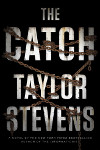
Taylor Stevens – The Catch
Posted 26th September 2014
Category: Reviews Genres: 2010s, Angst, Crime, Social, Thriller
1 Comment
All aboard.
Publisher: Crown (Random House)
Pages: 356
Type: Fiction
Age: Adult
ISBN: 978-0-385-34893-5
First Published: 1st January 2014
Date Reviewed: 25th September 2014
Rating: 3/5
When Munroe is employed to join Leo’s team on the ship in east Africa, she quickly realises that she hasn’t been told everything about what’s going on. She’s been kept in the dark – and kept out of the payment, too. When the ship is hijacked it’s time to reveal her true colours to Leo and the crew, and time to try and find out what happened. She doesn’t care what happened to Leo, but she feels for his wife and Victor, a kind team mate, and whilst she could leave them to fate, she’ll stay to help.
The Catch is the fourth book in the Vanessa Michael Munroe series. Whilst fair, it pales in comparison to the other books, especially as the previous, The Doll, was so exceptionally good.
The story itself is okay, but there isn’t enough of it and so the narrative has been padded out with repeated details. It’s both a case of necessary filler content and lacklustre editing. Repeated phrases and info-dumps slow the pace to a halt in many places and it may prove difficult to get through a number of chapters and work out exactly what’s happening. There are a great many characters in this book.
However Michael is as good as always, straddling the fence between good and bad, her background continuing to have an affect on her. In The Catch the reader sees her weaknesses – whereas she mostly escapes unscathed, here she is wounded badly and so Stevens is able to explore her willpower further than ever. The wounds are a bit of a problem, as they fall under the repetition – Munroe spends most of the book in pain and we know about it – but it does fill in for the previous occasions. And because Stevens has always managed to have Munroe escape unscathed without it seeming convenient, it is excellent that here she’s allowed the reader to see what happens when she is harmed.
The book feels more a standalone than the others; Bradford is not here and Munroe’s dealings with Leo are new and presumably not to be continued. Certainly it seems like a spin-off of sorts, illustrating what Munroe gets up to without her ‘usual’ team. We may have known she took on similar jobs, but this goes one further.
The Catch may not sport a particularly interesting story, and it most definitely is not the first Munroe book a reader should choose, but it does give you more insight into Munroe.
I received this book for review from the publisher.
Related Books

Lisa Jewell – Before I Met You
Posted 17th September 2014
Category: Reviews Genres: 2010s, Chick-Lit, Domestic, Historical, Social
2 Comments

Before the time.
Publisher: Century (Random House)
Pages: 456
Type: Fiction
Age: Adult
ISBN: 978-1-846-05923-0
First Published: 19th July 2012
Date Reviewed: 16th September 2014
Rating: 3/5
Betty lived with and looked after her step-grandmother during her early twenties. Now its time to move on. Armed with a few clues from the awesome older woman, Betty takes on the task of tracking down the mysterious inheritor of most of Arlette’s wealth. Back in the 1920s, Arlette made a series of choices and it’s up to Betty to find out what it all means.
Before I Met You marks a step in a new direction for Jewell, ending her run of chick-lit titles and looking towards something more literary. Featuring a dual plot line and the addition of history, the novel is a fair step if not particularly successful.
Jewell seems to be aiming for a more literary style of writing. It is more literary, however it’s still similar to her chick-lit work and is thus likely to suit past readers rather than those looking for lovely language. But it does fill a gap in the market, making a case for dual plot line fiction that isn’t literary fiction.
Along with these changes are growing pains, so to speak. The editing could be better, there are research errors, and the book is far too long. The historical section being somewhat predictable means that the extra chapters (that one can assume are there to further the change in genre) are superfluous. There are also many occasions where, almost oddly, a little more ‘telling’ would’ve been excellent, as the narrative jumps, sometimes weeks into the future, wherein given the previous scenes an update would have been useful. Betty’s sudden interest in a pop star she doesn’t have any interest in signals a bit of a character hole, as do many of her other decisions.
What’s better is Arlette’s story, her journey. Although we read mostly about 21 year old Arlette, Jewell introduces the 90 year old well enough and for long enough that the jump in time here isn’t so ‘bad’. It may be that the young and old versions of the character don’t match but this makes senses and it means that instead of throwing the reader into the story of someone they will never meet except in hindsight, there is reason to read about Arlette. You even get a good idea of where it ends (this is different to the predictability, showing you how Arlette ends up later on rather than at the end of Betty’s search).
Good too is the historical information. A lot is fictional however it is akin to reality enough to be of interest. Jewell slots in a few references to the beginnings of racial tolerance and interracial relationship tolerance (though forgets sometimes other places where it would have cropped up), as well as discussions of the impact of war upon the youth at home, the way war changed perceptions and goals. The tolerance/intolerance especially is written well, being rather quiet as befits the particular situation but no less problematic. And of course Jewell deals with the difference between life on a small island and in a big capital city.
It’s safe to say that Betty’s story, away from her search, resides fully in chick-lit territory. She may not be quite the same as Jewell’s previous heroines, but she is definitely in the same boat, as are those around her. She smokes, she meets various men, she has her moments of wonder. Jewell may have taken a new road, but she wants her fans to follow her along it.
Before I Met You is a mix; a mix of genres, a mix of good and bad. The few too many plot threads, the development, and the random changes in character (Betty isn’t the only one who sees sudden personality changes) do mean it may take a while to get through the book. If you’re already a fan or looking for that non-literary dual plot line, you might want to give it a go, otherwise there’s nothing here that can’t be found to greater success elsewhere.
Related Books
None yet
Kamal Ben Hameda – Under The Tripoli Sky
Posted 3rd September 2014
Category: Reviews Genres: 2010s, Social, Spiritual, Theological, Translation
2 Comments

Time passes. Separately.
Publisher: Peirene Press
Pages: 96
Type: Fiction
Age: Adult
ISBN: 978-1-908-67016-8
First Published: 2012 in French; 2014 in English
Date Reviewed: 2nd September 2014
Rating: 4/5
Original language: French
Original title: La Compagnie des Tripolitaines (The Company of Tripolitans)
Translated by: Adriana Hunter
Hadachinou, a child in 1960s Tripoli, Libya, tells the reader about his mother and neighbours, citing with a child’s frankness the differences in gender, religion, and race.
It would be fair to say that Under The Tripoli Sky is a society-driven book. Neither character nor plot driven, even though there is time spent on Hadachinou’s development, the novella is very much a vignette rather than a ‘proper’ narrative, more ripe for study and deep thought than average enjoyment.
Hadachinou spends his days with his mother (as much as she will let him), observing her friendships and the relations and lives of others. It should be noted that although he is frank, the narrative is written in a way that suggests hindsight and so there is a maturity to his discussions of slavery and freedom as though he has since grown up. Hadachinou the majority of his time observing, meaning that time is spent solely on the issues and cultural dynamics.
There are many cultures at play, though you could place them into three categories: the original Muslim culture of Tripoli, the cultures of the Jews, Christians, and American forces discussed, and the new hybrid that arrived with the European and American people who have settled there. Most of the attention is on the Muslim culture and the way it differs from the new hybrid, and this illustrated by the family dynamics. The women gather together to discuss their dreams, their wishes, and much is said of those who don’t align with the accepted values. The woman who killed her abusive husband; the woman who has had many men. Hadachinou, who neither condemns nor agrees, tells us about the beatings and unhappiness some of the women suffer, meaning that we hear three ‘sides’ – the women’s, the women’s from Hadachinou’s observations, and the men’s, also from Hadachinou. In this case, given the focus of the book, life from the men’s perspective is not needed. The book looks at the future through a lens of equality, tradition balanced by the new.
As for race, Tripoli is multi-cultural. Hadachinou talks of those who have assimilated themselves (somewhat) into the community, people who have been slaves or whose ancestors were slaves, those of African origin. In race, the book is interesting, introducing the differences between the native Tripolitans and the story of a white Jewish woman whose community left her alone due to her relations and later pregnancy with a black American man. The Tripolitans may still regard others as different, but there is more of an emphasis on similarity. In this way the different ways cultures mix and stay apart are explored.
The writing style is very literary; the wording is superb. Kudos must be given to the translator, Adriana Hunter, but it’s not hard to see where the original text is behind the English. The book is about culture and difference, and those must come first, but of great importance is the text itself. At times it’s so lovely that you may find yourself having to read over a passage again as you end up focusing on the words rather than the message.
Under The Tripoli Sky is simple and the issues are dealt with in a nice, obvious, way, thanks to Hameda’s use of a child. Indeed Hadachinou at times sounds older than his treatment may suggest, but that does not matter so much as what is said. It’s a short read, with a lot to say, and potentially plenty to use for the reader up for a bit of research.
I received this book for review from the publisher.
Related Books
None yet
Sherry Thomas – His At Night
Posted 27th August 2014
Category: Reviews Genres: 2010s, Domestic, Historical, Thriller
4 Comments
His In Abstinence.
Publisher: Bantam (Random House)
Pages: 415
Type: Fiction
Age: Adult
ISBN: 978-0-553-59244-3
First Published: 15th May 2010
Date Reviewed: 22nd February 2013
Rating: 3/5
Lord Vere is considered an idiot by society, and that’s the way it needs to be. Working as a secret agent, being oblivious is a good cover for times when he is caught in the wrong place at the wrong time (or, rather, the right place and right time). Elissande lives with her aunt and uncle, and the latter is a tyrant and unstable. When Vere arrives at her house, under a sort of pretence so that he can spy on her uncle’s actions, Elissande realises that her guest could be her ticket out. But with issues between them and a set up to make marriage inevitable, from the word ‘go’ it was never going to be a happy ever after.
His At Night is a wonderfully written but somewhat lacking tale that manages to capture Thomas’s unique storytelling whilst missing what could have been a good book. The major issue is that there is in fact very little romance – the characters misunderstand and hate each other for almost the entire book and these misunderstandings can become rather irritating.
As an example, one can look to Vere’s pretend stupidity. Whilst it made sense to keep Elissande unaware of his education for a while, the pretence lasts far too long and this is a pity because it is a lot of the reason for the lack of romance. A quick divulging of secrets would have sufficed, and Vere could have kept pretending to others. A few of the things Thomas says Vere has achieved, due to his impression on people, are unbelievable, especially considering the extent of this pretence.
What romance there is is rather strange. Vere has had an ongoing fantasy of his ideal woman and when he first sees Elissande, whose physicality matches perfectly that of his make-believe lover, he is happy, but when her personality doesn’t match up he gives up on her. Vere lives so much in his head in this way that he wonders whether he ought not just keep doing so rather than be with a real person. It does illustrate the differences between imagined perfection and reality, but it makes Vere difficult to feel for.
There is a great deal of time given to the mystery plot and what Elissande is afraid of regarding her uncle. It is interesting and well-plotted, but with the addition in the book of a secondary romance thread (a proper romance thread one might add) it detracts from the main storyline.
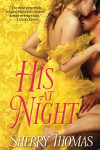
Given the book’s title and cover, you’d be forgiven for thinking that this would be a steamy romance. But Elissande is neither His At Night, his in the day, or his at the weekend after lunch. However despite the fact the contents do not match the cover or title, Thomas’s wielding of language is as stunning as always and the actual development of the characters is not bad at all.
His At Night is a spy story driven by a particular difference – it’s hiding from itself and thus you, too.
Related Books

Meike Ziervogel – Clara’s Daughter
Posted 25th August 2014
Category: Reviews Genres: 2010s, Domestic
6 Comments

The cycle will continue until it’s broken, and it’s still going strong.
Publisher: Salt
Pages: 131
Type: Fiction
Age: Adult
ISBN: 978-1-907-77379-2
First Published: 15th September 2014
Date Reviewed: 18th August 2014
Rating: 5/5
Michele and Jim’s marriage is on the rocks, and Jim is against Michele’s mother moving in. Clara doesn’t want to live in a nursing home, nor does she particularly want to live in Michele’s basement, but Hilary has no space and no one will let her live alone. Michele has little time and a lot of responsibility – she’s not making enough effort in her marriage and she’s certainly not a model daughter… It’s never that easy.
Clara’s Daughter is an excellent follow up to Ziervogel’s Magda and, like its predecessor packs a lot of punch in a very short space of time.
The book creeps up on you. It starts out well enough – the writing good, the initial themes easy to identify – but it still takes a fair few chapters to really get into the story. This is to its merit. Although clear from the start, it can take a while for the structure of the novel to truly seep its way into your reading, and so there comes a point, likely slightly different for each reader, at which you’ve suddenly a deluge of questions you want answered as you notice a myriad of elements all at once.
The book doesn’t read from start to finish, as far as events go. Neither is it really structured into dual plot lines. The chapters are roughly sorted into ‘then’ and ‘now’ but you have to keep your wits about you, not only to remember (or realise in some places) what time ‘period’ you’re reading about, but also to work out just what is going on.
This may sound complex, but it’s a necessary complexity. Ziervogel effectively ends the story in the middle of the book, meaning that the remainder of the time is geared to showing the reader the ‘how’ rather than the ‘what’. Depending on your particular reading you may deem some of what follows the end not so relevant – it’s worth noting that this is a book that begs a re-read (and it’s short enough to do so soon) – and it all comes down to which character or which element you are most drawn to, which you have chosen to focus on. The whole idea of the ‘how’ being far more important than the ‘what’ is by itself a fine reason to decide to read the book.
The story details both Michele and her mother, Clara. It may be called Clara’s Daughter, but the title isn’t to suggest that Michele is the only person you’ve to think about. She is the main person, yes, and everything that happens leads to her life changing, or a reaction, or a forced decision. And yes, she is often ‘Clara’s daughter’ rather than ‘Michele’ (more on that in a moment). But in order to understand Michele, you must meet Clara. It is the old, acknowledged cycle – in many cases you’re likely to make the same choices and live similarly to your parents unless you actively break the mould. In seeing things from Clara’s perspective, and from knowing her own hopes, worries, life, you get a better insight into Michele. You get a better insight into how the cycle ‘works’ in general. And there is much to take away, enough that you might recognise something that’s the same or at least similar in your own life – reading the book lets you see it from another perspective.
Who, then, is Michele? Michele is torn between who she wants to be, who she is, and who others want her to be. Each of the three Micheles differ. Likewise Michele has a responsibility to herself but is caught up in her responsibilities to her mother and husband. Yes, her husband, too – the seemingly lacking amount of time she spends on the relationship, at least if we believe Jim and take Michele’s turning him away in favour of her mother as evidence, is actually balanced by her constant thoughts about the marriage. Ultimately the time she doesn’t spend on herself comes back to haunt her. Michele is Jim’s Wife, Hilary’s Sister, Clara’s Daughter. Given the way Clara often speaks of her, the reader can assume she is not always ‘Michele’.
A few chapters imply a foisting of responsibility from Hilary to Michele. Hilary wants her mother near, but she has no time and can’t take Clara in. Yet Clara, for a while, speaks more highly of her than Michele. You’ll want to know more about whether what Clara says about Hilary is true, but Ziervogel stays silent. You have to work out whether that’s even important.
Ziervogel’s second novel reminds us that whilst we have and should have responsibilities to others, we have to make time for ourselves. It reminds us that we have to communicate effectively and that it’s vital to work out which option is most important. And it reminds us that our parents’ relationship can affect us without us realising.
Clara’s Daughter is superb. Plan double the amount of time you need to read it, because you’re going to want to read it twice in quick succession.
I received this book for review from the author.
Related Books