




Suzanne Collins – Catching Fire
Posted 23rd July 2014
Category: Reviews Genres: 2000s, Political, Science Fiction, Social
9 Comments

Having struck the match…
Publisher: Scholastic
Pages: 437
Type: Fiction
Age: Young Adult
ISBN: 978-1-407-10936-7
First Published: 2009
Date Reviewed: 22nd July 2014
Rating: 5/5
Katniss and Peeta, free of the games, moved into District 12’s Victor’s Village. Three people now take ‘pride of pride’ in the exclusive neighbourhood, but it was never going to last. President Snow sees Katniss as the catalyst in the rebellion just as everyone else does – excepting the girl herself. But Snow isn’t worried. As far as the Capitol’s concerned, the rebellion will soon be over because the Quarter Quell is about to begin and there’s always a twist…
Catching Fire is the awesome second book in Collins’s trilogy and whilst repetitive (somewhat expectedly) the book is on a par with the first: no holds barred; quick pace; a writing style that makes you want to skip meals so that you can read on.
Due to the similarities, let’s focus first on the differences. There are new characters, including a new master gamesmaker, and a whole set of tributes to get to know. (In this book there is more of an emphasis on getting to know the tributes, and for good reason.) Of course there is the furthering of the rebellion of which our strong, brave, but still naïve heroine finds herself the projected leader.
This naïveity first began in The Hunger Games, however this time it is more frustrating than understandable, the reverse of what it was. Not too frustrating – it won’t put you off reading – but enough that you wish Katniss would just get with the times, as it were. She’s reluctant, she doesn’t believe she’s the best person for the job, and as the novel’s told from her perspective the reader can understand this. But as she’s inspired others and wants to be part of the rebellion it’s hard not to wish she would have more confidence and desire.
Honestly, however, beyond that there’s little to dislike or consider in terms of whether it works or not. There is another Hunger Games, the Quarter Quell, and your expectations as to what it is and who will be entered will be met. Perhaps you may feel that Collins could’ve been more original, but it’s hard to deny that another games wasn’t a good idea. There is something that could technically be considered a cop-out at the end, however the Quarter Quell is on the whole a success for the book. The games are different in setting, colour scheme, costume, you name it, it’s only the goal and the manipulation that remains the same. And as if the last games weren’t bad enough, Collins attempts to make this one worse. The tributes are a new set of people altogether and at first glance you may think it a lesser evil, but the author is at pains to show you that it’s not. The hideous injustice doesn’t end with children here.
New also is the war and the place the war originates from. If the previous book was about the Capitol and emphasised how bad it was, Catching Fire hones in on all the things you aren’t supposed to know about what remains and has been kept secret.
You will still forget the evil, maybe not so much because this time you’ve come prepared, knowing Collins will manipulate you as the Capitol manipulates its residents, but it will happen. However what you will see is a stronger attempt to right the wrong, a better display of rebellion than the aborted nightlock poisoning (that is to say the display here is easier to set in motion and not quite as drastic, all things considered). You will be with the tributes, at one with almost all of them, as they work their way through the games. The careers are still there, but the difference in who they are means that even they are not quite as straightforward as last time.
Collins hasn’t let us down and it’s clear that she’s a writer to continue watching long after the games are over, long after they are hopefully over for good.
The odds are in your favour; Catching Fire is excellent.
Related Books


Suzanne Collins – The Hunger Games
Posted 11th July 2014
Category: Reviews Genres: 2000s, Fantasy, Political, Science Fiction, Social, Thriller
7 Comments
A dystopian future. An ancient-style blood lust.
Publisher: Scholastic
Pages: 434
Type: Fiction
Age: Young Adult
ISBN: 978-1-407-10908-4
First Published: 14th September 2008
Date Reviewed: 9th July 2014
Rating: 5/5
The reaping. Every year the Capitol picks from each district two children, a boy and a girl, to face all the others in a fight to the death. Whoever is left last wins and is ensured food and shelter for the rest of their days. This is the final year Katniss is eligible to be chosen. It’s her sister’s first. Her sister wouldn’t survive, but maybe Katniss can.
The Hunger Games is the first book in a trilogy about a deprived dystopian world. With a big helping of Battle Royale, a seasoning of Lord Of The Flies, and a side dish of reality TV, the book is an unapologetic violent young adult novel that brings horror, suspense, and fine characters to an often-lacking list of books.
That it is violent is of course something to be considered, but in a way you could say that Collins is respecting young people’s intelligence. Young people know a lot about violence and horror, with video games and advertisements never far from view, and by not treating her readers with kid gloves, Collins better aligns herself with her target audience. Yet, whilst violent, The Hunger Games doesn’t linger over the gore for very long at a time, only once spending more than a couple of pages on a scene that even then is told whilst narrator Katniss is hiding from it. The gore is often something the reader conjures up themselves – the first bloodbath is related third-hand.
The characters win you over, whether they are good or ‘bad’ (because the villains are only villains because they have to be). Katniss is a hunter, a poor person transported to a rich person’s world. She never succumbs to the damsel-in-distress syndrome that claims so many other intelligent young women in today’s YA, and the stereotypes remain flipped over. Peeta may be a hero, a protector, but the terms are equal. Despite the fact that many characters will die before this first book ends, Collins give each a personality. You might not know them for long, but by and large you would be able to take a fair guess of who they were in life.
The plot keeps moving; the pace is pretty fast. The author has split the story into sections, meaning the the Games themselves are not too long. (It’s fair to say that if it had been the entire content, you may have become almost used to the horrors.)
This being used to horror, this immunity, is a fascinating aspect of the book – the way Collins interacts with her readers. Through the not long but long enough Games, and also through the relative lack of (reported) gore compared to the numerous deaths that occur, Collins effectively exploits the idea of normality. What I mean by this is that the reader won’t ever see the violence as okay, of course they won’t, but because you get all the extra plot threads you start to see how the horrific practise has become acceptable to the city residents. And the part of your reader-self that is involved in the bare basic task of reading the book from start to finish does become somewhat immune.
Awful, isn’t it? To think that there might come a point in the reading when the horror ceases to affect us so much. But whilst this could be attributed to a lack of knowing when to call it a wrap on the writing of the Games, given that Collins’s book is to teach children about war (further information here) it could be said that this immunity was planned. (As I learned after writing this, it was indeed planned, as this interview implies.) It is such that you know it is happening to you and you wonder why you’re not as moved by it. Isn’t this what happens in real life? We see so much war that we can often just turn off the television, make a coffee, forget about it. Then something ‘worse’ is reported and the immunity is gone. And the cycle starts again.
Back to the writing. Collins’s text focuses on story and meaning rather than sounding nice. The balance of the sections works well, as said, and the build-up to the Games leaves you fully informed. The reality TV nature of the book keeps you in context.
Beyond all this it must be said that the book offers some true survival tips. This is not nearly as important, obviously, but readers interested in roughing it will find an additional source of reader pleasure.
There is so much to his book, both in-text and otherwise, that you will be spending a lot longer than I have here, discussing it all. And I think I’ve discussed enough. The Hunger Games is excellent, no matter the comparisons to other works. It has much to offer even as it forcibly takes away. As a reader you are in a similarly safe position as the city dwellers. Make the most of it – even if this sounds bad, enjoy the book.
Related Books
Isla Morley – Above
Posted 9th May 2014
Category: Reviews Genres: 2010s, Angst, Domestic, Political, Science Fiction, Social, Thriller
5 Comments

Can’t let the monster in.
Publisher: Two Roads (Hachette)
Pages: 370
Type: Fiction
Age: Adult
ISBN: 978-1-444-79700-8
First Published: 4th March 2014
Date Reviewed: 8th May 2014
Rating: 4/5
On the day of the parade, at sixteen years old, Blythe was abducted by the school librarian. Locking her in an old missile silo with provisions for many years, Dobbs told her he was protecting her from the apocalypse that was soon to hit. Unable to escape, Blythe is forced to live with him and his madness, his passive aggressiveness, his abuse, and she watches as he often leaves to go Above, back to the world he tells her is falling apart. Throughout, Blythe’s hope, though faded, never dies – one day she will escape and get back to her family. And Dobb’s madness can be put to rest. Or can it?
Above is an epic story that spans a fair few decades, many themes, and culminates in a rather tidy ending. It is an interesting book, as it could be said that it isn’t sure what it wants to be – there are two parts to the story that, whilst sharing a general element vary greatly – yet the overarching idea of theme exploration does manage to keep the two plots together.
Whilst the first half of the story is inevitably dull on occasion, the second half transforms the book into the afore-mentioned epic. Above is a lot longer than the almost 400 pages suggest, partly because the time scale is convincing and partly because there are so many moral elements considered.
Beyond the dullness of a lot of the first half – the days spent with nothing to do, the literal dullness of a world without sunlight – there is of course the times in which abuse takes place. Dobbs tends to ere on the side of caution, that is to say that generally the horror of Blythe’s situation is the fact of imprisonment and Dobb’s removal of things that make her happy. However, as may be expected, there is some violence involved. It’s a creepy sort of violence – Dobb’s doesn’t beat Blythe up but he does enough, and he does it in a ‘careful’ way as to make it sobering. Morley affectively shows how a person can seem average, even good, and keep a certain façade or even belief around them, which can make others think they are okay. Even Blythe, though she is strong at heart, feels sorry for him despite what he does to her.
This abuse and manipulation is the biggest thought of the novel. Morley puts the reader, and Blythe too, in a particular situation. We hate Dobbs because he is a bad man. There are no two ways about that – he forces himself on Blythe and his kidnapping does not begin and end with her. The man is bad. However once you reach the second half of the book you are presented with confusion. Blythe’s confusion. The confusion of both the prisoner she was and the person she is right then in that moment. This confusion doesn’t change the fact that Dobb’s is a bad person, but in the context of the book, and in the context of science fiction, it asks its main character and the reader questions. Blythe makes you question.
(The rest of this review will contain references to the twist in the tale, by necessity.)
Because what Dobb’s had been saying all along turns out to be true. Blythe has been abused by Dobbs, but she has also been protected. This means that Dobbs, in some ways, occupies a grey area. Both the character and the author herself constantly refer back to Dobbs, and it is obvious that Morley wants you to really hone in on this question of right and wrong. She never suggests Dobbs should be pardoned, of course he can’t, but she opens up all the sorts of thoughts we as a society tend to push aside. What exactly is right? What exactly is wrong? Can wrong ever be right, just a little bit? Do we truly try to understand victims or do we pretend we do? More than the questions surrounding Dobbs, Morley urges us to relate to Blythe.
Once you’re ‘familiar’ with this line of questioning, the rest of Morley’s ideas become apparent. Above isn’t ‘simply’ a story of abuse, nor an apocalyptic book. It is much more than that. It’s a study, a constant questioning of morality, of race, of government, of the news, of disability. The last on that list becomes prevalent towards the end. Most everyone is disfigured, and Morley compares viewpoints. Blythe, born before the apocalypse and kept safe, notices the disfigurements. Adam, her son, having lived solely below ground, doesn’t notice any differences. Or if he does (because he has read books and seen films) it doesn’t bother him. With Morley telling the story from Blythe’s viewpoint, every new person or group of people is detailed, their scars, burns, and lack of features brought to the forefront. You could even say it’s too much, that Blythe sees too much even after she’s been Above for a good few days. It’s interesting to contrast this detail with Blythe’s unhealthy pallor but ultimately flawless (as far as radiation is concerned) person. Especially when she notes her pale, now freckle-less face, and notes that her old crush would likely not find her attractive now. It takes us, the reader, to remember that, saying her crush is still alive, he is likely disfigured beyond compare.
Included in this study of the view of disability is the way the medical group of people are trying to create a perfect baby (to recreate humanity as it was) and the group of average citizens who are saving the creations who haven’t turned out correctly. This is now a world that values difference. Difference is all there is.
There are other things to consider, such as Blythe’s naming her son Adam – a stated plot device that infers who Adam may end up to be – and the experience, though only a minor part of the story, of a black albino woman. There is the effect that sudden freedom can have on a person, the effect of a difference that wasn’t expected (of course this particular difference wasn’t expected, but you know that Blythe would never be returning to life as it was when she was sixteen, the world moves on, and this is what she hasn’t really thought about), the struggle to regain what’s loss, and control, possession. In Adam you see the world in a new light, literally and metaphorically, in Blythe you may end up appreciating what we have now just that little bit more.
Above isn’t a masterpiece. There is a disjointedness to the duel plot-line that is likely only to be healed with prior knowledge of the duality, the writing is average, and once Blythe has escaped she’s not quite the person you may expect or even like, and not simply because of her displacement and longing for the past. The epic nature also makes it seem a little too long and there are reports from people familiar with Kansas that the numbers aren’t correct. But the morality and the way Morley uses a society harmed in order to make her point clearer is good to read and, as the length of this review suggests, leaves you with plenty to think about.
Combining ideas and repeating details, Above may not be the book you were expecting it to be, but judged on contents alone it is very much worth the read and the time it takes to reach the end.
I received this book for review from the publisher.
Related Books

Speaking to Isla Morley about Come Sunday, Above, and The Last Blue) (spoilers included)
Charlie and Isla Morley discuss growing up and travelling back to South Africa, creating a negative heroine, the 1800s medical phenomenon wherein people were literally blue, and what it’s like owning five tortoises.
If you’re unable to use the media player above, this page has various other options for listening.
Melissa Marr and Tim Pratt (ed.) – Rags & Bones
Posted 28th October 2013
Category: Reviews Genres: 2010s, Fantasy, Horror, Paranormal, Science Fiction, Short Story Collections
6 Comments
Building from the foundations.
Publisher: Headline (Hachette)
Pages: 365
Type: Fiction
Age: Adult
ISBN: 978-1-4722-1052-4
First Published: 22nd October 2013
Date Reviewed: 25th October 2013
Rating: 5/5
A baker’s dozen of creators, including Marr, Pratt, and one artist, have teamed together to produce a collection of short stories based on others’ works.
Rags & Bones is an anthology that retells several stories – all with some sort of fantasy, paranormal, and/or horror base – to create one solid and undeniably excellent book.
It’s interesting to note that the title of the collection comes from its concept. Marr and Pratt wished for stories that were the result of existing tales rewritten it to the effect that the meaning was still there, and perhaps certain elements (for example Neil Gaiman’s The Sleeper’s Spindle is very much Sleeping Beauty) – but were still original works. As the editors put it: “boil those stories down to the rags and bones, and make something new from their fundamental essences”.
And it works. Whilst the stories may indeed at times be easy to place within their context, at others it is more difficult. Certainly it is to the collective’s advantage that the stories chosen for reworking are not all timeless classics. There are lesser known works amongst them which means that there is a lot of ‘new’ for the reader, as well as ‘old’ – it is unlikely that any one reader will know of every story represented.
The stories themselves are compelling and the writers chosen are all rather famous. The horror in the tales is often understated and of the grim, psychological sort rather than the gore and violence sort. And the range of settings and times is vast. Sometimes it is difficult to ascertain when or where a story is set. This adds to the tales rather than detracts.
So each story bares a message. Carrie Ryan’s brilliant That The Machine May Progress Eternally takes on E M Forster and weaves a foreboding tale of a child of a post-apocalyptic earth falling into the technological underworld where humans with no reason to move about study history from the safety of their kingdom. Neil Gaiman’s The Sleeping Spindle borrows from Hans Christian Anderson and switches elements around to create a humorous version of an already chilling children’s story. Melissa Marr herself channels Kate Chopin and writes of selkies, a mer-woman imprisoned by a well-meaning but abusive human, in a study of both the selkie myth itself and the wider context of inequality. And then there is the exceptional When First We Were Gods by Rick Yancey, the longest story in the book, a purely sci-fi retelling of The Birth-Mark by Nathaniel Hawthorne that focuses on a specific sort of human immortality, looking at what is lost when forever is achieved. Woven into the collection are Charles Vess’s illustrations, artistic retellings of older tales and poems. The addition of Vess’s work is a reprieve of sorts, a nice method of segmentation, that is provided just as much time for explanation as the written works. (Each contributor explains their inspiration and why they chose it following their story.)
The works highlighted above are those chosen by the reviewer – there are plenty more and each one is just as worthy as the rest. There are no average stories in the collection, the sensational quality is consistent throughout. And whilst the messages and meanings may differ from one to the next, the overall ideas of knowledge, of thinking before you act, of human agency in general.
On the face of it, Rags & Bones is a mixture of oft-scary genres, but it is so much more. Real horror comes in patches, slowly, and timeless fantasies tend to have a dark base. You don’t read this book, become frightened and miss a night’s sleep. You will sleep at night. What these stories do is creep into your consciousness and make you aware of very real ideas and possibilities, as well as things that already happen. And this is regardless of whether the story is of a believable future or of vampires and zombies.
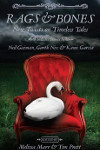
The gorgeous cover art will stay with you, the collective of popular and talented talented writers will stay with you, and the concept of wishes coming with a price, like Rumplestiltskin’s promise, will stay with you and haunt you for a good while.
There are ways to scare, there are ways to inform, and then there is Rags & Bones.
I received this book for review from Headline.
Related Books

Julie Kagawa – The Iron Queen
Posted 21st August 2013
Category: Reviews Genres: 2010s, Domestic, Fantasy, Romance, Science Fiction
2 Comments

The first was good, the second bad; the third is rather special.
Publisher: Mira Ink (Harlequin)
Pages: 358
Type: Fiction
Age: Young Adult
ISBN: 978-0-778-30479-1
First Published: 25th January 2011
Date Reviewed: 23rd June 2013
Rating: 4.5/5
The battle for the Nevernever isn’t over. Called back from exile, Meghan is ordered by King Oberon to slay the new Iron King as the Nevernever loses ground and faces ultimate defeat. Together with Ash, Puck, and the cat Grimalkin, it’s up to the mortal to save fairyland from the burgeoning power of technology.
If we consider that the previous book in this series, The Iron Daughter, was but a filler, then The Iron Queen picks up from where The Iron King left off, bringing back the wonderment present at the start of the series. Kagawa is back on target and it must be said that whilst she doesn’t make the most of all the opportunities created by her stunning premise (technology threatening traditional imagination) she has certainly stepped up her game.
Meghan, the half-human heroine, is stronger this time and is becoming quite the powerful character. Though still silly at times, for example she says a trip was a waste of time despite being given an item deemed necessary by someone in the know, and seeming to never have seen a musical notation despite having a musical father, she has surely come into her own, being now rather bearable, it could be said, for most readers. Her kindness towards the Iron fey is at once surprising and utterly understandable – Meghan is very much a person of both the old world and the new, seeing the possibility of both co-existing whereas the older realm of course see the Iron world as the destruction of mankind.
In a style instantly recognisable as typical of fantasy storytelling, Kagawa creates another force of evil for the older fae to fight. And whilst there are romantic scenes a plenty, there are few occasions where deep discussions go on too long during battles – in other words the pacing and placement of dialogue is realistic.
Kagawa has reintroduced the epic nature of her story and her usage of Shakespeare’s work is an obvious foundation which she never strays from. The story looks into the dark side of fairytales but there is little to shock or feel uncomfortable about as it’s more a basic backdrop.
Being that Meghan is from our world and Puck has lived there a long time, the contemporary vocabulary and slang fits perfectly. It may jolt you out of the story for a moment but you soon remember that this is far from a case of Kagawa simply seeking to emulate your typical teen story, here the wording is appropriate. It also reminds you that humanity is never far from Meghan’s thoughts.
Meghan isn’t quite the leader you might expect, a somewhat indecisive and stubborn girl in love, but then given the title of the book you knew what to expect anyway. And it must be said that in the case of this series, the titles letting you know the subject of that particular book isn’t as much of a spoiler as you would have thought at the start.
One of the themes of the series is loyalty, and here it is used more than before. A lot of lore is employed to make a comparison between faery and our world, for example to show how Meghan wouldn’t feel for the lack of marriage in the realm, and to some extent Kagawa demonstrates how even the dark faery world can have its trust and vows. This is of course shown through the continuing romance between Meghan and Ash (readers may be happy to hear that Kagawa isn’t going to insist on continuing the triangle) and whilst Kagawa lets the relationship take on a fantastical atmosphere – of the knights and chivalry sort – she doesn’t shy from introducing contemporary views to the book, either.
So there is little time spent on the actual premise of technology taking over traditional dreams (meaning the logistics of it), which would have made an even better book, but it can’t be said that The Iron Queen isn’t a good book. Because it is a very good book.
Read The Iron King, skip The Iron Daughter, and move onto The Iron Queen. The characters will not always delight, and the incessant eye-rolling is… incessant, but the overall atmosphere might just create that magic for you that the fae surely hope for.
Related Books


