




October 2016 Reading Round-Up
Posted 2nd November 2016
Category: Round-Ups Genres: N/A
3 Comments
Last time I said it was likely I would read more books in October than I had in September. And I did. I’m rather happy about that. I know on Twitter I’ve been saying I had 10 books to read – I did, just that I had a little more time than I’d thought for some of them and managed to finish some in September, so there isn’t 10 here. Anyway, this month has been one of if not the busiest, mentally, of my life. A ton of promotion for the first In Conversation event – as you may now know there will indeed be a second; we’ve Elizabeth Fremantle joining us in Southampton on 24th November – and a whole lot of reading. I feel like there was a reading slump involved at some point but this was one of those times where I absolutely had to read so it happened.
The Books
Non-Fiction

Dan Richards: The Beechwood Airship Interviews – Whilst studying for his MA, Dan decides to create a decorative zeppelin for his student union bar and as he starts the process he considers the relationship between artist and their space which leads him to interview various well-known people. A great book that defies categorisation.
Fiction
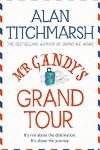
Alan Titchmarsh: Mr Gandy’s Grand Tour – When his wife dies, Tim decides to go on a few months’ long trip to continental Europe to take the sort of journey he’d always wanted to go on in his youth. There are a lot of devices and some repetition, but this is a lovely book full of summer. (My non-British readers may be interested to know that Titchmarsh is first and foremost a household name here due to his career as a TV gardener. His show was one of, if not the first, reality makeover series on our televisions.)

Jo Bartlett: Somebody Else’s Boy – When his wife dies in an accident at the theatre where she worked, Jack decides to move to the coastal town they both liked and in doing so he meets drama teacher, Nancy. Predictable in that good comfort-read way but a bit tell-rather-than-show.

Kate Walker: Indebted To Moreno – Rose left Nairo’s squat a decade ago, thinking he was a drug dealer, and when he shows up at her bridal store as a rich customer the real story starts to unravel. Including a sensitive look at anorexia, this is a pretty fair book.
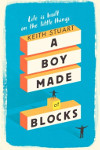
Keith Stuart: A Boy Made Of Blocks – Alex has found relating to and dealing with his autistic son difficult and as the family reaches breaking point, young Sam discovers the video game, Minecraft, which Alex starts to find may be key to healing the rifts. A superb story with keen writing and a lot of heart, this book can be considered semi-autobiographical (the author is in the same position as main character, Alex) and is a lot of fun.
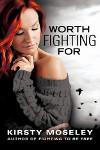
Kirsty Moseley: Worth Fighting For – When Ellie’s parents are involved in a car crash she leaves her new home in Britain to return to America and the boy who broke up with her three years before. Not a bad book but suffers from an overly oblivious heroine and a bit of info-dump.
Looking just at the books here, both The Beechwood Airship Interviews and A Boy Made Of Blocks were a joy to read. Stuart’s book finds me in a new situation: I’m aware that some of the references to Minecraft are not factually correct (which is odd when he’s a gamer by trade) but it’s such a wonderful book with an important message and lessons that I want to make it one of my ‘best of 2016′ books despite that. I’ll probably be thinking on it for a while longer. The Richards might make the list too, but I think one bent rule is enough for one year (to have two of Richards’ books would set a precedent).
Quotation Report
Getting beer in stock either for the babysitter or the kids is absolutely fine when you’re absolutely desperate for time away with your wife, or, at least, so thinks Matt from A Boy Made Of Blocks.
November’s looking pretty busy too!
How was your October?
Series I’ll Likely Finish; Series I Won’t Be Finishing
Posted 31st October 2016
Category: Chit-Chat Genres: N/A
6 Comments

You’ll relate to this, I’m sure, and I’d love to hear what’s on your own lists. I’ve many book series that technically, in a dubious sense, are on the go. In some cases I have all the books already waiting (in most cases these are the series I’m not so fond of; isn’t that always the way?), others I have half the count, and more others I’d have to purchase. (Having more to purchase/borrow can sometimes itself be a reason to pause reading. It’s the reason I never got around to finishing that series with the boy wizard and man who shall not be named… and now I’ve missed collecting the set in one design.)
Whilst looking at my shelves for an idea of what to photograph in order to have some stock photos ready, I noticed how many unfinished series I had. I picked out a number of them – limited to the last book I’ve finished per series – and split them into two groups.
As I looked at them all neatly stacked on the table, I noticed a pattern that confirms something I’ve known a long time: I love fantasy but don’t make it a priority. I would say fantasy is a favourite genre but it requires a mental investment that I find difficult, a particular attention made more important due to my wish to review, and it keeps me away. I suppose what I’m saying is I love fantasy but find it hard to review, and I don’t know why. It may have something to do with my fear that I’ll miss key concepts, something I’ve got over when it comes to literary fiction and historicals but not yet imaginary worlds. I’m a video game and 90s sci-fi TV show geek who lost her way and thus doesn’t know many references any more.
Series I’ll Likely Finish
Elizabeth Chadwick’s Eleanor of Aquitaine trilogy
I’ve finished book one, The Summer Queen, and have The Winter Crown on the shelf. The first was excellent but there was that pesky factor of having to wait for the next book to be released that meant I lost track. I will get to it – I’m slowly, successfully, making my way through Chadwick’s backlist. And I thought it prudent to wait until she’s published the last book so a marathon can be a possibility.
Lian Hearn’s Tales Of The Otori series
‘Current’ book: Grass For His Pillow. I have the next two (of three) on my shelves. I’ve been reading this series almost as long as I’d been reading His Dark Materials before I finished it earlier this year… about 15 years, now. It’s an investment thing.
Charlaine Harris’s Sookie Stackhouse series
Book 2, Living Dead In Dallas. I have most of this series thanks to a heavy discount that reduced the first ten books – what was published at the time – to the price of one store-bought book. (British readers may be familiar with The Book People.) This isn’t my favourite series thus the time it’s taken so far, but I like it enough to feel fairly confident in saying it will happen.
David (and Leigh!) Eddings’ The Mallorean
Book 2, King Of The Murgos. (There seems to be a pattern with this second book thing; it might be worth exploring at some point.) I pick this series up when I want older fantasy and am happy to read something repetitive. In many ways this series is a rehash of the previous, The Belgariad, that features the same characters. My problem with this ‘reboot’, as it were, is the change in Ce’Nedra and the way that because she’s had a baby she’s been largely left out. I’m making slow progress.
Series I Like Won’t Finish
Lauren Kate’s Fallen quartet
Book 2: Torment. It was a torment finishing the first two books. I went along with my standard ‘second chance’ mode of reading. I could carry on but I can’t say that interests me and negative reviews for negative reviews’ sake – no thanks.
Anna Belfrage’s Scottish time travel series
The Prodigal Son, book three. Akin to Diana Galbadon’s epic series, I read this series for a few tours and had to turn down the next two due to prior commitments.
N K Jemisin’s Inheritance trilogy
Book one, The Hundred Thousand Kingdoms. This book didn’t do it for me but I do plan to try another of Jemisins’ series.
Terry Pratchett’s Discworld
Book seven, Wyrd Sisters. I’m going to continue this series but being realistic there are so many books involved that I doubt I’ll ever read them all. I love Pratchett but need to read him in stages. I very much admire Jessica’s journey and am experiencing the series vicariously through her reviews.
Anyway, question time: which series do you have on the go and which have you given up on?
Rare Saturday Post To Say…
Posted 29th October 2016
Category: The Worm Hole Genres: N/A
9 Comments
I interrupt my regular posting schedule, which does not include Saturdays, to say the following:

I am on the official shadow panel for this year’s Young Writer Of The Year award together Simon Savidge, Kim Forrester, Naomi Frisby, and Eric Karl Anderson. We’ve known for a couple of weeks and can now reveal it. We can’t tell you who is on the shortlist at this point – look out for that announcement next week. I will be reviewing the books over the next month and will likely have some other bits and pieces of news to share here and on Twitter, too.
Annoucement on the official site.
My Event Report: In Conversation With Dan Richards
Posted 24th October 2016
Category: Events Genres: N/A
4 Comments
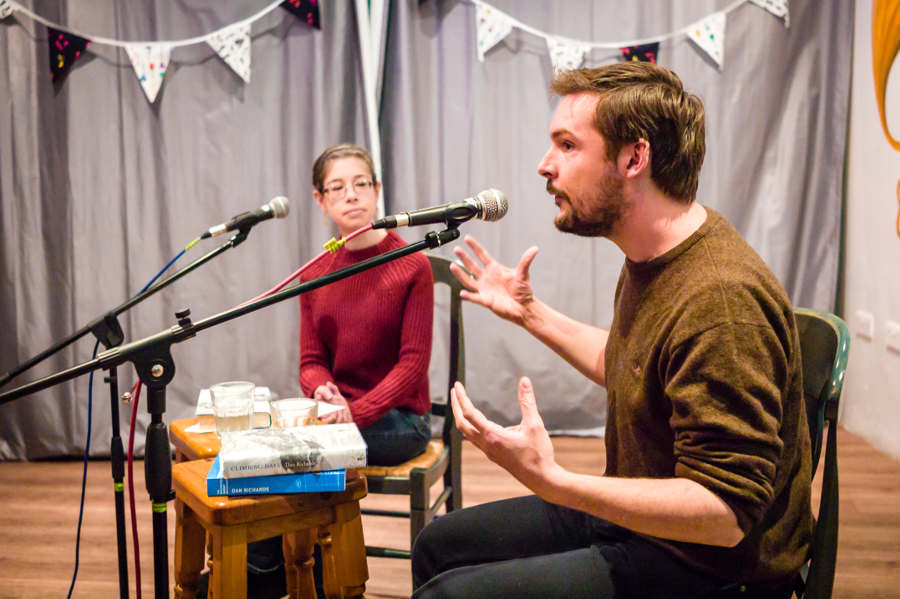
© Photo:Gerry Walden/gwpics.com 2016
Thursday saw the first In Conversation event here in Southampton, hosted at The Notes Cafe. Dan Richards came down from Bath via Norwich – a very busy day that resulted in a likely miffed cat – and spoke to us about Climbing Days and The Beechwood Airship Interviews: how it was to be a female mountaineer in the early 20th century; the problems with climbing then as opposed to now; being greeted as the great-great-nephew of a climbing legend; interviewing popular artists about their work within their creative spaces.
With me on stage too, this post was never going to be like my other event write ups. It would have looked a little odd for me to have a notebook and pen, not least to be jumping off the stage to gets photographs… of one person and an empty chair, so I mollified myself with the occasional glance to check my live tweeter was indeed tweeting (he was but as we discovered later, he didn’t know about mentions/replies – this is why I was posting tweets the next morning) and rested assured that there was a professional photographer in the house.
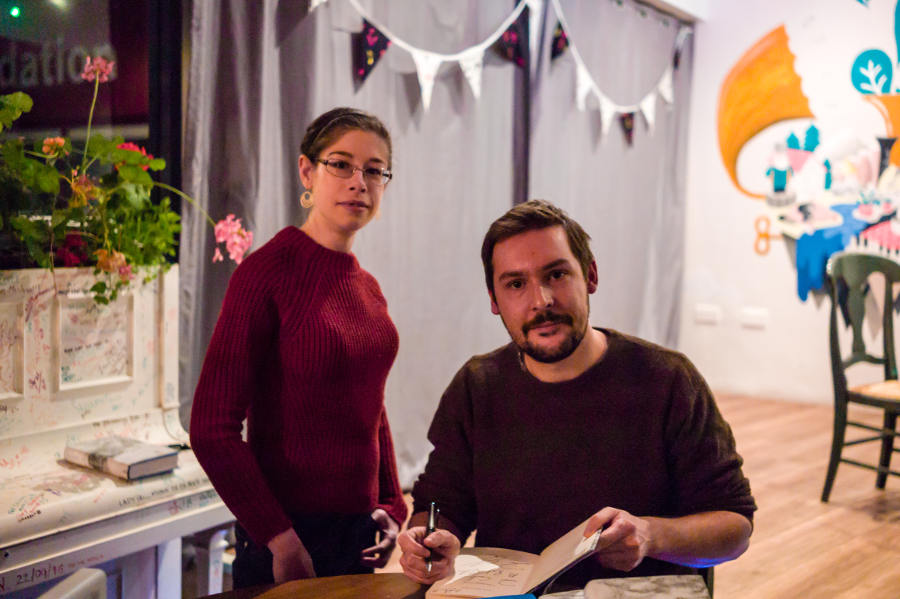
© Photo:Gerry Walden/gwpics.com 2016
Faber sent us some letterpressed prints of Stanley Donwood’s book cover art, signed by both artist and Dan, and we had all three books on sale. It was lovely to see those I’d met before and those I’d met on Twitter; April Munday joined us (we met at last year’s RNA conference) as well as Paul Cheney who I now know, through Dan, and who travelled a fair distance all considered.
It was a lovely evening and we look forward to a second – on Thursday 24th November, Elizabeth Fremantle will be joining us, Facebook event page here. Do come if you can!
What’s the most recent literary event you’ve attended?
Random Encounters With Readers
Posted 21st October 2016
Category: Chit-Chat Genres: N/A
5 Comments

Story time.
I think it’s one of the nicest literary pleasures – books, your love of them and another’s love of them, forming a connection even though you don’t know each other. Books are one of those obvious ice-breakers, unless perhaps you’re using an ereader (though that doesn’t stop the possibility, only limits it), as books are something that are visual, an insight into the person you can use to start up a conversation. It lets you form an immediate connection, bypassing small talk (yay!) and given how much we readers often lament the lack of opportunities for bookish conversation in our daily lives, it’s a real boon.
One day I sat down at the bus stop; it was one of those small basic shelters, yet to be updated, all irrelevant outdated poster timetables and little space. Chewing gum on the flip seats. A girl around my age sat on one, deep in her book. I hadn’t encountered someone reading ‘in the wild’ for some time, let alone a reader my age. Etiquette flew out the window as I asked her what she was reading. It was a very brief conversation as she wanted to get back to her book – she was reading Virginia Andrews. That was my introduction to the writing pair. I don’t think I was headed anywhere particularly mundane that morning but the conversation made my day. It must have – here I am remembering it all these years later.
A few months ago at the Curious Arts Festival – I suppose I’m cheating here as it wasn’t long ago – I was attempting to finish Before I Go To Sleep without showing off what I was reading because S J Watson was sitting nearby and I’d made an admittedly oddly specific reference to where I was in the book when I’d asked him to sign it the day before. (Page 425, if you’re wondering – why I thought he’d know what scene that would be I don’t know.) I’m very aware of the pally-pally thing, of that blogger meeting an author thing, silly really. (I once went to a concert with my father and we stood with a group of friendly women we’d been queuing behind. We unfortunately found later we were standing with people who took fandom too far. A few of these experiences later and I’m very keen on the get-item-signed-and-get-going approach.) Anyway, a girl asked if she could share my bench and wondered which Watson I was reading. We had a brief chat about it – she didn’t want to spoil the ending for me and we both had books to read. Her enthusiasm was infectious and although I was already reading as fast as I could at the time, I finished it just that bit sooner because of it.
My last story is more of a sighting. A middle-aged man walking past doing the book equivalent of eyes glued to the screen. I was more than happy to do the swerving – not only was he reading but it was a favourite book of mine. It wouldn’t have been right to stop and say something but how I wanted to. It made me interested in looking for different opinions of the book (this was before blogging) because it was historical fiction about an empress and whilst I was perhaps on the younger side of the target audience, in stereotypical terms he was an outlier. Still in stereotypical terms, however, he looked like a university teacher and thus apt.
These are my stories. I wish I had more but then would encounters have such an impact if they were more numerous?
When did you last meet a reader by chance?


