




Hay Festival 2017: David Mitchell And Colm Tóibín
Posted 14th August 2017
Category: Events Genres: N/A
Comments Off on Hay Festival 2017: David Mitchell And Colm Tóibín
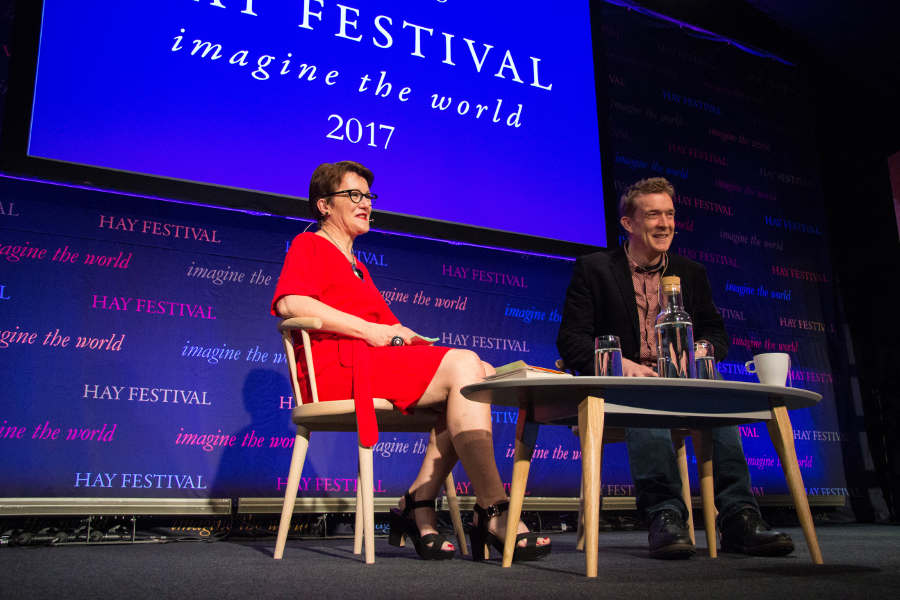
Photo © 2017, Liam Webb.
David Mitchell’s newest book was released last month (July). It’s a translation of Fall Down 7 Times, Get Up 8, written in Japanese by Naoki Higashida, about living with autism. Translated by both Mitchell and his wife – who is Japanese – the English language release is an effort towards making autism more understood; their son has it.
The speech and then talk between Mitchell and Rosie Goldsmith – who also has a child with autism – revolved around the condition. Like Steve Silberman last year, Mitchell used the hour to explain autism in real-world terms, breaking down the medical/world barrier. (Good, honest, conversation is something Hay does well.)
Historically, autism was seen as under the umbrella of clinical schizophrenia, or ‘living with the fairies’. Treatment was psychological analysis; in the 1960s, electrotherapy and LSD was used. The damage from these methods was massive and research into the condition was not worth the name.
Mitchell said, in the context of today, that the more ideas there are, even wrong ones, the more our knowledge will increase. “Just because research is faulty, [it] doesn’t mean there was nothing in it in the first place.” he said of MMR.
The writer uses the term ‘person with autism’ because people with it have asked him to; people made the adjective known to him – it’s fine when it’s a person. But Mitchell with call a person by the term they prefer on an individual level.
He does not like the assumption that a person with autism who can’t communicate is intellectually affected – it’s better to assume the reverse.

Photo © 2017, Chris Athanasiou.
There were a reported 1700 people in attendance for Colm Tóibín’s talk with Claire Armistead. The two talked about the author’s latest work with ancient texts – House Of Names, a retelling of a Greek tragedy.
Tóibín talked about Antigone and Electra, working with the stories, using voice. He said that what Antigone, the character, says in dialogue is a translator’s dream; well-worded lines. He looked at Electra’s story from the point of view of her mother which gave him a different perspective, helping him with his own novel. In using ancient texts, he could get away from Ireland, the rosaries, tea, and rain – he kept the new book dry in that way. He pointed out that in retelling an older story, you can take just the story, whereas a contemporary novel has to be detailed and move more slowly. ‘Things you can just see in a play, you have to detail in a novel.’
He ended by saying that if you start to feel the weight of the historical work on you, you’re in trouble. (He just took what he needed.)
Armistead asked ‘why this story, now?’ Colm Tóibín responded that Nora Webster had taken many years, then came Brooklyn for another while as there was so much he had to use from his memory, his childhood, that he had to get right. He said that no matter how much you try to resist, some of what you know – your background, studies, and so on – will make it into a book; there’s a bit of Nora Webster in House Of Names.
The author works at 3:30 in the morning for a bit; the morning is useful for erasing bad ideas; one has time to chew on it.
The Forest Of Bere, Rainy Spring Day
Posted 9th August 2017
Category: Photo Posts Genres: N/A
1 Comment
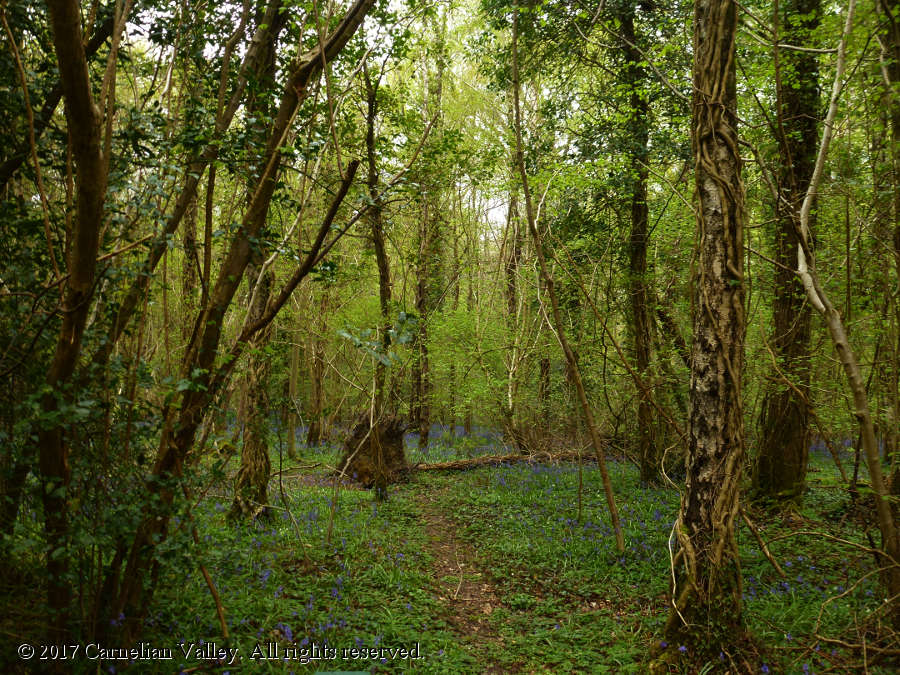
On a dreary day in May, having decided to get lunch to go, we chose to drive for longer than usual to find somewhere new to sit. On a road we’d never been on, a ‘what’s that?’ moment happened; we turned down the tiny lane and found the Forest of Bere. It’s a relatively small area of land just north of Fareham and on that day there were bluebells as far as the eye could see.

A couple of bridges define the place where a railway line once skirted the edge of what is now a road. There are a couple of entrances, that we could find, and the ‘main’ one is set up for picnics and short walks, parking and benches aplenty. Some sites call it ‘the former forest of Bere’ – it is essentially, now, at least, a patch of forest in an otherwise rural but populated place – there is a country park and myriad villages nearby.



Reading Life: 7th August 2017
Posted 7th August 2017
Category: Reading Life Genres: N/A
3 Comments

I’ve been struggling with overwhelm recently. I received a lot of books for purposes other than review that I hadn’t expected; I’m making progress but together with other happenings it’s been difficult. I’m making an effort to clean up my list of currently reading books, finishing those I’m nearing the end of and making a decision on those I’d not got too far through that have been languishing on the list for months. A Brief History Of Seven Killings is off for now; I only got about 50 pages in and the amount left… I know it’d just languish longer. Twelve Years A Slave has been removed because I think by removing it I might actually get back to it; I was enjoying it a lot (as much as it can be enjoyed; as a historical document). There is definitely something to be said for not having a number of books currently on the go. I think three’s the limit for me – any more and it doesn’t feel as though I’m making any progress. It’s also, I’m starting to realise, a reading slump creator.
I finished Erskine’s Sleeper’s Castle last week. As it continued it seemed to me that it’s two stories put together, a plot thread of time slip and a plot thread heading in the direction of Gone Girl; both threads petered out in the end. I may give Lady Of Hay a go but it isn’t something I’m going to prioritise at the moment.
The past couple of weeks I’ve been making a big effort to read in the tiny moments available; I’m trying out the idea of reading in queues, when waiting for people to be ready to leave, that sort of thing. At the moment it’s an ebook I’m carrying via a tablet so there has been some start up time factored into it, but I’ve read a fair number of pages this way, particularly when considering my slow reading speed. Whether I’m actively retaining the information, in terms of whether the ‘quality’ of such reading will result in a fair opinion at the end of the book I’m not yet sure – I think in this case it will be fine because the book is an easy read.
I’m determined to have finished more currently-reading books by the end of this month for a better reflection of what or, rather, how much I’ve read, which is more than it seems at present. A reading list with many finished books means a clearer head for future reading.
What are you currently reading, and do you read in those spare moments?
July 2017 Reading Round-Up
Posted 2nd August 2017
Category: Round-Ups Genres: N/A
1 Comment
I tend to read a fair amount in the month of July, be it in the number of books I read or page count, but this time I’ve finished very little. It’s been an overcast month (being outside away from electronics helps) and seeing my nephew a lot more than usual ensured I spent more time answering multiple proliferations of questions rather than concentrating on books. Many evenings have been spent playing Monopoly and Mouse Trap. For once, I regret nothing in terms of numbers, even if I’ve now a huge pile to read post haste.
All books are works of fiction.
The Books

Susanna Kearsley: The Shadowy Horses – When Verity is offered an archaeology job in Scotland she takes it and decides to keep it even when she meets the leader of the dig who is basing his theories on supernatural events. A fair book but Kearsley leans too much on a fictional/literal Scots dictionary, constantly halting scenes.
Tove Jansson: Letters From Klara – A collection of short stories with a subtle underlying theme. You need to make time for it, because subtle really is the word, but it’s good.
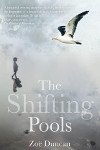
Zoë Duncan: The Shifting Pools – A woman who suffered war-based trauma as a child and has yet to heal goes through her grief, eventually finding herself in a fantasy world where the people require strength to fight battles. It’s difficult to sum this up well – saying there is a fantasy world sounds, well, too out there, but it really works; a wonderful book.
Duncan’s book wins this month, hands down. I loved it; the fantasy element could be considered too lengthy but the structure of the book and general way it’s all been written is exceptional. It’s worth reading the back story, the author’s childhood, that is the reason for the book.
Quotation Report
In The Shifting Pools, Duncan puts forth the concept of getting over something, healing, and studies it, saying why time doesn’t heal, it merely allows you to scab over, to find new ways to live. Stasis rather than healing.
In theory, August should be packed.
How is your summer/winter going?
Musings On Notebooks
Posted 31st July 2017
Category: Chit-Chat Genres: N/A
1 Comment

I’ve a lot of notebooks lying around and have filled many more that have been thrown away. All have been used for various purposes; the basic idea is to use them for reading notes and blog post drafts but inevitably at some point they also get used for ‘what to take on holiday’ and gift lists and so forth.
My view or almost relationship with notebooks has changed over the years. First I bought anything, mostly refill pads, and also used scraps of paper, to make notes on the books I wanted to review, including notes I actively wanted to include and thoughts and quotes I knew probably wouldn’t make it. I’d throw the notes away once the post was up, because why would I need them?…
Then I realised my error – I did need those thrown away notes, particularly those I’d made for general purposes; I bought notebooks with the intention of keeping them, and gave myself the ‘choice’ to slim the books down later on (if they were spiral bound).
Thirdly, I realised there was no rhyme or reason to this, and I was still using scraps of paper – often notes were split across scraps and books – and they got lost. I reverted to refill pads.
Keeping quotes I want to remember is a sort of compromise I’ve made with myself – I’ve often thought of starting a commonplace book, but putting it into practise strikes me as overwhelming. Where to start, exactly? How to categorise? And would I actually end up using any of the notes or quotes? This new refill pad that I’m not tearing pages out of – as I did all the others – is a way round that. I’ll probably digitalise them all with the caveat that they get kept – I’ve deleted lots of digit notes, too.
This refill pad is almost full so I’ll have to make a decision soon.
What do you look for in a notebook, and how do you go about using them in the context of what you need them for?


