





A Brief Word On Imagination And Description
Posted 28th July 2017
Category: Chit-Chat Genres: N/A
3 Comments

The woman went to the sink and washed her cup. I was pulled out of the story – hadn’t she already done that? Looking through the past few paragraphs in the scene I found that she hadn’t.
I realised that as I’d been reading, I’d imagined the two women talking at the table – as the dialogue showed this was happening. I saw one taking sips of coffee as the other spoke and then the reverse, and, as often happens in reality when you’ve a friend with you in the kitchen and it’s all very casual, the home owner had left the table to rinse her mug. That I’d imagined this made me very happy; I’m not great at taking a scene and running with it; description is useful (though I agree with the fact that lots of books have too much description).
(On this note there’s a ‘condition’ in the same region as Synesthesia, called Aphantasia – the inability to create mental images. It’s an interesting thing to read about.)
The washing up brought to mind the fact that stories don’t need to ‘tell’ – even if you’re not actually imagining, you don’t need an exact run-down of what’s happening, you don’t need the minor details repeated. Perhaps that’s where the line is, between telling and showing, the line between a reader taking on the scene’s construction themselves compared to being hindered because the author won’t let them create.
How do you find the visual part of reading? Do you find yourself creating the background and context?
On Book Haul Posts
Posted 24th July 2017
Category: Chit-Chat Genres: N/A
3 Comments

…Or what I refer to here as Latest Acquisitions posts.
I haven’t written an acquisitions post recently. It isn’t because I’ve not received/bought/borrowed any books – I have had fewer books enter my home but enough to warrant a post. It’s because the knowledge that they are easy posts, and the considerations as to how and when to create them, got me thinking I should write less of them.
That ‘worry’… I’ve been about it in some shape or form for ages, then Holly posted her own thoughts which in turn were inspired by Ariel Bisett’s video. I thought I’d take a leaf from their book and write down the thoughts I’ve kept to myself. Primarily my thoughts concern the ‘why’ of book hauls, but also revolve around the form the posts take.
I create my latest acquisition posts because I like to highlight books I’ve received, knowing it’ll take me a while, sometimes forever, to get to them all. I do it because it gives me a chance to flag up a new release I’m not set to review until after the publishing date. I do it to share my excitement and my reasons for saying ‘yes’ to a request or buying a book. (In the second case – buying – it allows me to share my journey, if there was one, to buying it.) And I like posts that include lots of books.
On a less personal note, book haul posts are easy. Yes, they are easy (generally) for me to write (on occasions when I’ve accepted a book for review not knowing too much about it I feel the lack of good background information) but also easy to read. As much as long posts are great, sometimes people just don’t have the time to read them so a mix of long and short posts hopefully helps mean more time for both. I don’t think it’s a coincidence that short posts see more comments, and it’s entirely understandable. (Reviews are excluded of course – in my experience they are effected, comments wise, by whether or not the blog reader has read the book.)
Two of my considerations are length and time:
- The balance between a short, easy, post, and something of value is something that in the case of hauls I’m still working on.
- Time – how often to post; how many books in each post (which may affect post frequency); how many are too many.
And always lingering at the back of my mind – when dealing with review requests, does this constitute showing off?
I’ve acquired many books since my last haul post but due to pulling back a little on review copies for the time being, I’ve been reviewing them pretty swiftly… which is another thought – I don’t like posting about a new book twice in quick succession unless I’ve lots (and lots) to say about it.
Though I should probably write another acquisitions post soon, leaving out books I’ve since reviewed – that’s another factor. Wait too long and calling a book ‘new’ is no longer true.
The amount I’ve written here… I guess this post has been a long time coming!
What do you think about book hauls and their value?
Contemplating My Favourite Genre(s)
Posted 21st July 2017
Category: Chit-Chat Genres: N/A
4 Comments

I’ve the urge to read some books that have been on my backlist. Specifically I’ve been wanting to read historical fiction of the fantasy variety, mostly time travel and time slip; in the case of the books I’ve had on my shelves, it’s primarily time slip.
I’ve been wanting to do this since I briefly picked up The House On The Strand some time ago. It occurred to me earlier this week as I sat with Susanna Kearsley’s The Shadowy Horses, that I might have been wrong all this time that historical fiction and fantasy fiction are my favourite genres. It’s far simpler – I like both put together.
Historical fantasy is a genre I always feel comfortable with in that particular way of sitting down to read and feeling the need to relax back into the chair and not do anything else for a good few hours. Even if I don’t think the book’s great, as I ultimately found with the Kearsley, the feeling remains. Historical fantasy speaks to my passion for history and my longing to be back in time, the part of me that loves visiting castles and old houses. It’s like coming home.
And I think it’s more like coming home than reading a good classic can be. I’m surprised to find that my joy in reading classics is pipped to the post by historical fantasy.
I don’t mind a romance, but only when it works. Could The Shadowy Horses have done without the romance? I’d say so, yes. Could Nicola Cornick’s The Phantom Tree? Yes. But I think Cornick’s previous, House Of Shadows, would have been a little less without the progression of a relationship.
Historical fantasy is a genre I don’t own many books in. It does take a bit to get it right and where it’s something I don’t read too often (and whenever I do read it I have to stop myself reading too much) I don’t often actively seek new books.
I should. I have only the Du Maurier, that I stopped reading because there were other books I had to read that I knew I’d abandon if I didn’t stop; Kearsley’s Season Of Storms and The Firebird; Barbara Erskine’s Sleeper’s Castle – my current read. Unless there is time travel/slip in a book that I do not know about, that’s my lot. Everything else – not much – has been read.
I think I need to get better at identifying what I like the most and making it more of a priority, both in terms of reading and when at the bookshop/library/when reading requests.
Has your favourite genre changed over the years?
Hay Festival 2017: Samanta Schweblin, Hari Kunzri, And Ann Goldstein
Posted 17th July 2017
Category: Events Genres: N/A
1 Comment
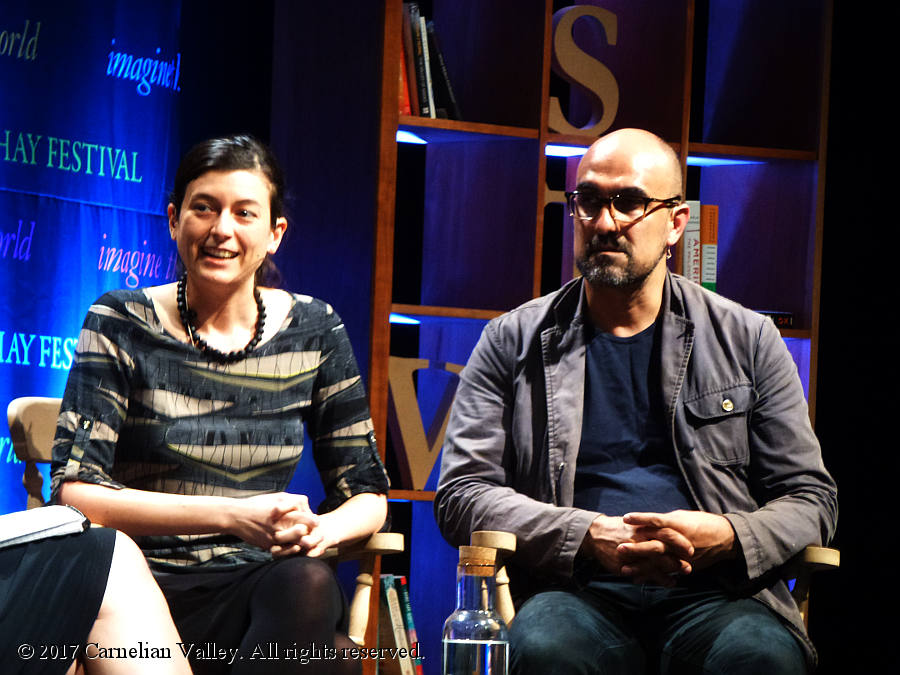
On the afternoon of the first Saturday, Hari Kunzri and Samanta Schweblin, together with a translator for the latter, gathered on stage with Claire Armistead.
I’d read Schweblin’s book but Kunzri was new to me; his book is about collectors and cultural appropriation, quite different to Schweblin’s look at chemical agriculture but perhaps with a similarity in the way both books care about countries.
Schweblin said that the ‘rescue distance’ of her book (which is the Argentinian title of it) was something she invented rather than anything she knew of people doing. (She likes the English title, Fever Dream, but believes it’s disadvantaged by the suggestion that the dream is more prominent than the worries of the mother for her child. Of the ‘dream’, she said, “I think it’s real… it could be a dream… I would like to play with both up to the end of the book, about the ties that bind us”.)
Armistead asked about the worms in the book. “I was playing with the idea of chemicals,” said Schwebin, “because she [the main character] gets poisoned… the point of your fingers start to feel like worms.” She said the physical effects of the chemicals are very real. The author later said that the novel has not changed anything in the country.
Schweblin likes to put words in the reader’s head that aren’t on the page, words one must figure out and that make you want to asked questions. “I feel I’m a short story teller. Tension is so important.”
Kunzri became interested in the idea of the haunting quality of music. Haunting is both a metaphor and not, he said. It’s an experience and you can never forget the distance in time – static, for example. He spoke of the early days of recording when audio was physical – vibrations created discs. His story is partly about how white people used black music. “I’m interested in who gets forgotten and who gets remembered.”

Photo © 2017, Sam J Peat.
There was much for Elena Ferrante’s translator, Ann Goldstein, to talk about with Daniel Hahn. To use a common phrase the stage was a full, if small, house.
Goldstein recently quit her job as a copywriter after 45 years; though it was not stated, one can assume this was in part due to Ferrante’s success overseas. She did not learn Italian until her mid 30s; her speaking skills are not as good as her written skills. She goes to Italy a couple of times a year and is always translating something. The job role itself was an accident; a book had been sent to her newspaper editor and she read the book and liked the idea of working on it. The finished result was published in the New Yorker.
On the subjects of problems when translating Italian to English, Goldstein noted gender; the syntax is more flexible in Italian. Her feeling is that Italian is a musical language and hard to capture. Sometimes English has to fill in, she said, and Italian has suffixes that can change a whole meaning so you have to be careful. You can never find a word that will have all the same nuances, or syllables. You have to decide what is most important. Hahn summed it up: it’s never as simple as changing words for other words, and different people privilege different things.
“If I haven’t read the book [prior to translating]… I’m typing and reading at the same time and that is exciting,” Goldstein said later. The first time round you miss things. When Hahn pointed out, in regards to translation decisions, that a person may have no idea what might happen in later books, Goldstein replied that that is true in her case. She couldn’t get ahead of herself in the story. The later books hadn’t yet been published – in any language – for her to be able to know what would happen.
The translator had to go through editors to get information about Ferrante’s translations. She still does, even now. Hahn noted that Ferrante has said she trusts Goldstein and Goldstein said she had read a translation of one book but not the Neapolitan novels. ‘I thought it was important for [Ferrante] to have a voice, a public voice, in English. So many people liked her books, even if I couldn’t speak for her, I could speak as someone who knew them.’ This is why she goes to festivals.
In the USA, 30% of published books are translations; that hasn’t changed. But that lack of change is good when there are more books being published overall. In the last 15 years, the UK sold 5.5 million books and a very good percentage were translations.
Further Thoughts On Kate Chopin’s Désirée’s Baby
Posted 10th July 2017
Category: Further Thoughts Genres: N/A
Comments Off on Further Thoughts On Kate Chopin’s Désirée’s Baby
I found Désirée’s Baby rather profound, which somewhat surprises me due to the similarity between its ending and the ending of The Awakening – one would have thought it wouldn’t seem so shocking given both the similarity of the actions and the similarity between the reasons. Away from that, I think it’s fair to say that many, many people like the story.
One of the biggest questions regards Armand’s background and behaviour. The Kate Chopin International Society’s website describes the likelihood of Armand having black mistresses, quoting:
“And the way he cries,” went on Désirée, “is deafening. Armand heard him the other day as far away as La Blanche’s cabin.”
The site says that this could be evidence of Armand’s affairs with black women – La Blanche is one of the women on the estate. Significantly, however, they remind us that all we have to go by are Chopin’s words. They also quote this:
One of La Blanche’s little quadroons…
Who knows what Chopin meant exactly, but this is the point when Désirée starts to worry and it seems she is literally putting two and two together – the site suggests Désirée’s baby is also a ‘quadroon’, a person who is a quarter black, and that perhaps Désirée also spots a likeness between La Blanche’s child and her own, facially.
Beyond the site’s ideas of family connection, Désirée has seen something in her baby’s skin tone that wasn’t noticeable before and with Valmondé having already pointed out a change – we can assume this is the baby’s skin colour – it’s possible that what Désirée notices is that resemblance to La Blanche’s son. We can assume that for whatever reason at birth, it was not noticed.
Then Armand’s opinion and behaviour:
“It means,” he answered lightly, “that the child is not white; it means you are not white.”
We don’t know much about Armand, but this assumption, if we can be so kind to call it thus, fits in with the age-old idea that a woman is at fault for the sex of a baby being female – it’s Désirée’s fault the baby isn’t white; her lack of known heritage means it’s her problem.
What’s particularly interesting is how Désirée chooses death in a similar fashion to Edna Pontellier. Although for different reasons, both have been rejected. Désirée does not take the offer of moving back to her adopted parents’ home. Was her mother’s feeling that something was off, and the offer of returning home, due to knowledge of Armand that Désirée didn’t have?
And is there anything in the eeriness of Armand’s house? We can possibly see something there, a foreboding, and a metaphor for his personality, which the International Society says could have been dark, pointing to the details about his father and the difference cited between father and son.
In burning his wife and child’s possessions, Armand effectively and symbolically throws away his own heritage. We do not know if he knew about his heritage prior to this, and indeed the reading is more profound if we consider it was a revelation to him upon discovery of the letter, but it’s possible he did and that he’s doing his best to ‘pass’; a subject recently studied by Helen Oyeyemi. In wondering if Armand knew, we can look to this:
…the unconscious injury she had brought upon his home and name…
Is injury a strong enough word for Désirée has supposedly done?
Beyond this tragedy is another: when Valmondé says to return, she doesn’t refute Désirée’s fear. In terms of what Chopin was saying, it’s fair to say Valmondé didn’t think Désirée was black and that her lack of acknowledgement of that is a device that allows Chopin to create the ending. Had Valmondé addressed the question she may have saved Désirée’s life.
Désirée meets her death whilst looking angelic:
…her hair was uncovered and the sun’s rays brought a golden gleam from its brown meshes
She has feet ‘delicately shod’ and a ‘thin white garment’ that’s been torn by her journey. And she ‘disappeared among the reeds and willows’ – symbolic, perhaps, as the baby’s cradle, we learn shortly afterwards, was made of willow and that cradle also ‘dies’.
Of Armand’s possible discovery – rather than reminder – of his heritage, all Chopin says is this:
There was a remnant of one back in the drawer from which he took them. But it was not Désirée’s; it was part of an old letter from his mother to his father. He read it.
He read it – Chopin says that, and ‘dear Armand will never know that his mother, who adores him, belongs to the race that is cursed with the brand of slavery’.
The jury’s out but we can assume if it was in the back of the drawer and a remnant, it could have been there since the days of his father, because otherwise the question is what happened to the rest of the letter and why did Armand keep only that bit?


