




The Polari First Book Prize 2017
Posted 4th September 2017
Category: Miscellaneous Genres: N/A
Comments Off on The Polari First Book Prize 2017

I wanted to take a moment to feature the Polari First Book Prize. I was given the opportunity to read last year’s winner, The Good Son by Paul McVeigh, and, having enjoyed it, when I was offered the shortlist this year I said ‘yes’ to a couple of them (time restraints). I didn’t know much about Polari other than the fact there was a prize and so decided to look into it, so, full disclosure, I’ve been asked to review some books which will happen soon, but this post is of my own making.

Photo credit: Krystyna FitzGerald Morris
The Prize is for LGBT books, books that explore the LGBT experience. Entries are accepted in all forms – poetry, fiction, non-fiction, and self-published works are welcome. On the shortlist lasy year was Andrew McMillan’s awesome poetry collection, Physical, that was high on the list for the Young Writer of the Year, too.
This year’s shortlist (lots of independent publishers):
-
Expecting by Chitra Ramaswamy (Saraband)
Guapa by Saleem Haddad (Europa Editions UK)
We Go Around In The Night And Are Consumed By Fire by Jules Grant (Myriad)
Straight Jacket by Matthew Todd (Bantam)
The Vegetarian Tigers Of Paradise by Crystal Jeans (Honno)
Jerusalem Ablaze by Orlando Ortega-Medina (Cloud Lodge)
I’ll be reading the Ramaswamy and the Ortega-Medina. The first is a memoir/essay collection, the second a collection of short stories.
The Prize was launched in 2011 by the Polari Literary Salon, a once a month Arts Council supported event hosted mostly at the Southbank Centre in London. To mark the Salon’s 10th anniversary (so that’s 2011 for the Prize, and 2007 for the Salon), they are doing an event tour that runs until October. Eighty authors are involved and the winner of the Prize will be revealed on 13th October at the Southbank Centre as part of the London Literature Festival.
The tour started in June. Here are the remaining dates:
-
13th September: Printworks, Hastings
15th September: Lewisham Library, Lewisham
17th September: The Place Theatre, Bedford
22nd September: Assembly Roxy, Edinburgh
8th October: Birmingham Literature Festival
13th October: Southbank Centre (winner revealed)
20th October: Marlborough Theatre, Brighton
24th November: Southbank Centre, London
August 2017 Reading Round-Up
Posted 1st September 2017
Category: Round-Ups Genres: N/A
5 Comments
Lots of reading this month – I decided early that I wanted to make up for the last two and I managed it. The small moments helped but just making a firm decision and stopping yourself from watching a film (or Mozart In The Jungle in my case, the follow up series to the last several months’ Parks & Recreation) is great. I can’t say I remember having many conversations about a topic other than books but for one month that’s okay.
The Books
Non-Fiction

Adrian Mourby: Room’s Of One’s Own – Wanting to find out about and experience the spaces past writers have inhabited and worked in, the author journeys around the world to visit them. An okay book; often Mourby is denied access to the buildings which means you end up reading his suppositions instead, and there is a distinct lack of diversity.
Fiction
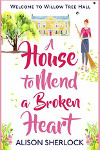
Alison Sherlock: A House To Mend A Broken Heart – A self-proclaimed bad housekeeper struggles to keep a large historic house clean without any estate income and when the Lord’s grandson arrives and schedules some builders the company may end up being dodgy but the man himself seems a winner. Lacking in chemistry, characterisation, and writing.

Barbara Erskine: Sleeper’s Castle – When Andi’s partner dies and his long-gone ex-wife reappears looking for a fight, Andi travels to Hay-On-Wye to house sit and finds herself dreaming of people who used to live in the house… and it seems they are aware of her presence. Strictly okay.

Eric Beck Rubin: School Of Velocity – Jan’s lined up to play in front of an audience, one of many occasions he’s done so, but this time the random music in his head is too much to bear; he takes us back to his childhood, his extremely popular and extroverted friend, and a relationship that he’s still to get his head around. A super book about the lasting affects of a friendship and a whole lot about music in all its technicality.

Isabella Connor: Beneath An Irish Sky – When Jack’s estranged wife is killed in a car crash he doesn’t want to visit the hospital bed of the teenager people are calling his son but he does, even if it would upset his snobby parents; he still doesn’t know why his wife left him and young Luke’s councillor is interested in helping. The basic story is all right but there are some stereotypes, and the relationship between Jack and his son’s trauma councillor raises questions.

Kitty Danton: Evie’s Victory – Britain during World War Two; Evie wants to be a better person. There’s no plot to this book – it’s a series of social calls – and there is far too much telling and explaining of commonly understood things.
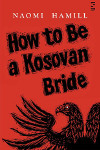
Naomi Hamill: How To Be A Kosovan Bride – The story of two women from the day of their weddings, one who passes her virginity test but doesn’t like her husband, and another who fails and goes to university instead. A wonderful book interwoven with stories of the conflict and folklore tales.
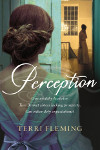
Terri Fleming: Perception – With Jane, Lizzie, and Lydia married and away, there are just two girls remaining, and whilst Mary doesn’t think she’ll ever marry there may be a bookish man out there for her. A sequel to Pride And Prejudice, this is a very well told book with an excellent use of language, great knowledge of the characters, and no fear in sticking to the idea of less action in a story… and there is a fair amount of time spent organising library.
I think the Fleming just gets it this month in terms of pure enjoyment – it’s an easy read and a very pleasant surprise (I’m suspicious of sequels). In terms of literary appreciation the Hamill wins with the Rubin following swiftly afterwards.
Quotation Report
In School Of Velocity, Jan recommends a musician use the energy in the air as the house lights go down as a kind of armour. Then there’s this:
Accompaniment is a particular skill. You are the bridge between the audience and the soloist, a lens that magnifies the leading melody, a handler to the outsized personality next to you, one player who sometimes has to be two.
And in Rooms Of One’s Own, Mourby quotes from William Morris (“Have nothing in your houses that you do not know to be useful, or believe to be beautiful”) which makes one wonder whether Marie Kondo is a fan.
The coming month is likely to be chock-a-block. I’ve a lot of reading to do – we’ve secured an author for the conversation in Southampton for So:To Speak – and I’m working with the festival generally, which means lots of content to write. But I’m very much looking forward to it; by the end of October I imagine we’ll all be exhausted but hopefully it will pay off in spades.
Did you make a rough goal of how many books you wanted to read this year, and, if so, are you on track to achieve it? (I’ll probably be somewhere between my usual 50-60.)
Reading In The Small Moments
Posted 30th August 2017
Category: Chit-Chat Genres: N/A
9 Comments
I’m not sure if there’s an established, or relatively established, term for this – reading in every available moment you have free. Reading in queues, whilst waiting for people, at stations, and so on. I recently added ‘in the car wash’ when you’re a passenger. (I get travel sick. I recently turned to my nephew, sat reading in the back seat, and asked him, ‘don’t you feel sick reading in the car?’ He had no idea what I was talking about. I’m jealous!)
I’d heard people reference the small moment ‘method’ of reading many times before but never paid it much heed as I always got caught up wondering how it could work – attention needed, time to find the book in your bag, your place, and so on. I finally decided to try it out a few weeks ago after reading about how a person who read many more books than me in a year did it. They credited reading in the same moments, a big factor.
First thing I learned: it takes practise. Starting out, you have to remember it’s something you can do. You also have to be prepared to look anti-social.
There’s a learning curve I’m still on: the thought of ‘is this going to be enough time?’ takes time – unless your answer is an immediate ‘no, because they’ve taken one step away to throw something in the bin’ this self-questioning isn’t productive in any way.
You’ve got to work out how short a moment of reading is your limit in terms of retention. A two sentences read moment is likely pointless – better to add the two to the three pages you’ll be getting to whilst your friend pops into the store to get a coffee. In a similar vein, it works best when you’re with people you know or when you’re at a place you know fairly well. Is my friend likely to spend time chatting at the counter with the barista? Yes. Will this queue of twelve people at the hardware store take time? No, because there are eight cashiers on duty and everyone has one item. (I don’t encourage tracking things in this detail, but it works as an explanation.)
Easy going books that you’re enjoying work best. You’re pretty much primed to step back into the fiction or non-fiction quickly, which again means more time used effectively. Anything heavy going is possibly going to be hard to fully comprehend.
Ebooks work best in terms of finding the book in your bag and getting to your page, but only if the device is already on. (I’m still working through the ‘sleep mode uses a lot of battery when I don’t know when I’ll be picking it up again’ conundrum.) Bookmarks in physical books are a must unless you know you have a fair amount of time.
You’ve also got to remember to take the book with you. Everywhere. It’s going to be the times you don’t that you’ll find would’ve provided the most time. I do find now, having got into the habit, that when I don’t take my book (at this point that’s an active decision), I regret it.
So reading in the small moments has been cited as a reason for having read many books in a year; I don’t think it’s as much a factor as people might lead you to believe, but it does definitely help. For me, my August stats will show that, combined with the big effort I made to make up for less reading in June and July.
There can only be one question: do you read in the small moments?
Noirwich Crime Writing Festival
Posted 25th August 2017
Category: Miscellaneous Genres: N/A
Comments Off on Noirwich Crime Writing Festival

Photo © Writers’ Centre Norwich/University of East Anglia.
No, it’s not a spelling mistake – Noirwich is a festival of crime writing that happens in Norwich. I’d very much like to go but am unable to make it; it’s a good programme so I thought I’d post the details in case any of you are interested. (This post isn’t sponsored.)
The festival runs from 14th – 17th September and tickets can be purchased per event, per day, or for the entirety.
On the Thursday, Val McDermid will be discussing her latest novel as the launch event. She’ll be in conversation with Stav Sherez.
Friday sees The Times/The Sunday Times crime club. Arne Dahl will be at UEA. Later that evening at the same venue, Martina Cole will be in conversation with Harry Brett.
On Saturday there are a few multi-author events. ‘Female characters and writers’ with Laura Wilson, Mel McGrath, and Erin Kelly. Later, Lone Theils, Daniel Pembrey, and Nick Quantrill will be talking about fiction further afield; Mark Billingham and Christopher Brookmyre will take to the stage (though this event is sold out), and there’s a 2pm chat with Anthony Horowitz.
Sunday, Stella Duffy, Felicia Yap, and Cassava Republic’s Leye Adenle look at international crime writing; Karen Maitland, Andrew Martin, and David M Mark look at historical crime fiction, and closing the festival will be Stuart McBride.
There are also fringe events: a murder mystery evening; and book group; a writing exhibition; a short film, and there are writing workshops on the Friday.

Photo © Writers’ Centre Norwich/University of East Anglia.
It’s an excellent line-up and three weeks away. If you’d like to go and haven’t tickets already, get planning.
What festivals, literary or otherwise, have you always wanted to go to?
Hay Festival 2017: Tony Robinson, Neil Gaiman, And Stephen Fry
Posted 21st August 2017
Category: Events Genres: N/A
Comments Off on Hay Festival 2017: Tony Robinson, Neil Gaiman, And Stephen Fry
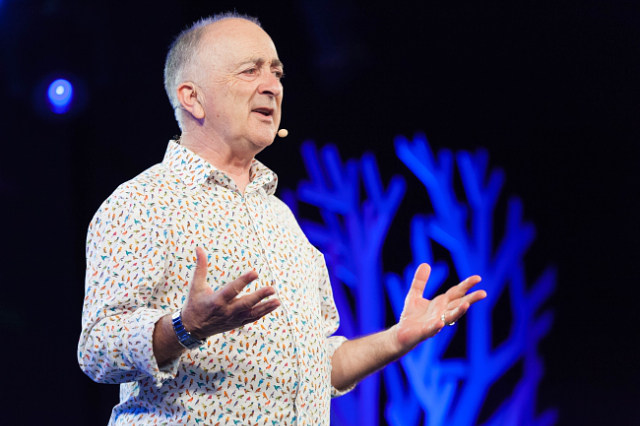
Photo © 2017, Liam Webb.
Tony Robinson wanted the house lights up so he could see everyone. Lucy Cotter introduced him as a politician and history buff at which point Robinson said “just a bloke doing his life really’. There was a fair chunk of humility that was apparent from the start.
Also setting the tone from the start were the jokes: Robinson’s mother spent World War Two defending the nation’s amateur dramatics. But on a serious note, she did encourage him to do theatre. As a teenager, the actor was understudied as the Artful Dodger and knew enough to get it right… he didn’t know the lyrics of ‘Consider Yourself’. He later went to drama school.
On the subject of school he said, “why does everything have to be a university degree?” He’s passionate about children having an education that is flexible, and said that as we don’t know what will happen in the future (what will be important then) why have just 5 important subjects?
When Robinson first read the pilot script of Black Adder he “though it was shite”, but then at that point it wasn’t what it would become. His letter, inviting him to audition for Baldric arrived very late in the creation process; he knew he wasn’t first choice. He never thought the role would change his life. There was little laughter during production; it was all about collaborative critique. “I don’t think there will be another Black Adder,” he said. The show ended on a high – even if another was written if wouldn’t be as good, nor as good an experience.
Of his TV show, The Worst Jobs In History, he said the worst was making the show; he was constantly ill from all the ‘muck’ and it took him 6 months to recover.
Cotter asked ‘why politics?’ (Robinson has joined the Labour party.) The actor spoke of hating bullying, the outrage about American history, but most importantly he didn’t want to just ‘moan about the world’ and then die knowing he hadn’t tried to do something about it. He talked about power in numbers. He’s active in his Bristol community; whilst it’s all away from his job as an actor he does realise the power of celebrity. People listen to him. He’s criticised Corbyn but says the leader had a good campaign. “We need the most robust opposition we can get.”
Robinson is also an ambassador for the Alzheimer’s Society. His parents both had Alzheimer’s for years; it was the ‘central motif’ of his life outside of acting. He found there was a lack of support for the condition and made a documentary about his mother, for which he received more letters than he had for Black Adder.
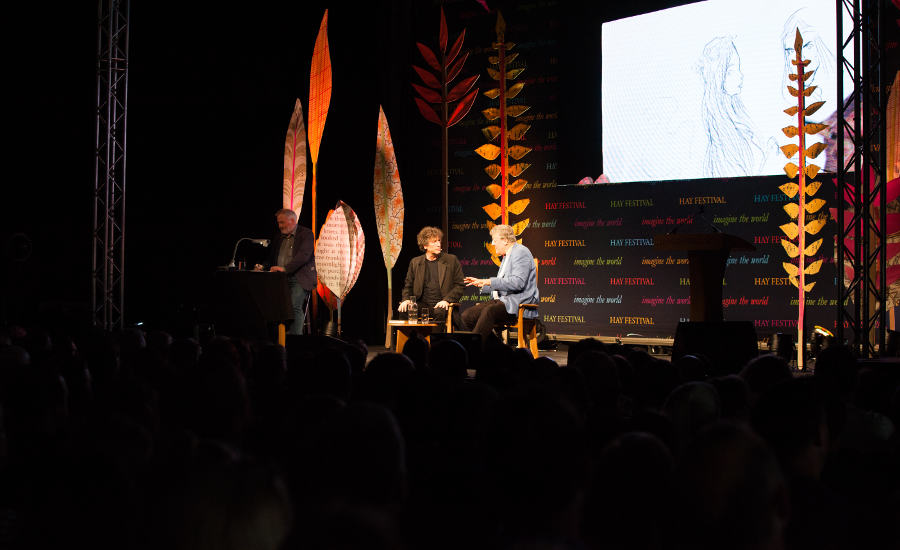
Photo © 2017, Marsha Arnold.
The evening after Tony Robinson’s talk, Neil Gaiman took to the stage with Chriss Riddell and Stephen Fry – it just made sense to link the two events together, all the more so as Robinson caused a small stir in the audience prior to the event, taking a seat in the first row. Riddell was there to ‘live draw’ the talk; the sketching was show on a big screen and for the most part Riddell drew his interpretation of the stories Fry and Gaiman were discussing, except the first drawing which was of Fry and Gaiman from Riddell’s literal point of view, a sketch of the side of Fry’s face and the back of Gaiman’s head. It was a fun talk throughout, but it was Riddell who initially set the tone.
The theme of the discussion was mythology, in particular Gaiman’s new book, Norse Mythology. The writer has always been interested in the topic and loved the Thor comics. The book began 9 years ago when he was asked about the subject. He spent several years thinking about how he should write it. It was important to him to write in a voice children could cope with. When it came to Loki and fighting, he stuck to one paragraph; he had looked forward to writing it but found it didn’t work dramatically.
Both author and actor read from their respective myth-inspired works; Fry’s is a book about Greek mythology.
Has Gaiman ever felt like a god, when writing and drawing? The reply: only twice – once when writing a Doctor Who script and including a stage direction, ‘interior Tardis’, and the second 30 years ago when he wrote what Batman might say.
At the end Gaiman’s wife, Amanda Palmer (who was performing at the festival) came on stage to read a poem he had written. All in all it was a much greater event than even the description (and quoted appearances) could have suggested.


