




Reading Life: 11th May 2018
Posted 11th May 2018
Category: Reading Life Genres: N/A
5 Comments

You may have seen on Twitter that I was away over the last week. For the first time I took only my Kobo and one very thin book, Valeria Luiselli’s Faces In The Crowd, which I found on a library shelf, the last date it had been borrowed suggesting to me I’d better take it out soon. I’ve learned a lot about library use the past few months.
Luiselli isn’t an author who has been on my list, but I recognised her name from a panel at Hay two years ago and knew that if she was there along with other well-known authors, her books were likely worth picking up. Faces In The Crowd, translated from the Spanish by Christina MacSweeney (Luiselli is Mexican) is about a woman who works as a translator, going around her city’s libraries to find more Latin American authors to add to her small company’s list. It’s a clever book-in-a-book, the novel she’s writing interspersed with dialogue and questions from, for example, her husband – on one page there is a paragraph about how the character shares a bed with another woman, and the couple of sentences that follow after a pause are composed of her husband asking her if it’s true she’s slept with women. It’s sometimes difficult to tell when or where any one vignette is set and whether it’s fiction within the fiction or simply the first level of it, as it were, but that becomes part of the charm and is undoubtedly a part of the point of it all.
I didn’t consciously borrow this book thinking I’d take it to Spain, but for the language it ended up being a good choice. As it turned out, my plans to read outside early each morning weren’t realised – the weather wasn’t very good – so I’ve still a fair amount of the book to read.
In other bookish news, I recently received Claire Fuller’s upcoming Bitter Orange and Yaa Gyasi’s Homegoing; the latter is set in the 1700s and already at page nine I’m loving it. With my event now less than a week away I’ll be switching between these two books, leaving others aside until the end of next week; the Gyasi is set for review on Monday, and I plan to have a good chunk of Fuller’s book behind me by Thursday. The remaining portion of The Female Quixote will have to wait a little longer.
At some point in the near future I’ll be reading Patrick Gale’s A Place Called Winter. I’ve wanted to read it for a while and found a library copy to browse through. The opening pages took me straight back to the fantastic literary atmosphere Anna Hope created in Wake; I want to go back to that particular combination of writing and setting.
What was the last translated book you read?
The Bookshops Of Hay-On-Wye
Posted 9th May 2018
Category: Chit-Chat Genres: N/A
Comments Off on The Bookshops Of Hay-On-Wye
Hay-on-Wye is called the town of books for good reason – there are more bookshops than you can possibly visit unless you don’t intend on browsing and haven’t come for the festival. Considering the amount of choice there is, it makes sense to go in with a plan. During my downtime at last year’s festival, I had a mooch around the streets to see what was on offer. Here are five of the best stores:
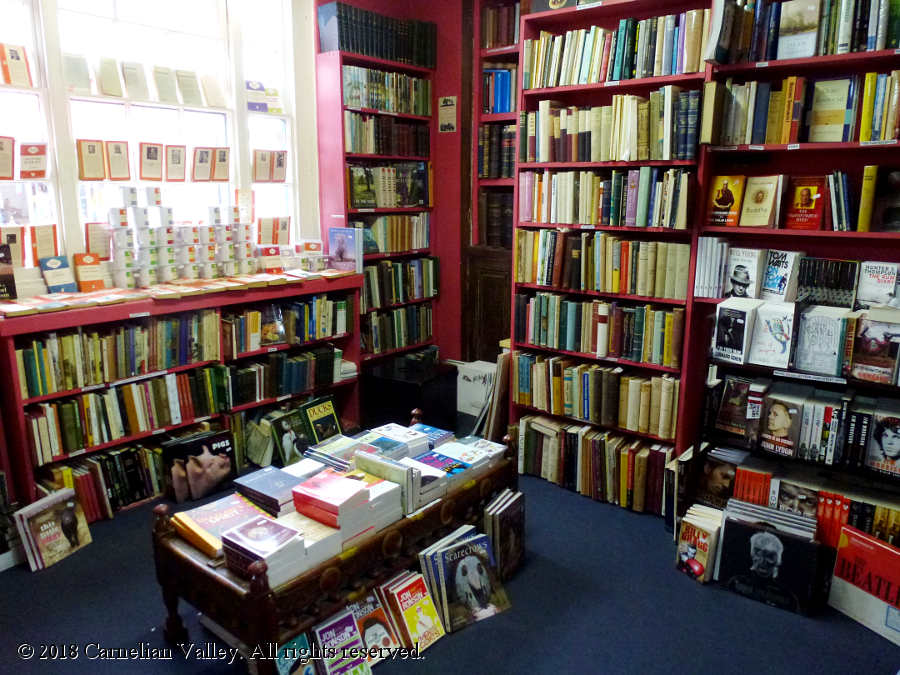
The Addyman Annexe: 27 Castle Street
Monday – Saturday: 10:00-17:30
Sunday: 10:30-17:30
There are two Addyman locations; this is the largest and stands on the main street you walk down from the festival site. The Annexe sells a lot of literary-related items; last year Taffywood Books mugs jostled for space on a windowsill with old orange Penguin Classics. A special festival section for children’s books took a little space. The shop sells a good range of both new and second hand books and is vibrant in its colour. Don’t miss the upper floor; the stairs are against the wall by the tall yellow shelves in the back room.

Broad Street Book Centre: 6 Broad Street
Open all week: 10:30-17:00
Situated across the street and a little further down the road from The Granary (a cafe you will come most definitely come across or hear about), is the Broad Street Book Centre. A fantastic rabbit warren of a store, just when you think you’ve reached the end it goes on further, with more books than you’d ever have thought possible from outside. The books are solely second hand and the variety spans all ages and categories, older books and new, from fiction, non-fiction, and poetry. Stacked away in a tiny space towards the back is a pretty marvelous selection of very old books, some popular selections, others you may never have heard of but want to buy nonetheless.
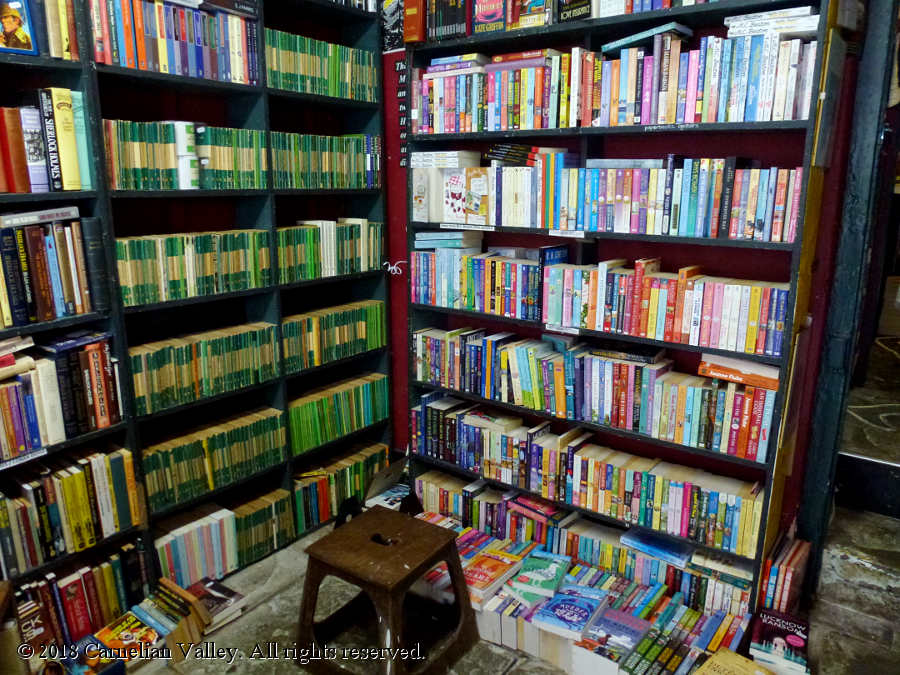
Murder And Mayhem: 5 Lion Street
Monday-Saturday: 10:30-17:30
Open some Sundays
This shop does what it says on the tin, except for the murder part! Whilst other shops have books on various surfaces, Murder And Mayhem takes it a literal step further with piles of glorious Allison & Busby mystery classics sat against the walls of the stairs. It’s worth the careful journey north as the room at the top is rather beautiful in its extreme bookish messiness. Back on the ground floor and the room you first enter into is full of wonderful publisher-specific piles. A great many Penguin Classics fight for space along the left wall, hoping you won’t miss them in this unusual arrangement where there are so many more books equally capable of grabbing the collector’s attention.
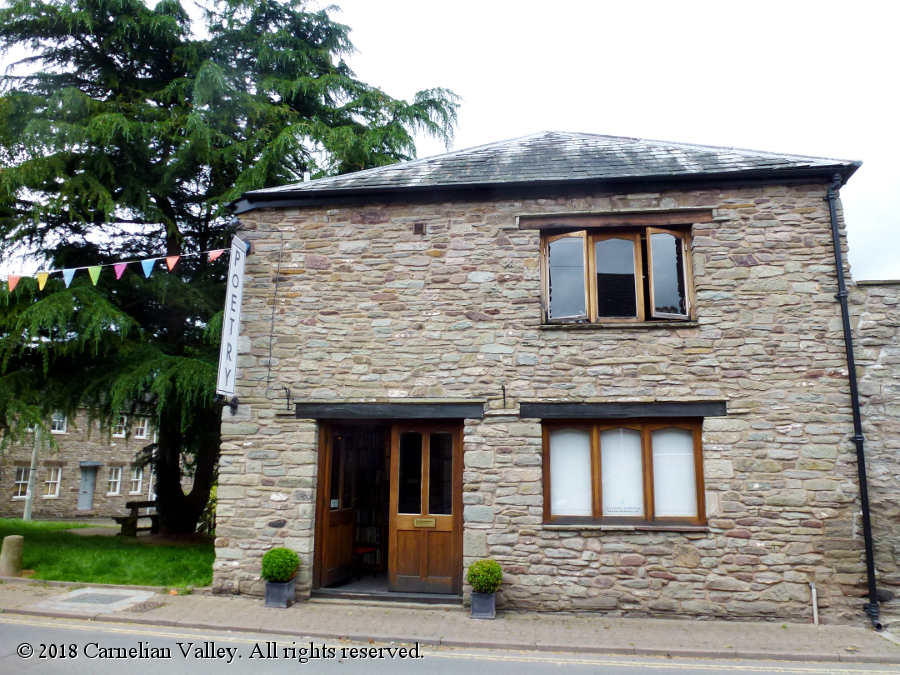
The Poetry Bookshop: The Pavement, Lion Street
Monday-Saturday: 11:00-17:00
Open some Sundays from 12:00
At the end of a tiny street away from the hustle and bustle of the town (at least when the festival is on) sits The Poetry Bookshop, in a detached building. A fair space, there are lots of shelves here and everything is carefully categorised. There are also lots of biographies of poets, compilations of literary magazines content, and books full of interviews. A selection of second-hand fiction rounds it off.
Richard Booth’s: 44 Lion Street
Monday-Saturday: 9:30-17:30
Sunday: 10:30-17:00
Cafe
Tuesday-Saturday: 9:30-4:30
Sunday: 10:30-3:30
Last orders are 30 minutes before closing
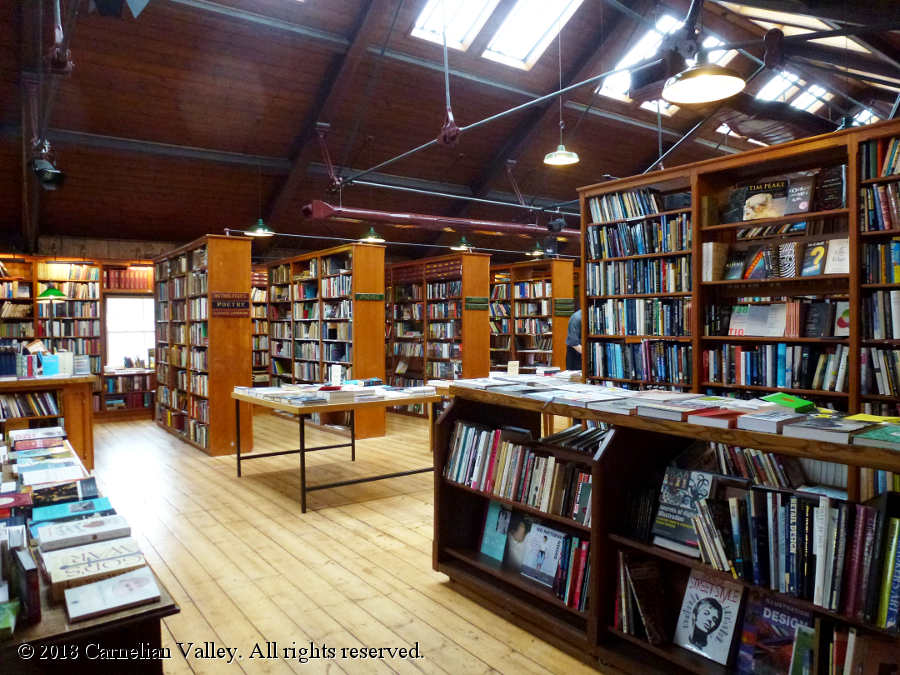
Richard Booth’s is one you can’t miss: nestled between others in its terrace, the exterior nevertheless stands out, its design ensuring your interest. At its entrance – very grand, all wood and lovely low ceilings, is the fiction, with a lot of books by authors in attendance at the festival. Awesome stationary – on this occasion sheets of wrapping paper with recipes printed on them – sat beside the counter. It’s worth walking on towards the back – a stunning staircase runs from the centre of the floor up to the new level where a large number of shelves are arranged much like a library. The selection is extensive. Sofas at the end of the main aisle, with plenty of light from the back and above in the roof make for an atmosphere place to read your new purchases. Crime books can be found in the basement.
In addition to a bookshop, Richard Booth’s own a cinema on Brook Street that shows a range of films – many based on books (the new adaptation of The Guernsey Literary and Potato Peel Pie Society is currently one of those on offer. I’m so glad they kept the full title!)
When I first walked round the bookshops and took my notes, I envisaged writing about them soon afterwards, partly because of the current climate of closures. I wasn’t able to write in time and, deciding to keep it back until the festival tents were up once again, I am delighted to say that all of the shops I visited – ten in total – are still there. Long may it remain the case.
April 2018 Reading Round Up
Posted 2nd May 2018
Category: Round-Ups Genres: N/A
4 Comments
A month of much better weather, Brits putting on the shorts and firing up the barbeques at the first higher temperatures. In the south we had our hottest April day on record for many years, a complete contrast to the snow of March. In reading, it was a month of authors beginning with ‘C’, entirely by accident. Whilst carrying on with my 1700s reading – and I’ve another on the list to start afterwards – I read Claire Fuller’s work in preparation for the restart of my conversation events. After having moved venue twice due to closures, I’m hoping I’ve found a good place in Cobbett Road Library, a community/local not-for-profit run hub.
All books are works of fiction.
The Books

Charlotte Smith: Emmeline – An orphan is finally visited by her uncle after a lifetime of neglect; the man brings his son who falls in instant infatuation with her and so begins a journey of getting away from suitors and finding her own way. Not so good in the context of today, but excellent in its historical context.

Claire Fuller: Our Endless Numbered Days – At nine years old, Peggy’s father kidnaps her from London, taking her to a remote place in Germany and telling her the world has ended when it hasn’t. A story of isolation and the effects of extremes, that ends with a nod to magical realism.

Claire Fuller: Swimming Lessons – Gil sees his long-lost wife outside the bookshop and injures himself trying to catch up with her; alongside the narrative of the family coming together to help him are the letters Ingrid wrote to Gil about the lie of their marriage, that she slips in between the pages of relevant novels. This will be on my best of list for this year, it’s an utterly fantastic book – very well written, well plotted, and the literature aspect is incredibly compelling.
No guesses which my favourite was!
Quotation Report
In Swimming Lessons, Claire Fuller posits that ‘writing does not exist unless there is someone to read it, and each reader will take something different from a novel, from a chapter, from a line. A book becomes a living thing only when it interacts with a reader’.
It’s getting to that time of year when shortlists are publicised in earnest and many books are released in time for the longest of days. I’ve got a lot on my list to read (Fuller’s Bitter Orange, Manu Joseph’s latest) and looking forward to it. But first I have to finish the Charlotte Lennox; at 1/3 of the way in, I’m starting to wonder if anyone is going to point out to the main character that her ideas of gallantry and death are based on ancient mythology and cannot be applied to the real world…
Which new releases are you looking forward to?
Rebecca: What Does Du Maurier’s Purposeful Omission Of The Narrator’s Name Imply?
Posted 30th April 2018
Category: Further Thoughts Genres: N/A
Comments Off on Rebecca: What Does Du Maurier’s Purposeful Omission Of The Narrator’s Name Imply?

Screen shot from Rebecca, copyright © 1940 Selznick International Pictures.
Looking first at the way the question is written, with emphasis placed on Du Maurier’s choice – pointedly phrased as ‘purposeful omission’ – one must consider the real life context of the book. It has been reported that Du Maurier wrote Rebecca as a study of jealousy (House, 2013), and whilst many have seen it differently, the author’s life and in particular her relationship with husband, Tommy Browning, supports it. Du Maurier was rather jealous of Tommy’s former fiancée (House, 2013); not much is known about Jan Ricardo besides the fact of the broken engagement, and the taking of her own life (Dennison, 2008) shortly after the publication of the book, which Du Maurier was reportedly sad to hear (Picardie, 2008) – her jealousy may have been considerable but not that zealous.
The novel is of course very strong in its thoughts on the woman who came before, but given the evidence, it would be wrong to say Du Maurier didn’t use her own feelings as a jumping point, letting the novel unravel from there, particularly considering her works tend to be thrilling generally. There are however definite distinct references to Jan, such as Rebecca’s signature – an elaborate ‘R’. (Du Maurier once found letters from Jan to Tommy, signed off with a flourish (Picardie, 2008).) Perhaps Du Maurier saw it as a sign of possession or used the idea of such in her fiction. Certainly the unnamed heroine views the situation as one of Rebecca’s posthumous possession of house, husband, and everyone related to them.
Away from this context, the omission implies a lack of importance, and here we can point both to the heroine’s lack – or perceived lack – of importance to others and the lack of importance she believes herself to have. (Surely with the amount of dialogue included, someone would have said her name at some point.) The dialogue running without reference to a name allows Du Maurier to showcase the way Max treats the heroine – ‘little love’ and other terms of affection, as well as the usage of ‘you little fool’ is a constant reminder of the age gap between the characters and an insight into how Max may feel about her.
The lack of a name simply reiterates Rebecca’s importance.
In our popular consequential reference to the narrator as ‘the second Mrs de Winter’ we emphasise the ranking, albeit very unwillingly. Perhaps Du Maurier had that idea in mind when she wrote – she must have considered the consequence of not providing a name. Should we have adopted this as a name? Or do we thus take this potential extra layer of decision not to include a name as further evidence of omission?
A minor point to consider: given the various allusions to Jane Eyre, could the lack of a name also be a reference to Jane’s position, a commentary on it? It is unlikely but interesting to posit nonetheless.
With all the above taken into consideration as a study, however, it is important not to neglect primary or secondary sources:
“She couldn’t think what to call her and so she didn’t call her anything. And then it became a challenge: could she actually write the whole thing without it… Funnily enough, in the Hitchcock film, in the script she is written as ‘I’, but they all called her ‘Daphne’ on the shoot.” — Kits Browning (Browning, in House, 2013)
“I could not think of one, and it became a challenge in technique the easier because I was writing in the first person.” — Daphne Du Maurier (Du Maurier, p.388)
It has been said that when writing, Du Maurier called her ‘Daphne’.
References
Online
Dennison, Matthew, 2008, How Daphne Du Maurier Wrote Rebecca, Telegraph.co.uk, accessed 30th April 2018
House, Christian, 2013, Daphne Du Maurier Always Said Her Novel Was A Study In Jealousy, Telegraph.co.uk, accessed 30th April 2018
Picardie, Justine, 2008, Daphne: The Truth Behind The Story, Justine-Picardie.blogspot.com, accessed 30th April 2018
Books
Du Maurier, Daphne, 2005 [1938], The Rebecca Notebook & Other Memories, Virago
The Influence Of The Female Quixote On Northanger Abbey
Posted 27th April 2018
Category: Further Thoughts Genres: N/A
2 Comments

In her 1989 introduction to the Oxford University Press edition of The Female Quixote, Doody proposed that, with its bookish heroine who believes women’s lives and loves should play out as they do in epic novels (the character’s sole experience of life is through reading), Lennox’s word influenced Austen when she created Northanger Abbey. I’m now several chapters into Lennox’s work and already the inspiration is very apparent; whilst Northanger Abbey speaks of Ann Radcliffe, Frances Burney, and Eliza Parsons (whose referenced works were first thought, in the context of Austen’s book, to not be real) there are a huge number of similarities between it and Lennox’s work.
It’s interesting that the book that was perhaps the biggest influence was not named by Austen in her novel1; perhaps the older work, successful during its time (and Lennox is now seen in academia as incredibly important2), wasn’t popular enough later on for her to feel a commentary was worth it. (‘Moderately popular’ has been proposed as the level of Lennox’s fame in the 1800s (Wikipedia, n.d.); the book is pretty obscure today but slowly gaining in popularity again.) It’s also possible, if we consider the subject of plagiarism that is so commented on today, that Austen was aware just how similar her work was, that she was parodying a book that is itself a parody, and, to use a modern phrase, didn’t want to go there. However, considering the way she is very open, through the character of Catherine Morland, that her book owes a lot to the Gothic fiction of decades past, that second possibility isn’t nearly as compelling.
I think we’d better have a list of the comparisons I’ve noted so far:
- Both Catherine Morland and Arabella are incredibly bookish.
- Both read books that are real works of literature.
- Both get their ideas of romance and what they should expect from that literature.
- Both expect the world to align somewhat to that literature (though Arabella expects far more).
- Both books are comedic.
- Both books break the fourth wall between author and reader.
The characters’ choices of reading material differ slightly – Catherine reads Gothic romance from the 1700s, and Arabella reads epic romances from 1600s. (Arabella’s favourites include the longest work of literature published by a mainstream publisher, Artamene Ou Le Grand Cyrus by Madeleine de Scudery – 13,000 pages. No wonder the hero of the book is shocked when he agrees to read her favourites and Arabella’s servant arrives with them!)
Exaggeration and high drama permeate both characters’ choices, but Arabella takes it further than Catherine. Where Catherine gets excited about staying in a gothic building, opens doors she shouldn’t, and accepts criticism, Arabella lives her life to the letter, so to speak, and expects people to conform to the ways of behaviour of her favourite characters which, given they are often historical and taken from ancient myths, are even more exaggerated and over the top than anything from Arabella’s own period. Catherine is a little out of touch with the reality of her world; Arabella is getting towards being a transplant from centuries past.

The reason for each character acting the way they do is different. Catherine’s reading aligns somewhat with what we know about Austen: her bookishness is ultimately her choice and she is fairly independent. Arabella has been isolated all her life, in part due to choice, but also due to her standing; she found her father’s library and that was that. Lennox was estranged from her husband for years before they separated, a man who claimed to be an Earl but likely was not. Lennox was part of the same literary scene as Samuel Johnson, Joshua Reynolds, and Samuel Richardson. The women of the circle were not fond of her. She was well known in her circles but otherwise mostly anonymous.
Two authors of relative independence who were quite successful in their times but mostly anonymous; known to a few people of standing – Lennox more than Austen; both more successful in the years since their deaths, with Austen’s fame increasing far quicker than Lennox – Austen has been famous for a long time, whilst Lennox’s fame is today still on the rise.
It’s fascinating to look at two works alongside each other, one known or suspected to be an influence on the second. It’s particularly compelling when looking at works of centuries past where close reading is required more than it is when comparing more modern texts, the lesser amount of knowledge as to the writer’s background and the genesis of the work necessitating more time spent on the fiction due to there being fewer, if any, opportunities to incorporate authorial evidence that supports the idea.
Footnotes
1 It is, however, named by Austen in a letter to Cassandra:
“Alphonsine” did not do. We were disgusted in twenty pages, as, independent of a bad translation, it has indelicacies which disgrace a pen hitherto so pure; and we changed it for the “Female Quixote,” which now makes our evening amusement; to me a very high one, as I find the work quite equal to what I remembered it. Mrs. F. A., to whom it is new, enjoys it as one could wish; the other Mary, I believe, has little pleasure from that or any other book.” (Austen 1807, cited in Woolsey, 1892)
2 In a general article about Lennox, Facer says: “Today Lennox’s careers as poet, dramatist, translator and editor have been eclipsed by her reputation as one of the most celebrated novelists of her time.” (2012)
Book References
Doody, Margaret Anne (ed.) Introduction, in Lennox, Charlotte, The Female Quixote (1989) Oxford University Press, Oxford, page unknown.
Woolsey, Sarah Chauncey (ed.) The Letters Of Jane Austen (1892), Little, Brown, And Company, Boston, p.90
Online References
Facer, Ruth (2012) ‘Charlotte (Ramsey) Lennox’, ChawtonHouse.org, accessed 27th April 2018.
Wikipedia (n.d.) ‘Charlotte Lennox’, accessed 27th April 2018.


