




British Book Awards 2019: Non-Fiction Narrative Book Of The Year
Posted 13th May 2019
Category: Chit-Chat Genres: N/A
Comments Off on British Book Awards 2019: Non-Fiction Narrative Book Of The Year

An update is at the bottom of this post.
Tonight, at a large awards ceremony in London, the winners of the British Book Awards (‘Nibbies’) will be announced. A set of prizes that have been given out yearly since 1990, the Nibbies are the awards of The Bookseller magazine, which has itself been around since 1858. Called ‘the BAFTAs of the book trade’, the Nibbies are comprised of eight awards which are judged by eight different panels and the idea behind them is that they champion books that are ‘well written and brilliantly published’ – honouring both author and the publishing team. There are then a variety of awards for industry people, publishers, and book shops.
The categories for books are: Debut Book of the Year; Children’s Fiction Book of the Year; Children’s Illustrated & Non-Fiction Book of the Year (new for 2019); Fiction Book of the Year; Fiction Crime & Thriller Book of the Year; Non-Fiction Lifestyle Book of the Year; Non-Fiction Narrative Book of the Year; Audiobook of the Year. It’s a lot of categories but, as I noted when writing this, it ensures books are compared with others that share a subject, whilst not being too niche.
Philip Jones, editor of the magazine and chair of the judging panel, has said that the shortlists ‘showcase the breadth of talent available to publishers in the UK, after a year in which international writers… have shown that there is a real hunger for stories, well-told, that originate elsewhere but reflect back on us… today’s books sit at the intersection between culture and politics, and between entertainment and reality’.
As the awards are tonight I thought I’d look at the six books in an ‘at a glance’ fashion; I’ll be reviewing one or two in the weeks to come.
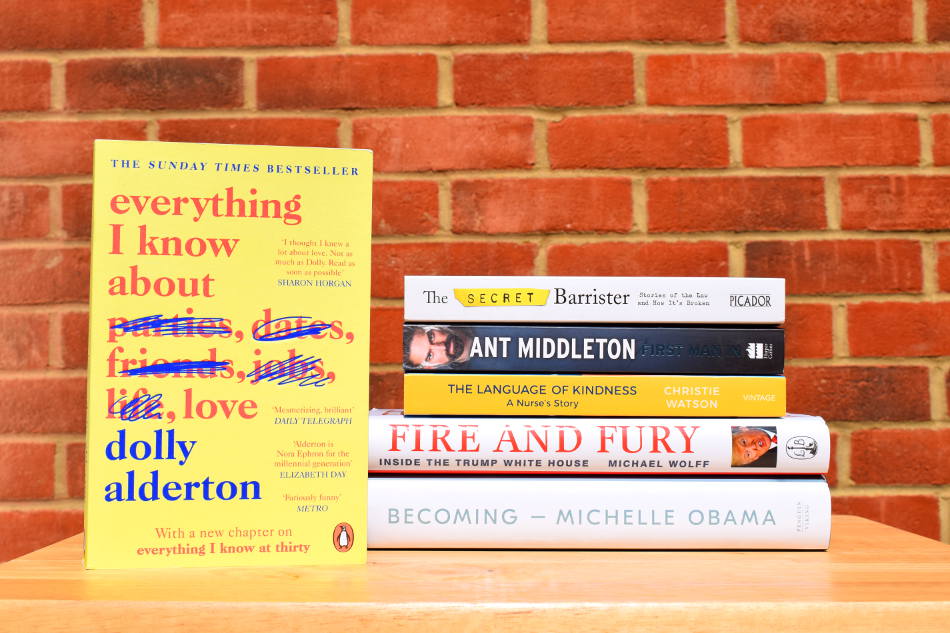
Everything I Know About Love is a memoir about Alderton’s teenage and early twenties years, told in a sort of essay fashion; it goes back and forth between various places and times, detailing Alderton’s experiences with drink, drugs, sex, and relationships both platonic and romantic, an open account of her growth as a person. Alderton is a journalist for The Sunday Times and a radio presenter; through reading her book you learn about her shorter periods of time in television and about her freelance career. The book is written in a casual, carefree, manner which suits the content, enables the humour to work very well, and means that the book is an easy read in a very good way. Speaking at the Curious Arts Festival last year, Paul Blezard, who interviewed Alderton, said the book is about ‘the honesty of growing up and learning from it’. (My post on this is here.)

The Secret Barrister by someone known only by the title of their book, this is a collection of stories of life inside the courtroom. It’s ‘both an account of the human cost of the criminal justice system and a guide to how we got into this mess’. Written in a jovial tone, it’s about the issues in the system and what needs to change; it’s won a couple of awards already. The author cites themselves as pretty average; it’s the everyday of someone who deals with things we don’t tend to consider everyday things.
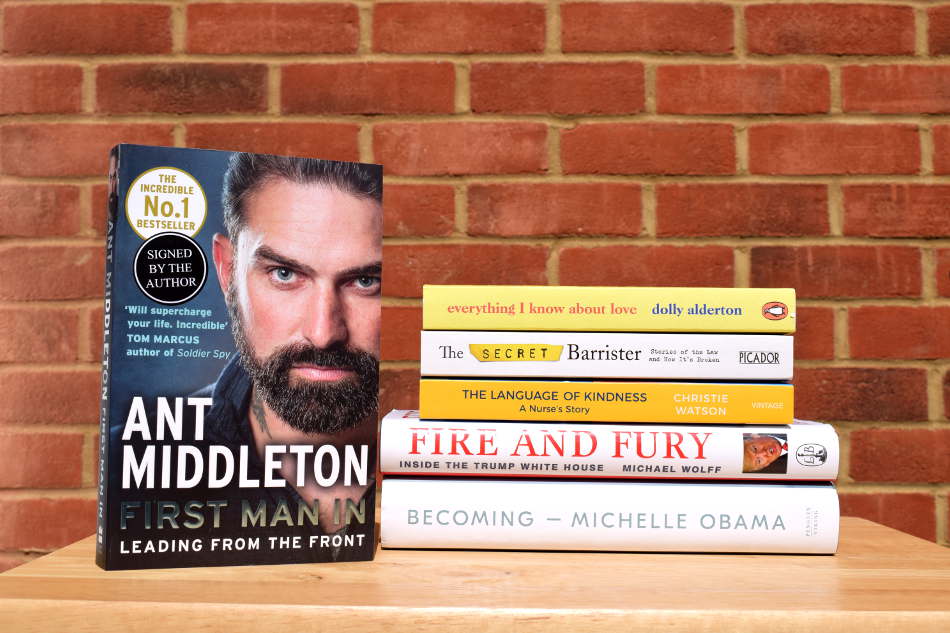
First Man In by Ant Middleton is a memoir of Middleton’s various careers and what he has learned through them. The author is a former soldier, adventurer, and is currently the ‘Chief Instructor’ for Channel 4’s show, SAS: Who Dares Wins. (This year 25 people will go to the Andes; people eat, sleep, live together, whilst completing a tough course.) Middleton has been in the Special Forces. He spent time in the Special Boat Service, the Royal Marines, and the 9 Parachute Squadron Royal – the three are the ‘Holy Trinity’ of the Elite Forces.

The Language Of Kindness is Christie Watson’s memoir of her twenty years as a nurse. The author of the Costa First Book Award winner, Tiny Sunbirds, Far Away, Watson’s prose has a particular flow; even if you’ve not read the novel, as I haven’t, you can see the writing background. Beginning with a short summary of how she came to be a nurse – a previously indecisive sixteen year old finding reward working for patients with the charity now called Scope – Watson details many periods of her career, individual stories of hospital stays, good health and happiness alongside sadness, with a close attention to privacy for those involved.

Fire And Fury is Michael Wolff’s ‘Trump era exposé’, an account of the early days of Trump’s presidency by a journalist who was afforded particularly good access to the White House in the first hundred (and more) days of the time, and also followed the campaign. As Wolff details, few on the campaign team thought that Trump would be elected, and Trump had a concession speech prepared. And as the election was very different to others, there was a lot to get used to. Told in a style that’s anything but dry, and featuring mirade interviews, it’s proved a popular book so far.
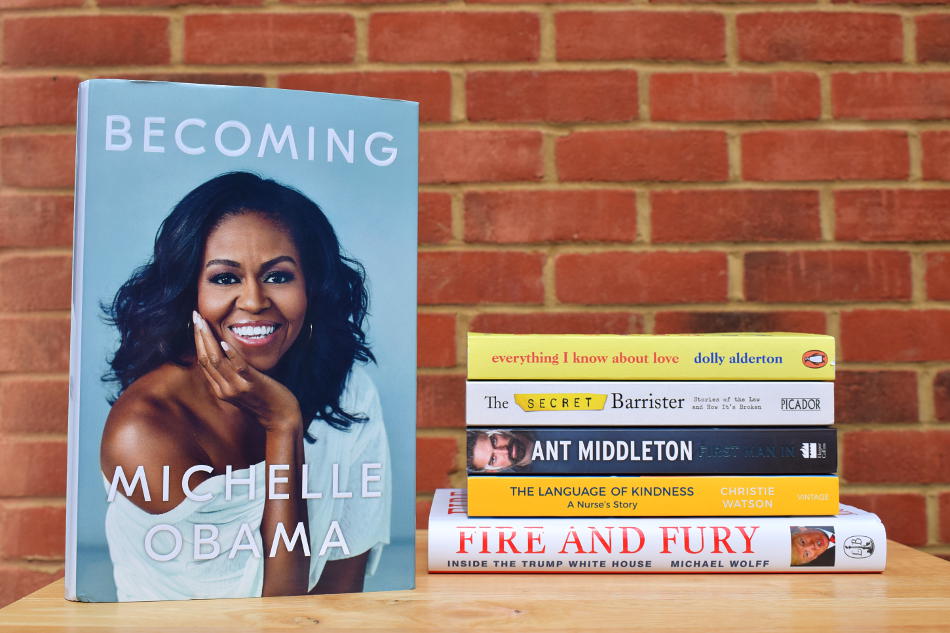
Becoming is Michelle Obama’s memoir, a hefty tome of a book that, though I’ve only read a couple of chapters so far, is surely worth every one of its pages. Told in a lovely detailed and, dare I use the word everyone else has, honest, tone, she tells the story of her early years to the present, with stories that hold particular memories – the preface contains a brief summary of life as First Lady and the return to life outside the White House; the first chapter is focused on early piano lessons in her aunt’s apartment against a background of her general family situation. The book is also on the shortlist for the Audiobook of the Year category (and it’s narrated by Obama herself). A book by and about someone well loved and respected for a great many reasons, who is incidentally also known to be a big reader – this is the book I’d be betting on and would be happy to see win.
Update at 11PM: Michelle Obama won this category as well as Audiobook of the Year. In a video message she said to those gathered at the ceremony: “This is an incredible honour. I want to thank the British Book Awards for this recognition, as well as Penguin Random House UK and everyone who helped bring this book to life – especially the readers. It’s been such an uplifting an powerful experience to share my story with everyone across the United Kingdom these past few months. I especially loved the opportunity to connect with so many bright young women, like the incredible students at the Elizabeth Garrett Anderson and Mulberry schools in London, whose stories reminded me so much of my own. Two years ago, when I started writing this memoir, I wasn’t thinking about awards; my biggest hope was simply to create something meaningful for the people who read it, something they might be able to connect to their own lives. Because I know that my story isn’t unique. It’s the story of a working class black girl learning to make music on the piano with broken keys, of a high school student who wondered if she’s good enough, of a mother trying to balance a career, two daughters and a husband with big goals, while carving out a better sense of herself. I want to thank all of you for allowing me to share my story. My greatest hope now is that each of you will share yours too.”
Have you read any of these or have any thoughts as to which might win?
Mudie’s Select Library And The Three Volume Novel
Posted 10th May 2019
Category: Chit-Chat Genres: N/A
Comments Off on Mudie’s Select Library And The Three Volume Novel
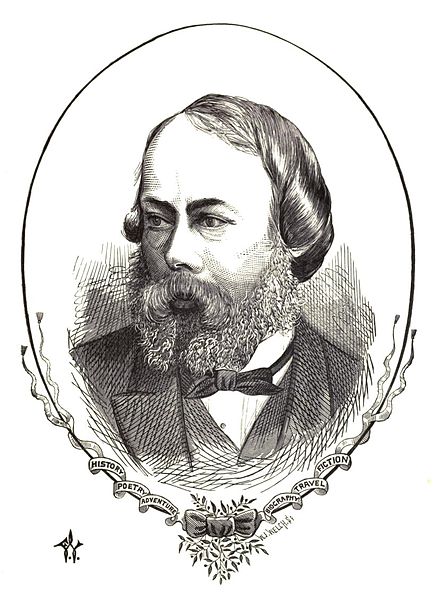
Born in 1818 in Chelsea, London, to newspaper shop keepers originally from Scotland, Charles Edward Mudie wasn’t the first person to create a circulating library but he was the person who brought it to prominence. He had the business background to build his library upon. He opened his first bookshop in 1840, ‘a little shop in Bloombury’ as The Times called it1 (The Times, 1913).
In 1842, Mudie began lending books to students of the University of London. For a guinea a year (equal to 20 shillings – in today’s currency a shilling is roughly 5 pence) a student could borrow one volume at a time. The system was so successful that Mudie moved to a better location and soon had branches of his library in other cities, including Manchester and Birmingham (Wikipedia n.d. a). Deliveries in England were made with vans and trains. Ships took orders overseas (ibid.).
The reason Mudie was so successful is summed up by George Landow in his 2001 [1972] review of Guinevere Griest’s 1970 work, Mudie’s Circulating Library and the Victorian Novel. Landow notes the ‘famous guinea yearly subscription’. (For a higher fee you could borrow more than one at a time.) Landow also notes the advertising that created ‘something very like a best-seller list’, a new market that established Mudie’s power. Mudie also ordered books in large numbers, sometimes entire print runs. (A print run would comprise of up to 1000 copies.)
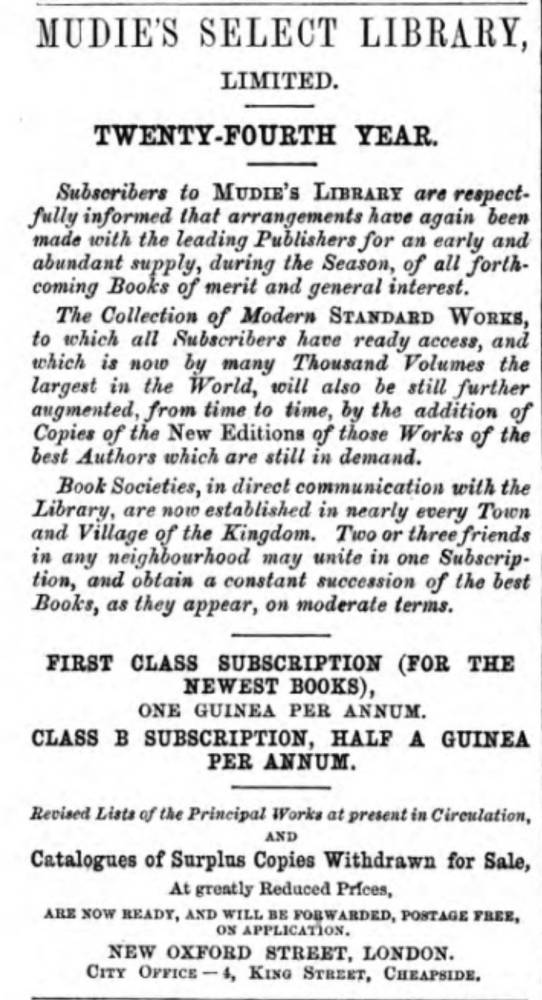
Readers didn’t have to wait long to read the books they wanted. At the height of the library’s popularity, Mudie boasted over a million titles (Spiegel, 2011). The Library catalogue for January 1860 notes, in letters rather than numbers – possibly so that it looks even better – ‘rate of increase exceeds one hundred and twenty thousand volumes per annum’, and genres include history, biography, religion, philosophy, travel, and, in all its pomp and capitalisation, the ‘HIGHER CLASS of FICTION’ (Catalogue of New and Standard Works, 1860, contents page).
Mudie had originally started lending to provide wider access to non-fiction; the genre was a good amount of the stock, and it was this that made the consumption of scientific volumes a success – Mudie bought 500 copies of Darwin’s On The Origin Of Species; Darwin’s own reading was thanks to Mudie (Wikipedia n.d. a). But Mudie recognised the market for fiction.
It was Mudie’s influence that led to the popularity and full adoption of the three volume novel; Mudie demanded publishers produce only three volume novels, which allowed one work to be divided between multiple subscribers, increasing both stock and the number of borrows. Why Mudie was so successful here is due to the fees he set and the accessibility of his library. Lending libraries were crucial to the middle class’s access to literature. Books were expensive to buy, costing the equivalent of half the weekly income of an average household but the guinea per year set up at Mudie’s was relatively lower cost. Mudie’s influence over publishers, due to this social mobilisation of the middle class, effected the morality, subject, and scope of what was published for the next 50 years (Landow 2001). He was all the more powerful because other libraries began to follow his recommendations. Books were censored or not published at all if Mudie didn’t like them (he took note of his customer’s opinions on books)2. Authors were often contracted for a specific number of pages and if their books weren’t quite in line with the format they were asked to change them so that they were in line. (This is likely why Charlotte Brontë, when writing to her sisters’ publisher – her own potential publisher – noted that Jane Eyre was a work in three volumes, and is also perhaps why Emily and Anne’s novels were sent together as a combined three volumes. Despite a rejected first novel, she knew what needed to be done in order to succeed.) Mudie’s advertising informed subscribers of new works and reminded them of the service in general3.
Thus the three volume novel became the standard in the 1800s; before that there had been novels in volumes of varying numbers. Shorter works were simply divided into chapters. The format had first been produced by publisher Archibald Constable in the early 1800s; however his influence over the three volume novel was small – publisher Henry Colburn (who had worked at a circulating library) made it more popular. The format made it easier for new authors to be published. Their reputations were more in Mudie’s hands than the critics, who in turn often hoped bad novels would just not be ordered by libraries – but the system put a barrier between authors and readers, and discouraged several generations from buying novels (ibid.). In an article published in 1965, Guinvere Griest said that there were single volume novels – mostly books previously published in three – but that there was an ‘aura of dignity and worth’ to three volumes which eclipsed all other forms (1965, p. 117).
The three volume novel remained popular as a form until 1894, when Mudie (the library), along with W H Smith’s (first founded in 1792 as a news vendor and, according to Griest, Mudie’s only rival) stopped buying it.
Mudie himself died in 1890. His libraries continued to run until the 1930s when public libraries began to rise with services that were even cheaper. (They had first begun to gain traction in the late 1800s and thus Mudie had experienced the lessening of his empire.) But interestingly, as Landow says, Mudie’s lost its power in particular due to its own decision to abandon the three volume novel (2001). ‘The end of the Victorian circulating libraries, however, does not coincide’ says Griest, ‘with the end of [Mudie’s and W H Smith and Sons] but rather with the extinction of the three-decker, a method… so closely entwined with [circulating library] prosperity that the end of the one spelled doom of the other’ (1965, p. 104)4. As publishers began publishing very cheap second editions comprising of all three volumes, the libraries had trouble keeping their capital and not finding themselves faced with a ton of books that were no longer being borrowed. They tried to tie publishers’ hands but now the publishers were worried about the effect a return to higher prices would have on the industry and readers. Mudie’s successor, his son, Arthur, chose to kill off the three volume novel rather than raise subscription prices, believing higher prices would not help (ibid, p. 123). He said later that he didn’t believe in the three volume novel. How his father would have taken that, we can never know.
Footnotes
1 The Times notes that circulating libraries had been in existence since at least the Middle Ages, though they state as the pioneer one Samuel Fancourt (1678-1768).
2 Straight after the list of genres included, and the Catalogue says, in italics, ‘Cheap reprints, Serials, Costly Books of Plates, Works of merely Professional or Local Interest, and Novels of objectionable character or inferior ability, are almost invariably excluded’. (At least they gave a capital letter to those Novels!)
3 Landow’s referenced writer, Griest, said in an earlier article about Mudie, ‘Publishers’ advertisements of newly issued fiction in the middle and late years of the nineteenth century frequently proclaimed to interested readers, “Popular New Novels, at all the libraries, each in three volumes, crown octavo,” or “This say, at all libraries, in three volumes…,” thus revealing the importance of these great lending organizations in book distribution and, by implication, the dominance in the fiction lists at the libraries of the novel in three volumes. In other words, novels were announced not for sale, but as available to the public through lending organizations.’ (Griest, 1965, p. 103).
4 We can assume Griest meant W H Smith’s in its historical form – Smith’s survives still today though it is now a combination of bookshop, newsagents, stationers, and often post office.
Book References
Catalogue Of New And Standard Works In Circulation At Mudie’s Select Library (1860) Charles Edward Mudie, New Oxford Street London
Article References
Griest, Guinevere (September 1965) A Victorian Leviathan: Mudie’s Select Library, Nineteenth-Century Fiction, Vol. 20, No. 2, pp. 103-126, University Of California Press, accessed 10th May 2019.
Landow, George (2001 [1972]) Mudie’s Select Library and the Form of Victorian Fiction, The Victorian Web, accessed 10th May 2019.
Spiegel, Nancy (2011) Circulating libraries: library history and architecture, University Of Chicago Library News, accessed 10th May 2019.
The Times (2nd September 1913) London Circulating Libraries, accessed 10th May 2019.
Wikipedia (n.d.-a) Charles Edward Mudie, accessed 8th May 2019.
Wikipedia (n.d.-b) Three-volume novel, accessed 10th May 2019.
Latest Acquisitions (April 2019 – Thanks To My Sister)
Posted 6th May 2019
Category: Acquisitions Genres: N/A
8 Comments
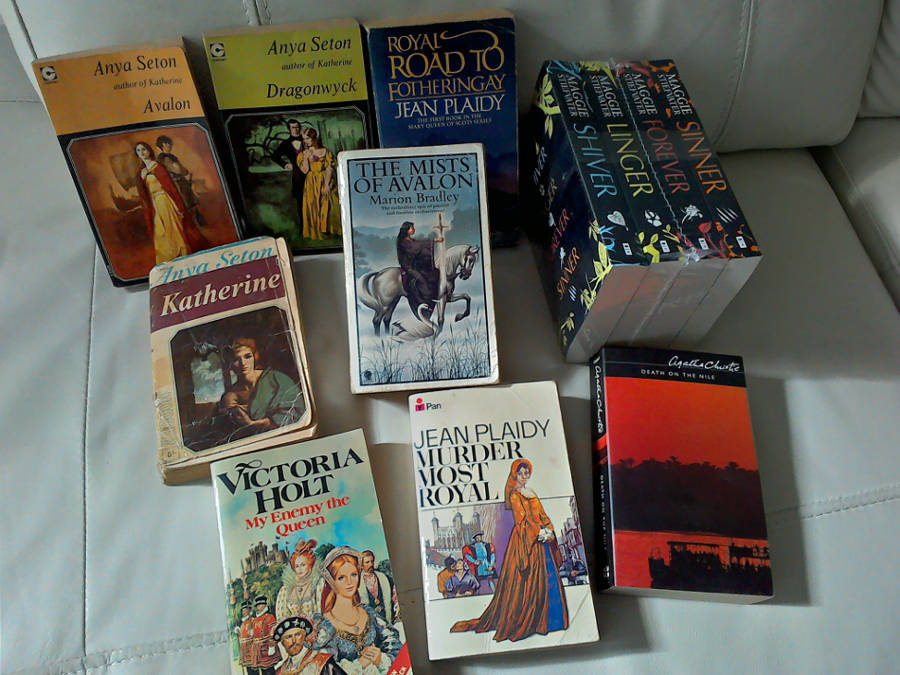
Considering this is a different sort of post and also considering I wrote a latest acquisitions a couple of weeks ago, I’ll keep this short. Suffice to say, as I imagine you’ll all understand, I was excited to see the above books in the collection. Victoria Holt and Jean Plaidy are one and the same; as Holt the writer’s books can be difficult to get hold of and I’d been recommended them. The Christie is several books into the series, but if what I’ve read is correct, the stories can stand alone – is that right? I’ve wanted to read Anya Seton for years but never knew where to start; that the copy of Katherine has been incredibly well-read made me look it up online and it sounds as though it’s a favourite of her readers. I’d also been wanting to read Maggie Stiefvater but after losing track of her publications I put her books on the ‘maybe’ list; I’m now able to move them back up.
I’m guessing almost all of you will have read at least one of these books or other books by the same authors. Where should I start?
April 2019 Reading Round Up
Posted 3rd May 2019
Category: Round-Ups Genres: N/A
5 Comments
I did fairly well this month, all told. I’ve still got a number of books ongoing but I finished the two below and am not too far from finishing two more. In related news, my sister asked me if I’d like to look through her historical fiction before she unloaded a number of boxes to the charity shop and it was very exciting to see her collection included old Anya Setons and Jean Plaidys (she also had an unopened bundle of Maggie Stiefvater. I’m considering a special acquisitions post. (On this note, she had a copy of Castle Dor attributed to Daphne Du Maurier, and whilst I didn’t take it has an interesting backstory. It seems to be news to most people – it’s actually the completion of a draft by Sir Arthur Quiller-Couch (‘Q’); Du Maurier was given it by his daughter. Although it’s based on an interesting story – Tristan and Isolde – readers have stated that due to a seemingly hands-off approach to the initial draft, it’s very noticeable where Du Maurier comes into the picture, and unfortunately this leads to a disjointed text with a beginning that’s very much at odds with the values suggested in Du Maurier’s own books.) Books aside, April has otherwise been good, a busy but fun Easter, and many days without rain – being able to have breakfast outdoors has been wonderful.
All books are works of fiction.
The Books
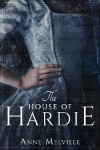
Anne Melville: The House Of Hardie – Two sets of siblings in late 1800s England work towards their wishes for life which mostly go against the norms of the day. It feels repetitive considering my last post was the review, but ‘fantastic’.

Orlando Ortega-Medina: The Death Of Baseball – The night of Marilyn Monroe’s death, a Japanese American boy is born and as he grows older he finds a particular kind of kinship with her; meanwhile a devout Syrian American Jewish boy is struggling with extreme, dangerous, compulsions. This is out in June and I’m reviewing it then so for now I’ll just say if you like psychological thrillers and films from Hollywood’s golden age, you’ll appreciate it.
Quotation Report
In The House Of Hardie the irony of women having the strength to get through multiple births is noted alongside the expectation that they also be completely afraid of mice. Noted also is the fact an education is important in moving up in the world, and that novels ending with wedding ceremonies doesn’t account for the wedding being a beginning.
May will be about finishing more of my current reads, and I’m likely to choose one of my sister’s books to add to the list.
What are you currently reading?
The Crossway: An Overview
Posted 29th April 2019
Category: Chit-Chat Genres: N/A
2 Comments

On the Rathbones Folio Prize 2019 shortlist is Guy Stagg’s The Crossway, a narrative non-fiction account of his journey on foot from Canterbury to Jerusalem. It’s the book I have been championing for the Prize on Twitter.
On New Year’s Day 2013, Stagg begins a pilgrimage that has been done for a great many years by Christians for varying reasons; it’s a journey not taken lightly but in Stagg’s case is all the more significant for the season in which he departs. Along the way, particularly during those months where the winter is cutting and the snow will hinder progress, the people he meets exclaim their surprise and often advise pausing the pilgrimage until the weather improves; or perhaps he should be using transport – most pilgrims start in spring, autumn at the latest. But Stagg is driven by the feeling that if he stops he won’t continue; he began his journey when he did because he knew that to wait would result in never beginning. There is of course irony in his hosts’ advise – to stop what is supposed to be a difficult journey – but the determination Stagg has, at once wonderful and foolhardy (though it pays off), is what keeps him going. And the events during his journey provide a present day context for the stories he tells of historical, religious, figures.
Stagg is not religious, though his attention to detail in regards to the various saints and other pilgrims shows a great interest in the facts regardless; the specifications of stories about pilgrims, both those cannonised (or beatified) and others who were simply popular, include a good amount of research. Presumably first conceptualised at the time of his introduction to the figures through conversation with those along the road, and later researched in greater detail, these stories form one third of the overall content of the book.
The other two thirds are comprised of the journey itself and Stagg’s reason for walking – he hopes the ritual of pilgrimage will help him as he heals from mental illness. The journey doesn’t get as much time as you might expect – this is somewhat accounted for by Stagg’s stories of the kindness of those who gave him shelter and the way of pilgrimages where the path is trodden enough that there are systems in place – but where the road is particularly difficult, the details are fleshed out.
Catholics, Christians from other denominations, and those with the knowledge (whether religious themselves or not) may be the most obvious readers for this book, but the stories included are valuable also simply for history’s sake, particularly where the stories concern times when religion was more important than it is now; quite a bit of the information required to understand the religious references is included and the rest easy to find online. The pilgrimage, as a journey, also pits the book alongside others that are about similar sorts of travels. The aspect of mental illness is compelling and a reason in its own right.
The Prize winner will be announced on 20th May.


