




Authors And Contexts And Referenced Works Redux
Posted 17th June 2019
Category: Chit-Chat Genres: N/A
3 Comments
Several years ago, when I was in the first flush of my ‘new’ reading style, I wrote a post about the impossibility of disconnecting an author from their work. I’ve posted on it at least twice since; it’s a topic that won’t go away.
I haven’t changed my opinion on it, in fact I’ve become more firm in my opinion – you can’t always disconnect the author, no matter how much you want to. You can, of course, in literal terms, but you’d get so much less discussion, thinking, and so forth from it I’d hazard to say that in terms of certain books (a good number) the discussion might be worthless. (I’m thinking here of the books I’ve read in the past, where my initial thoughts have become irrelevant when finding out about the author.)
I find the philosophy of reading in a vacuum fascinating – how would opinions of books be if people read without any context of anything, if they had no knowledge of the world at all, or only limited knowledge? The reality of such a concept is of course awful, and you’d need information to learn to read anyway, so an idea for philosophy it must stay: we can only imagine how opinions might change or be different with different knowledge. We sometimes achieve something similar, such as the point I made above about not knowing about the author before you read, and those times when you read a review and you finish it thinking ‘that’s all very well you didn’t like it, but you missed the point of the book entirely’. (Often those sorts of reviews are so well written and considered, that you really do wish the person had got the point or had the context necessary because their review would likely have been excellent.)
I’ve missed points before, and likely will do again. It comes with the territory; we can never read everything, and we can’t remember every single aspect of every single book.
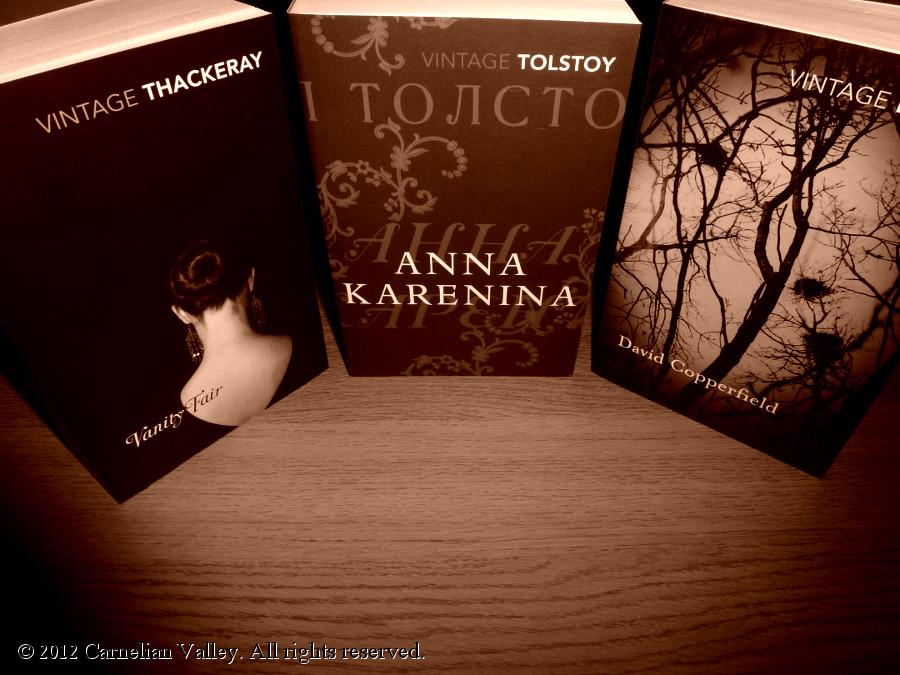
This subject of contexts came back to me recently when I was reading Lady Chatterley’s Lover and seeing a – perhaps tenuous – link with Anna Karenina, the way both writers are pining for something that’s important in their lives. Would I have enjoyed Lawrence’s musings without being able to contrast it to Tolstoy’s? Probably, but being able to do so wasn’t just interesting, it was downright fun, tenuous or not.
I’ve found it interesting that reading in context covers all kinds of books – I think what I’d consider the problematic aspects of Outlander, for example, are somewhat explained by knowing the reason Gabaldon wrote and the ‘place’ she was coming from. Without that, I’d say it’s just a good book with a bit too much sex. now, I’d say that it has a bit too much sex regardless, but knowing it was a writing project and continued because a small group of Gabaldon’s fellow readers and writers wanted to read more brings a few ‘aha’ moments1.
In contrast, I found it fascinating to read Anne Of Avonlea, the second book in L M Montgomery’s Anne series, that I thought far surpassed the first book, and then discover that the author hadn’t wanted to write it2. Perhaps Montgomery’s feelings, and the little insight you get into the mind of her publisher via her written opinion on the whole thing, shows a publisher who had a belief in their author and knew she wasn’t yet at her peak. (And so then it’s interesting that she hated writing it yet it was so good.)
With my current reading ‘theme’ of reading around the subject, I’m seeing the advantages in taking author context even further. Researching Louisa May Alcott’s literary influences (I’m reading Little Women – it’s a horrible, wet, June, and feels appropriate) leads to seeing, for example, exactly why Jo March is reading a particular book. It’s seemingly the smallest thing: in chapter three, titled ‘The Laurence Boy’, which introduces the previously off-stage Laurie, Jo reads Charlotte Mary Yonge’s The Heir Of Redclyffe, and it makes her cry. If you hadn’t already heard of Yonge’s book, it was very popular in its day. This information, in the context of Jo reading it, is something I found out a few years ago; I had been researching Yonge rather than Alcott, so the path to the discovery was different, but the result the same.
However, whilst that fact of popularity accounts for Alcott’s using it as Jo’s reading material, what I discovered yesterday when having another read-up on Yonge’s book was that there was a lot more to it than popularity. (Spoiler incoming for Alcott’s series – skip to the next paragraph if you don’t want to know.) It has been said that Alcott uses Yonge’s book in this chapter as a sort of clue as to where Jo and Laurie might end up, not together. Apparently, The Heir Of Redclyffe features a similar set up to the place Alcott takes her story. Perhaps in years gone by, when the March sisters were first introduced, people found more in Alcott’s decisions about Jo and Laurie than we can today. Yonge’s book is mostly forgotten, and we can’t relive the literary world as it would have been when she was famous.
This of course all links back to what I said recently about lost contexts and authors of yore not necessarily thinking about the potential pitfalls of dating their books.
Reading related books is obviously difficult – as I’ve said before, where should you stop, and what path should you follow? – but gaining author and background context is generally easy, what with the Internet and so on. What I’m personally yet to decide on is what order works best – is it better to read the book and then find out about the author? Is it better to find out about the author and then read the book? Or is a mix of reading and research the best way? Each method will produce different thoughts and highlight different aspects of the book; I think the biggest thing to keep in mind is that once you’ve chosen a particular method, you’re not going to be able to go back and wipe the slate clean. Any thoughts you have of a book or of a part of a book will necessarily build on top of what you’ve already thought.
That is both compelling and kind of scary – you might still miss the little things. But without that vacuum it’s going to happen.
Footnotes
1 On her page about the background to the book, Gabaldon says: “I became a member of the Compuserve Books and Writers Community (then called the Literary Forum), somewhere in late 1986. […] So – with trembling hands and pounding heart – I posted a small chunk (three or four pages, as I recall) of the book I was calling CROSS STITCH. And people liked it. They commented on it. They wanted to see more!”
2 “I’m awfully afraid if the thing takes, they’ll want me to write her through college. The idea makes me sick. I feel like the magician in the Eastern story who became the slave of the ‘jinn’ he had conjured out of the bottle.” (Montgomery to Weber, 10th September 1908)
May 2019 Reading Round Up
Posted 3rd June 2019
Category: Round-Ups Genres: N/A
6 Comments
Other than May being the month when I finished books – discussed last week – this month also marked my first non-fiction book of the year; I read two, in fact. (The scary thing to discover was that I haven’t read non-fiction since last February.) May was a very long month, cold and wet – it’s been pretty wintry here – but full of goings on. There have been book awards and interesting new releases, concerts, days out, and time with family.
The Books
Non-Fiction

Dolly Alderton: Everything I Know About Love – Alderton looks back on her twenties, her previous decade that was full of parties, drinking, and spending time with friends. An okay read.
Guy Stagg: The Crossway – Hoping to heal from depression, Stagg embarks on a pilgrimage from Canterbury to Jerusalem, following ancient roads, staying in religious guesthouses along the way, and learning more about himself and the famous religious people of the various regions he passes through. A good book, but it could have done with more information about the journey itself and more positive descriptions of those Stagg meets on the road and stays with.
Fiction
Maria Edgeworth: Belinda – A young woman, the last of several nieces to be taken under the wing of a notorious match-making aunt, enters society and surprises everyone with her differing personality. Worth reading – I believe – if you find a copy of the first or second edition, those that talk about interracial marriage.
It’s hard to choose a favourite here because I don’t really have one; the reading experience of the books above was good, but in terms of enjoyment the one in my mind is Michelle Obama’s memoir which I haven’t finished yet.
For June I’ve a rough plan to spend half my reading time on two books – Obama’s included – that I started in May, and half on ‘new’ books, which includes a reprint of an early 2000s novel and the Nicola Cornick I haven’t yet got to.
How many books have you read so far this year? (I’m on 19.)
Reading Life: 31st May 2019
Posted 31st May 2019
Category: Reading Life Genres: N/A
Comments Off on Reading Life: 31st May 2019

As I’d planned at the start of this month, I’ve put my reading time in May to use in finishing books, a couple of which were starting to languish on my list.
I’d been reading The Crossway for a few weeks, which isn’t a bad time for a book I’m not too sure about; it’s a good book, but there was a lot less about the pilgrimage itself than anything else – the ‘whys’ were covered, but most often the ‘hows’ were left out. The best aspect of the book as it is, to my mind, is the history, for which Stagg has done a lot of research to expand on the stories he heard and read about along the way.
Belinda, if you saw my review last week (my last post in fact; it’s been a hectic week) you’ll note was partly problematic due to my having read the wrong edition (or the right edition depending on the era of the reader, and therein lies the problem). I have a mind to find a copy published by Oxford World Classics, try to work out exactly what I missed, but at the same time I’m loathed to make it a priority; I’m expecting that it’d be a case of finding a few paragraphs – which would be easy enough – but then combing through the text for the rest.
Having finished these books, as well as the Dolly Alderton that was a quick read, I’m now making my way through Michelle Obama’s Becoming and Peirene Press’ upcoming You Would Have Missed Me, the English translation of a Birgit Vanderbeke, their second book by the award-winning German author.
I read the first chapters of Becoming for my post on the British Book Awards, and knew at that point, already, that it was going to be a good read. Now, on chapter five, I can say it most definitely is. The pages are flying by. It’s a very open book, and the information about the social history of Chicago, provided by way of the story of her childhood, is fascinating.
I’m 40 pages into the 122 page Vanderbeke and I’m on a roll with it; I’m planning to go back to it after publishing this post, and I’m aiming to finish it tonight. Having struggled with Woolf’s Mrs Dalloway I thought twice before starting – like the Woolf, Vanderbeke’s is written in a stream-of-consciousness manner – but it’s brilliant. The ‘stream’ here is used to return to previously discussed topics – it’s much like the way stand-up comedians loop back to their opening subjects during and at the end of their allotted time, just without the humour – and the voice, adult but in the context of the character as a child, and the themes, are fantastic. I’ll save the rest for the review.
There has been a lot less literary study or literature-inspired internet rabbit hole journeys this month; it’s been strange to write this post feeling something’s missing. I have been watching literary-related programmes however, most notably the BBC’s Gentleman Jack, which I’m loving almost as much as the first series of The Marvellous Mrs Maisel (though I know they are very different!) The acting is superb, the breaking of the fourth wall a lot of fun (I’ve assumed this is so that we can hear from the source material itself, unedited), and the general execution of the story as a screen adaptation just very compelling. Unfortunately Anne Lister’s diaries are not on Project Gutenberg – I checked, though I think it’s likely that due to them being rediscovered and decoded recently, ownership – Shibden Hall, probably – will continue for a while.
The Rathbones Folio Prize 2019 Awards Ceremony
Posted 22nd May 2019
Category: Events Genres: N/A
Comments Off on The Rathbones Folio Prize 2019 Awards Ceremony
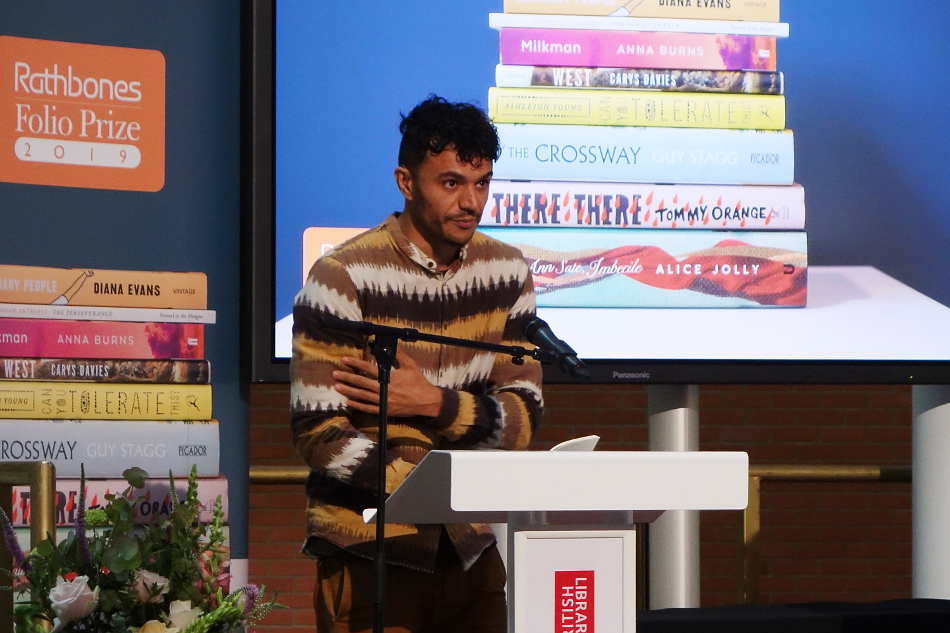
On Monday evening, poet Raymond Antrobus was announced as the winner of this year’s Rathbones Folio Prize.
The ceremony took place in the Entrance Hall of the British Library. It was the culmination of several months of discussion and well over a month of concentrated publicity; the shortlist had been announced early in April; the judges announced last November.
Beginning with live music and time for drinks and conversation, there ceremony was then officially opened. We were welcomed by Rathbones (sponsor) and Andrew Kidd (co-founder of the prize). The shortlisted authors who attended were brought onto the stage for photographs and flowers. The Chair of the judges, Kate Clanchy, then took over to tell us about the judging process, the three judges’ general opinions of the books, and to announce the winner. Alice Jolly, she said, had been a close second.
Raymond Antrobus gains £30,000 for his poetry collection, The Perseverance. Clanchy had introduced him as winner saying it was “an exceptionally brave, kind book – it seemed, in our atomised times, to be the book we most wanted to give to others, the book we all needed to read”. In a show of wonderful humility, Antrobus thanked everyone and noted the poets he spotted in the audience, spending time introducing them. He then read a poem from his collection.
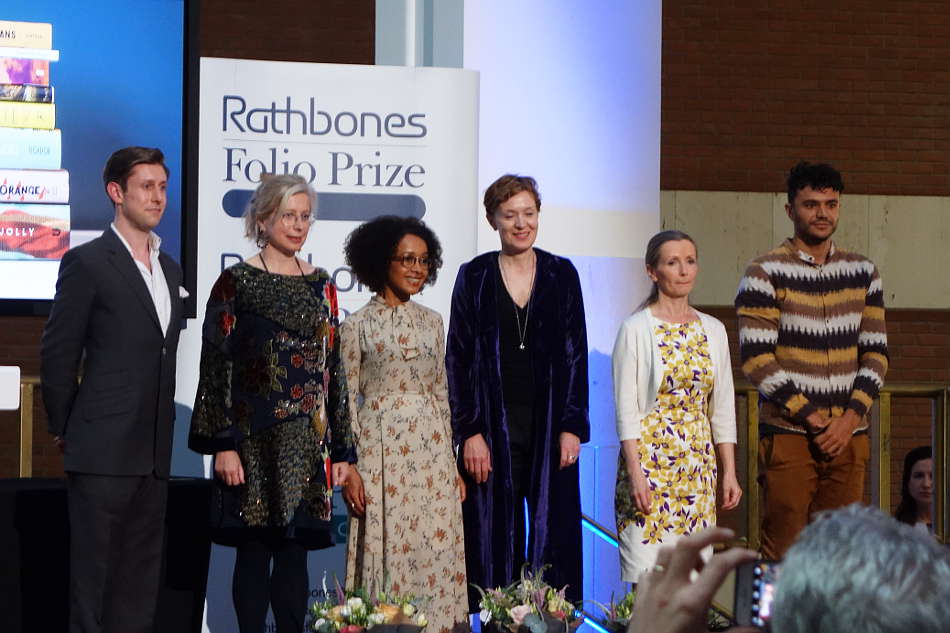
Antrobus is a Jamaican British deaf poet. Born 33 years ago in Hackney, East London, he was considered dyslexic and severely learning disabled, his deafness not discovered until the age of 6. He performs his poetry often and was one of the first recipients of an M.A. in Spoken Word Education (from Goldsmiths, London).
The Perseverance, published by small press, Penned in the Margins, in October, explores issues such as his diagnosis, his mixed heritage experience, masculinity, and his beloved father’s alcoholism and later decline into dementia and death. For it, the poet has received the Ted Hughes Award, having included a redacted poem Hughes wrote about deaf children (‘Deaf School’), and writing a response to it; Hughes’ poem showed to Antrobus a lack of understanding.
The Guardian says the book ‘confronts deeply rooted prejudice against deaf people’. In an interview with literary magazine, Four Hubs, Antrobus said: “This book is me trying to find a use for all the things in my life that felt like a disadvantage, a nuisance, the things I once tried to hide”.
Have you read or do you plan to read any of the books that were shortlisted?
The Guernsey Literary And Potato Peel Pie Society: The Book In A Book
Posted 17th May 2019
Category: Further Thoughts Genres: N/A
2 Comments

Allow me a little extraneous backstory. I am constantly going back to The Guernsey Literary And Potato Peel Pie Society; I’ve read it twice since buying it around 2015, and have re-read sections about four times since then. Most recently the reason was the film; it had highlighted to me things I’d not really thought, the cultural aspects of Juliet’s period – clothes, for example. For some reason I’d always pictured her in 1990s gear, so caught up was I in the story of the war. I also think much of my overlooking of things was due to the fact of letters rather than regular prose, description of a certain kind. (Incidently, I enjoyed the film, and thought it handled the source material, the limits imposed by letters, very well.) It’s apt that I was always seeing the book, its cover, everywhere, because this is what led me to buy it – it had seemingly followed me around, taunting me to read it, and since I gave in it’s continued to follow me, if now at my bidding.
It was during one of those later dips into the book that I realised the meta concept – author Mary Ann Shaffers’ book is fictional writer Juliet’s book.
Juliet needs to write an article to ‘address the practical, moral, and philosophical value of reading… I am to cover the philosophical side of the debate’ (p. 28). Over the course of the novel we see Juliet finding material for this article (which ends up becoming a book) and in so creating this narrative for Juliet, Shaffers in turn writes the same book. Guernsey is a book in a book.
Of course this idea contains a fair amount of conjecture on my part; if there’s something I’ve learned over the time spent planning this post it’s that we unlikely to find more background to the writing of the novel than we have. Shaffers’ death before its completion – happily, she knew it was to be published, after having handed it to her niece to finish (if I recall correctly, Barrows’ input was mostly in the editing of it1) – means that what we already know, partly from Barrows, will likely be it. We have a brief background, that’s included at the front of the book – at least in the UK edition; it was a trip to Guernsey that American Shaffers made, as well as persuasion from her book club to write, that got her started. Given the content of the book, the fictional literary society (which we can give the catch-all term of ‘book club’ to), together with the ‘value of reading’, as quoted in the previous paragraph, it’s fair to say that Shaffers mixed her day-to-day reality with her experience of Guernsey2 – we can see why she wrote what she did, the further content than the occupation. Juliet needed to write an article, needed something to continue the success she found in being a best-selling novelist. Shaffers needed a book, needed to write something after her peers told her she should. It’s pretty similar.
So then, in effect, Shaffers is the writer ‘part’ of Juliet. Shaffers uses Juliet’s experiences to look at the affect reading can have on people, to look at the way it can be used, both conventionally and unconventionally – if we consider its role as a loophole for which the residents of Guernsey could get around the banning of meeting in groups – and the way it brings people together in various ways. Most obvious is the use of the literary society with its colourful cast of characters; there is also the beginnings of Juliet’s trip – the love of Charles Lamb uniting two people, as well as the fact of the secondhand book trade in itself. There’s the use of what we can call marginalia for its effect – the name of a reader written into a book, which forms a connection as the book passes hands. (Here Shaffers brings in the musings of a reader who finds evidence of a previous owner, connecting the two readers in her fictional reality.) Reading brings Juliet and Dawsy together, it brings residents of an occupied island together, and its final result is that it brings the history of Guernsey to a wide readership, both the off-stage readers Juliet is looking to reach and the real-world readers of Shaffers’ novel. All those values of reading that Juliet lists, Shaffers satisfies in her work. And as to the practical, educational side, well, that’s what the literary discussions are for.
On page 34, Amelia Maugery notes that Juliet’s bestseller (Izzy Bickerstaff Goes To War3) had provided her with an update on what those in Guernsey didn’t know about the war elsewhere. Juliet’s response, page 35, includes, ‘…the Spectator felt a light approach to the bad news would serve as an antidote and that humour would help to raise London’s low morale. I am very glad Izzy served that purpose, but the need to be humorous against the odds is – thank goodness – over. I would never make fun of anyone who loved reading.’ This somewhat coincides with Shaffers’ book – a happy tone where appropriate – and as much as she provides the bad, it is in effect an antidote to it, showing the humanity in an otherwise inhumane situation. (It’s interesting to compare the book with Caroline Lea’s more recent When The Sky Fell Apart – a book about occupied Jersey that uses a different method to tell a similar tale (the occupation of the Channel Islands). Happiness in the face of occupation, friendship and society doing what they can.
I’ve wanted to explore this topic without too much contemplation of facts because I found a lot more there for the taking than there was when just looking for the book’s backstory. There is so much of the idea and reasons for literature in itself in this book and the crafting of it that we’re not going to hear about directly from the authors. However there is this, at the end of Shaffers’ part of the acknowledgements that needs to be looked at:
If nothing else, I hope these characters and their story shed some light on the sufferings and strength of the people of the Channel Islands during the German Occupation. I hope, too, that my book will illuminate my belief that love of art – be it poetry, storytelling, painting, sculpture, or music – enables people to transcend any barrier man has yet devised.
It surely does.
Footnotes
1 From the acknowledgements of the book (Bloomsbury edition): “…Annie, who stepped in to finish this book after unexpected health issues interrupted my ability to work shortly after the manuscript was sold.” Barrows took it on once it had been passed to an editor. Wikipedia (n.d.) notes, ‘After the manuscript had been accepted for publication (2006), the book’s editor requested some changes that would require substantial rewriting’, however there is no citation for this.
2 From the acknowledgements: “I had travelled to England to research another book and while there learned of the German Occupation of the Channel Islands. On a whim, I flew to Guernsey and was fascinated by my brief glimpse of the island’s history and beauty. From that visit came this book, albeit many years later.” Shaffers also notes her daughters insisting she sit down and type, to get the book written.
3 Issac Bickerstaff was the pseudonym Jonathan Swift used as part of a hoax to predict someone’s death.
References
Shaffers, Mary Ann and Barrows, Annie (2008) The Guernsey Literary And Potato Peel Pie Society, Bloomsbury, London.
Wikipedia (n.d.) The Guernsey Literary And Potato Peel Pie Society, accessed 16th May 2019.


