





November 2019 Reading Round Up
Posted 2nd December 2019
Category: Round-Ups Genres: N/A
4 Comments
November has been brilliant, full of books. I decided on the 30th to try and finish the 250-odd pages I had remaining of the book I was looking to finish next and spent the evening with it to success. I’ve also read a wider variety of books, which most likely helped.
The Books
Non-Fiction

Gabrielle Malcolm: There’s Something About Darcy – Malcolm looks at the continuing interest in Jane Austen’s Fitzwilliam Darcy, from early in its publication to the present day. This is a 50/50 book; the first half, which deals with Austen’s near contemporaries and extends just to the 1995 adaptation, is excellent, but the second half is all about fan-fiction, where books are summarised repeatedly.
Poetry

Raymond Antrobus: The Perseverance – A collection about the poet’s life as a Jamaican Brit, a person in the deaf community, and various related historical and contemporary stories. Utterly fantastic.
Fiction

Julia Armfield: Salt Slow – A collection of short stories about identity, mostly women’s, which takes concepts and realities to their extremes in order to look at them closer. A brilliant collection.

Nancy Bilyeau: The Blue – 1700s’ Hugenot descendant Genevieve is recruited by Sir Gabriel Courtenay as a spy at Derby Porcelain factory to steal for him the formula for the newest shade of blue; she has agreed because he promised to send her to Venice to train as a painter, but when she comes to know those involved and the reality starts to show itself, she has to make a few decisions. This book is chock full of research to good effect, and whilst the middle is pretty slow it’s worth it as the latter third picks up the pace considerably and the secrets and truths fly everywhere.

Phillip Lewis: The Barrowfields – Henry looks back on his childhood, his father who tried so hard to be a writer, his distant relationships with mother and sister, and his own attempts to be someone. Utterly fantastic.

Samantha Sotto: Before Ever After – Shelley’s younger-than-middle-aged husband died and a few years later a boy claiming to be his grandson turns up at her door. Brilliant story combining a mass of different genres.

Samantha Sotto: Love And Gravity – The cracks in the wall start happening in Andrea’s single digit years and although no one believes her she comes to look forward to the rare sightings of the historical boy, a budding scientist, on the other side of her wall. A great time slip/travel novel that makes use of a box of manuscripts found amongst Issac Newton’s possessions to tell its story.

Seishi Yokomizo: The Honjin Murders – A couple on their wedding night are murdered in the annex building of the family estate; a three-fingered man was seen around the place the night before and his hand prints are on the wall, but why did it happen? An excellent 1940s novella that is a lot more about the ‘why’ than the ‘who’.

Stein Riverton: The Iron Chariot – One evening, a little way away from his hotel, our narrator sees the forestry inspector leave the company of a woman the narrator admires, and a bit later the narrator hears the sound of chains rattling which a fisherman says precedes death; the next day a dead body is found. Not bad at all – quite of its time but there’s a lot to appreciate in context.
I don’t have a favourite this month – there are some 5 star reads amongst the above, all but the non-fiction are 4+, and I appreciated various things about every one. It has been a very good reading month all round.
In this last month of the year and decade I’ve a few books to get to that are yet to be started and I hope to finish up a few more; I’m not sure I’ll read as much – Christmas is almost here, after all – but it should be good.
What do you hope to get to in this last month, and what has been your favourite book of the last few weeks?
Reading Life: 27th November 2019
Posted 27th November 2019
Category: Reading Life Genres: N/A
1 Comment

I’ve been reading almost every evening for the past few weeks. It’s been wonderful, both in general and in terms of adding to my list, but I’m currently taking a couple of days out, hoping to see off any burnout before it happens. I noticed yesterday the words just weren’t going in so I took myself off to a digital medieval world; I got fined for accidentally starting a fist fight with a city guard – the keyboard controls to fight and to talk are next to each other – but regardless it was a lot of fun. I plan one more evening of it and then it’s back to the books. I reckon two days away from reading should work – either way, it’ll be interesting to see if this amount of time (albeit that I’m still blogging about books during it) works to freshen up the reading and reset any tendency to burnout.
The book I completed most recently was the Riverton I reviewed on Monday. My current reads are Nancy Bilyeau’s The Blue and Sherry Thomas’ Delicious, both historicals but set a century apart and in different genres. They’re my fourth and third read by the two authors respectively. I’m about a quarter of the way through the Bilyeau and so far so good – it’s obviously very different to the author’s Tudor period books but the sense of evident research that pervaded those books is in The Blue as well, which is lovely. I’m about a fifth of the way through the Thomas, and it’s going okay – this is a longer-term read that I should technically have finished a while back, as I started it a couple of months ago.
On that note of books still to be finished, I started looking at mine last month and have divided them into two categories (they’re not quite lists, thankfully). There are some that I barely started and really should be removed if I’m to be honest about time limitations and how much I’m actually reading: Susanna Kearsley’s Season Of Storms (begun just after the New Year, and never returned to – wrong time); Elizabeth Chadwick’s The Love Knot (begun in earnest but never returned to as I already had two current reads at the time); and Philip Pullman’s The Secret Commonwealth which I struggled with upon beginning, got past that, but then faltered. Then there’s Lillian Li’s Number One Chinese Restaurant (started in September, still in mind, and just not managed to get back to properly yet), and the Sherry Thomas which as noted above is a current read again. Along with the Thomas, I’m going to see if I can complete the Li and the others I’ll probably remove from the list for now. I once carried over three ‘old’ reads from one year to another. It didn’t go well.
In book-related life, I’m looking to sort one of my shelves out. A couple of my bookcases are properly organised but I have another that I’ve just been adding newly acquired books to without standing them on the shelves – I’ve been piling them up instead, partly due to time but mostly because I’m aware it’s my last bookcase and at the moment I can pretend that the books not yet properly shelved don’t equate to one and a half shelves of properly placed books which would lead to only one and a half shelves remaining. This said, I really enjoy organising my shelves so there’s a tug of war going on between the part of me who doesn’t want to admit I’m running out of space and the part that wants it all looking nice and tidy and done.
There’s at least one book on my Christmas list this year, first time in a while. I’d probably better get on with it…
Have you (ever) run out of shelf space? What did you do? And what does the last month of this year look like for you in books?
The Present Past: Russell-Cotes Museum
Posted 22nd November 2019
Category: The Present Past Genres: N/A
4 Comments

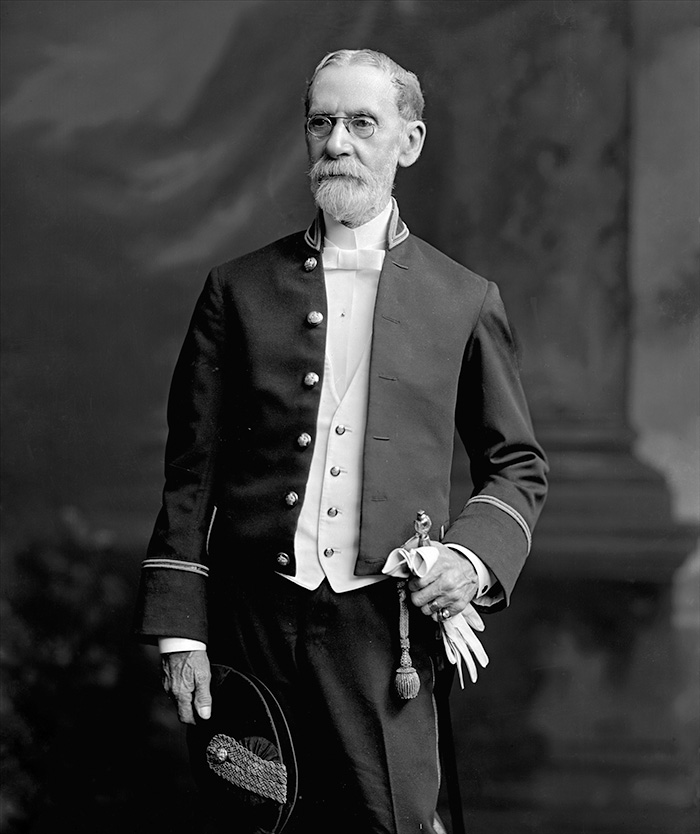
This is an image-heavy post. The photograph of Merton Russell-Cotes from 1909 is held by the Lafayette Archive of the Victoria and Albert Museum.
The Russell-Cotes Museum is a historic semi-hidden, purposefully-constructed house, on the edge of the coast of Bournemouth. If you didn’t know about it already and decided to go to the beach, to walk along the sand or promenade down the pier, you would most likely miss it; at most you might spot a couple of none-too-tall spires in the distance. This is because the house is situated on a cliff that is accessed by a pathway that climbs the hill from the opposite end of the car park to the beach access route. There’s also not much to see from the pathway unless you continue up the hill away from the house – in fact, when I saw the sandwich board outside the single-width gap in the stone wall, I reversed my steps to make sure the Museum wasn’t actually the big building with a pavilion and lawn next door. (That building is the Royal Bath Hotel which seems to have taken use of the Museum’s pavilion; the original owners of the Museum building had bought the Hotel.)
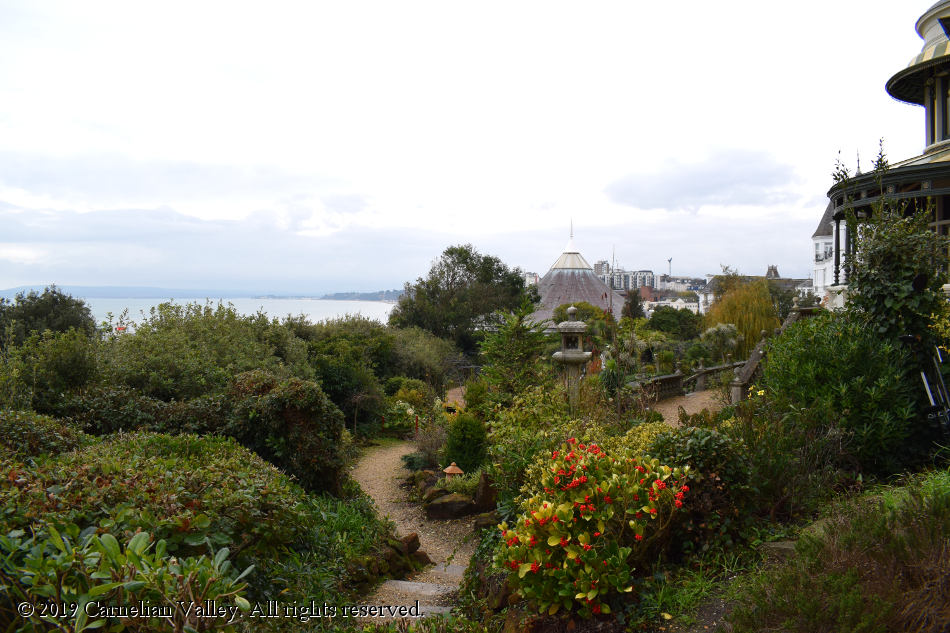
As you might expect, once through the gap, the front garden (there isn’t a back garden) is fairly small in relative terms and at least in autumn more focused on greenery than flowers (there could be flowers but the amount of evergreen suggested not too many). It’s the kind of garden you might expect of a house where the interior is everything. You’d be right.
The main building, the rather Gothic house in the photograph above, is joined on the left to a new building that holds the ticket office, shop, and cafe, and on the right an extension that was built by the original owners (the builders of the house). In building the cafe/shop building, the group that run the house made a decision that works incredibly well: unlike many historic houses, where there are many more rooms than you, as a member of the public, can access, due to cafe conversions and storage spaces, the majority of the Museum is publicly accessible. There are a few smaller rooms for the staff and workings, but what you see in the photograph above you will for the most part view from the inside outwards, too. (I will from now on be referring to the people who run the Museum as ‘Bournemouth’, as it is officially the Borough of Bournemouth who do so.)
This is where we get to the history. The Museum, previously called East Cliff Hall, was conceived by Merton Russell-Cotes as a gift for his wife, Annie, and completed in 1901 (the extension was finished in 1919). Its conception was for the general purpose you see today: the couple were avid travellers and wanted a house that could exhibit all the items they brought back from around the world. Essentially, for all they lived in it, the building was a museum first, house second. In 1907, before the extension was built, the couple donated the house as a museum to the town of Bournemouth (it’s now a city) and continued to live in it until their deaths. From what I can ascertain, the shop/cafe building was created a lot later, in 2000.
Due to the couple’s love of beautiful objects and their interest in culture, there is a monumental amount to see. And everything gives you a firm idea of the interests and values westerners of the time looked for in the ‘exotic’. Joining these objects are a vast number of artworks, many from back in the day, and some closer to our own time. Owing to our discoveries of how light fades things, the blinds over almost every window are pulled down; only a few rooms have natural light to see by. I went to Russell-Cotes not knowing much about it other than it looked like it would be a place I’d love, so I was unprepared for the relative darkness and I didn’t have a polariser with me – please forgive the blurry lights in these photographs.
So, we begin just a little inside. We have gone into the new, left-hand side building, bought our tickets, walked through the shops and up a staircase into the large cafe. Our trip starts beside the cafe’s fridge where we find a narrow corridor – the modern building opens straight into the house and we are, in many ways, about to step back in time.

As you get to the house-end of the rather short corridor, you step into the dining room, just as you see above. This is your first example of what you’re going to find as you venture further in. It’s all rather fantastical in this room, and you can walk around freely (more on walking around later). Everything is detailed, even the high ceiling and the area just above the coving is covered in artwork – peacocks. Besides the cafe entrance, there are three doors leading out of this room. One right next to the corridor’s door, that leads to a grand hall, one at the left end, and one opposite that which leads to a conservatory (where the daylight is coming from). The conservatory is currently closed to visitors – there are a number of buckets on the floor; Bournemouth are looking for donations to restore it.

I’m not going to take you through to the hallway just yet, but I will tell you in advance that in this house, almost every room backs out into the hallway – the rooms of the house are clustered in groups of two or three in the corners and sides behind the hallway, both ground and second floor – so there’s no real linear way to go around; it’s really up to you.

I’ve taken you through the left-end door and into the morning room. It was in fact a study for Merton; his desk was a table originally made for Napoleon. The present-day room, as you see, is very bland compared to almost every other room; parts of the ceiling started coming down around 1928, and it’s believed that the original design is behind the one there now. War damage created more problems. Bournemouth have decided to restore the room to its 1949 appearance as they don’t have enough details of what it looked like prior to that year. This is of course a pity, but, when you see the rest of the house you may in fact be grateful for the pause in grandeur.

This is a section of the ceiling that has been restored.
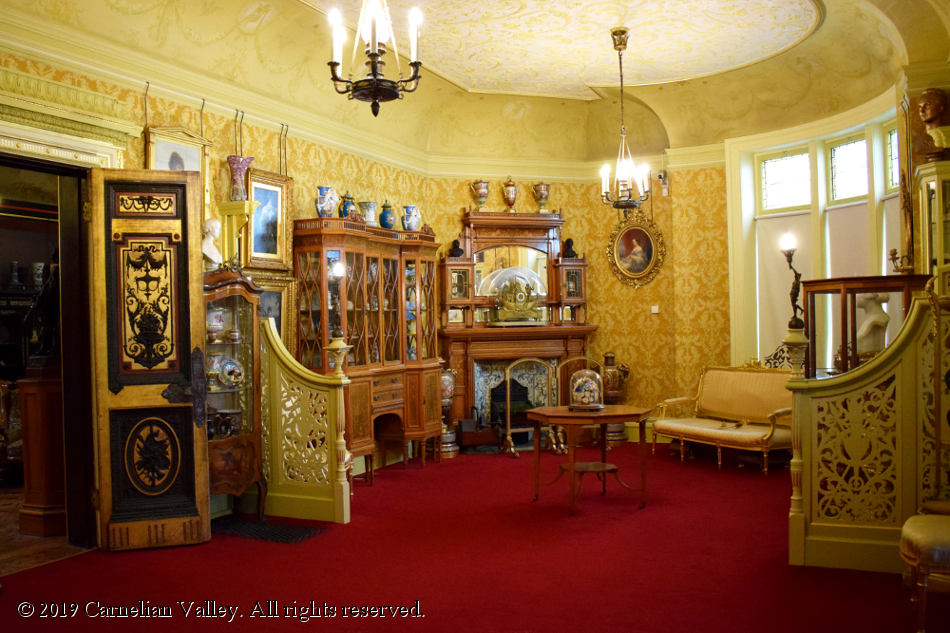
Carrying on through the morning room and you get to the drawing room, a room you could probably identify without the information board, it’s so much of what you’d expect. Even with the blinds down it’s incredibly light and airy.
Now. Now you turn out of the room and through that door you see in the left of the photograph, and enter the hall.
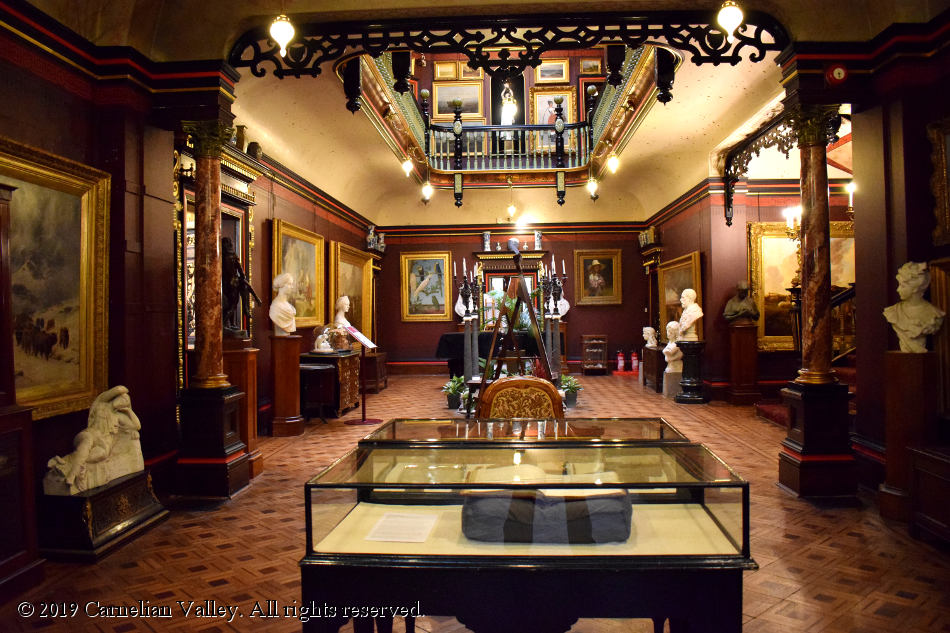
It’s no exaggeration to say that I fell in love with this room. I found an excuse to go back to it a good few times and I’d have been happy to stay there all day. The view you see above was taken from a few feet away from the end looking towards the dining room door. The opposite view is also spectacular, perhaps more so, with its sunken pool and grand piano, but the gorgeous potted plant that rounds it off unfortunately means that a 2D photo doesn’t work so well. So, to the left, where you see the pillar, is the drawing room; behind me, effectively, is the gallery, which we’ll come back to. Beside me on the right is the lift with decorated doors, the size of which suggests an old store room. Then, you can just see them, are the stairs.

If I could sit at the bottom of these stairs and read all day, I’d be happy. I considered it – I could have. The door to the right leads to the Ladies; I considered taking a photograph because the room, split into three parts and almost certainly always used as a toilet, was just as decorative as the other rooms.
Up the stairs, and both side staircases go to the mezzanine floor. Looking at the photo above, on the sort of mini floor/turnabout space you can see before the left staircase begins, are a couple of small rooms that are roped off but visible.
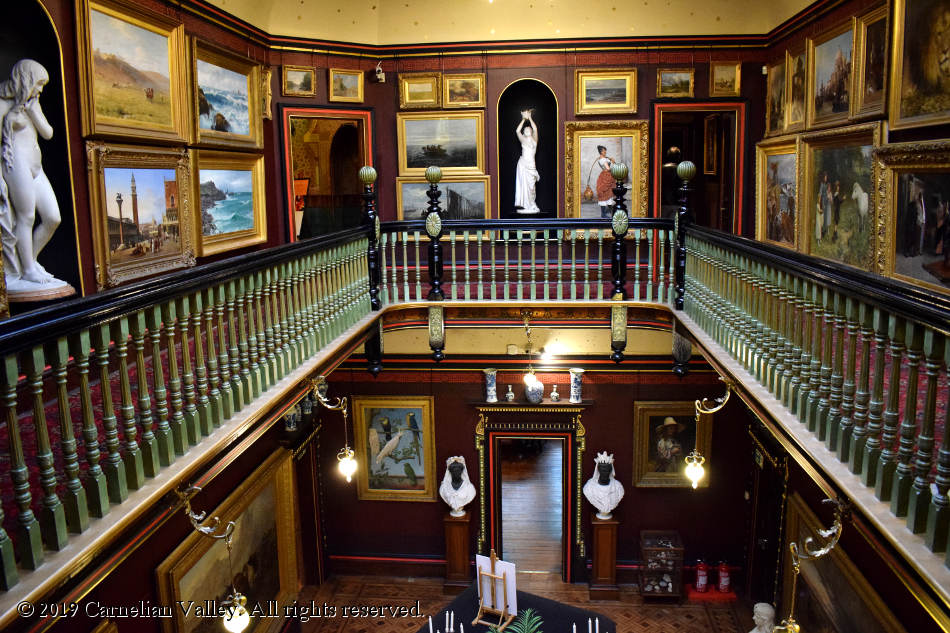
This photo was taken from the same end of the hall as the one downstairs. The area is slightly smaller – the mezzanine ends roughly where the marble pillars downstairs are situated, but again all rooms lead from it. We’re going to the doorway you see on the right.
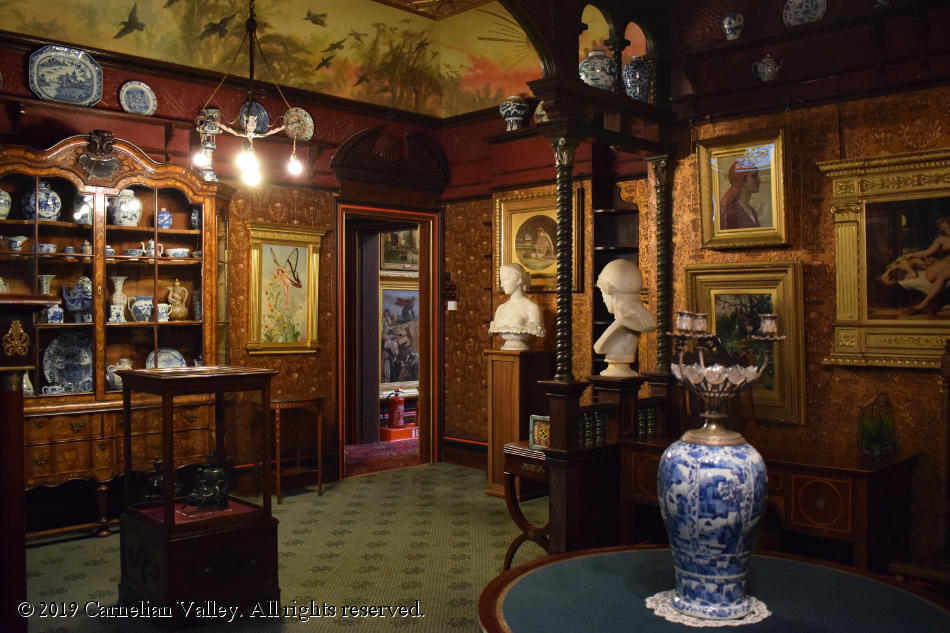
The study is on the left of the doorway; it’s a beautiful little room just big enough to walk around. Essentially split in two parts, the study gives you an idea for the rest of the upper floor.
The room to the right of this cluster isn’t pictured because that room is smaller, black-walled, and simply holds paintings, photos, and memorabilia of Henry Irving, the the very-famous stage actor for whom we’ve lots of contemporary accounts and reviews but, due to the time period, no video footage.

Back out, and we’ll go to the left-hand cluster. The rooms here are joined by a sort of anteroom in the Arab style. It’s difficult to get a proper photo – I didn’t want to lie down – so I decided to take one that gives you a general idea and shows you how the clusters work. The pink room to the right is the boudoir, and the room on the left has been turned into a big display, various ‘exotic’ items behind glass.

This is the pink Boudoir room for the lady of the house, split in two like the study.
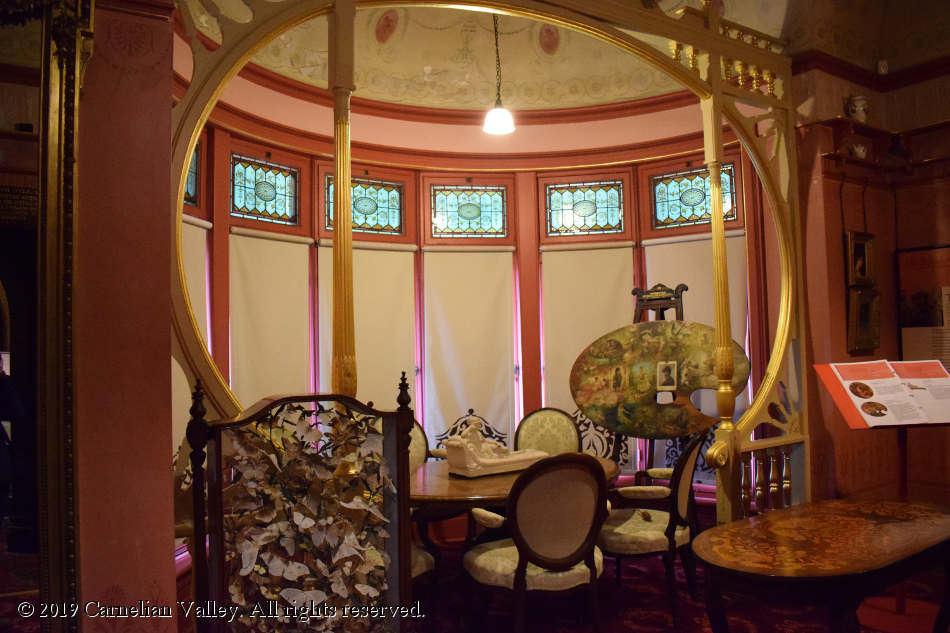
Japanese-esque, the room features dressers like the others, but then the sitting area that’s really quite lovely.
I haven’t included a photo of the display room – it’s difficult to get a photograph without simply showing the objects and the relatively plain wall (compared to the others). From here, however, you walk straight into the bedroom.
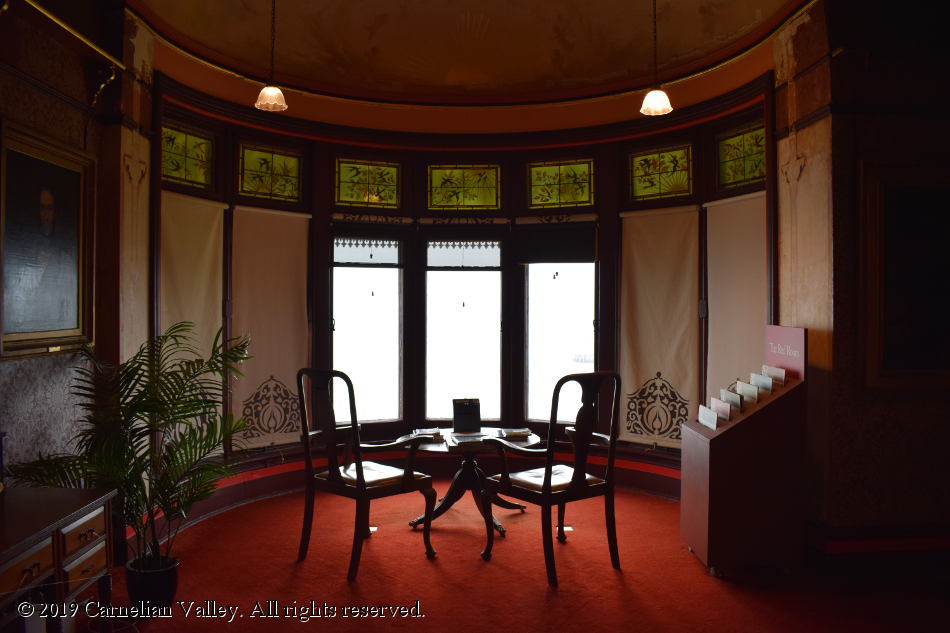
Annie Russell-Cotes’ room, where she passed away, is a lot simpler than the others, thought there’s a lot of space to move freely. This room is the third with a bay window, and it’s situated at the far right end of the original house. Behind and to the right is where the bed is, and behind and centre is a dresser. Beside the dresser the door leads back to the mezzanine.

From here there’s just two more rooms: the Mikado room, above, and a small display room with one object for each letter of the alphabet. Highlights in that second room include a painting of a native New Zealander, a piece of a gown that belonged to Marie Antoinette, and a suit of Samurai armour.

We go back downstairs and to the end of the hall that was behind me in the photograph. This leads to the 1909 extension.
Full of light and utterly different, the three rooms from here compose the gallery, where collections of artworks from a few artists adorn the walls, statues stand in glory, and, just like many galleries, there are lots of seats to sit on. The day I came to the Museum, an overcast day mid November (last week if you’re reading this at the time of posting) the twenty or so other visitors were all artists and most were sat making studies in these rooms. I’ve no idea if it was a one-off trip or if, like Virginia Woolf’s house, this place simply welcomes artists generally, but it was rather wonderful. It added to the relaxed atmosphere of the place – there’s no one route around the house; you wander at will.
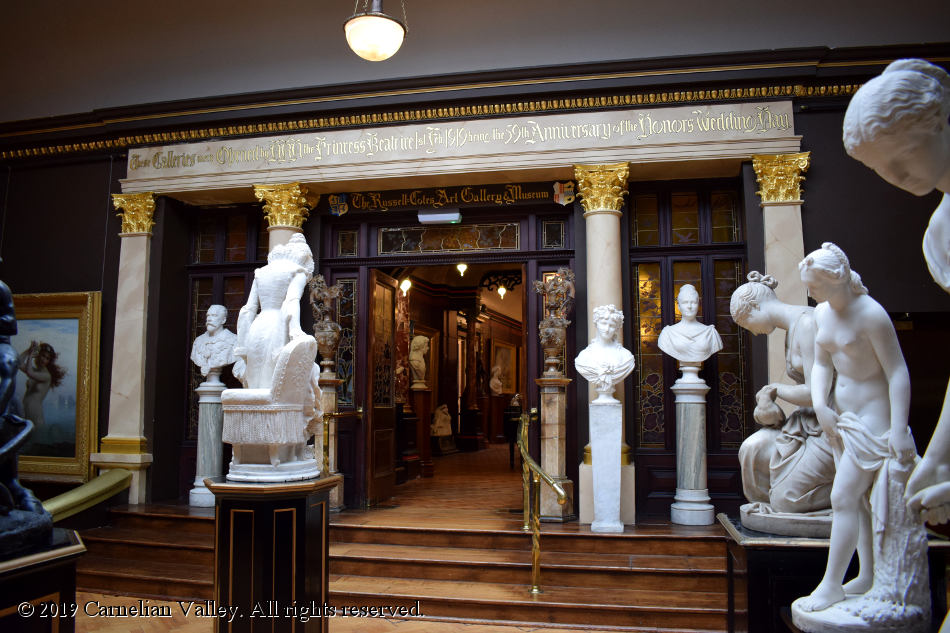
The second gallery hosts more paintings and some decorative plates, and the third, a lot smaller, boasts a collection of tiles.

Looking around Russell-Cotes (for, apart from the garden which is a quick visit, we have reached the end of our tour) doesn’t take very long. If you’re the type to take in more of the whole than study in detail you can easily get round it in about an hour. A little longer if you want to stop in, on your way back, at the cafe. The detail-oriented will want to schedule at least double that time. There are parts of the house that I haven’t covered today – there are tours available at certain times that take you around areas that aren’t always open – that you may want to look into.
Owing to the period and style, access will be difficult if you struggle with walking or are in a wheelchair. The lift does allow a fair amount of access to the ground floor but getting around may be difficult – that is relevant to everyone.
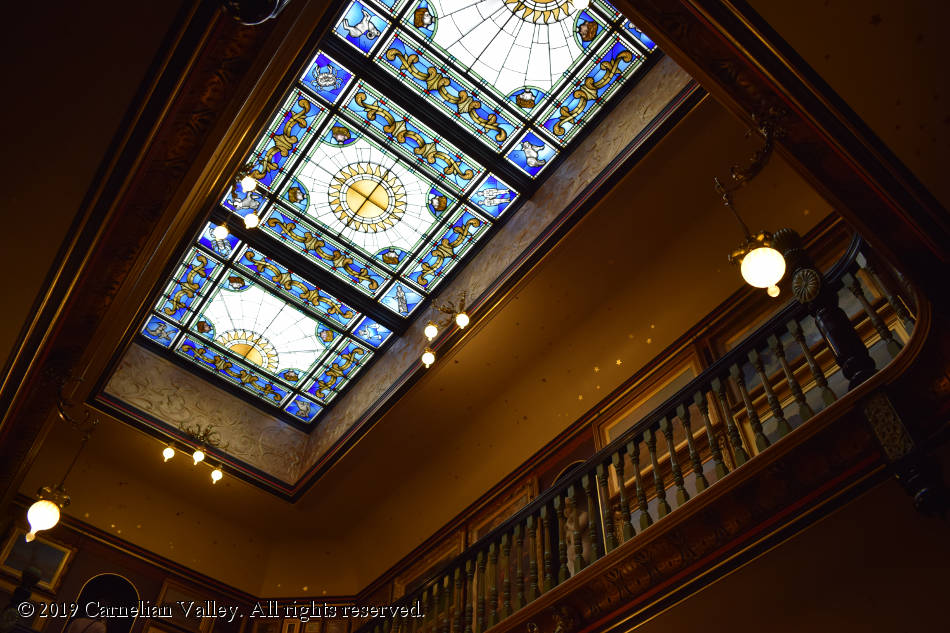
After I had been to Brighton Pavillion and again after Cardiff Castle, I wondered if anything could top those places. It’s been a few years since I visited them and I was starting to think that at least in Britain, finding a place that beat them would be hard. Well, they are both stunning, but in a great many ways, Russell-Cotes far surpasses anywhere I’ve ever been and, needless to say, it’s worth every moment.
Latest Acquisitions (September – November 2019)
Posted 20th November 2019
Category: Acquisitions Genres: N/A
4 Comments
It’s been a busy few months for me and books; if I included books I’d already reviewed in these posts we’d be looking at a good few more, but this way is far more manageable and less repetitious. I’m really looking forward the books below, some will feature here shortly, others a little later; it’s a good mix of genres and types as well as reasons for reading.

Deirdre Le Faye (ed.): Jane Austen’s Letters – It started in January; I wanted to write about Jane Austen but needed some primary sources. I needed her letters. Using the library would require many renewals. Having a book of Charlotte Brontë’s letters, I decided to research the theme from the later writer’s perspective. (I ended up writing about her sisters’ influence on her instead of the original topic, but it was still interesting.) Over the last several months I’ve had two further Jane Austen ideas that would require a copy of her letters so I finally added it to a year-round wishlist and thank my family very much.
Lillian Li: Number One Chinese Restaurant – A family tries to work itself out when their restaurant suffers disaster. I’m a couple of chapters into this one; it’s on the back-burner and I hope to finish it within a few months. It was on the Women’s Prize longlist and I received it from the UK publisher.
Nancy Bilyeau: The Blue – This is Bilyeau’s fourth book over all and second effective story, her previous three being a trilogy. It’s set a couple of centuries later than her Joanna Stafford books and is about the porcelain industry in 1700s Europe and the construction of blue pigment, one woman’s journey to learn about it in order to be given the chance at becoming an artist.
Robert Galbraith: Lethal White – The continuing story of Comoran Strike, It’s true that I’m still to read the previous three books in this series; I’ve got this one early because I’m collecting the hardbacks, but I will get to them.

Seishi Yokomizo: The Honjin Murders – From the publisher, this is a murder mystery first published in the 1940s set at the time of a village wedding. Yokomizo was a famous Japanese novelist so I do have this on my too-be-read.
Stein Riverton: The Iron Chariot – A Norwegian classic crime novel first published in 1909 about a murder at a holiday guesthouse where the narrator (the last person to see the victim) joins the investigation after having heard the noise of chains post-incident, a noise known to foreshadow death. From the publisher.
Susmita Bhattacharya: Table Manners – A short story collection that travels all around the globe, looking at love and loneliness in cities. Bhattacharya is a well-respected local writer; I’ve heard her read and her use of language and concepts for the poem performed was lovely.
What books have come into your life recently?
Do Adaptations Show Us Extra Meanings?
Posted 15th November 2019
Category: Chit-Chat Genres: N/A
3 Comments
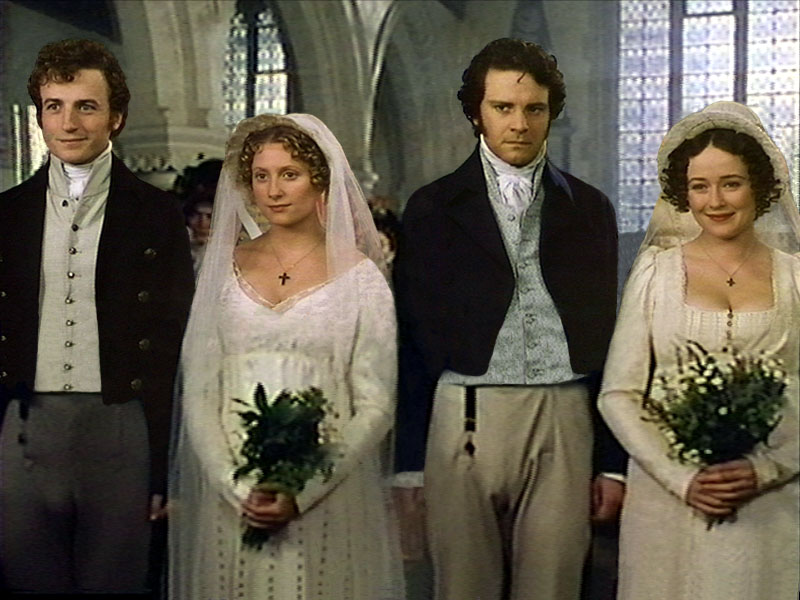
Screen shot from Pride And Prejudice, copyright © 1995 BBC.
In an article about the art of adaptation, which focused on Brooklyn, writer Shastri Akella said that adaptations that are very different to their source material can make us look at other meanings that might be found in the text. This she wondered after having thought over the concept of bringing to visual life characters from literature.
I found this an interesting idea. My initial thought was to wonder how seeing other meanings in a book thanks to a visual production would work – is it possible? I was too caught up in the idea that films can never be as good as the book. Away from that, I think Akella is on to something, however today I’m going to look at adaptations as a whole rather than adaptations that are necessarily different – I’m not against differences, but I do gravitate towards adaptations that stay close to the books.
An adaptation is a single person’s (or multiple people depending on where the idea to adapt originates and goes) idea about a book. The film or television series (radio series as well?) is thus a detailed explanation and interpretation of someone’s reaction, their own visualisations of characters, location, and meanings that make up the book. It is as valid, in an objective, general, sense, as anyone else’s reactions and interpretations (supposing the director or whoever it is has read the book, of course), it’s just that putting it on screen for all to see is going to suggest, if unintentionally, that it’s a fairly definitive interpretation and a correct one, a valid one, an informed one. It is valid – in essence it’s an interpretation as good or clever, and so on, as any other, the difference is simply in the ability to put it on screen.
So, due to this, it gives the viewer (who I’m considering has read the book) an easily accessible way to discover another’s thoughts on the story, albeit that screen time is not always enough to provide the full picture. So is an adaptation that seems or is, objectively, very different to the source material useful? Unless there are reasons for the difference that move away from interpretation – say those times when directors modify aspects of the story for their own reasons (the recent Sanditon was sexed up) then the adaptation is going to fulfill Akella’s idea of this purpose of providing other meanings.
In her forthcoming book about Darcy (disclaimer – I’m reading it for review), Gabrielle Malcolm notes the 1995 BBC production of Pride And Prejudice wherein Darcy narratives the letter he sends Elizabeth about his history with Wickham against a backdrop of visual flashbacks that enable the viewer to put visuals to the letter’s content. This, Malcolm notes, was done to better infer to viewers Darcy’s better side. Austen doesn’t include the background itself – the words are all there is; whilst the choice of the production team doesn’t move in a wholly different direction to the book, it does include things that aren’t in the book (the ‘wet shirt’ scene is, of course, another) that perhaps provide slightly different insights about Darcy that you don’t get from Austen, making Darcy more accessible to the 20th century viewers, watching the series almost 200 years after the book was published.
Staying on the subject of Austen’s book – it’s in my head at the moment – the 2005 film better showed me why debate surrounds the relationship between Mr and Mrs Bennet, the changes in dialogue and chance to see characters in reality making a difference. On one side of the debate are those who believe Mr Bennet treats, and has likely always treated, Mrs Bennet poorly, enough that she was always going to become a bit over the top. On the other side are those that see Mrs Bennet as the problem – over dramatic, overbearing – and Mr Bennet the product of having it in his life so many years as to be resigned to it. I’m not sure I have an outright opinion on this – Donald Sutherland’s acting leads me to ponder the second side but that’s his influence, not Austen’s, so I’m not inclined to draw a line in the sand. I’m also not sure that Austen had thoughts either way; I think she was thinking more about what would be funny. Mrs Bennet is only a little more dramatic than the characters she is thought to be inspired by – certainly Maria Edgeworth’s Lady Delacour from Belinda, who is less ‘nervous’ but actively neglectful and deceptive struck me, upon reading about her, as a likely influence for Austen, with Mrs Bennet being inspired by Lady Delacour but ultimately being a lot nicer and unaware rather than deliberately dramatic.
There are numerous other possible influences, too, with melodrama being ‘in’ around that time. Austen was responding to her culture, to the overblown stereotypes of those who wrote a little before her time. But add a couple of hundred years to her publications and understandably a changed society questions her characters. There are far fewer limitations on what we can say and who is ‘allowed’ to have an opinion.
I do think adaptations – the ‘right’ adaptations? – can help us understand the source material better. They can definitely make us appreciate it more and they create debate, discussion. They keep our love for the work alive. It can take some getting used to when it comes to changes made or, more often, it takes some time getting used to another reader’s imagination if it differs enough from yours, but they can be useful.
What are your thoughts on the values of adaptation?


