

Jane Austen – Emma
Posted 4th November 2011
Category: Reviews Genres: 1810s, Comedy, Domestic, Social
1 Comment
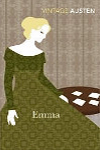
Perhaps the best example of how wonderful Austen’s ability to create characters was.
Publisher: N/A (but I’d wager Vintage’s a good one)
Pages: N/A
Type: Fiction
Age: Adult
ISBN: N/A (Vintage’s is 978-0-09951-1168)
First Published: 1816
Date Reviewed: 13th October 2011
Rating: 5/5
Emma Woodhouse is rather well off, and intelligent and charismatic to boot. She wishes to add to this list a talent for matchmaking, and indeed already has introduced a widowed neighbour to her governess and they are a fine couple. Now she wants to enhance her new friend Harriet’s position in society, and the man who wants Harriet’s hand does not fit the proposed expectations. Emma doesn’t want to marry herself, but will she able to carry on her initial success?
Emma is a fantastic examination of what happens when a person tries to involve themselves in other people’s affairs, and what this means for that person’s knowledge of their own feelings. The events in Emma are largely held in the same one place, in fact Emma herself never leaves her village, and yet Austen succeeds in being perhaps more witty and introducing a more detailed cast of characters than in any other of her books (Mansfield Park aside as this reviewer has yet to read that one).
It cannot be disputed that what makes Austen so readable is her cast of characters. In Emma every single person is very different to all the others so that it wouldn’t be difficult to know who was speaking even if you stripped the manuscript of all names. If it seems that some characters are similar it is only because they are less talkative. Of the ones who speak often you can clearly discern the man of sense, the woman who talks too much, the joker who wants entertainment, the hypochondriac who tries to push his hypochondria onto others, and so on. There is a particular chapter in volume 2 of the book, chapter 11, that is simply sublime – hilarious, all show and no tell, and a prime example of how these very different characters interact. Surely Austen is one of very few authors from whom this reviewer would be happy to read all dialogue and no description.
“Did you ever see such dancing? – Was not it delightful? – Miss Woodhouse and Mr. Frank Churchill; I never saw any thing equal to it.”
“Oh! very delightful indeed; I can say nothing less, for I suppose Miss Woodhouse and Mr. Frank Churchill are hearing every thing that passes.”
Austen undoubtedly had a whale of a time writing this book. The discourses between Mr. Knightley and Emma are brilliant, Mr. Knightley being the one this time round who has a level head. And as usual Austen shows us that she was not only ahead of her time but would fit very well in society today.
Where Emma thinks wrongly, Austen is always ready to have a laugh and put her on the straight and narrow in the form of her Mr Knightley. As is the case with Northanger Abbey, bar the narration itself in that novel, Austen employs a male character to voice her feelings. In a way, the reader may wonder why Austen, a woman in a male-oriented society, would often want to make her male characters the ones with the most sense, but in doing so she opens up her work to a wider audience.
It is this continual discourse between Mr Knightley and Emma that sets the reader up with the knowledge of what is to happen. In the character of Emma we have Austen trying to test the boundaries of class and seeing what happens when people try to get around them, even if it is only for their own benefit and fun.
As a counsellor she was not wanted; but as an approver, (a much safer character,) she was truly welcome.
Emma herself is fun for being so intelligent yet so out of her depth when it comes to matchmaking, and for having the inept ability to choose entirely wrong people for her friends.
It may be possible to do without dancing entirely. Instances have been known of young people passing many, many months successively, without being at any ball of any description, and no material injury accrue either to body or mind…
The reader might say that the set up of matchmaker could have been continued longer, with more people involved, but what is included is so well thought out that it doesn’t really matter. The way that Emma provokes her friends to follow her ideas and, as is once the case, literally follow her around, is worth a lot more than numerous matchmaking attempts.
Pride And Prejudice may be perhaps the most famous of Austen’s novels, but Emma makes a good run for Elizabeth Bennett’s money. Whether or not Emma would have chosen Mr Darcy for Elizabeth however cannot be speculated. The phrase that would conclude this review best is “read it”.
Related Books


Richard Rex – The Tudors
Posted 4th October 2011
Category: Reviews Genres: 2000s, Biography, Domestic, History, Political, Social
2 Comments

‘Defender of the Faith’ was more than just a motto given by the Pope. You also had to have faith in your successor’s ability (or willingness) to have children.
Publisher: Amberley Publishing
Pages: 203
Type: Non-Fiction
Age: Adult
ISBN: 978-1-4456-0280-6
First Published: 2002
Date Reviewed: 26th September 2011
Rating: 4/5
The Tudors were an intriguing bunch of people. Strong-minded and self-righteous often, they caused much joy and much sorrow. Obstinate when it came to the succession, they tended to leave their counsel with plenty of work to do in wondering who should be next up for the crown and whether or not so-and-so was a good choice. Yet there is little doubt that what they did is still worthy of being so famous, or rather infamous, today. Rex gives a quite broad and detailed account of those five people, from the man who wasn’t really in a position to be king, to the woman who refused to provide for the future of the dynasty.
Rex sets out with a couple of goals. He says his mission is to write from the royal perspective, and that his book is for readers rather than academics. The first he succeeds in doing completely – what social information there is in the book is there because it needs to be there to set the rest in context, and it truly is a book about the dynasty rather than anything else. The second is more difficult to rate. The book is humorous – Rex presents the facts while allowing himself and his readers to have a good laugh in places where people were a bit silly. But this humour is quite okay considering that Rex is clearly passionate about his subject; knowing all that he does it’s fine to have a laugh now and again. The humour is what makes it a book for readers, along with the obvious influence of David Starkey, who is a historian Rex admires. However there are a lot of extra details on aspects such as taxation, war, and money in general, and while this is interesting it does move the book more into the realm of academia. There are times when the book is like those you read for study purposes, and indeed the information included is written in a way that makes it perfect for university essays.
Henry Parker… an old-fashioned aristocrat who often bestowed upon his sovereign the fruits of his limited literacy skills…
Like all historians, Rex has his opinions, but he is very good at presenting several arguments and telling you why they could be possible and why not. Obviously he tends to lean towards his own thoughts, so for example after he has covered the possibility of Elizabeth’s having a sexual affair with Robert Dudley, it is mentioned no further. Something that is also intriguing is that he tells you where different theories have stemmed from, and why they have been discounted in modern times, or why they are continually believed. He refers to a range of different types of primary sources and the book itself, at least this edition, is full of pictures of these written and artistic sources. This visualisation of the sources, however, could have been better handled by whoever decided where they should be placed. There are a lot of them in the chapter on Elizabeth and although it makes you feel like you’re reading very fast (because the sources often take up most of the page) it breaks up the text in a way that disrupts the reading experience. This reviewer must also mention the pages of colour images in the book as she found them rather strange – they are copies of originals, however whether they are the originals or not she cannot say as in many places the colours of people’s eyes have been changed.
In the preface Rex says that he hasn’t worried too much about references, and he hasn’t, preferring to simply leave the vast majority to the further reading section. While this does help the flow of the book, it means that if you want to find out exactly whom he has referenced you may need to do a bit of research. What this lack of references does mean, though, is that Rex escapes the trap that many others fall into of unintentionally (or intentionally, if we consider G W Bernard) moaning about his fellow historians. In fact Rex tends to lump groups of people together in a loose way rather than point anyone out, except of course people of the past, which is the starting point of his polite disinclination to favour opinions that do not match his own.
The act included a declaration that it was treason for a woman to marry the [aging] king if she had had premarital sex. As the Imperial ambassador caustically observed, this rather narrowed the field.
There is a chapter for each of the monarchs, though anyone seeking to learn about Henry VIII’s wives in detail, or the ‘reign’ of Lady Jane Grey should understandably not expect to gather much information from this book. Rex has defined his book as one of rulers, so there is little about, for example, Henry VIII’s brother Arthur.
On first glance, The Tudors appears to be a quick introduction into each of the monarchs between 1485 and 1603, but when you read it you discover that it is in fact rather in depth and a sometimes hefty read. True, as Rex says himself, most of the content is general Tudor knowledge, but it is the way that it is presented and the afore mentioned depth that make it worth a read no matter how much you already know.
It is definitely written by an academic, and it is definitely written by someone with a sense of humour. The Tudors is a very good starting or continuing place for anyone interested in the dynasty.
Related Books




Elizabeth Gaskell – North And South
Posted 22nd September 2011
Category: Reviews Genres: 1850s, Domestic, Social
6 Comments

The industrial revolution shook England up and changed everything, but where is the plot in Gaskell’s book?
Publisher: Vintage
Pages: 547
Type: Fiction
Age: Adult
ISBN: 978-0-099-51148-9
First Published: 1855
Date Reviewed: 12th September 2011
Rating: 2.5/5
After Mr Hale decides that he can no longer be a vicar of the Church of England, he takes his family from their home in the New Forest, to Milton in the north. Whereas the New Forest is pretty and problems are hidden, Milton is smoky and full of issues. Margaret, the daughter and the heroine of the novel, learns to live in Milton.
Aside from the uprooting of a family, I could find no real plot to this novel. Discussions on life, yes, but a firm here to there in any theme, no. Gaskell is both humorous and knowledgeable about the subject on which she writes, but in detailing the industrial revolution as she did it she forgot to tell a story. And whilst her characters are okay, they are not interesting enough by themselves to make the plot irrelevant.
Margaret isn’t a heroine to enjoy reading about. She receives proposals of marriage and gets angry about it and her speeches single her out as a self-righteous woman who, while not wanting to demean herself and act like a woman was supposed to, does often cause one to want her to be quiet. When a friend dies she refuses to see the body, and at one time she calls herself a genius – for doing something that the reader will identity as common sense. It’s not said in a humorous manner and is thus difficult to read.
Neither are the other characters particularly readable. Mr Hale comes across as selfish in his desire to leave the church, and the younger men have nothing special to recommend them. A lot of characters are there just because. The class issues are not looked into very well and hardly scratch the surface. Yes, Gaskell tells you what happened, but her whys aren’t particularly compelling.
While it may be the melodramatic nature of Victorian literature, that so many people start dropping like flies doesn’t suit Gaskell’s writing at all. It comes across as fake and convenient. The ending is rather sudden and unbelievable and the conversations go on and on without making any real progress. You get excited about all the possibilities with a character or a relationship and then Gaskell kills them off or makes Margaret stop seeing them.
To be sure the information presented is interesting, if you are in to economics and trade, and the later development of an understanding between those with power and those with none is good to read about, but by and large this reviewer cannot see why North And South proclaimed a classic.
Related Books
Shannon Stacey – Exclusively Yours
Posted 7th September 2011
Category: Reviews Genres: 2010s, Domestic, Romance
1 Comment
The past comes back to bite you in the arse, and that doesn’t refer to the sex.
Publisher: Carina Press (Harlequin)
Pages: 197
Type: Fiction
Age: Adult
ISBN: 978-1-4268-9001-7
First Published: 2010
Date Reviewed: 11th August 2011
Rating: 4.5/5
Keri Daniels is going to get promoted – if she’ll fly back to her childhood home and interview the publicity-shy author who happens to be the man she left twenty years ago for her career. If she doesn’t get this interview she’s fired but if she gets it, well there’s no saying what will happen in the process. After all, she left her ex-boyfriend heartbroken and he’s not going to make it easy for her to get the interview. And he might also make it less easy to leave the second time around.
Exclusively Yours is the first book in the Kowalski series and it is as strong as the later-released Yours To Keep. What I love about this series is the family element. If 50% of the book is about red-hot chemistry, and Stacey truly does write character matches that you can believe in, then the other 50% is about the value of family. So much time does Stacey spend on developing, for example, the children in her books, that you feel just as attached to them as you do the hero and heroine. You can become totally engrossed in the family, and when the romantic couple are getting comfy and in walks a kid with a stream of words about how another is going to give someone a swirly in the toilet, as everyday as it is, you can’t help but smile. For prosperity, here is the afore mentioned quotation:
“Uncle Joe,” Bobby yelled. “Brian got ice cream in his hair and then Danny and Joey said they were going to give him a swirly to wash it out and Brian tried to kick Joey in the pee-pee and-”
For this, the first book in the series, the plot has more scope and falls on its feet slap bang in the middle of a well-used but continually well-loved idea – the return of the one-who-got-away. What’s interesting is that both the major characters have a lot of money and status, albeit that one stays away from the culture of the wealthy, but the book never makes this a focus in the way that so many other romances do. Where often the wealth of a character rules the story, in Exclusively Yours it is merely a factor of the character’s personality.
The chemistry is, as mentioned, red hot, and it is incredibly easy to see why Stacey has sexual encounters occur so often because the book would not be at all realistic without them. The other characters are great, each is a fully developed person of fiction, and the secondary romantic couple fits the story well and compliments the main one. Stacey deals with a good few relationship issues and concludes them well without ever suggesting that her way is the only way or that everyone will have a perfect happy-ever-after.
…he had a trace of what men were allowed to call character lines…
A quick bit of research for anyone not familiar with the culture presented is recommended, because ATVs (quad bikes) and very close family relations are a major part of the series in general, and a word should probably be said about the respect towards parents that has crumbled in our world – because the mother’s word being law for everyone including the adults can take some getting used to. As a Brit I don’t know if the picture in my head would match reality, but the world the Kowalskis inhabit is a far cry from my own estranged society.
Keri smiled back at her, remembering the curling iron and aerosol days. If the EPA had shut down their cheerleading squad back then, global warming might have been a total non-issue today.
The setting is simple, almost the entire book takes place on a campsite where there are few things to do (though this does mean there’s more time for sex) but because of the number of people there is never a time when the narrative becomes boring. Even the characters that don’t have a plot are interesting in themselves and the amount of time devoted to dialogue is large but never questionable. Walking to and from a caravan to a campfire, and repeating many of the same trips in quad bikes, has never been less dull.
Exclusively Yours is a brilliant beginning to what has become a continually strong series and is highly recommended to all, romance fans or otherwise.
I received this book for review from Carina Press.
Related Books


Louise Douglas – The Secrets Between Us
Posted 4th September 2011
Category: Reviews Genres: 2010s, Crime, Domestic, Paranormal, Psychological, Romance, Social, Thriller
1 Comment

The truth can haunt you.
Publisher: Bantam Press (Random House)
Pages: 451
Type: Fiction
Age: Adult
ISBN: 978-0-593-06708-6
First Published: 7th July 2011
Date Reviewed: 31st August 2011
Rating: 5/5
Sarah left Laurie after he’d decided to sleep with her friend because he couldn’t understand her [Sarah’s] depression over giving birth to a stillborn baby. She travelled to Sicily with her sister in order to get away from everything and it’s there she meets Alexander and his son Jamie. Alexander’s wife has left him after a turbulent marriage and no one knows what’s happened to her, but to Sarah that’s not as important as the feelings she is starting to have for him. When Alexander suggests she move in with him and Jamie and live in the village of Burrington Stoke, where outsiders are not welcome, she joins him on impulse. But the mystery of the wife is far from over.
Douglas has created a work that binds different genres together into something quite extraordinary. What’s intriguing about it is the way in which it’s told. Douglas favours a sort of detailed abstract style – there is plenty of detail in it but sometimes it feels as though she’s left things out, the not so important things, even if in actual fact she hasn’t. It’s a unique style and means that you come away with a completely different experience than you do with so many writers who are hard to tell apart from style alone.
The story is well plotted. There is never a dull moment, during the mundane activities Douglas never lets her narrator stop thinking. The book takes place over several months yet it could just as easily have been a few days for how quickly it moves, and rather than be strange this aspect is interesting. It shows how rapidly problems can escalate.
Now Sarah is a difficult one to place on the spectrum of good or bad because she is clearly affected by the death of her child, and the reader can see times where her judgment is affected because of it where she can’t herself. Because her depression continues throughout the book one only knows her in this state. Yet a few things she does makes you wonder how much is due to her trauma and how much is due to that usual feeling of jealousy in love. Does what Sarah does sometimes illustrate control from outside, her mental state, or a spiteful character?
The book dissects the idea of a perfect living situation and shows how undercurrents can produce more harm than situations generally thought to be harmful. When everyone is living in everyone else’s pockets, everyone seems to know everything. But this feature of the village actually introduces the situation where no one actually knows anything and had there been true discretion the mystery might have been solved a lot quicker. Lives lived in public produced more secrets.
There is so much detail and thought given to the twists in the plot and the red herrings. Unlike a lot of books where at least some of the results are obvious early on, in The Secrets Between Us you really can’t say for certain what’s happened or who played a part. It’s like a whodunit only in pure “literary fiction” style and without the detective narrator.
The characters and their secrets affect the reader’s knowledge, as the reader only ever knows as much as Sarah does about Alexander. In this way the book’s title takes on a second meaning – not only are there secrets between the couple, those secrets spill over to the reader.
Some things are never used in the plot, such as the similarities between the wealthy mother and her daughter. When Virginia discusses her theories with Sarah never does the irony of the situation come into play, whether in discussion or in thought. And an idea about police involvement doesn’t get resolved.
But the few negatives are nothing when placed in the whole. Douglas is an extremely talented author whose ability to spread out a plot over a vast number of pages without once waning, still has this reviewer in awe. When she does exploit the idea of drama she still keeps a hold of the element of realism and possibility and so the book is truly spooky. And even though it’s spooky you just can’t stop reading it.
You will take away with you knowledge – the knowledge that you still have so little knowledge about the characters, which is something you don’t actually realise until you think back on the book. Douglas had you going there for a minute, thinking you know everything, but you don’t. Those secrets that were between you and the book are actually still there. And that feeling is incredibly satisfying.
The Secrets Between Us is for anyone who is looking for one of those elusive blow-me-away books, those that are off the scale for reasons you could never quite explain.
I received this book for review from Transworld Publishing, Random House.
Related Books