




A Visit To Gilbert White’s House
Posted 18th April 2016
Category: Chit-Chat Genres: N/A
4 Comments

If you are driving with an aim to pass Winchester, coming from the west, you are shown directions to Jane Austen’s house in Chawton. If you are travelling with an aim to pass Winchester, coming from the east, there are two options – Jane Austen’s house and Gilbert White’s house. Why the discrepancy I’m not sure.
All this to say that once we were driving through the area and came across one of the signs for White’s house, looked him up, and decided to make a detour. The house turned out to be a hidden gem and as such I would like to share it with you.
Located in the village of Selborne in Hampshire, a place where the majority of buildings are old – many thatched – and where any new ones are built to match, is this Gilbert White’s house. Known to those in the village as well as likely those who study the same field, White has been largely forgotten otherwise.
A man of the Georgian period and slight of stature if the supposedly life-scale model is anything to go by, White was a person who favoured details, the little things most people don’t consider, or at least didn’t in his time. It was he who first noted differences in bird songs, categorised breeds. A naturalist and priest, he was educated at Oxford’s Oriel College and was born and died in Selborne. The reason, perhaps, for his being forgotten lies in the name of his book, The Natural History and Antiquities of Selborne – it’s specific.
In the house also is the Oates’ collection. The Oates family were later owners of the house and very into nature themselves. More on that in a while.

You can visit Gilbert White’s house to see the house, gardens, and tea room, or if you wish you can skip the house and go straight for the coffee. Choosing to go to the tea room is obviously free; you have to walk through the hallway to get there so it’s down to you to be polite and not go wandering into the rooms themselves without having paid entry.
We went to tea first, or, rather, lunch. The tea room is situated in the old dining room so it’s rather apt; I must say the food was lovely. My coffee was brought to the table in a small French Press which is particularly nice as asking a coffee shop or restaurant for decaf so often results in an overpriced instant or an overly-milky espresso-based drink. The soup was superb, the sandwich good, too, and the hot chocolate boasted clotted cream on top.

Back to the entrance hall and to pay for admission to the house, we visited all the rooms we’d passed on our way to lunch and went upstairs. About 60% of the house is decorated in Georgian style, the remaining 40% given over to the Oates family. The downstairs is all Gilbert’s: a room dedicated to information about his life is the first one off the hallway. Painted in an alternative frieze are quotes from famous people about White, including one from Virginia Woolf. Here are a few of them:
“He… raises his eyes to the horizon and looks and listens.” — Virginia Woolf
“From reading White’s Selborne… I remember wondering why every gentleman did not become an ornithologist.” — Charles Darwin
“Selfishly, I, too, would have plumbed to know you: I could have learned so much.” — W H Auden
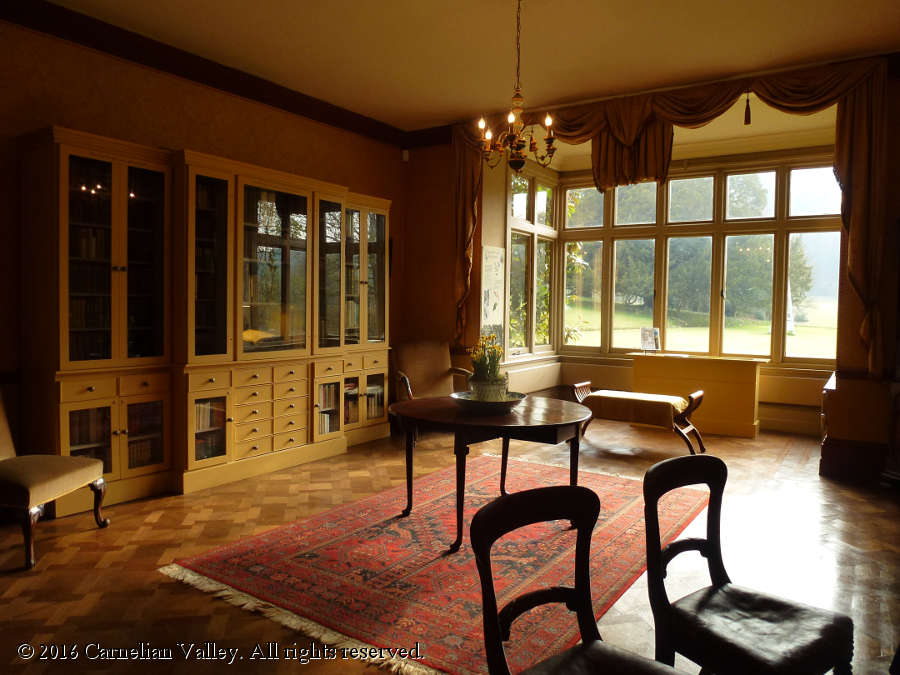
The next room is a library of sorts. This is where you start to notice the quirk of the house. Every bookshelf you see in the rooms dedicated to Gilbert, every single shelf, holds copies of the same one book, his The Natural History and Antiquities of Selborne. The copies are different editions ranging from the first, published in his time, to fairly modern copies. We spotted a few Japanese editions. There are hundreds of this one book in the house; it’s really quite something. It sounds like a project and indeed it was; between 1986 and 2010, one Ronald Davidson-Houston went around buying up all the copies he could, including ones at auction, for the house to have. One might call it mad but in this place you can understand it – we’re not talking Jane Austen here; the lady who lived down the road a little later on is far less likely to find her work thrown in the bin, I’d say, than a person who wrote of a village relatively unknown.
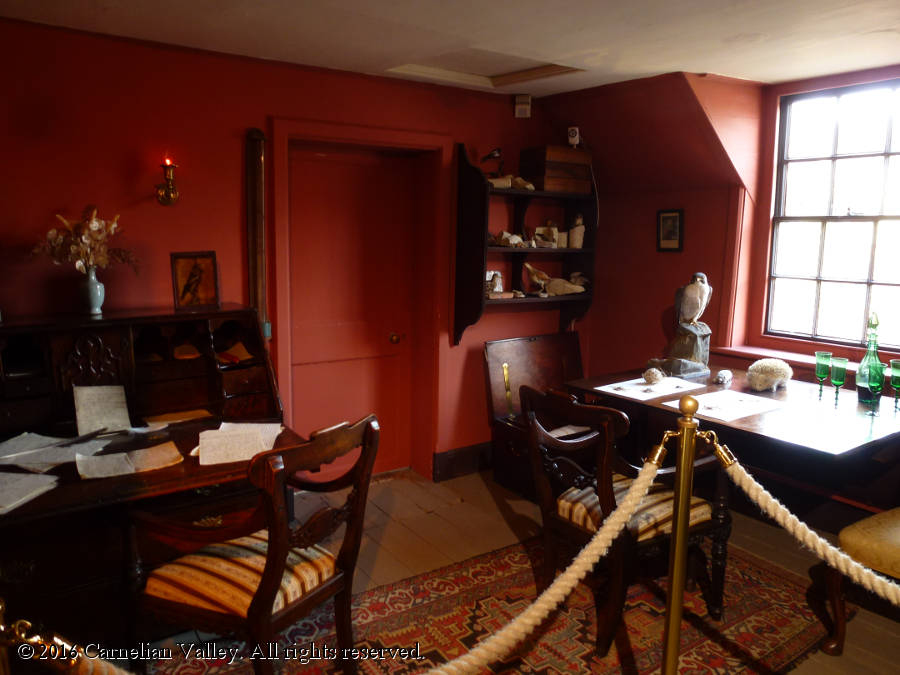
The next room is the parlour, where the hallway opens out, the main stairs play host to the model of Gilbert White, and you can choose between the tea room and the rest of the house. When we visited said main stairs were not open for use – whether they are usually I don’t know – so we followed the room round and used what were likely the servants’ stairs. On the landing are lots of drawings of birds and a fair view of the gardens. Gilbert’s bedroom is shrouded in darkness to preserve the fabrics and thus I did not take a photograph (photography is permitted barring flash). Up another set of stairs is a small library room that can be used for meetings, then there’s Gilbert’s study, and that’s it for the Georgian decoration.
The rest of the upstairs is dedicated to the Oates’ family. The reason for the exhibitions and the walls being whitewashed accordingly is that two members of the family were explorers.
Frank Oates, a Victorian, was, like Gilbert White, a naturalist. An explorer in Africa, he made a long expedition, travelling from Southampton to the then south African colony of Natal further north over the course of nine months. During a visit to Pretoria – then a town, now a city – he’s quoted as having been upset at the lack of a bookshop in the area. He also explored the Americas. The rooms dedicated to his travels are full of stuffed animals, showing the efforts, in a time without photography, to bring findings home. It’s an uncomfortable few rooms to stand in, certainly.
Lawrence Oates, whose exhibition is completed by the sounds of high winds, was Frank’s nephew and also an explorer. He travelled to the Antarctic at a time when little was known about it; those on the return journey perished eleven miles from one of their last storage depots. Sadly, Lawrence himself had already chosen self-sacrifice; suffering badly from gangrene and frostbite and knowing he was slowing the men down he told his crew he was going for a walk and never returned. Photographs showed lack-lustre accommodation, there were references to poor food planning – like most firsts, this one ended badly. In this case at least remnants, research, were recovered – the exhibition includes photograph negatives, stuffed penguins.
At the end of this floor a modern staircase has been added, I expect so that on busy days people can move in a linear fashion. They take you back to the lobby and gift shop.
Would you believe none of what I’ve spoken of acted as the reason I wanted to visit the house? Here is my reason for visiting:

As far as you can see, to those trees, and likely beyond if the information board I saw beyond the fence is concerned, the grounds belong to the house. They haven’t always, but as time has moved on so the grounds have extended. We aren’t talking lots of gardens here – there is a kitchen garden or two – as most of the grounds is simply fields. But it’s stunning. I expect that on busy days they feel smaller but when we were there there were few people and the fields went on and on.
Just outside the house is a lawn kept very short. A ha-ha signals the relative end of it and then the fields are less groomed and ripe for walking. There is a seat nestled in a barrel that I believe was for Gilbert’s perusal of his garden. Seemingly far in the distance is a statue of ancient design. Once you get closer its true nature is revealed – you’ve just been tricked into walking up to a large painted board. The fact it looks like a statue from afar is the very point it exists – there wasn’t enough money for a statue so Gilbert bought something that would look luxurious from the green.
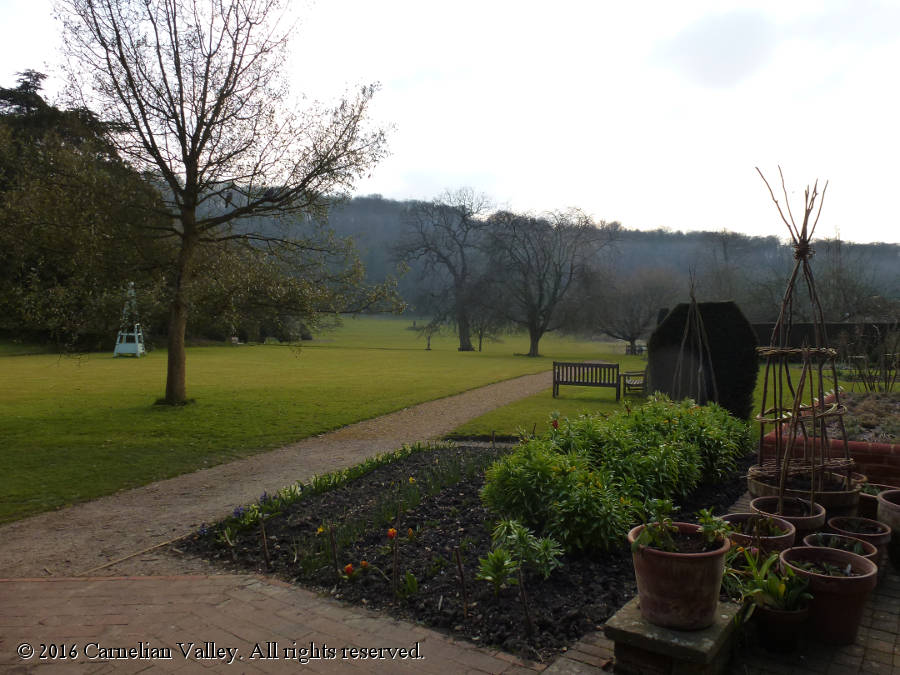
Undoubtedly there will be flowers here in the summer but this isn’t somewhere you go for colour, rather a place for walking and just enjoying nature.
I highly recommend getting off the beaten path and visiting this house. The building is small enough that you could do it on the same day as your trip to Chawton. And because it can and does make a difference I’ll say that the staff are awesome.
Are there any books you’d ever collect a lot of?
Brief Notes On The Cassava Republic Salon
Posted 15th April 2016
Category: Events Genres: N/A
2 Comments
An evening of much discussion and laughter was had at Waterstones Piccadilly this week, the culmination of sorts of the launch of Nigerian publisher, Cassava Republic Press, in the UK; it was the last time the three launch authors would be together before going their separate ways to other literary events and festivals.

We were seated in a meeting/event room on the lower ground floor and began with chatter and a look at the books. The authors – Elnathan John, Leye Adenle, and Sarah Ladipo Manyika – spoke first about the background to their books (Born On A Tuesday, Easy Motion Tourist, and Like A Mule Bringing Ice Cream To The Sun respectively). Elnathan said, in regards to his main character, he’d worried about people, specifically university students, being seen as numbers. He spoke of the poetry he’d written when at university himself, bad poetry about death and “all the girls who didn’t like me” – he set the comedic tone to the evening early on. He’d wanted to talk about those who aren’t noticed in society but also he just thought it’d be cool to have written a novel.
Sex is a part of all three books. As you may have heard or read in the Q&A I posted last week, Sarah said she’d wanted to explore desire in older women. Leye wrote what he thought was a bad sex scene (he differentiated, for us, the way this was a scene of consensual sex – his book also contains rape). His editor got back to him saying this bad sex scene needed to be written in full and then got back to him after that to say it needed more detail. It turned out it wasn’t so bad at all… but Leye will be skipping sex scenes next time.
For Elnathan, exploring the nature of sexuality was critical. The age of his character necessitated it and the author wanted to talk about that time of life, to ask all the questions we ask about sex, to explore the years in which sexuality is fluid.

Is it difficult to talk about horrible characters? Leye said that after he’d finished his book, he missed all his characters. Sarah diverted the subject to discuss how she’d created characters through silent acting. She spoke of how she tried to act out a character she’d wanted to create, a cleaner from Nigeria, and how it had then burst out of her, at which point she turned on an accent and became the person she’d created, filling the room with the voice of a lady who’d just cleaned up and now everyone was making a mess.
Elnathan doesn’t think in terms of literary heroes, he’s more about those who make him think deeply about books. He creates categories depending on what subjects are involved and spoke of how for their present work, his fellow launch authors are inspiring him. For Leye it’s Chinua Achebe all the way. Sarah has included her heroes in her book – Jean Rhys and Charlotte Brontë for starters.
It was an awesome, fun, evening and a note towards the end bears repeating: African writing often gets stereotyped so the more we talk about the books, just talk about them, the better.
What books are you excited about right now?
Factually-Based Historical Fiction And Spoilers
Posted 13th April 2016
Category: Chit-Chat Genres: N/A
4 Comments
Can factually-based historical novels be spoiled? That was the question that entered my head a few weeks ago when I was pondering my last post on the general subject. I think there may be a few genres where the question ‘do spoilers affect your reading?’ needs more details prior to answering but the most obvious in my mind is factually-based historical fiction. Be it historical in general, historical romance or historical fantasy (less likely, I think we can say, to be completely factual), it’s harder to say that fiction based on history, particularly history that we know a fair bit about, can be spoiled.
I suppose you could liken this to the argument that we should get over ourselves when it comes to spoilers for the canon, that they’ve been around too long for anyone to walk on eggshells; a substantial number of people are likely to know the historical details of a historical novel, be they readers or not, and they aren’t going to keep quiet about them. After all, history is a different discipline to literature; to use the favoured turn of phrase, so-and-so would roll in their grave if we made something of their story having been spoilt for us. Where history is concerned, the issue of spoilers is moot.
I reckon the concept is more prevalent in the film industry, where people don’t want to know the ending of a story unless they’re currently watching it. Of course this sort of no-knowledge tends to depend on the person not being into the history except in the context of films.
If a book is based on a real person/people and/or events, I don’t think you can expect to read your book free of spoilers. Not only would you have to watch out for the writings and conversations of other readers but also of historians in articles, in television documentaries and for random occurrences like a 500 years late funeral. And the more popular the history, the more the discussion.
But in this there’s a big positive – if you are sensitive to spoilers this is one genre where you can throw caution to the wind and research. You get to read the book for the first time as though it’s a re-read. Historical fiction is full of opinion and interpretation, more so, perhaps, than other genres and it offers an easy way to study History, to study without studying and to gain knowledge, to learn academic methods and disciplines in a non-academic environment.
I’m thinking we can’t apply the concept of spoilers to factually-based historical fiction in the usual way, that at most we can say that authors’ interpretations and retellings can be spoiled for us.
Your thoughts?
‘A Classic Is A Book That Hasn’t Finished Saying What It Has To Say’
Posted 11th April 2016
Category: Chit-Chat Genres: N/A
2 Comments

A few years ago now, I wrote a post about what makes a classic a classic, looking at different ideas though mainly at what I was going to use as my definition in terms of my Classics Club list. A few weeks ago I read an article, Why Read The Classics? that included the line I’ve used to title this post, and it was a mini revelation to me. Not a complete light-bulb moment, because, and I think I speak for all of us when I say this, whilst I already had the idea mulling in the background, I’d never put it into words. Here was, in words, made into a statement, everything that seems true of a classic. I still think there isn’t one sole definition of a classic as the word encompasses so many concepts and interpretations (and I think that’s needed) but I love the statement and wanted to consider it further.
I do reckon it’s perhaps the unofficial ‘correct’ definition of a classic – and I realise that in saying this I’m to all intents and purposes contradicting what I’ve just said above. If you think about it, it’s the books we still talk about that are in the canon, it’s the books we still talk about that are, well, talked about, be they Victorian, from the 1930s, or a little beyond that. (In this way such a time limited definition would rule out my own definitions, of the work of Angela Thirkell and Barbara Comyns being called classics, because so few people read them – though there’s a case to be made for them becoming en vogue in the future just as many of the books from the Victorian period have done… and Thirkell and Comyns have been making their mark on bloggers.)
Such a definition requires a period of time to work: there needs to be a certain amount of time after the book’s release before we starting calling it a classic because there will always be a lot to say about a new book and time must progress before we find out if it has staying power. We can guess but we’re guessing in the moment what will be relevant in the future and we don’t know what the future holds.
How long should we wait? This is surely where the term ‘modern classic’ comes in handy. A newer book we think is likely to survive time can be a modern classic. It will then either join the canon as hoped or fade away from our collective consciousness.
But just as there are differing definitions of ‘a classic’, so ‘modern classic’ differs. I’d say Daphne Du Maurier – you knew I’d include her in this somewhere – is almost an author of ‘classics’ rather than a modern one; I hope she makes the canon. (I’m sure doing my accidental darnedest to make it happen!) But others might say differently. Certainly I’d say the definite, widely-accepted cut-off at present for ‘modern classics’ is the 1920s – we consider The Great Gatsby part of the canon.
There’s something else that affects the canon that I’d like to consider, briefly – defining moments in literary history. I wouldn’t be surprised, for instance, if Fifty Shades Of Grey ends up being known for a long time to come, not necessarily because it would still have an audience but because of its literary social context, the way it was the first erotic novel to break into the mainstream, creating a path others have followed. (Then again could we call that a reason to be added to the canon? I think not, but if a book is kept in the public consciousness for its social history then by all accounts even if no one likes it it’s still a classic.) Perhaps this is the reason why there are so many classics no one likes, then again the idea of ‘hasn’t finished saying what it has to say’ works with dislike as much as with like – we’re still talking about Heathcliff and by all accounts he did some terrible things.
To move away from E L James – yes please – and back to the main topic, the problem with the idea that a classic is a book still making conversation is that it’s subjective. Some books no one could argue against – we do still talk about the works of Jane Austen – but other books we could argue against. One could say that we’ve dissected a book, others many disagree. In many ways it’s down to individual taste, to personality and, whilst elitist-sounding, down to education, too. To speak personally, I think I’ve written all I have to say on Cranford in long-form (to be posted) but a literary student with a focus on Victorian social history, perhaps specifically on Victorian poverty or Victorian fictional towns full of women who prefer Samuel Johnson to Charles Dickens, would probably say I’ve made a start rather than a finish and that there’s plenty more to say. Many of us would say we’ve exhausted Twilight but someone who has experienced life both as a Mormon and in another religion, for example, might say everyone else has missed key points.
There will always be new interpretations as time goes on and that would be true whether the book in question is a classic or if one day in the future someone discovers a copy of a dated, out of print, forgotten everyday novel. The progression of time brings new information about things we already do and know about, as lead was once thought good for cosmetics and nowadays we can weigh in on ill health in a more enlightened manner – that sort of thing. And the progression of time brings new viewpoints, away from information itself, in the form of new social contexts, upbringings, and so forth.
If we apply this line of thinking then we see where books may enter and leave the canon – enter when relevant, leave once they’ve said everything. We can assume books like Orwell’s 1984, that are highly relevant right now, more so than they were when they were first published, will see us for a while longer but will eventually lose relevance, in Orwell’s case perhaps in the near-ish future. (That said maybe there will be a lot more talk in hindsight of that book in future.)
I agree with the concept raised by the statement. Personally I find it’s generally the classics that I get the most out of in terms of thinking and writing. Part of that is because I know there are more people out there who might be interested in posts on a classic, a book more likely to have been read than one of the plethora of others, and that spurns me on – obviously, whilst I might find posts about random books great to write, others may not know enough to ‘get’ them. But regardless, for me it’s easier to write more about the classics. And of course when we write about books our aim is to not repeat what’s already been said – at most we’ll take a well-used subject and put a new spin on it… and the book therefore still has something to say.
And we’re still doing all that for the books we call classics. It is what makes them classics and as such it’s surely fair to say that a classic is a book that hasn’t finished saying what it has to say.
What do you think about the statement discussed here?
Q&A With Sarah Ladipo Manyika
Posted 8th April 2016
Category: Interviews Genres: N/A
2 Comments
Upon finishing Like a Mule Bringing Ice Cream to the Sun I had some questions and took the chance offered to put them to the author. Not only did Sarah answer them, she prepared an audio version just for The Worm Hole. I’m hopeful the majority of you will be able to listen to the file, but if not the written answers are below. Pausing the audio takes you away from the track, so be aware that if you do pause, you’ll have to either reload this page or visit SoundCloud’s page for the file. If anyone knows how to stop this change happening, do let me know.

Where did you get the idea for the book and where did the title come from?
In life, I meet many older women who have lived colourful lives, and yet when it comes to fiction I find few stories that mirror this, especially when it comes to the lives of black women. Whenever I cannot find stories that I’d like to read, I inevitably try writing them for myself. The title of my book, Like a Mule Bringing Ice Cream to the Sun, is taken from two lines of Mary Ruefle’s poem, Donkey On. I love the imagery in these lines and the fact that it evokes multiple senses and possible meanings.
Morayo’s love of books is written in detail. Following this you show the process of de-cluttering, then Sage finds a book and keeps it. I was wondering if there was anything in this process?
Morayo’s love of books is, in a way, homage to many of the authors that I’ve admired over the years. The passing of one of Morayo’s many books to my homeless character, Sage, is perhaps symbolic, showing how books can also bring people of all backgrounds together.

Both Morayo and Reggie are afforded time to talk about their sexuality. Could you tell us about that, the importance of it and so on?
I often find that sexuality in older age is either thought not to exist, or that it shouldn’t exist at all. My characters obviously think quite differently.
The ending is left open – there’s a likely but not forgone conclusion. What was it that made you choose this slight ambiguity?
I’ve always liked endings that leave room for the imagination – for scenarios that even the author might not have imagined. The other day, a reader of my first novel informed me that the way he interpreted the ending of my first book (in which my two main characters sit outside on a bench, hand in hand, reminiscing about times past) was that my characters sat outside in the cold for so long that they froze! This was not at all what I had envisaged for those two characters but…
Any plans for your next book?
Right now I’m working on non-fiction, including a piece on homelessness in San Francisco.
My thanks to Sarah for her answers and also for making a recording – a lovely surprise! Thanks also to Alice from FMCM Associates for the book, information, and set up.


