




World Book Night 2016
Posted 29th April 2016
Category: Events Genres: N/A
5 Comments
“I think I’m on a list,” I said to the woman on the door. It was one of my first times on a list for a public event and I wanted to notify her in case the ticket desk wasn’t the one I’d need, without sounding pretentious. Yes, I was over-thinking it.
Here we were at the British Library Conference Centre for the World Book Night gala event. It was pretty packed.
Roly Keating, who I expect finds lots of people asking if he knows of the pop star with the very similar name, welcomed us to the event. He’s the Chief Executive of the Library and told us, in reference to the whole Shakespeare celebration (it’s the 400th anniversary of the Bard, his birthday and death day being the same date) “we’re going to party like it’s 1616”.
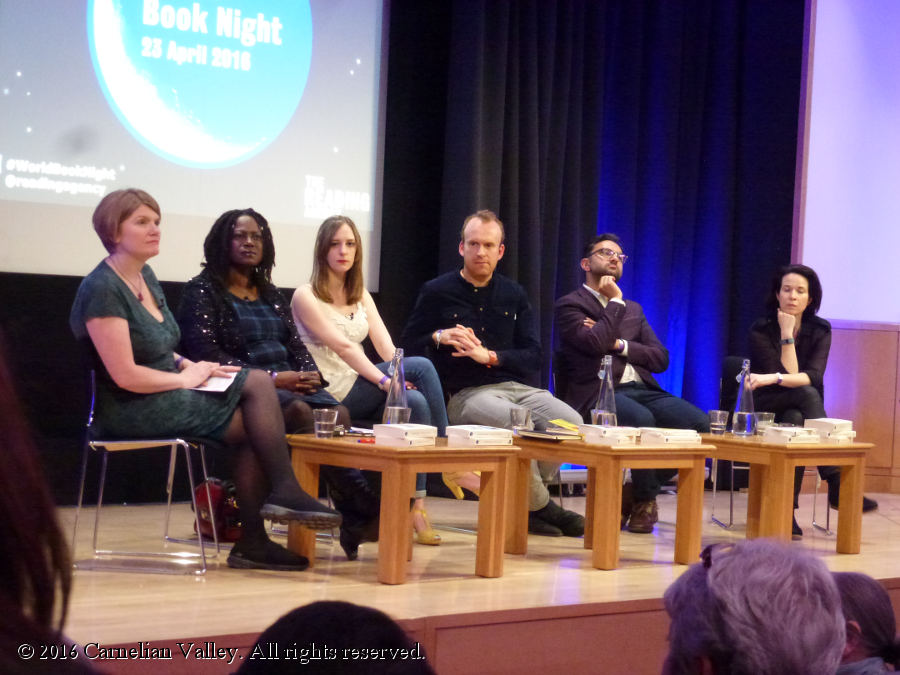
Not straight away, though – Sue Wilkinson, Chief Executive of The Reading Agency, introduced us to the night’s proceedings and to the panel of authors about to take to the stage. She spoke of the charity and of reading in general, the mission of the Agency. “Libraries aid us all our lives… we believe everything changes when you read.”
It was the goal of those who created World Book Night to get thousands of people who’d never read a book before to read one then, to be inspired and to pass their book on to another who could also benefit. Research shows World Book Night does get people reading: 85% of the 5000 surveyed, who’d never read before, said they’d kept on reading afterwards.
The panel consisted of Cathy Rentzenbrink as chair, Dreda Say Mitchell, Holly Bourne, Matt Haig, Sathnam Sanghera, and S J Parris. Dreda gave a brief introduction to east London, her home, saying how it doesn’t fit the stereotype, that it’s full of culture. There weren’t books in her childhood home because there didn’t need to be – there were plenty of good libraries, an art gallery, and Dreda and her siblings would visit them all, their parents not always in the know. Her first favourite books were the Topsy And Tim series and the scratch and sniff books of yore.
Dreda does a lot of prison work. 50% of people in prison have poor literacy skills. “Reading opens doors for you… if only so much [money] was spent on reading,” she said.
For Holly, reading helped make sense of life. She called it both an escape and a hallucinogenic drug. She didn’t see how hard life was where she grew up because her face was always in a book. Her love for reading dipped in secondary school due to the requirement for exams on things she loved. Her first poem, the first she liked, was a Philip Larkin – she liked the use of the F word. “You can’t find poetry,” she said of her late development in it, “poetry has to find you“.
Matt remembers reading tractor catalogues in his younger years; he had dreams of working with them. Similarly to Holly he said, “school distanced me from that pure joy for a while”. He came back to books at 13, reading The Outsiders. Then, suffering from depression and anxiety, he got back to his childhood favourites, minus the tractor catalogue. He said reading had been his only escape from himself. “Stories are about change,” he said. The good thing about his issues, he jested, particularly the agoraphobia, was that it narrowed down his career options.
Sathnam’s father was illiterate but took his children to the library. As a child the author became obsessed by the idea of owning a book and bought a nice copy of the collective works of George Orwell. He was too young to understand it but enjoyed pretending he’d read it when his cousins came from miles away to see it. He still hasn’t read it.
In regards to his own work: “If your parents don’t read books you can write anything you want about them”. Much laughter. Most people he knows just want to know when there’ll be a TV adaptation. Ending on an ironic note, he told us he’d failed the audition for his own audiobook.
S J Parris – Stephanie Merritt – grew up in a house full of books because neither parent had had books as children. She was very young when she picked up her first non-picture book, one of The Famous Five, and thought the chapters inferred it was a short story collection. The book she read to us from, A Christmas Carol, she first attempted aged 10.
We moved on to Shakespeare. Stephanie said she’d had a great English teacher who had made a bet with her to read the Bard’s complete works by the end of her GCSEs. She read most of them. “A bad adaptation is the worst thing in the world, a good one the best,” said Sathnam. Teachers need to be aware that it’s hard for kids, he said, they need to break the text up. Matt spoke of how there’s wisdom in Othello and Hamlet about mental health – it’s as though Shakespeare invented Cognitive Behavioural Therapy; it’s hard to read the plays and not see the writer’s depression.
Holly’s introduction was via Keanu Reeves – she didn’t need to understand it. Matt mentioned the Leonard Di Caprio Romeo And Juliet – yes, she liked that, too. School put her off but she’s interested again; she spoke of Shakespeare being 400 years ahead of his time in the way he approached gender, treated women, and said he showed there was more to women than was thought at the time. She loved that he invented the words ‘eyeball’ and ‘lonely’. What did we do without the word ‘lonely’?
Dreda said what by now we were all thinking – Shakespeare’s taught badly. She had a teacher who emphasised performance and spoke of how her class had been enthralled by Judi Dench saying ‘unsex me now’. If you get a good production you can really draw kids in, she said. He’s writing about things we like, what we watch on TV.
What books would the authors give away? Dreda chose The Colour Purple, Holly To Kill A Mockingbird, Matt The Outsiders and The Cosmos. Cathy said she’d give away Matt’s book and has done previously, saying it illustrates how reading makes you feel less alone.
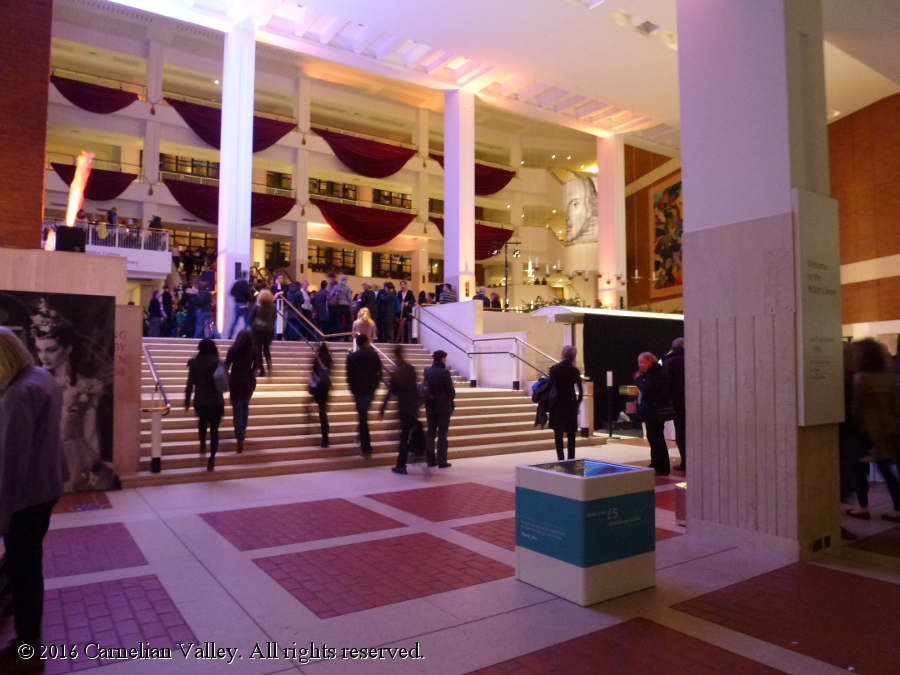
After this we all went into the main lobby of the library, joining many others, to view the exhibitions on Shakespeare through the ages. There were primary sources involved, so no photographs, but along with the original texts there was Vivian Leigh’s Lady Macbeth costume, and a room dedicated to black actors playing Othello (the first in Britain acted in 1925… it’s not like Othello was written to be a black man, after all…). There was also the last draft of one of Angela Carter’s books.
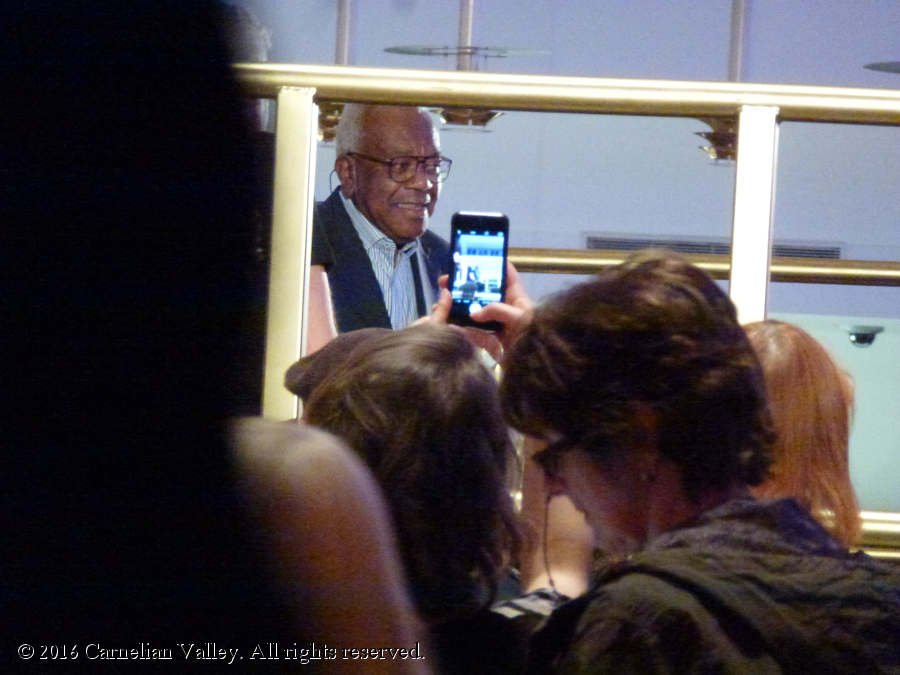
Here’s a grainy photo of Sir Trevor Macdonald. I was too busy trying to take it to really listen…
I forgot that June Brown was Dot Cotton from Eastenders so I missed half her set. She was speaking of her Shakespeare plays, how she’d been taught to keep thinking to rehearsals and not think when performing. She said she’d speak all night if she could and that she’d once interpreted a spotlight on her as encouragement to go on when it was actually a hint for her to stop talking. Here a glass broke somewhere downstairs in the bar area and she shouted at them to stop making so much noise when she was on stage. I remember seeing her drunk on Graham Norton’s show alongside Lady Gaga and thought she was funny; seems she’s funny all the time. I suppose one has to be when they work on Eastenders…
Having never done anything for World Book Night before because I always miss the date, it was a super first innings. Thank you, Alice, for inviting me.
What did you do on World Book Night? (I’m assuming most of you were very appropriately Readathoning!)
Elizabeth Gaskell – Cranford
Posted 27th April 2016
Category: Reviews Genres: 1850s, Comedy, Commentary, Social
5 Comments
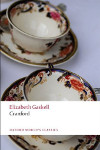
No man’s land, gender form.
Publisher: N/A
Pages: N/A
Type: Fiction
Age: Adult
ISBN: N/A
First Published: 1851-1853
Date Reviewed: 8th April 2016
Rating: 3.5/5
Our narrator – whose name we will learn in time (this is no Du Maurier) – takes trips to the town of Cranford periodically and informs us of the goings on. Most of the residents are women – men tend to disappear – and a certain propriety functions. You’ve people like Deborah – faithful to the works of Samuel Johnson – and you’ve the richest woman, Mrs Jamieson, who struggles somewhat to retain feelings of wealth in a town where money never grows on trees.
Cranford is a novella, one of three that looks at the fictional town; it deals with many different subjects. Akin to a long-running soap opera in terms of its lack of action and overall excitement, the book is more an escape and ripe for pleasant Sunday afternoons.
This said there are two ‘sides’ to Cranford. Certainly the surface dressing and the majority of the content is frivolous – we could well imagine people in Gaskell’s time sitting down to the most recent chapter (the work was first published as a serial) but there is a second side akin to Gaskell’s work in North And South. It may take a while for the side – the social commentary – to become apparent but to put it simply, the book includes a small-scale study of poverty. One can assume Gaskell was wanting more contemplation for her readers, in fact one could assume she was wanting to say something without jeopardising their interest – she looks at poverty in general and how other people work to help each other, whilst simultaneously never implying anyone lacks money. Needless to say the book can be read in a variety of ways; Gaskell seems to want you take away what you will.
Away from this there’s little to comment on in depth. The book is all about its humour – every now and then you may laugh out loud but the emphasis is on subtlety. Here, again, Gaskell doesn’t want to alienate her serial readers – the characters are women and that’s great, but we’ll have some fun at the expense of them on occasion. The male characters, likely deliberately, are all good guys, men that can match the women in wit and personality and thus stay in town.
The writing is strictly okay; you can see why, perhaps, Gaskell is not considered on a level with her friends Charlotte Brontë and Charles Dickens, but it does the job.
That this review is so short should clue you in to what you can expect from Cranford – fun, yes, and escapism, but a lot of average moments and a sense of convenience. Reading the book is like watching Neighbours, just without the divorces and deaths. It’s something to read whilst you’re deciding what to read.
Related Books

Now With An Editorial Calendar
Posted 25th April 2016
Category: Chit-Chat Genres: N/A
5 Comments
By the time this post goes live I will have been using an editorial calendar for 2 months. That I’m writing this post a month in advance is part of the reason for writing it.
I used to think editorial calendars weren’t for me. A system wherein you note which posts you want to put online and when, that fundamentally means you’re working with a view to weeks ahead, wasn’t something I thought would work. Many big blogs speak highly of it but trying a few WordPress plugins only confirmed my thoughts.
From the time I started my blog, I’ve kept posts in drafts. I always found deciding what posts to post within a two week limit to be what worked best and I rarely reached that limit.
I’ve been using a calendar since the start of March. The turning point was when I realised just how much time I was spending looking at my drafts and wondering what to post. Knowing a calendar could make that easier, because you slot posts in in batches, I decided to go semi-old school, manual, and created a table-based calendar document. It offered the control I felt was lacking in the plugins. It’s working; I’ve been a month ahead. I can look at a full month of days and by slotting in all my ideas and noting where I am in the posting process I can easily switch them around if needed later. It’s also spurred me to write more as seeing blank dates, even if they’re weeks away, pushes me to fill them. It’s a kind of good anxiety.
All this to say if you’ve noticed a change here, there has been one. It seems to be affecting what I post, too, in a good way. I can see at a glance how many less ‘involved’ posts are planned – round-ups, links – and mix it up better.
My belief is still the same – an editorial calendar will work if you want one but I don’t think they’re as essential as some blogs say. It really depends on your ‘whys’, ‘hows’, and time.
For me, the time was right.
What tools do you use for blogging/writing/keeping track of your reading?
Reluctant Readers, World Book Night, And Quick Reads
Posted 22nd April 2016
Category: Chit-Chat Genres: N/A
4 Comments

Alice from FMCM got in touch with me about World Book Night (this Saturday, which this year coincides with the Readathon) and to ask if I’d like to see a Q&A conducted with some of the authors whose books the volunteers are giving out. I said yes, had a look at the content, and one of the questions – actually, one of the answers – gave me an idea for a post. I’m going to share the answers with you now so we have the context to go on because I’d like to make it into a discussion.
What are 3 books you would give to a reluctant reader?
S J Parris: Talking It Over by Julian Barnes; Dress Your Family In Corduroy And Denim by David Sedaris; The Pillars Of The Earth by Ken Follett.
Sarah Hilary: The Hitchhiker’s Guide To The Galaxy by Douglas Adams for its anarchic humour. The Greatcoat by Helen Dunmore for its chilling, touching brevity. Honeydew by Edith Pearlman for the sheer joy of short stories.
Leigh Bardugo: The Shadow Hero by Gene Yang. This graphic novel tells the story of the first Asian-American superhero. It’s hilarious, thrilling, and poignant too. Plus, if your reader gets hooked, Gene has a fantastic body of work to sustain that interest. Shadowshaper by Daniel José Older invites readers into a magical New York and takes on themes of creativity, appropriation, and power while never scrimping on adventure. This is a great one for young artists who may not quite believe in their gifts. For younger readers, The Wig In The Window by Kristen Kittscher is a witty, diverse middle grade mystery with an even more charming sequel.
Holly Bourne: One Day – It’s funny, on-point, romantic and sad – with incredible dialogue. There’s a reason the entire London underground seemed to be reading it in 2009. Station Eleven – I’ve been literally shoving this into the hands of everyone. It’s an incredible literary book, but with a gripping premise that will keep anyone up until silly o’clock to get to the end. The Fault In Our Stars – YA fiction is great for reluctant readers as it’s so plot-focused. I defy anyone not to be totally bewitched by this one, and John Green is a great gateway drug into the amazing world of teen fiction.
Ann Cleeves: I’d suggest anything on the Quick Reads list. Quick Reads are books that have been specifically commissioned for people who are new to reading for pleasure. The content is very definitely for grown-ups, but the language is relatively simple and the chapters are short. The scheme has been going for ten years now so there’s plenty for people to choose from. For instance, this year there’s a story by Lucy Diamond about pregnancy, an edited version of Malala’s story and a crime novel by me! I wouldn’t want to recommend specific titles because reluctant readers have their own tastes and preferences like everyone else. Part of the joy of reading is wandering into a library and taking a chance with a book. So instead of giving 3 books, I’d give a library ticket.
Jan-Philipp Sendkar: It totally depends on the age of the reader, the gender, the interests, the personal background so it’s impossible to generalize. I do believe there are books for every reluctant reader, though. Sometimes it is just a matter of time or the right timing. Sometimes it is a matter of finding the right match. One of my children is a very reluctant reader but once in a while, when she finds the right book, very often by accident, never because I gave it to her, she reads through the night. I believe that very often a book finds its reader… and luckily books do have a long shelf live.

Now I actually rather like the reasons the authors gave (I’m all for the John Green, I think that’s a good pick, though I disagree with including the Emily St John Mandel because I think it’s too literary) but it’s the last two answers I like the most and Sendkar’s in particular is the one I’m going to hone in on here (I’ll speak briefly of Cleeves’ at the end because it’s a different subject, though she does end on Sendkar’s note). Sendkar’s answer struck me as a fair response; I think the right book for a reluctant reader is dependent on who that person is.
I wonder if the key, perhaps, is matching potential reader to a particular slice of popular culture, the sort they might like or relate to or be familiar with at the very least, like a child a few years ago might have been more inclined to read the Harry Potter series than a relatively random book their mother loved, albeit that the mother could be right in thinking her child would love it too. Clearly it has happened that way – Harry Potter has brought books to non-readers – but I do wonder if that love of books the recommender has for particular novels can sometimes be a problem.
Here I’m actually thinking of a child trying to get a parent reading or, more correctly, I’m thinking of the effort I went to a few years ago to get my mother reading. She reads reference books and I had just finished my first few Austens and wanted to share them with her. I knew she’d seen Colin Firth appearing from the lake and thought that might be enough context, when mixed with my own enthusiasm, to get her reading it. So I bought her a lovely edition of the book, she read three chapters, and who knows where it is now. I did the opposite of what I do now; I asked her a few times if she’d read it so there were some awkward conversations.
And with that awkward memory, I’d love to know your thoughts on Sendkar’s answer. Let’s not talk any more about my Austen thing…
In regards to Ann Cleeves’ answer I wanted to talk about Quick Reads, the programme she’s involved in and so understandably plugged. I’ve heard a bit about it from Cathy Rentzenbrink from reading her book The Last Act Of Love and possibly also at the blogger brunch. (Rentzenbrink’s the Project Director of Quick Reads.)
Reading about this year’s World Book Night has answered a question I’d had – I’ve seen these ‘Quick Reads’ books and you can’t really get away from Galaxy’s promotions here in the UK (happily in the case of books and not that you’d want to anyway because they really do know how to make chocolate) but I didn’t know what the programme was about. Quick Reads, now a part of The Reading Agency – the literary charity that started World Book Night – is a special line of books commissioned each year. Famous authors write short, easy-to-read books, or they create a collection of stories as the editor, or they abridge popular reads, all in a drive to promote literacy and make books less daunting.
I haven’t got a point on this, I just wanted to share what I’d learned.
Here’s the World Book Night list and after that some questions for you.
- Amanda Prowse: Perfect Daughter
- Ann Cleeves: Too Good To Be True
- Carol Ann Duffy: Love Poems
- Elizabeth Buchan: I Can’t Begin To Tell You
- Holly Bourne: Am I Normal Yet?
- J Paul Henderson: Last Bus To Coffeeville
- Jan-Philipp Sendker: Whispering Shadows
- Jonathan Coe: The Rotters’ Club
- Leigh Bardugo: Shadows And Bone
- Lucy Diamond: The Baby At The Beach Café
- Matt Haig: Reasons To Stay Alive
- S J Parris: Treachery
- Sarah Hilary: Someone Else’s Skin
- Sharon Bolton: Now You See Me
- Stephen E Ambrose: Band Of Brothers
What do you think of the particular books the authors have chosen?
What do you think about what Sendkar says?
What books have you recommended to non-readers?
And are you taking part in/doing something for World Book Night?
My Classics Club List Four Years In
Posted 20th April 2016
Category: Chit-Chat Genres: N/A
9 Comments
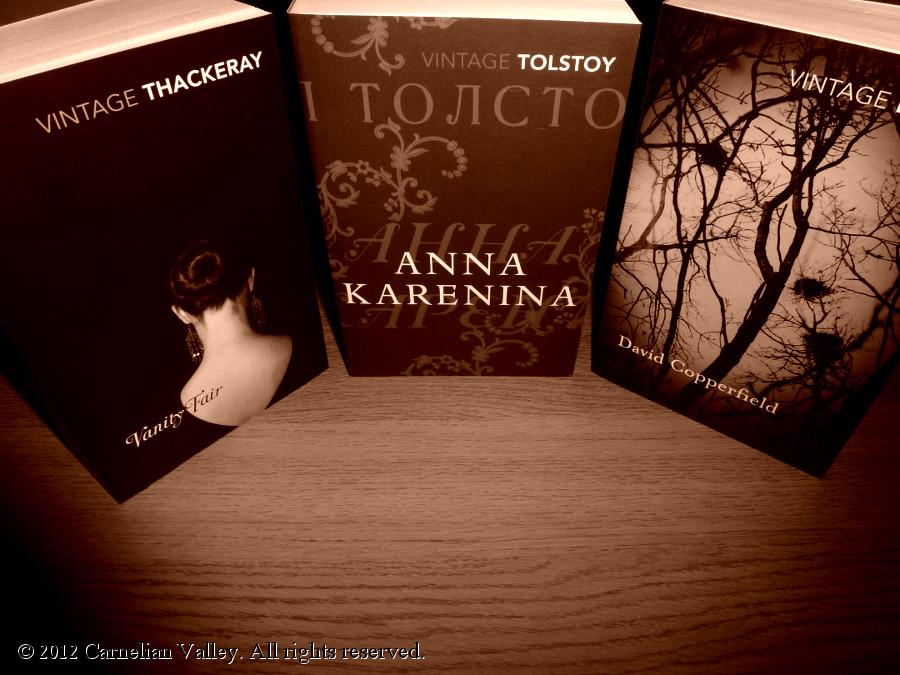
Five years (the length of the Club goal), especially given the possibility to extend it, is a long time. People talk of five-year plans – where do you want to be? – so it shouldn’t come as a surprise that a list of books for that period starts to become irrelevant, particularly when you’re far from on schedule.
In January I noticed that whilst I’ve barely made a dent in my list it’s not reflective of my reading itself. I’m reading the classics, just not those on my list. Often I know the book I’m reading’s not on my list, other times I’m baffled.
This bafflement introduced me to the fact I’ve changed. When I made the list I was full of the same hope and enthusiasm I still am today but my knowledge of the classics was minimal. Back then I was excited to learn, now I’m further along in my education. I know better what I like; before I just wanted diversity and to read what everyone else was reading. Crucially I made the decision to add only one book per writer, I thought that would be less daunting, and now I’ve some favourite writers I don’t want to move away from them so soon.
The list was a guide, good at the time. I like that it illustrates where I was as a reader then. I don’t want to abandon it completely because there’s no firm deadline and I would still like to read many of the entries at some point. And it did get me reading classics and keeps me on my toes. Perhaps I should pay more attention to it, then I wouldn’t be so shocked when I find a book isn’t on it, but that would be a chore.
For me, then, I think the success of the list isn’t in the reading but in the spin-off. I do wonder if I should update it, or categorise it.
Did you make a Classics Club list? How do you feel about it, however far along you are now?


