






Further Thoughts On The First Book Of Calamity Leek
Posted 20th April 2015
Category: Further Thoughts Genres: N/A
Comments Off on Further Thoughts On The First Book Of Calamity Leek

I wanted to follow up my review of The First Book Of Calamity Leek with the thoughts I had that dealt with spoiler content. I can’t say I’m covering everything, indeed, I know I’m not covering everything, but maybe that’s a good thing; I don’t want to bore you all with an essay! I should also add that these are my own views: if anyone reaches this page through a search, don’t take them as verbatim. As always, I’m rambling on, repeating myself, jumping back and forth between subjects as I’m wont to do.
There’s an element of religion in the book. Emily is almost a deity and descriptions of the statues make it sound as though they might be of the Virgin Mary Obviously no one was going to have made statues of Emily herself, most especially as Mother wants the place to be secret, and the number of statues there are intimate that, at best, they are of various people. If Mother was a religious person, statues of religious figures makes more sense.
Another, possibly more pertinent, argument for the statues being of the Virgin Mary is the way Mother’s story and approach to her daughter suggest a saint-like belief. Emily the pure, untouched daughter, vassal of higher power. If the statue is of Mary (and I say this even knowing there were other statues, too) then might Emily have been Mary, Mother casting herself in the role of Saint Anne? Highly unlikely, I know, but I think the comparison is interesting. Mary wasn’t abused but a person in Mother’s state could feasibly view what happened to her as beyond her control, in a bad way.
The writing is odd. It’s particularly childish. Its meaning can surely be found in Calamity’s non-education, the non-education she believes is an excellent one, that has led to not only a narrow mind but a complete lack of knowledge. The word choice, the generally poorly-constructed sentences that defy description, given as an idea as to what was most important to Mother and Aunty: speaking ability was not it. It’s interesting; if we believe Calamity’s report it seems the other girls speak better. It’s possible they’ve broader minds – their relative strength compared to Calamity’s absolute trust in her captors is where the differences lie.
Although Lichtarowicz does not specify exactly for what and why the children are stolen, we are left with a pretty good idea. Trafficking; though whether Mother’s plan truly was to hurt men or if that was a ruse is not known. Certainly the content of the book suggests Emily was harmed and Mother wants to hurt men as revenge, but these young girls have no knowledge and obviously, being young, their strength.
Where Emily is concerned, our lack of knowledge is regrettable because we don’t know to what degree there was an issue. The way Mother seems to be, there is a fair chance she has thought too deeply about a situation that may not warrant it. Whilst Emily could have been trafficked, abused, Mother’s behaviour suggests Emily may well have simply decided, for example, to have sex against her Mother’s wishes. Who is to say Mother didn’t kill her daughter? She is happy to kill other children.
Of course it’s incredibly uncomfortable to ponder over such an idea as the possibility of Emily’s lesser issue. We can at least say we’re dealing with the mother. And the thing is that Lichtarowicz doesn’t tell us because it an important thing to comment on, but at the same time she could be telling us, just not openly. That’s this book – everything is vague and the vagueness is surely deliberate. I know I read a real reasoning for the vagueness even if I still think it’s confusing and bizarre. This is awful; let’s move on.
It’s interesting to look at the way Lichtarowicz makes you question emotional and mental stability alongside cruelty. The adults certainly know they’re doing wrong – Mother runs away, Aunty shows remorse and real care for the children – but have Mother’s choices been due primarily to money, to please others beyond the garden? Or are her choices more to do with a true wish for revenge? How much are the choices down to issues in their pasts, down to emotional scars? Aunty hated the way she was seen when acting and took it too far. Depending on who exactly Mother wants to punish, she’s potentially wanting to punish many for the crimes of a few.
Interesting when compared to the way Mother suddenly changes once the garden is under threat. This is where we see some truth and the fact the girls are a mass group to Mother.
The way Lichtarowicz deals with the sexual ‘content’ remains something to think about. Certainly these girls are being groomed but the talk of weapons is a odds with that. It’s a case of placing the information about Japan alongside all this talk of weapons and making of it what you will.
The dedication to purity, if placed beside the idea (fact?) that Mother was looking for a replacement for Emily, makes a lot of sense. If Emily was harmed, abused in some way, then Mother wanting all the girls to be beautiful and pure shows the emotional strife of the woman. Even if Aunty had most of the control, Mother was the one stealing them.
The desire for youth, beauty, that runs through the book has many implications. Traditional roles, morals. They can surely also be the emotional affects of these older women. There’s almost a geisha-like quality to it. And Mother wants to keep her children young.
The affect of the confinement (for lac of a better word) on Calamity is shown throughout and in the way she relates to those outside. What’s interesting is the way the author doesn’t say that Calamity will ever be okay with the reality. It may not be sunshine and roses; she has seen much, witnessed horrors and was genuinely happy, never knowing any different. Stockholm syndrome is evident.
If we trust the story of Mother – wife of a Lord? – then what of Aunty? Where did she live, what was her connection to Mother? Is there a connection to Emily? Aunty seems to be somewhat under Mother’s thumb, too, exploited, used.
How do you solve a problem like Maria? – Aunty certainly didn’t know. But we do. Maria never was mad. She was likely ill due to lack of sunlight but her madness was a ruse and it served her well. It let her explore possibilities and kept her away from Mother and Aunty suspecting her.
Thus ends my rambling. Plenty questions; few answers, but thoughts enough for a fair discussion.
Have you read this book? What did you think of it?
The Symbolism Of The Sphinx In H G Wells’ The Time Machine
Posted 6th February 2015
Category: Further Thoughts Genres: N/A
Comments Off on The Symbolism Of The Sphinx In H G Wells’ The Time Machine

As I read The Time Machine, one thing in particular drew my interest: the sphinx. ‘Why the sphinx,’ you might ask, ‘when the rest of the story has so much meaning, so much going on?’, but to me it was the identification. Whereas the main messages are easy enough to work out once you’re a fair way through the story, the sphinx is a lot more subtle. And whilst you can say ‘oh, it’s power’ and get enough from that, I sensed that there was more to be had. And, whether or not I was over-thinking it – though I would argue not given the lengths Wells goes to otherwise – I decided it was worth further research and thought.
Let’s begin on that most obvious of thoughts, then: the overall idea about sphinxes is that they are very powerful. No doubt this is emphasised by the sheer size of the statues ancient societies built, but it’s safe to say that there is the idea of power regardless of how big they are in art. In Wells’ story, the sphinx is controlled by the Morlocks, likely belongs to them, as much as it can if it was salvaged (more on that later). This, then, infers that the Morlocks have power over the Eloi, even if neither sub-race could grasp such a concept.
It’s worth the time exploring what the sphinx meant to those who first used it. In sum, the sphinx is an ancient symbol from the old world, even if it was not actually made during what we call the ancient era. There is the possibility the Morlocks, or Elois, took it from one of the museums mentioned in the story. If someone did take it, which race did they belong to? We could say it was the Morlocks because the Eloi are scared of the sphinx, but that fear could easily have been conditioned – who’s to say an Eloi didn’t place it to warn of the Morlocks or, indeed, that it wasn’t originally meant as a good sign?
To both the ancient Egyptians and the ancient Greeks, the sphinx was viewed as a guardian, but apart from that thoughts varied. In Greek culture, the sphinx was seen as a riddler; those who could not answer the riddle were killed or eaten. We don’t know for certain if the Morlocks kill the Eloi, though it is suggested, however we do know they eat them. Whether they kill or whether they simply take the deceased the comparison remains – the Greek myth matches Wells’ story.
As far as additional evidence is concerned we can assume the Elois can’t figure out the ‘mystery’ of the sphinx, at least as far as the time traveller is concerned. This can be compared to a riddle not being answered. Then there’s the time traveller – he can’t or, rather, doesn’t, solve the ‘riddle’, and whilst he escapes, his machine becomes bait.
Ancient Egyptians saw the sphinx in a better light. It had great strength, yes, but it was benevolent. This matches the believed strength of the Morlocks, yet it could also be said to match the time traveller, who is stronger than the future races in a multitude of ways.
Could the sphinx represent the time traveller himself?
Whilst later ages interpreted the sphinx as less dangerous, I think we can assume, if we look at the content of the book and Wells’ background, that the author did his homework. We can assume that Wells was familiar with the original ideas of the sphinx and used them because as much as the sphinx in The Time Machine may not actually do anything itself, it represents something that is dangerous, even if the danger is not something that’s fully comprehended by itself (that’s to say that the Morlocks may not realise they’re dangerous).
In regards to the time traveller’s place in all this, then, we know that the sphinx is a grand statue standing in place of a laboratory – the laboratory of not just a scientist, but a time traveller. The laboratory of a person from the past who would have a direct impact on those who lived with the statue. This placement of the statue intimates that the symbolism is not clear-cut – as much as the sphinx is a symbol of the Morlocks, it is also about the time traveller. Even if the Elois and Morlocks didn’t understand what or who he was, the time traveller’s appearance next to the sphinx in a way symbolises the coming of power; it’s a sign, a prophecy of sorts.
And whilst the time traveller would not see himself as dangerous, just as the Morlocks likely do not, he is a threat to the world he enters. He creates discord, he saves lives when such a thing is not ‘normal’, he passes borders, he starts fires. He kills. There is no doubt that there would be after effects and confusion once he left. If the sphinx proclaims the coming of the time traveller, or even if it’s just a memorial to him, then it’s a fitting comparison. No one in 802701 can answer the riddle of the time traveller; they cannot understand him and they don’t understand his machine, and in turn he brings destruction. He may be benevolent, like the Egyptian sphinx, but he is also merciless like the Greek.
The comparisons between mythology and Wells’ story are too many to dismiss. The balance between various theories has to be taken into account also. In my opinion, it would be fair to say that Wells intended all possibilities, all meanings, and that the sphinx is a symbol of both the dynamics between the future races and history’s place in that future time – the time traveller being part of history, of course.
What are your thoughts as to the symbolism of the sphinx?
Further Reading
Further Thoughts On H G Wells’ The Time Machine
Subscribe to this site via email and you’ll receive 3 posts a week. If you use Gmail, you may find the posts are stored in your ‘social’ or ‘promotions’ tab.
Further Thoughts On H G Wells’ The Time Machine
Posted 23rd January 2015
Category: Further Thoughts Genres: N/A
3 Comments
I’m posting a little differently today. Normally I review a book before considering posting a ‘further thoughts’ piece, but when I came to write my review on this book I found I couldn’t; I ended up writing what’s below instead. As there are many, many spoilers in what I wrote, I thought I’d go ahead, post it now, and write a new review-like piece for later. This is technically analytical.
The Time Machine is an exceptional novella in which the goals of the writer are clear. Rather like Thomas More’s Utopia, the structure of the work is dialogue, conversation, between a traveller and his acquaintances, the clear purpose being to deliver to the reader the author’s messages. Whilst it is generally recommended that a reader read without thought for the writer, in the case of Wells’ book it is almost necessary to consider the author’s background; without it you may miss the nuances of the narration. Whether or not you read the book with a view to studying it, you’re very likely to find yourself studying it regardless; it could be argued that, like More’s work, Wells’ is as relevant if not more so than it was when it was first published.
“Nature never appeals to intelligence until habit and instinct are useless […] There is no intelligence where there is no change and no need of change.”
Wells was a socialist and this shines through his prose. He uses the idea of hindsight, of ideas, to get around the limitations a linear story can place on the number of messages an author wants to include. What’s interesting is that despite the fact the time traveller presents one of Wells’ messages as an idea that was later shown to be far from the truth, it’s that message that is perhaps the most compelling of the lot. Wells sets the scene of the year 802701 – written in text, which makes it seem even further into the future. Life is thus: having removed war from the world, hunger, disease, the need to work, hardship, even the need for two different genders, society has become weak. Language is simple, the people rather like fairies in their manner, of absolutely no intelligence whatsoever (see below), and very easily tired. There is no sense of self, everyone is the same. The only fear left is that of the people below, which makes everyone sleep in one room together. The removal of dangers have rid humanity of the idea of family. The people eat extremely genetically modified fruit, play in the river, and sleep. It’s both utopia and, as the time traveller comes to realise in the context of his own time and dare I say we ours, hell. As Wells puts it, it is the ‘perfect conquest of nature’.
It is interesting, then, to take away the time traveller’s point that though we may loath hardship and wish to improve the earth, we are better off for our suffering because it makes us strive to work towards the greater good which in turn keeps us on our toes. And it is equally interesting to learn that this idea, this takeaway of the Eloi world, is not the impression he leaves with.
This change in impression is interesting because on the perceived lack of character we have only the time traveller’s word to go by. Indeed the Eloi sound a world away from us, but it’s possible that the difference in language and culture, as well as the heightened fight or flight response from the Victorian, may well have coloured his perception, even that last impression (see below). Fight or flight certainly colours his perception when it comes to the Morlocks of the underworld, when he makes fires to keep them away. We often change our perception of people and places once we get to know them and had the traveller spent longer in 802701 he may have discovered that the Eloi simply possessed a different sort of intelligence, one he had no grounding in to understand. It’s unlikely they did, given Wells’ reason for the story, but interesting to think about nonetheless.
So the utopia/hell is a lot more complex than first thought. The time traveller, as he searches for the time machine that has disappeared, discovers the deep waterless wells in the ground and comes to know of the existence of the Morlocks, the workers, a second evolution of humanity that lives without light and takes the bodies of those above as food. This, then, is the continuation of hardship, even if by this time the hardship is nature and not noticed by the Morlocks as hardship. Here Wells infers that somewhere something would have to give – that it would be impossible to have a perfect, fully-functioning world, without some level of work. Nowadays we might see work in the future as the domain of robots, but in The Time Machine at least, robots are not on the radar. It’s interesting to consider Wells’ new message that a perfect world is unobtainable.
Yet there is some potentially good news, ‘potentially’ because the time traveller doesn’t stick around long enough to find out for certain. The Morlocks may have some sort of intelligence – they must have knowledge of whatever it is that keeps the world moving for the Eloi. Wells thereby focuses on the way high society could become if everything was considered nature to those lower than them, a contrast of the general idea today that money can buy education whilst those without must work instead. Of course the lives of the Morlocks are not good, and Wells is far from suggesting that the future is bright, but he is obviously making a point he wants you to take on board.
Somewhat inevitably the traveller comes to see the humanity that remains in society. The devotion of an Eloi for the traveller himself upon a rescue. It might not detract from the messages, because if it did it would render much of the work pointless, but it is the most positive idea that Wells puts forward; beyond the destruction and the communism that Wells does not like the idea of, people retain a base level of feeling. It could be said that the traveller missed it because of the difference in culture and his overwhelming desire to find his time machine. (The worry over the disappearance of the machine is itself an irony that’s worth considering. Should the traveller have left time alone and not tried to meddle with it?) The supposed lack of interest the traveller believes the Eloi possess is also held to be suspicious. Maybe, just maybe, intelligence is still there, just that it differs so much that the traveller cannot comprehend it.
In sum, Wells wants to warn against extreme progression but is against suggesting that humanity could ever be entirely lost. There is some hope always.
Away from the messages, it’s worth looking at the place Wells’ book holds in literature. An early science fiction book, it is widely held to be the first book that explored the idea of time travel via a mechanism. It is both a book of politics and a damn good read in itself, and in an era, our era, wherein films don’t tend to look all that far into the future except to be able to create space ships and aliens, Wells looked all the way to the ends of the earth. For a short book it packs a punch, even if it does go on a little towards the end.
Something that is interesting to note is the way Wells deals with gender but never race. This of course is where the novella is a little dated because it likely reflects the whiteness that would’ve been Wells’ world, yet it’s worth a short ponder because of the way Wells uses the area that would’ve been London and the fact that as the capital it would have been one of the more diverse places. Perhaps Wells saw a one mixed race as too obvious to comment on or, (likely?), he simply didn’t consider it, but given the way he mixes women with men, thereby showing a potential relative interest in women having a higher place, it is a surprise of sorts that race is not spoken of.
Of future thought, however, there is the fact of time. The time traveller is with the Eloi for eight days which is three hours of Victorian time. When he disappears he is not seen in the three years the narrator speaks of. Could it be that in three Victorian years the traveller, in the chosen future, had time to live out his life, or did three Victorian years register as but days? And is there a significance to be found in the way that in the future his laboratory is replaced with a sphinx, or in the fact the it is the door to the Morlocks? (I think I’m going to have a write another post on this at some point.)
Have you read The Time Machine? What did you think of it?
Further Reading
The Symbolism Of The Sphinx In H G Wells’ The Time Machine
Charles Dickens And The Five Sisters Of York
Posted 28th November 2014
Category: Further Thoughts Genres: N/A
3 Comments
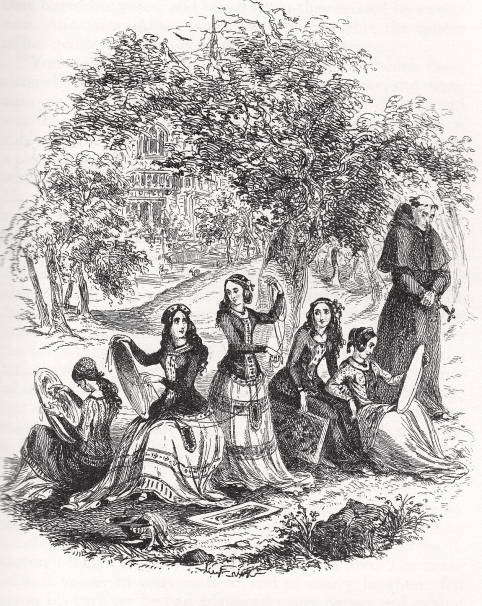
If you’d like to read this story before continuing, it can be found in chapter 6. Here is the link to said chapter on Project Gutenberg. It took me, a slow reader, ten minutes to read, perhaps fifteen including the commentary.
I’d like to explore the short story that is part of Dickens’ Nicholas Nickleby. I want to look at the reason Dickens included it, why he wrote it.
Of course the actual reason, so to speak, was to meet a word count. There’s no denying that; the story is told by a random passenger who happens to be on the coach with Nickleby, on a journey that is unnecessarily drawn out. The story doesn’t have much of a baring on the book as a whole, though there is a minor similarity in the themes. It could certainly be said that I’m over thinking things, but as the same could be said for Dickens I’d wager we should give his thoughts a thought of our own.
What is most striking about the tale of the five sisters, an average story by itself, is the way Dickens includes with it the morals that would’ve been acceptable at the time (my assumption was earlier than the Dissolution given the monk in the story) and then, when he reverts to Nickleby, it’s viewed in Dickens’ own more modern view. I know that whilst reading I was wondering ‘what sort of message is this?’ before Dickens asked the very same question. That he wrote such an old view into it, however historically correct, is something to think about. (One must consider the background to the story – to sum it up, Dickens used the Five Sisters window in York Minister as inspiration. As far as my research showed, he made up the story.)
As much as the story works by itself if viewed in its medieval context, Dickens wants us to consider the following conversation between his Nickleby characters as part and parcel of the tale. Dickens gives you the historical ending and viewpoint and shows how the Sister characters saw the conclusion as ‘right’, but then shows why the conclusion is not right.
Nickleby (by this I mean the characters of the book) notes that both ways of living ultimately led to death – Alice died when she continued to be carefree, just as the monk had hinted when he spoke of her taking the veil to make better use of her life. But, says Nickleby, had she not been happy, had she taken the veil and cloistered herself, wouldn’t the knowledge that she’d not been happy have made her death all the more upsetting? It’s something to think about given the differences in time and religion – in the medieval world, piety was important, by Dickens’ time, ‘life’ had gained a foothold.
When the sisters, minus Alice, are visited once more by the monk, they submit somewhat to his idea. They spend their time at the grave, no longer living life as they used to. I think there is something to be said for the way Dickens makes this, the ending, very quick, showing perhaps that the new gloom over the four sisters sped up their own deaths.
I think Dickens used the short story for a few reasons. To add to the word count, certainly, but also to make a case for happiness in his own life, in life in general, and for Nicholas Nickleby (both the single character and the others in the book).
If you’ve read the tale, what did you think of it? What’s your opinion of stories within a story?
Who Was Laura White And Why Did She Disappear In The Rabbit Back Literature Society?
Posted 10th November 2014
Category: Further Thoughts Genres: N/A
Comments Off on Who Was Laura White And Why Did She Disappear In The Rabbit Back Literature Society?

Laura White, famous writer, founder of the Society, and the person The Rabbit Back Literature Society revolves around, disappears near the beginning of the story. A snow storm occurs in the hall of her house and when it dies down she’s nowhere to be found. The book is in many ways about her, but Jääskeläinen doesn’t need her to be in the book herself – she is the nucleus, for all intents and purposes a plot device.
To ponder the thought of death is surely to ask, given the subject of the book, whether perhaps White ‘died’ as an overused idea can die, fade away.
If we consider White in this context, that she was an idea, her disappearance makes a lot of sense. We can see her as the ideal of brilliance, fame, intelligence, all that her country-folk believed her to be. To her public, White was a genius. Maybe it was time to let her go, to move on to the next hobby, so to speak, because ‘here is the tenth member, Ella, and everyone will be wondering about her’. Could we bring in the idea that White could see what Ella would become, what she would be doing, and feel her time was up? That White had met her match in Ella? By the end, Ella holds some power over White, she could in theory come to the conclusion that White was not at all as she seemed – maybe it was better to end on a high, rather as she literally did on the staircase above others.
Ideas spawn more ideas. White was an idea and would have provided inspiration for her society, certainly she got them thinking. And, to look towards a meta possibility, if White was taking ideas from the children (and was thus herself not truly great) then Jääskeläinen was using White as an idea himself. With the introduction to the other writers in progress, she simply wasn’t needed any more.
Was Jääskeläinen using White to show the impermanence of ideas?
We can consider White a plot device – she enables Ella to join the society, she’s the device Jääskeläinen uses to get Ella into the society so he can study it himself for the readers. White has served her purpose.
Of course a very interesting point to be made is the way White steals from the children. One could say she hasn’t chosen children so much for their writing ability as for their imaginations. If they were out of ideas, perhaps she would be, too.
Rather than create a convenient death, Jääskeläinen creates a convenient disappearance that makes you wonder about magical realism and whether or not he did it just to show how things disappear. Of course all the characters refer to her throughout the book so it’s safe to say they are holding on to this idea, this White, but much as people hope Rowling will write another Harry Potter, it doesn’t mean it’ll come into fruition.
Have you read The Rabbit Back Literature Society? What do you think happened to Laura White?


