





Privilege And Racism In E Lockhart’s We Were Liars
Posted 13th November 2015
Category: Further Thoughts Genres: N/A
2 Comments

To look closely at We Were Liars is to acknowledge the fact that the ‘reveal’ at the end of it somewhat dismisses the studies Lockhart does into other themes. As other reviewers have stated, and I agree, most of the themes are of no consequence. But it’s not quite as simple as that.
It’s the case that whilst the various themes, for example (white) privilege and racism, seem to and do lose their importance at the end of the book, where before their progress had been steady, Lockhart uses them to set the stage. She uses themes as a catalyst rather than as complete threads so that once you reach the end it may seem as though she’s dispatched them; what the reader has to do is shimmy their thoughts around and consider what privilege and prejudice lead to. It’s harder than it sounds.
Race is what shakes things up, what causes the perfection to start breaking down. Whilst holidays were taken by a group of people, all one colour and ethnicity, everything continued as it always had; it’s the arrival of two people of a different ethnicity, in this case Indian, that causes the first tremor. These people, Gat and his uncle, could have been any colour – what matters is that they are not white Americans. (They are quite likely not as wealthy, either.) Lockhart uses this episode to show the general prejudice of the family.
And we can indeed liken Gat’s arrival to a small tremor. The arrival is the start of a quake, the burning house the quake itself, a rupture. Most obviously we see the dislike of the adults for him, in particular granddad who says Gat will ‘hurt his head’ if he’s not careful. We see the disconnect between the family and their staff as Gat mentions those who look after the island to Cadence, who doesn’t even know their names. We can assume some of the staff are white but here we’ve race and class – Lockhart focuses on two who, from their names, we suppose are Mexican, placing privilege and race together.
Lockhart looks to classical literature to aid her work, inserting the idea of Heathcliff into Gat’s narrative. Not only does this give the average reader (most people know the basics of Wuthering Heights and if not can look it up) a lot of information about people’s views of Gat just in that one name, it also brings into the book all the discussions that have we have about racism in Brontë’s book, resulting in a broader picture and study in just a word. Lockhart’s general look at racism, plus the name ‘Heathcliff’ says a great deal more than the general look on its own. And whilst Gat is Indian and Heathcliff considered by us to be a gypsy, the references match well enough otherwise. Gat is the interloper, the child on a rich estate who appears to be gaining the love of the heiress.
There is the symbolism of Gat the mouse:
If you want to live where people are not afraid of mice, you must give up living in palaces.
The mouse doesn’t fit the human family and so he must leave, wants to leave. Gat doesn’t leave but his thoughts differ from the family and certainly they wish he would go.
It’s Gat who gets the teens thinking about the overbearing rules and the ‘be normal at all times’ factor of their life. Here he is, Heathcliff rebelling, as predicted by granddad; only unlike Heathcliff, Gat isn’t the only one and his statements are for the good. He does indeed mess up the family but in a good way – he forces them to consider reality where they push it behind them.
Cadence and Gat’s fledgling relationship is where the ‘whites only’ really rears its head. Because it’s not that they’re too young or unsuited and it’s not to do with money, it’s all down to colour. It’s every story where race is an issue for the society an interracial couple lives in.
Have you read We Were Liars? What did you think of the themes?
What Is Most Important To Anna Karenina’s Varenka?
Posted 7th October 2015
Category: Further Thoughts Genres: N/A
Comments Off on What Is Most Important To Anna Karenina’s Varenka?

In part two, chapter thirty-two of Tolstoy’s novel, minor character Varenka, the low-born adopted daughter of a well-to-do woman, tells Kitty that everything she (Kitty) is worried about in regards to Vronsky’s place in her life isn’t as important as something else. This ‘Vronsky episode’ as I call it, was the time during which Kitty was infatuated with the man whilst he in turn was in love with Anna; Kitty feels ashamed and guilty and has been sent off to a spa to recover from what the reader can determine is heartbreak. It is here she meets Varenka.
As it turns out, in chapter thirty-three, what Tolstoy was implying as more important is helping those less fortunate than oneself, becoming more godly. Varenka herself suffered in love and has found peace. She’s learned to be happy and comfortable by herself ever since her lover married someone else because his mother didn’t like Varenka. She seems indifferent to her attractiveness, her singing voice, anything that might get her noticed and potentially cause another man to court her. She lacks ‘what Kitty had in over-abundance… an awareness of her attractiveness’. It seems she no longer needs to be loved, so to speak, and has likely come to see the relative falsehood in societal love.
However throughout chapter thirty-two, before we’re shown Varenka’s life of charity, there’s a fair amount Tolstoy offers as the answer to what is more important than Kitty’s worries, and considering the knowledgeable way Tolstoy writes, it’s hard not to see some subtext. The author offers his concrete answer but the astute reader may see more and it’s all rather revolutionary as far as his era goes.
What is most important could be personal agency, female independence. We see Varenka planning to walk home by herself in the dead of night. “No, I always go alone and nothing ever happens to me,” she says. It’s reasonable to wonder if the subtext is two-fold, that Varenka isn’t just saying she likes to go by herself and is able but that it’s safe and, to boot, all the worries others might have are for nought. Tolstoy isn’t saying a woman would never be under attack, rather that one didn’t need to be so caught up in social norms – this one happening to be the idea that a man should escort her.
Similarly what’s most important could be letting go of what’s not to be. Varenka suggests Kitty forget the slight from Vronsky and that she shouldn’t be ashamed of feeling guilty because a man treated her badly. She tries to show Kitty that the relationship was one-sided.
“The point is whether you love him or not.” Is Vronsky worth pursuing? (Good luck, Kitty, if you say ‘yes’!)
Kitty likes Varenka because Varenka represents what Kitty, at that moment, wants to be. The grass is always greener. Varenka’s her opposite – her lack of care for social mores astounds Kitty because worth, in Kitty’s mind, is tied with beauty and men – Varenka wants neither, sees worth without them. Is Tolstoy saying that Varenka is better than Kitty? It may seem so but to go back to the note on Varenka’s attractiveness and look at the rest of the quotation, we have the following:
Besides that, she also could not be attractive to men because she lacked what Kitty had in over-abundance – the restrained fire of life and an awareness of her attractiveness.
The way it’s written (or, at least, translated by Pevear and Volokhonsky) suggests Tolstoy is objective, giving both girls credit. But he points out that perhaps Varenka is better in spirit whereas Kitty is all about appearances. The trip to the spa allows Tolstoy to experiment with change. Abundant is Kitty’s restraint for loving life – she is perhaps not as joyful or true to herself as she could be (if society was less restrained itself). In contrast to Kitty, Varenka is very modest, humble, and perhaps more visible for it.
Varenka might be a minor character as far as the amount of words expended on her are concerned, but the affect she has on Kitty, showing Kitty alternative views and a way out of her feelings, has a fair impact.
Your thoughts?
Looking At The Theme Of Love In Daphne Du Maurier’s Rebecca
Posted 5th October 2015
Category: Further Thoughts Genres: N/A
2 Comments
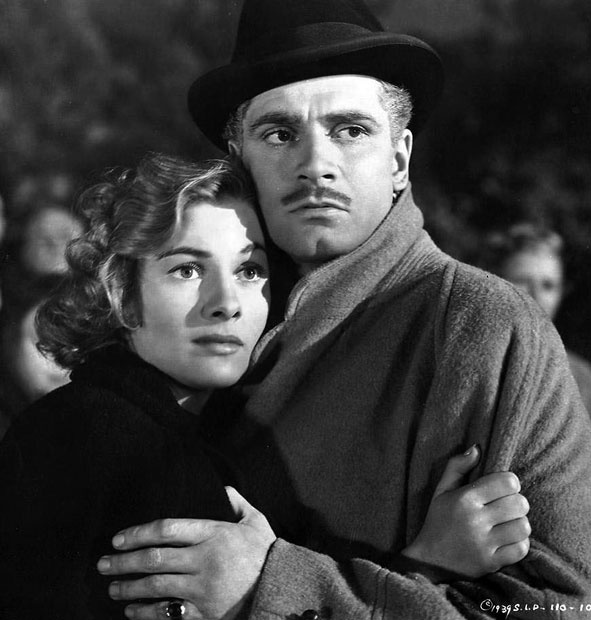
Screen shot from Rebecca, copyright © 1940 Selznick International Pictures.
I’m under no impression that love is of particular importance in Rebecca. Far more important is identity and, as Du Maurier is known to have said herself, jealousy. Indeed love is only crucial as far as the emphasis on the heroine is concerned.
However I started thinking about the role love, romantic and otherwise, plays, and had the urge to study it. What piqued my interest was the realisation that unless you’re looking solely at the surface dressing, the subject requires contrasting the characters with each other and looking deeply into what happens. Whilst love may not be important and isn’t so obvious an element, it’s there to be found all the same.
There are a few kinds of love in the story. Most notably it’s the romantic love (or at least being in love with the idea) the unnamed heroine has for Max. Less noticeably it’s about the love – or is it pity? – Max has for the heroine, which may or may not be romantic. Then there’s the obsessive love Mrs Danvers has for Rebecca and lastly there’s the question of Rebecca herself and whether she loved anyone at all. All these kinds of love, put together, offered me many avenues of thought.
Max offers the most to focus on. The major question in regards to him is whether he does indeed love the heroine or whether he feels pity, and if he does love her, is it romantic or more affectionate?
We don’t see things from Max’s perspective; the narrative is first person from the heroine’s point of view, but if we take the way Max talks and acts as truth, Max doesn’t show his love so as much as he speaks of it. It’s a case of all talk and no action, at least for most of the book, however we do have to factor in the possibility the heroine was so wrapped up in her identity issues that she may have missed out on ‘Max time’, or, rather, she didn’t provide enough of her own time for Max to be affectionate. It’s a tough call. If we go by what we have, then Max does not show his love except at the beginning – the journey to Manderley – and nearer the end when everything comes to a head in the boat house.
(To consider the beginning, it could be said that this was Max’s honeymoon period in the sense that it was the start of the relationship – rather than it being the literal honeymoon – where they were free of Manderley and the heroine was yet to be burdened by her new life.)
The beginning and the boat house aside, Max doesn’t really get to show us how he feels. We know he wants to introduce the heroine to his family and one gets the sense he is quite happy for her to rearrange the household. That she doesn’t rearrange is on her. We know about the party – how well might it have gone without Danver’s input? – and we know the rest of the characters think well of the heroine.
Of course the heroine, as narrator, only tells us what she hears and what she thinks is true – that’s natural. It means that Max may have felt differently, perhaps stronger than we’re shown.
Max knew about the heroine’s life with Mrs Van Hopper. We can assume much more was said at that time than we hear, but we hear enough. Of course one could question whether Max saw in our heroine a companion for himself, especially in terms of society and etiquette – that marriage proposal was sudden, albeit that the heroine was about to leave. At the same time the suddenness could have been the result of a person who is not good at showing or saying how they feel.
Surely the biggest factor for the side of pity is the way Max treats the heroine which is, to all intents and purposes that we can tell, like a child. Terms such as ‘my little darling’ show patronisation. Yet, again, we must consider the narrator. There is no question she feels like a child so it’s possible, probable, even, that this tints anything Max says. Likely not the words but the words the heroine uses around the dialogue, the descriptors.
If the book as a whole suggests pity and affection, the conversation in the boat house suggests potential romance albeit it interwoven with pity. The boat house is where we see Max without his mask. We see the real Max, the pain, the secrets, the person we haven’t seen up until now. The situation causes Max to open himself to the heroine. He tells her he ‘loves [her] too much’. We can take this as it is or we can take it as the words of a man concious he needs his wife on his side. Given the love the heroine has for him, we know there’s likely no need for him to worry, she’s probably not going to get angry or run away, but she hasn’t been particularly vocal so who’s to say he knows her much?
Max says he thought the heroine was unhappy. This may have affected his own feelings, however we know he doesn’t yet trust her when he says he nearly told her, once, about the murder.
In defence of romantic love, we have the statements about Rebecca. “Rebecca has won […] her shadow between us all the time.” This suggests love, that Max loves or at least wants to love the heroine.
And yet.
Here we have a man showing a potential obsession with Rebecca. Rebecca’s shadow has been between them, but not literally. Each character has effectively made a decision to allow there to be a shadow. Mrs Danvers is apart from the couple, of course, but she’s been focused on Rebecca. Our heroine has let her time at Manderley been ruled by Rebecca, has let Mrs Danvers take over. And maybe Max, as he seems to be saying, hasn’t let himself go, either. Certainly his situation is different – he killed Rebecca, of course she’d linger with him – but he’s let it remain, chosen to let her keep lingering. This could mean he regrets it, whether sincerely or simply because he worries about being found out.
In the context of the book as a whole, it’s hard not to see this named ‘shadow’ as one big ‘thing’ that encompasses everything. Of course it is a ‘thing’ – Du Maurier never suggests there is a real ghost; ‘shadow’ is the word she uses as the term for what the past does to the characters.
Max says, “How could I hold you like this, my darling, my little love, with the fear always in my heart that this would happen?” Could he be making excuses for not loving her so far? He’s not been as much of a husband, a lover, as he could have been and for all she’s in her own head, the heroine’s been kept at a distance. He calls her his ‘darling’ but also, then, his ‘little love’. This intimates inequality, patronisation. Max sees her with affection, almost as though she’s a pet rather than a person, his wife. His child. Considering her conduct we can somewhat understand it – she’s been timid and deferred to everyone else on everything.
Max asks her whether she’ll love him now, now that she knows about the murder. What is he worrying about – his future or her love? Does he want to start afresh with her or would that be more of an afterthought? There’s also an element of control: “You don’t love me now” he says, assuming the revelation will affect her in that way, perhaps trying to manipulate her feelings in his favour, to gain her support.
Much of the conversation which, due to the revelation is naturally focused on what Max has to say, is about the love the pair do or don’t share. If we take it to be in the context of the encompassing shadow it’s easier to deal with. There is simply too much evidence for the idea of pity for us to say Max felt romantic love. It’s possible, and we could argue the sudden proposal and the hopes for a romantic possibility stated in the boathouse, but with there being so much in the way of patronisation, when coupled with the heroine’s lack of self-belief the case for pity is great.
To contrast Max with the heroine is to see a small journey of self-discovery and a minor switching of roles. The revelation in the boathouse obviously does a lot for the heroine’s identity, for the way she feels in the context of family roles, but what we want to focus on is the way she goes from being the weaker person in the relationship to the stronger, however shortly. It’s reasonable to believe that for the remainder of their lives, there would be an equal or fairly equal standing.
The heroine gives Max a lot of support following his revelation. She stays with him, she’s willing to play her part, she builds him up. Given her previous lack of confidence in anything, this is her moment to shine. She is almost dogged in her trust and thoughts, echoing her feelings thus far. She has always loved Max.
Compared to Max’s ‘little love’, the heroine calls her husband by his first name and ‘darling’ (by itself). This can’t be taken as evidence so much, against Max, because Max is never able to use the heroine’s name – Du Maurier doesn’t allow it, it would ruin the effect the lack of a name has on the story. Yet we do hear less from Max than we do the heroine and as she’s so into letting us know about him, we can assume if he spent more time with her, loving her, we’d hear about it.
The heroine’s not sure Max loves her. This is a good moment of clarity, of mature thought. At the same time it could be her lack of identity, her constant anxiety and Mrs Danver’s manipulations that make this so.
One thing on the side of pity – “I’ll never be a child again”. This, from the heroine in the boathouse, says much. For her to say it she must have been aware that Max sees her as a child, that she acts like one.
It’s easy to consider the heroine’s feelings for Max an infatuation for her first romantic interest, an older man. However it’s far more conclusive than Max’s love/pity, her changes and the fact she stays with him suggests maturity, a progression to proper love. (It could also be support.)
Max and heroine covered, let’s look at a very different kind of love – obsession. This is surely what Mrs Danvers feels for Rebecca. She remembers Rebecca to an overwhelming degree. Even if it is the job of a family member to decide when to change the house, Mrs Danvers’ lack of desire to brighten the place is obvious. Certainly the heroine’s weakness affects Mrs Danvers’ treatment of her but another, nicer, housekeeper might have assisted her boss’s new wife, however begrudgingly. Mrs Danvers does nothing of the sort. Instead she toys with the heroine, manipulating her, using the weakness and increasing it. Mrs Danvers doesn’t want her there.
There is a chance Mrs Danvers isn’t simply obsessed or unable to let go – it could be her way of getting at Max. Mrs Danvers has no direct sway with him, otherwise she’d use it, but she can use his new wife against him.
Lastly we’ve Rebecca, or at least we have a second-hand account of her. Did Rebecca love anyone? Perhaps Mrs Danvers, but whether that was real is anyone’s guess. She may have loved Manderley; Danvers’ burning of it suggests there was an eternal connection. (Or maybe Danvers just couldn’t cope with the idea of someone else supplanting her favourite.)
The theme of love may not be the most important (I know the length of this suggests otherwise!) but it’s one worth looking into. I personally don’t believe there are hard and fast answers – it’s more possibilities and what you make of it yourself, possibilities for discussion.
For myself I think Max’s fears compound everything he feels but his feelings certainly seem more pitying that loving, even if there’s some love there. (There’s always the possibility he meant to be playful.) Regarding the heroine I think it’s a time-would-time situation. She loves him but whether in the ‘right’ way and for the ‘right’ reasons is hard to say.
What are your thoughts on the love in this book – what form do you think it takes for each character?
Revisiting My Thoughts On Narnia In The Context Of Jo Walton’s Among Others
Posted 14th September 2015
Category: Further Thoughts Genres: N/A
4 Comments
I posted my review of Among Others a couple of weeks ago and whilst I wasn’t particularly keen on the book as a whole, there were parts that I absolutely loved, such as the quote about double standards I included in my August round-up.

What I loved most was the commentary on Lewis’s The Last Battle. I once wrote a rant about that book; I stand by it still today. I found the book almost intolerable and felt tricked, betrayed, and I’m rather glad I read it as an adult because I think if I’d decided to finish the series when I first starting reading it, at around age 10 or so, the impact would’ve been greater. Maybe not because of the association of make-up with low morality as that would’ve likely breezed over my head – I wouldn’t start experimenting with make-up until my teen years – but certainly the sudden deaths and previously benign and powerful Aslan showing up and saying ‘oh yeah, you’re dead’ would’ve disturbed me no end. I might’ve missed the fact he was Jesus but to kill the characters and not let Susan into Heaven? I think any child would be confused by that.
Anyway, to get to the topic, I found Jo Walton’s commentary on Lewis excellent and in my opinion spot on. I loved how she commented on it in a ‘to hell with that’ attitude, in a way that would surely relieve the feelings of anyone, perhaps especially girls, who have been affected by it. This, for example (though I’m not saying anyone would be affected to this degree):
I’ve had periods for two years. I was afraid they’d stop me being able to see fairies, but they made no difference at all, whatever C S Lewis thought about puberty.
Of course Lewis doesn’t speak of periods – if make-up scared him then periods must’ve been worse – but here Walton points to the general feeling one gets when they read The Last Battle, that the boys can sail straight on in to Narnia and Lucy can because she’s young, listens to the boys, and can yet be saved from ‘nasty’ things – in fact she’ll never even be tempted by them, she’s pure now, forever – but Susan can’t. Peter was older than Susan, but he’s fine.
Though Walton does bring a sort of ‘them and me’ thread into her book:
Now Gill has pointed it out to me, I noticed the girls on the bus passing around a forbidden lipstick and giggling. They remind me of Susan…
It’s not a ‘proper’ division of characters, of personalities, but Mori is never one of those girls. By this Walton isn’t saying that Mori’s perfect, what she’s doing is showing differences and perhaps explaining the differences Lewis applied to Lucy and Susan. At the same time, though Mori is no friend of these girls, there is something more in Walton’s words than any slight meanness – Walton shows how trivial what Lewis intimates is. The girls at Mori’s school may not be particularly nice (it could be argued Mori isn’t nice either, of course) but they’re not particularly harmful either. And certainly they’ll grow out of that giggling if given the chance, the chance they’ll likely get simply by growing up, the chance Lewis does not seem to want to give to Susan because he wants to infer she’s awful and not a candidate for change.
Moving away from the one book to Narnia as a whole:
Lewis meant Aslan to be Jesus. I can sort of see it, but all the same it feels like a betrayal. It feels like allegory. No wonder Tolkien was cross. I’d have been cross too. I also feel tricked because I didn’t notice all this time. Sometimes I’m so stupid – but Aslan was always so much himself. I don’t know what I think about Jesus, but I know what I think about Aslan.

Walton sums up several points. Firstly that a child is unlikely to see the subtext unless shown or unless they know a great deal about the Bible and happen to be very very clever. Secondly that it can feel like you’ve been tricked and somewhat betrayed. Tricked because you thought you were reading a nice straight out fantasy, a children’s book. Betrayed because you thought you were just reading a fantasy and that was all there was to the book and that that’s a very good thing. (I’d say the way Lewis includes Christianity in Narnia suggests a book you expect to study in your latter secondary school/high school years. Yes, a child will understand it if told, but it reads as the sort of book you should be working out for yourself… which you have the faculties to do in your teen years, not as a child.) And if you’re reading this book as a child and it’s been written for children and you don’t ‘get it’… you might feel a little silly. Thirdly the sudden, if you weren’t expecting it, blending of Jesus and Aslan. Aslan was always powerful but he’s a lion, king of the jungle, and not obviously Jesus who isn’t exactly taught as someone to love but fear. (God was a different matter, but it’s past tense in Christianity and Jesus, as a human, is written differently.) Yes, Jesus is God and God is Jesus and thus Jesus is all powerful like Aslan but he’s… different.
I still can’t forgive Lewis for his allegory. I understand now why Tolkien said in the prologue that he hated them. You can’t take something that’s itself and make it stand for something else. Or you can, but you shouldn’t push it. If I try to think of it as a retelling of the gospels, that diminishes Narnia.
I think it diminishes the power of the books, too. I read Tolkien and saw the films without knowing he’d done the same as Lewis – inserted Christianity into the text. But when I was told and looked back on it I liked it; it is, to use Walton’s thought, never pushed on you. It’s there for the taking but you’re free to interpret it in your own way, to apply your own values to it. And this, I think, makes it worth a lot more than Aslan rising again on the third day.
I appreciate Narnia now perhaps more than I did a few years ago. The distance between me and my reading is enough that I can study it better, if not completely objectively. And I appreciated Walton’s commentary. She says what others have said, brings her own thoughts to the table, adds to the discussion. She can help the jaded reader, too.
But I’m still looking at Narnia as 6 books and conveniently setting aside 7. Lewis makes me question everything enough that I wonder if the fact there are 7 books is because 7 is the holy, perfect, number…
Have you read Narnia? How did you feel about the ending?
The Ending Of Kate Chopin’s The Awakening
Posted 27th May 2015
Category: Further Thoughts Genres: N/A
Comments Off on The Ending Of Kate Chopin’s The Awakening

It took me a few minutes to process the ending of The Awakening. I found it very powerful. Suicide was one of the outcomes I’d predicted – I came to see there were two ways it could go: Edna capitulating and giving in, going back to being a mother, or ending her life. I couldn’t not analyse it; here is my explanation.
The sheer force of what Chopin is saying about the western world is just as powerful now. And we have more choices in our day and age. There’s divorce, there’s the choice to remain child-free, there’s a social regard for mothers to have free time and for fathers to play their part.
There’s no way around the fact Edna kills herself – we may not see the final scene but Chopin makes it clear Edna can’t go back to the shore. She’s chosen to swim out to sea until she’s too exhausted to get back and only momentarily regrets her decision before being okay with it again. We read no more than that; indeed to witness the death itself whether detailed or summarised would be to lessen its impact.
What there is then is the question: why does Edna kill herself? Has she given up on life now Robert’s run off scared? Is she thus feeling hopeless, unloved? Or is the decision one of rebellion? One of power, a break for final, true, freedom? The success of the book rests on the answers.
To say that Edna was hopeless would be to negate the rest of what Chopin does for the story. Chopin has spent the whole book going against the grain – to show Edna as weak at the end would be to give in to her, Chopin’s, society. Would the critics have been so angry if Edna was weak? Maybe – we only know so much, that they were against a woman going against propriety. But including weakness would be to say that in the context of her era, Edna was a silly woman. Certainly her husband considered her ill.
There is a reason Chopin could’ve killed Edna due to weakness – to show how bad things were, what she was up against, powerless to do anything about. But that doesn’t fit in with the rest of the book, so is it plausible to look at Chopin and see this as a true possibility? We should consider Chopin’s situation at the time of writing – the widow, for several years by this point, of a husband she liked; she would have seen both sides of female life – 1800s marriage, and freedom.
So then: freedom. Is Edna’s suicide her final attempt to gain freedom, the lasting, definite way, she knows will work? This is where the symbolism of the sea is important, both the sea as written in the story and the sea as a general concept. The sea gives life and takes it – it is the catalyst to Edna’s awakening and the way she gains freedom. The sea goes beyond the horizon – Edna still fondly remembers her time in the meadow as a child, that horizon. And by swimming into that sea which brought so much happiness, she is in a way swimming into her happiness, no matter that Robert isn’t there with her. Edna knows that there is no way she can keep living as she desires – her husband will return, society will be unhappy, she will have to sell her house or share it with her family, and in no way could she keep up her affair with Alcee. But she can renounce it all and make a lasting decision that no one can stop her making.
Edna’s suicide is sad, no two ways about it. She reaches towards freedom and attains it but it’s not a freedom we can be glad about, even if we admire her strength. But it says a lot about the impossibility of her time and how things were, the differences today.


