





The Wellcome Book Prize Blogger’s Brunch
Posted 6th April 2016
Category: Events Genres: N/A
3 Comments

Saturday I attended the event this post is named for; a lovely few hours of food, drink, and conversation. As a couple of the authors mentioned (I was sat in a rocking chair just to the side of them) I took a lot of notes, so hopefully I can do justice to my scribblings. This will be a long post.
(My photographs are very poor quality. If you’d like a good look at how the event was set up, Natalie’s post shows it well.)
First I’d like to tell you about the prize itself. Started in 2009 (a previous one came before it), the Wellcome Trust awards £30,000 annually to one author of a book with a medical theme. It’s a broad description, medicine – if we take this year’s shortlist as an example, it includes works about addiction, mental illness, the effects of coma and eventual death on relatives, and autism. It’s a far-reaching concept that allows for much expression and difference and it’s yielded some fantastic winners and nominees. The Wellcome Trust itself was founded in 1936; it’s ‘a global charitable foundation dedicated to improving health by supporting bright minds in science, the humanities and social sciences, and public engagement’.
This year the judges are Joan Bakewell, Frances Balkwill, Damian Barr, Tessa Hadley, and Sathnam Sanghera. The shortlist is as follows:
Amy Liptrot’s The Outrun: a memoir of Liptrot’s journey from alcohol addiction to sobriety which took her back home to the Orkney islands.
Alex Pheby’s Playthings: historical fiction about Judge Daniel Paul Schreber who had Schizophrenia and wrote a memoir in the hope he’d be allowed out of an asylum.
Cathy Rentzenbrink’s The Last Act Of Love: a memoir of the author’s journey associated with her brother’s car accident and resulting coma and the hard decision, years later, to let him go.
Sarah Moss’s Signs For Lost Children: historical fiction about a female doctor in the late 1800s.
Steve Silberman’s Neurotribes: Non-fiction about autism and the positive side to it.
Suzanne O’Sullivan’s It’s all In Your Head: a book about psychosomatic illness – O’Sullivan is a doctor of Neurology.
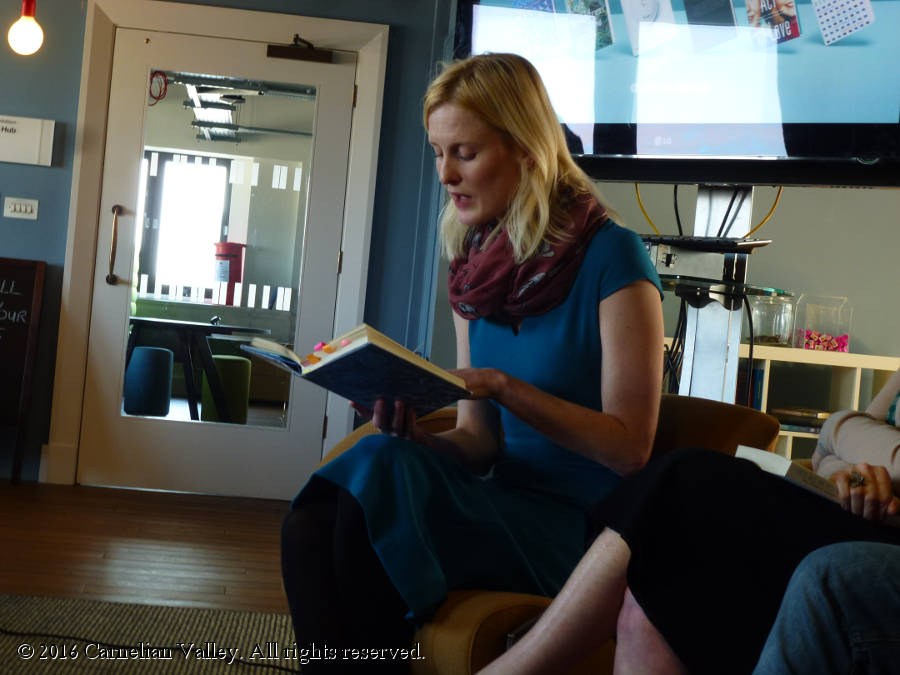
At the event were Liptrot, O’Sullivan, Pheby, and Rentzenbrink, and I’ll be eschewing my usual mode of referring to the author by surname only in this post; it just feels right. Simon Savidge, of Savidge Reads, chaired. We began with readings and a general summary from each author.
Amy wanted her book to be more about her life post-addiction than about the addiction itself. She wanted to pick through this phase wherein she found a new lifestyle. She wrote about a great deal of what was going on but said she decided not to write about the writing part of her days because it would be too meta.
Due to her relocation to the Orkneys from London, she found herself learning a lot about the great outdoors with the result that her book became as much about nature as about her rehabilitation. She said that before she had never really been into nature, wasn’t a ‘nature geek’, but her life in Orkney moved her towards being one. She lived in a pink house provided by the RSPB, taking walks and writing every day. She noted that what she’s written about is effectively a fantasy life; she appreciated the chance to bring people to the islands. At present she’s learning about woodcutting and said she hopes to carve her own gravestone!
Suzanne chose not to read from her book, the subject matter meaning she wanted to spend more time telling us about it. She wrote about people who are judged for their disabilities – disabilities that have no cause of reason for being. Whilst judgement happens to disabled people in general, in this specific case it’s due to psychosomatic illness. Suzanne wrote about her experience of working with her patients and her perspective is positive – her reason for writing is that not much is being done about psychosomatic illness, there are no facilities to help suffers which means that people will visit their doctor only to leave without advice. Because no one has any to give. Suzanne described one patient who said she was blind – and she had a carer – but tests inferred nothing was wrong. It was only once the woman’s psychological and emotional health was worked on that her vision returned.
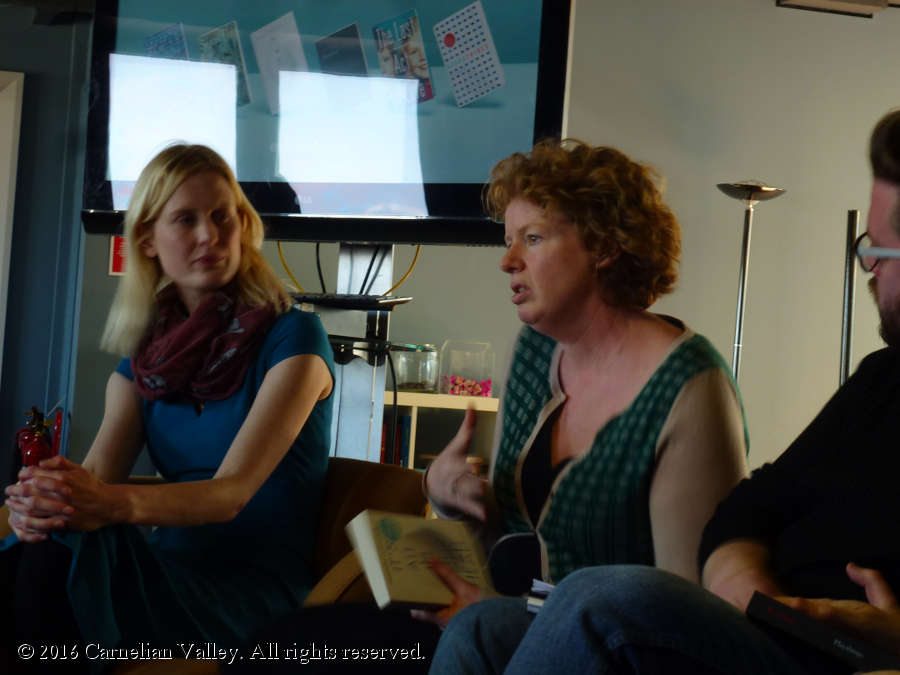
One third of all doctor visits are due to psychosomatic illness. It’s a standard part of a doctor’s everyday work but it’s treated as a non-illness and that’s why there are no resources. It’s akin to the ‘hysteria’ reported in days of old, when people were not taken seriously over things we now know are real and serious. If it’s diagnosed early enough it can be cured but this doesn’t happen for most people. Suzanne wants to change the idea it’s a lesser disease.
Of his book, Alex said there are lots of different readings to be had because it’s about a complicated person – a man who believed God would die if he himself was not cured. Judge Schreber wrote one of the most famous mental health memoirs; it showed how people can make irrational plans and be accepted but if those considered mad make irrational plans they’re not accepted. In the beginning, said Alex, the plan was to write a fictional continuation of the memoir but the fictional side took over. Alex’s book deals with how tied we are to the world and how it would be if we were untied, how we’re all in a state of mental ill-health and how is we don’t have the space and the support, we’ll be in trouble. That slippery slope.
After saying he’d like to see our interpretations of the book, Alex told us what it was he wanted to see if we caught. I can only speak for myself but my prior interest in the book only increased when he told us as it’s both something I’ve been reading about, studying, and something that is only now starting to really be discussed. We don’t talk about this thing in our world and we need to. I’ve asked Alex if he’ll write a guest post. I won’t go into it here because I’m both ill-equipped and conscious it’s the sort of thing readers might want to find out by themselves.
Cathy never wanted to tell her story and didn’t want to own it. She finds it difficult to start talking about it. She wanted to write comedy books and in that vein had us all laughing when she reiterated advice she gives as a bookseller to writers – don’t include religion at the start because it’ll put people off; don’t be a woman because it’s hard to get somewhere. Her book starts with religion and she’s a woman.
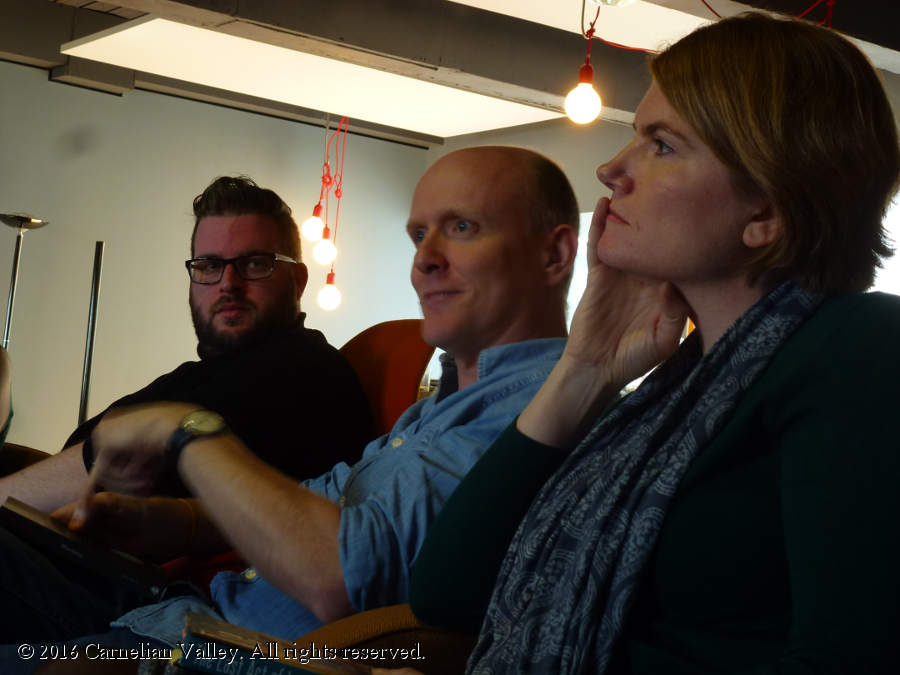
Whenever Cathy started a (comedy) book she would get as far as chapter 8 or so until the story of her brother started creeping in. It took a friend telling her she could write it and put it in a drawer for her to do it and she came to realise the drawer wasn’t the right destination.
Do the authors think about readers? “The longer I can keep the reader out of things, the better,” said Alex – he needed to do so in order to write what needed to be written. Suzanne didn’t think about readers, focusing on her patients because her cause specified a need to give them respect. For Amy the reality of readers has only recently hit her. For Cathy it was the thought of readers that later kept her going.
On the point of responsibility towards those who fill the pages, Suzanne said people are desperate to have their stories told, that her patients would have preferred she were even more honest. Amy had to deal with the conflict between talking about her recovering and that second A in Alcoholic’s Anonymous. “Most interesting is the people you leave out,” said Cathy, who referred to those who had been surprised she’d not included them in her tale – by writing you’re saying ‘this is how it was’ and she’d gone by nothing but the truth, just not all of it.
It was a great morning and I would like to thank Alice and those at Wellcome, particularly Zoe, for inviting me. It was lovely to meet Natalie and see Annabel, Sakura, and Jackie again.
Have you read any of the six books? What books have you read recently that include something medical?
The Young Writer Of The Year Blogger Event
Posted 18th November 2015
Category: Events Genres: N/A
1 Comment

Excuse the poorly-taken photo… Saturday afternoon saw me in the same room at the Groucho Club occupied for the Georges Simenon event. Hosted by the Peters Fraser Dunlop literary agency and The Sunday Times, it was a time to meet the nominees and hear from them about their books.
It was a pleasure to see Elizabeth Baines whose book, Used To Be, I reviewed earlier this month, and I met Dan Holloway who I believe many of you know and booktuber Pippa of PippityBop. We were a relatively small group of people and it worked very well, a time for chatting and a time for reading and questions. And of course there was wine (though admittedly I had water).
The Young Writer Of The Year award has returned after several years absence – the last winner was Ross Raisin in 2009. Andrew Holgate, literary editor of The Sunday Times, joined agent Caroline Michel to restart the award and they opened the submissions to Irish as well as British writers. (This includes writers born in other countries who have lived in Britain for a period of time.) There is diversity in the eligibility – whilst the books should be literary they don’t have to be novels. Poetry and non-fiction is welcome (though as Holgate said, literary non-fiction is a more difficult category to nominate; there’s not as much of it). This year there are three novels – Ben Fergusson’s The Spring Of Kasper Meier, Sara Taylor’s The Shore, and Sunjeev Sahota’s The Year Of The Runaways – and one collection of poetry – Loop Of Jade by Sarah Howe. Holgate believes this is the strongest short-list they’ve had for the award, and I have to say hearing about the concepts, writing, and backgrounds of each has left me anxious to finish up my current reads so that I can get to them.
Ben Fergusson was born in England but now lives in Berlin where he is an editor and translator. He’s already won 2 awards and, as a 35 year old, is on the cusp of being ineligible for this one. Sarah Howe is English but now lives in Boston. Her poetry was nominated for 2 awards including the T S Elliot prize. Sunjeev Sahota has written one book already, Ours Are The Streets, and read his first novel aged 18 – Salman Rushdie’s Midnight’s Children. You wouldn’t think it to read Sahota’s book. Sara Taylor’s The Shore was short-listed for the Guardian First Book award and long-listed for the Bailey’s prize.
Fergusson had the idea for his book, and for the character especially, years before but only made it to chapter three before throwing in the towel. He didn’t know enough about Los Angeles to keep going. Of his main character he said that there are lots of books about young gay people but not many about those in their 50s who have had a different experience and he wanted to explore that.

Howe took 8 years to write her collection of poetry. The poems are based on her mother’s life, as an unwanted girl in China and later adopted daughter. In the title poem, she said, she tries to given the barest testimony of what happened. She wanted to collect the different worlds, to ‘square’ them; the beauty and the horror. She wanted to trust the reader to do the same as she was doing, detective work, finding out what she herself doesn’t know about her mother. The poem she read to us was full of detail, a mix of poem and prose and was rather breath-taking. The title of the collection refers to the circle of jade that a toddler wears; the hope of the parents is that is the toddler falls the bracelet will break instead of any bones. She showed us her own; a circlet an inch or so in diameter on a chain.

Sahota said he would’ve written the entirety of his book in Punjabi if he could have. He spoke of the need to explain Indian things – culture, language – when English things wouldn’t be explained to Indians (that is to say books in English about other countries are piled with details and translations for words, but English language books about English-speaking countries do not have those details). As someone who speaks some Hindi and recently had to put down a book that was almost obsessive in its need to explain words, I have to say I understood where he was coming from, as I’ve no doubt bilingual and multilingual people would, too.
Taylor wrote her book at the end of her university years. She wanted to see what she could do if she just had fun and didn’t adhere to the rules of writing she’d learned. She couldn’t not take her risks. She didn’t have a plan, just wanted to explore the people in the place she was writing about, then, once she’d finished one person’s story she wanted to explore their relatives and then those relatives’ relatives and so on. Speaking to her later she told us that her story has much to do with her upbringing in Virginia and the conservative lifestyle she experienced. The book is considered a fractured narrative – the way it straddles both the concept of a novel and the concept of a short story. She has gone through 60 potential titles for her next book and is still searching for the right one.
The afternoon ended with more chatter and book signings; this is where I got the tote I spoke of on Twitter. It was a wonderful couple of hours that ended in what we thought might be a light malfunction but was the staff preparing for our leave, and introduced to us four of the next generation of successful writers – and I say that with confidence because from what we heard of the books and the writers themselves they are going to do very well.
The winner will be announced on 10th December. I have a hunch; it’s going to be interesting.
Have you read any of the four books? What did you think of it/them?
Book Launch For Meike Ziervogel’s Kauthar
Posted 9th November 2015
Category: Events Genres: N/A
2 Comments
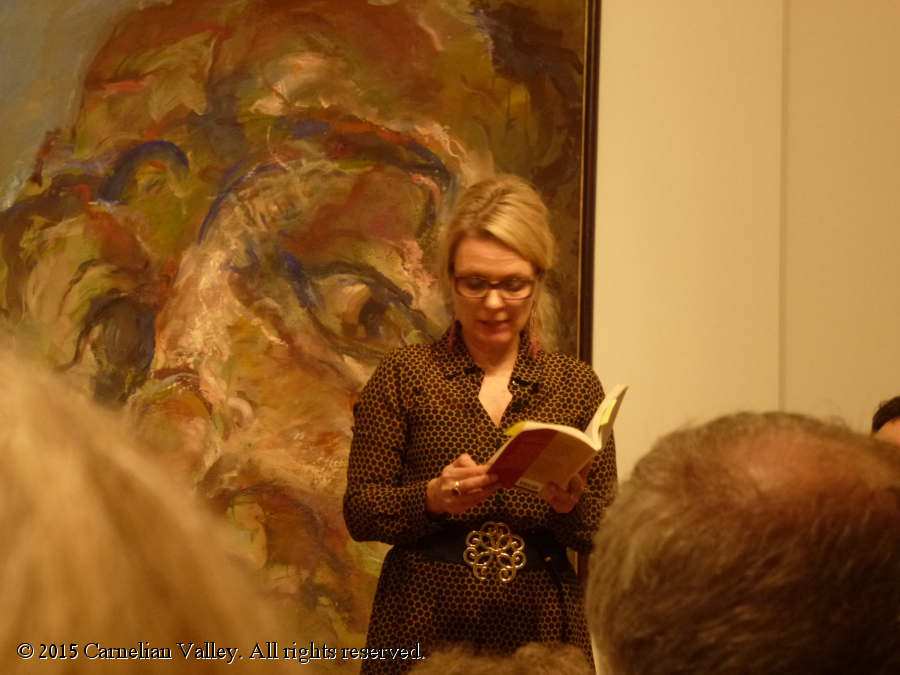
On Friday I travelled to The Mosaic Rooms in London for the launch of Meike Ziervogel’s Kauthar. I reviewed the book in August and highly recommend it. It’s the sort that lends itself well to a discussion.
And the book launch was all about discussion; alongside Meike were broadcaster Paul Blezard and playwright Hassan Abdulrazzak. The book is about a white English woman who is trying to find herself in life. Islam fits what she is looking for and so she converts, but she takes it too far.
Meike spoke of the beauty of the physical action of Muslim prayer. She spoke of her own experience as a near-convert herself, the way the religion appealed to her when she was in Dhaka. This near-conversion was one of the starting points for the book; the initial idea sprung from the news that a Belgian woman had converted, gone to Baghdad and blew herself up. Meike wondered about the whys – why the woman would’ve done this. She made a comparison to herself, how she had gone one way in her conversion and this other woman had taken the extreme opposite.
And so Meike went back in her head to why she wanted to convert when she wrote about Lydia, the woman Kauthar was as a young person. The author wanted a mature protagonist – Kauthar is in her thirties – so she could vocalise her feelings better, really put across what she was thinking to the reader. Lydia is searching for a narrative but couldn’t find one because for her in western society there was too much freedom. She needed rules. She doesn’t know what’s fine because no one is telling her. Hassan pointed out the way Lydia is attracted to the rigour of Islam. He said the conversion is written in a true way.
Pitfalls were discussed. Meike knew the intellectual dangers she was opening herself to but that she wouldn’t fall into them. She always knew she wouldn’t be ticking stereotype boxes and wanted to look at the psychological factors that would lead someone to extremes.
The author starts the book with the end; she knew she had to do this and put herself in her character’s shoes to work out where to go. She wanted the character to convert on her own terms. And she had fun playing with idea of the stereotype, that Rafiq, Kauthar’s Muslim husband, might seem like the evil one, except, of course, that he’s not. She let the characters taken on their own lives.
“It’s a book about a woman who doesn’t understand love requires compromise.” She wants to give and receive perfect love, but Rafiq is offering her a love that exists on earth. Does, then, God love her completely? Perhaps not by Kauthar’s standards.
It was an excellent evening; fascinating conversation and much laughter, too. Oh and some news for you: she’s writing book four. Anything more than that would be a spoiler.
Have you read Kauthar? What did you do over the weekend?
My Day At YALC, Summer 2015
Posted 22nd July 2015
Category: Events Genres: N/A
4 Comments

The Young Adult Literature Convention (YALC – the acronym is pronounced as a word) marks a beginning of sorts. We Brits don’t see many mass book events beyond festivals, so far having only to look at photos of events in America and attending those if we have the funds. With YALC and its parent, LFCC, it’s happening. My train trip demonstrated just how new this and the use of the convention is – a small number of carriages packed to bursting; not peak time, not expected.
For now it’s only in its second year so there’s not too much to see or do. More publishers and authors need to get on the bandwagon; the room was large enough to hold much more than it did. For what it is, however, it’s excellent. Everyone is brimming with enthusiasm, the publishers more than willing to chat – they are there to have a good time just like the readers – and the panels fun and informative. It’s difficult to hear at times because of the space, but only if you sit at the back.
I admit to having a shy day so I wasn’t as talkative as I could have been, but I got a fair amount of information regardless. (Can we make ‘shy day’ a thing like ‘bad hair day’ and the, albeit failed, attempt at making ‘fetch’ happen?)
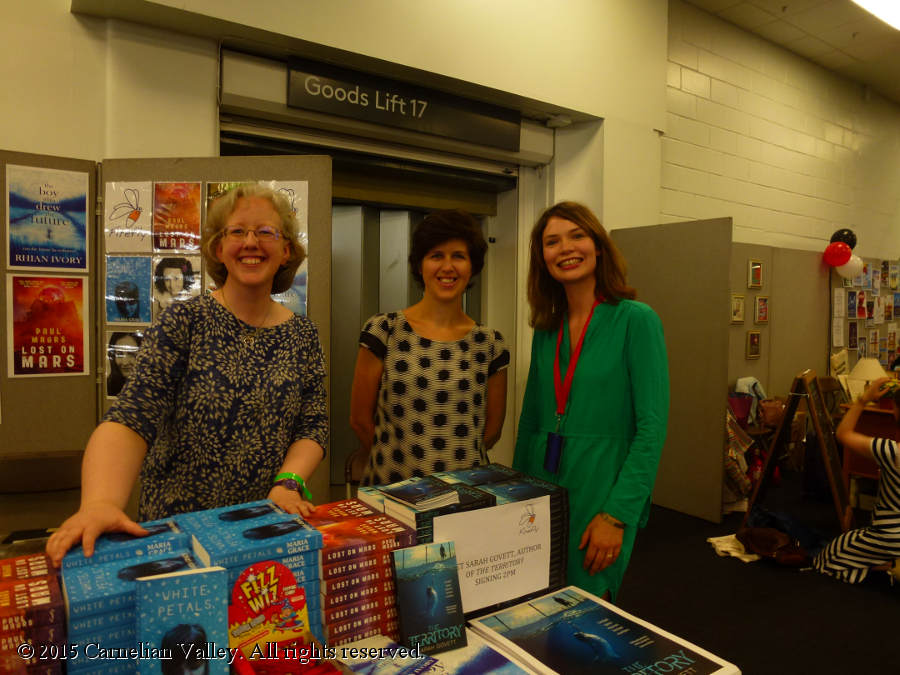
The publisher I want to mention here is Firefly Press, whose stall enticed me because I’d never heard of them before and they have rather awesome covers on their books. They are a small independent publisher of young adult fiction and their books fall into the fantasy and dystopian categories. They are Welsh and very new, in fact the titles on their table were what they’ve published so far. (If you want to get into their books now is the time to do it as it wouldn’t take too long to catch up.)
The cover I was most drawn to was for Sarah Govett’s The Territory. Govett (far right of the above photograph) was there and she told me about the book; I was sold pretty quickly. The Guardian calls it ‘the 1984 of our time’ and Govett described it as young adult but with political satire that adults will enjoy – this is a book for both young and old. The basic premise is that in the future, teenagers must pass exams to be able to live in relative happiness; if they fail there is little hope. The rich kids have help from their parents, the poorer left to the mercy of the exam questions. Govett told me it is today’s unfairness of exams, of schools, eliteism, that inspired the book. It sounds a ‘current’ read and one I’m very much looking forward to reading.

There was Pia Fenton (pen name Christina Courtenay), Claire Watts, and Gill Stewart of the Paisley Pirahna collective I told you about last week when I spoke of the RNA conference. They had a great little stall, selling the YA books they’ve self-published (and one of Fenton’s Choc-Lit books). The four (three at YALC) working together was certainly a good look – you’d think they were a publisher and that’s in their favour – but most importantly they were bringing self-published books into a mainstream traditional space. The authors plan to be at the next YALC later this year.
I could be seen hovering around the Hot Key Books stall, which had signed copies, tote bags (the ‘choose books’ one is perfect for book shopping in general) and is publishing a book by Call The Midwife’s Emerald Fennell, and the Penguin stall, where Oreos were offered. In addition to the publishers I met Missy Chambers, a soundtrack composer for various game and comic book companies. She told me about the artwork displayed and about her own work, which was fascinating to hear, perhaps because I’m musical myself.

I made notes of a couple of panels, and I’ll say now that I’ve never read any of the authors so my notes are strictly reported rather than commented on. The first, ‘Thrills and Chills’ was chaired by Matt Whyman and included Darren Shan, Will Hill, Dawn Kurtagich and Lou Morgan. Hill said his plan was to write less books, he never set out thinking it’d be an epic. He wrote the first book seeing where it would go. Morgan said she was inspired to write dark books by a part of London she lived in – no one had set a book there before. She used the Barbican and likes the Blair Witch Project idea of things starting normally then going bad. Shan said a person should write what they want to write. He likes mixing genres up and goes to bed thinking about scary things.
To the question of where the line falls between YA and adult horror, Morgan said that all the YA books contain things readers – be they youths or not – are interested in. You have fears when young and those fears feed into the books. For Shan the dividing line is sex. All the violence is fine but you’re not allowed much sex. You can explore adult dubiousness more in adult horror where the bad guys can be worse. Kurtagich agreed on sex, but said that characters are the dividing line. Adults are jaded so you really have to shock them. In YA it’s about coming of age so in horror books you can break the characters down. Hill hasn’t written things differently for teens; he doesn’t see the value in sanitising. His American publisher rejected the word ‘naked’ but had no problems with all the violence. Shan’s been told to scale back by his American publisher too, whereas his British publisher tells him to make it rough and gritty. Morgan’s lucky, she says, she’s been told she can be as dark as she likes.
Why are readers drawn to horror? Horror can explore what it’s like to be alienated from the world, said Shan, to make sense of it. Stephen King makes good characters and then constructs horrible things to happen to them, said Hill. You have to make the characters real or you won’t feel anything when something does happen. Hill said he went straight from children’s books to adult horror as a reader because there was no YA when he was young. Kurtagich said her favourite book is House Of Leaves because the first line is “This book is not for you.” We’ve always had a need for terrible stories, she said, and horror is that for her. And it’s safe – you close the book, you walk away.
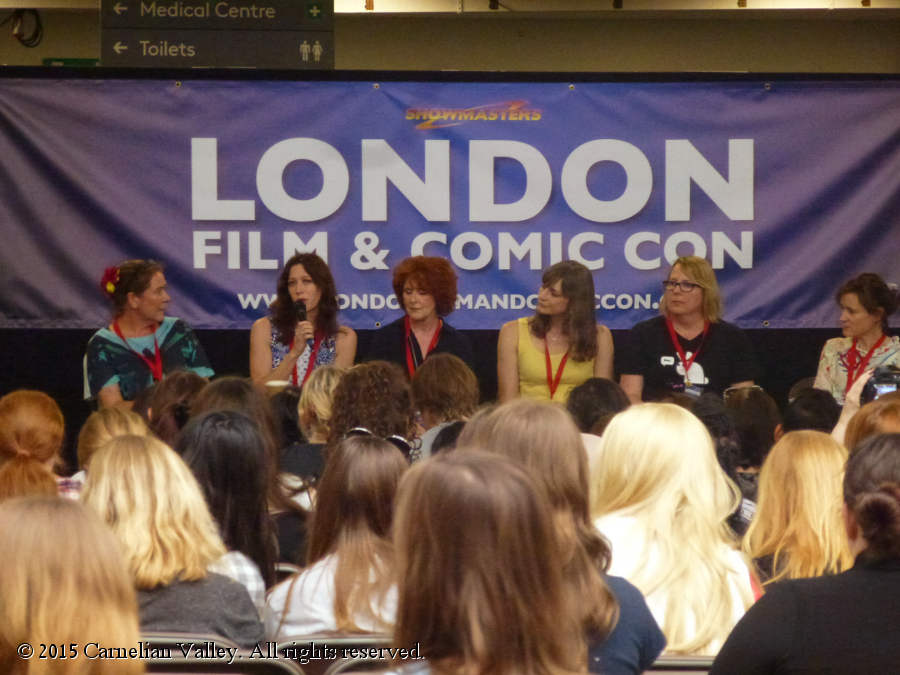
‘Apocalypse Now’ was chaired by Gemma Malley and included Virginia Bergin, Marie Rutkoski, Francesca Haig, Moira Young, and Teri Terry. Is dystopia a genre? asked Malley. Everything set in the future is called dystopia, said Terry. Young said that as soon as you put a label on a book it alienates others who may enjoy it. It’s useful for marketing but not for the author. Bergin said genres are narrowing. Dystopia is a philosophic genre, it works on both an intellectual level – thinking about things – and an emotional level.
Malley asked where dystopia is going next, which worlds we haven’t explored. I think it’ll be more interesting to look at not what we know – climate change and so forth – said Young, but things on a micro level, under the radar. Not just fighting things, making new things in our environment. Bergin said she’s interested in what technology is doing to how we communicate. We hear so much about the negative side of social media, she’d be interested in how that immediacy of communication is going to progress.
I’m glad for the few hours I had at YALC. The line was short, the day was bright and the inspiration and enthusiasm bounced off the walls. I think we’re at the beginning of something great and it’s going to fun seeing how it progresses over the years.
Did you go to YALC? If not, have you been to a literary convention before?
RNA Conference 2015: Day Three
Posted 17th July 2015
Category: Events Genres: N/A
4 Comments

Session notes aplenty here.
An earlier breakfast for my last, half, day. I would be leaving after lunch. I met Alison Rose (Rescue Me) in the queue; we’d spoken briefly on Thursday. Breakfast was spent with Charlotte Betts (The Chateau On The Lake), Ann Palmer, and Alison Burke. Betts had some excellent writing advice: she recommends having a cliffhanger at the end of each chapter and to see chapters as short stories.
I skipped the first session in favour of compiling my notes for these blog posts. Having previously met Sally Quilford (The Last Dance) we spoke about the conference and her books – romantic intrigue – over tea. Quilford said she can’t write straight out romance, there has to be a murder by chapter 3. I think that’s recommendation in itself. I also met R J Gould (The Engagement Party), a male romance writer who said something poignant, that men have emotions too – I can’t but agree to that one. After all the romance genre shouldn’t just be about women writers.
I sat in on Hazel Gaynor’s (The Girl Who Came Home) session, ‘Promotion Commotion’. This was an hour very well spent.
Gaynor stated that our Englishness makes promoting ourselves difficult, presenting us with a GIF of a flustered Hugh Grant. Writing the book is just one part of the job – talking it up is the other. You have to tell readers the book exists, and give them a reason to care, to convince them to buy it – but don’t resort to spam!
Alison Barrow of Transworld was quoted: “The author has always been vital for publicity. They know their book best… Be nice to everyone. They might be a future reader.” Be careful of offending, said Gaynor.
Engage rather than promote and engage between books – don’t disappear. Post a variety of updates. Build communities. People are online to be entertained, to be informed, to connect – remember that. Don’t use too many hashtags. Share quotes, use Twitter chats. Share milestones and links to discounts. Be wary of scheduling tweets – tweet manually. Focus on fluid media. Be part of the community. And don’t forget video – Facebook video view counts recently surpassed YouTube.
Attend and create virtual events. Attend festivals. Make use of online magazines; use Periscope to show where you write. Share interesting content that relates to your book. Keep your Amazon profiles up to date and remember Amazon keeps separate copies for the different regions.
Consider who you are online. Be wary of swearing – create a basic policy of what you will and won’t share. Add apps to your Facebook page that show sample chapters.
Pre-publication share your progress, do a cover reveal, get reviews. When the book is released do a blog tour, host giveaways and reader discussions. Make sure you have visuals for blog tours that include a list of blogs taking part.
Make use of Pinterest: your cover, related images of the locations you’ve used, your inspiration. Keep the board secret whilst you write, then make it public when the book is released. Remember fair usage.
Remember the real world: introduce yourself to your local bookshop, offer to work with them. Attend local writing events. Skype with bookclubs and libraries. Run workshops. Attend conferences, festivals, others’ book launches. Write articles for sites and for print.
Be creative: Brigid Coady contacted South Eastern Railways – she’d included them in a book. She became their ‘writer in residence’. Matt Haig asked readers if they’d like to feature in a video for his book, gave them lines to record themselves saying and then compiled them into one presentation.
Tips for pitching to radio and TV:
- Have a press release ready.
- Does your book tie into anything current?
- Make sure you fit the subject and/or type of show, format, and so on.
For radio:
- Research the station.
- Listen to the station for an hour before you go on.
- Think of how long you’ve got and keep an eye on the time.
- Make sure you mention the book’s title.
For TV:
- Similar to radio.
- Be succinct.
- Mention your book’s title a few times; the host may forget.
At events, Gaynor says to have your elevator pitch ready. Propose speeches and presentations, consider how many people will be there, be flexible to changes and be memorable. And she spoke of articles she’d written: one about the Titanic’s dogs when she was promoting her Titanic-based book; an article on wedding flowers when promoting her book about historical London flower sellers. She talked about the violet festival in France.
“Eighty percent on success is showing up” – one of the last slides Gaynor presented us with, this time a quote from Woody Allen. To say that Gaynor’s talk was enlightening would be an understatement.
I spoke to Julia Wild (Dark Canvas) during the break. Wild is self-publishing her back-list and showed me copies of her covers so far. The covers are feature silhouettes; Wild favours this concept as it allows readers to imagine the characters themselves. Off topic note: Wild has an awesome taste in bags.

The last session I attended was ‘The Vision For Writers’ panel on whether or not we can continue to write Happily Ever Afters. On the panel were Katie Fforde, Jane Johnson, Eileen Ramsay, and Daniel Hahn.
The actual world is tough, said Fforde, I like to give readers a safe place to go. She added that writing is no longer a ‘gentlemanly’ profession and authors should be a member of the Society of Authors.
We [publishers, editors] used to buy books because we loved them, said Johnson, we didn’t worry about sales. Her publisher at that time went out of business, unfortunately. It’s cut-throat nowadays, she said, harder to get published if you’re not in a specific niche.
Hahn joked that he can’t choose his endings – he writes non-fiction. Creative industries are healthy in the UK, he said, publishers are still making a profit. But author earnings are lowering. There’s a disconnect between the way there’s more money in the system but authors are seeing less of it. 95 percent of writers aren’t making an income from their work, said Johnson.
Self-publishing suits certain kinds of work and writers, said Hahn. But being able to write isn’t enough.
You have to appeal to emotion. Johnson told of a book in which a camel dies. The camel had been given a name for further appeal, to make it personal. Lots of sad letters from readers came in. “Never name your camel!” said Hahn.
Johnson said an ending doesn’t need to be happy but it does need to be satisfying. If you’re going to kill off a main character, it has to be the right thing to do. The ending needs to be decided and not lazy. The reader’s bought the book, they need an ending. Be wary of ‘go away for your tea’ syndrome, said Ramsay – going for a break and not quite coming back, losing the thread or concept of what you need to do.
I stayed for lunch, which turned into a bit of a picnic with Imogen Howson and Annie O’Neil (Doctor…To Duchess?) because there were no more chairs. O’Neil has some good ideas for Christmas books and has an awesome pen name in the works. And reading the back of Howson’s book… you’ll be seeing it on the blog soon.
I had a wonderful time at the conference. Everyone was so welcoming, the atmosphere brimming with inspiration and the work put into the sessions was fantastic. I thank Jenny Barden for inviting me, Jan Jones, too, and look forward to the numerous books I’ve added to my list.


