




RNA Conference 2015: Day Two
Posted 15th July 2015
Category: Events Genres: N/A
8 Comments
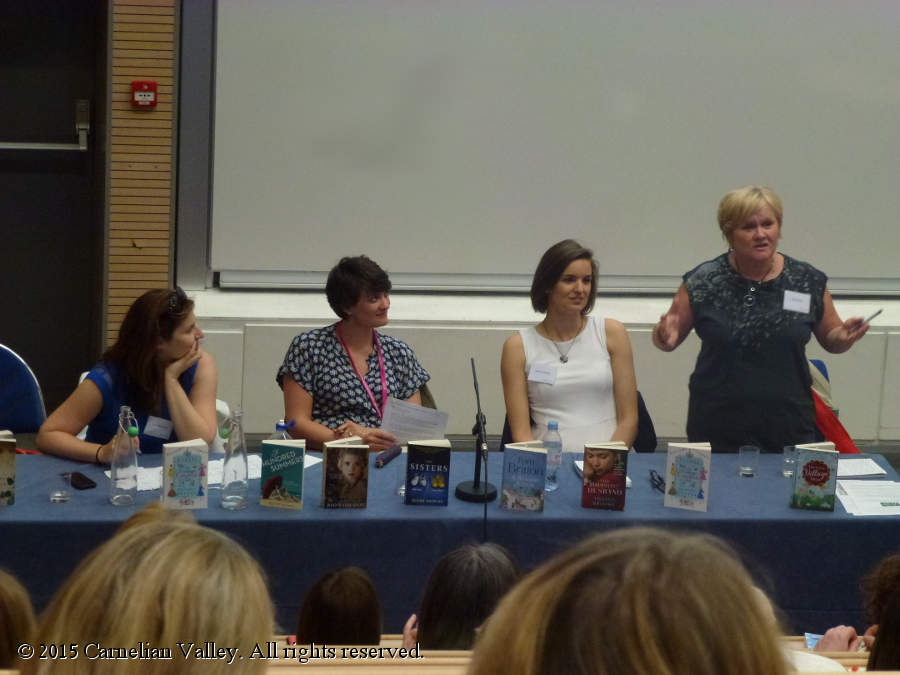
Friday I woke up tired but a shower fixed that. I rushed off to breakfast, made it in time, and got my half-full English. I met Jenny Harper (People We Love) more ‘officially’ – she was staying in the same flat – and then went to prepare for the panel I would be on later that day.
This, the first day of the conference, I sat in on the Harper editors panel, composed of Kate Bradley, Helen Huthwaite, Martha Ashby, and Kimberley Young. Bradley was quick to state that editors are looking for something on a deeper level, not just a manuscript that dots an I and crosses a T. She said editors remember books and names they see, even those they reject. She told us the story of the time she was at a party and met an author she’d rejected. They discussed the manuscript, the author went away and changed it accordingly, and got signed. It was agreed by all the editors on the panel that coming to the conference and joining the RNA was a good thing for new writers.
“For us [at Avon], it’s all about pitch and package… in 30 seconds tell us what your book is about.” Huthwaite began to introduce us to the work she does and how she wants to sign writers working on commercial fiction – fiction she can sell to supermarkets. Crafting that 30 second ‘elevator’ pitch was emphasised throughout the session.
Digital was included. Bradley pointed out that digital can allow for more creativity, that authors can use it to do something different. In a similar vein, Huthwaite told us not to let anyone tell us we can’t write in a different genre than their usual.
On the question posed by a member of the audience about changing viewpoints book to book, Bradley had this to say: she has an author who writes in the first person who she would like to see writing in third person to broaden their scope. In other words, if that’s how you’re seeing your book, in a different person, do it.

Their top tips for approaching editors? Be ready, said Bradley, the biggest mistake is not being prepared. Know how to describe your work. Huthwaite repeated that the elevator pitch is where it’s at – take the time to think about it. Show you know what’s working in the market, compare your books to those that sell well so the editor will see what the potential is. Ashby recommended reading as widely as possible, across all genres. Find out what’s working in that market and why. Young suggested simply talking books with editors, books being your common ground. She told us she’d had a conversation with an author about books; next day there was an email about the author’s own book – it was natural. Know what the editor has published, said Bradley, show an interest in them, in their work. “If you ask me to read your book, I’ll read it,” she said. Simple as that. It’s not a game. Find the right editor for you, said Ashby. Look for the editor in the acknowledgement pages of books you like. Everyone agreed: send the entire manuscript.
The session ended on the following notes: buy the Oxford Dictionary for Writers and Editors; find your own writing rhythm, your own schedule; find your voice by reading things out loud – you’ll hear if it’s not in your voice.
I spent lunch, a rather nice buffet, with Evonne Wareham, Tanya Russel (yet to be published) and an author whose name I’ve forgotten (let me know if that’s you). Wareham had much to say about Cardiff Castle which, not surprisingly, I was happy to hear.
After lunch I attended Sarah Broadhurst’s discussion of her life in the industry. Passionate about paperbacks, she began her career working for Kingsford & Campbell (founders of World Book Night and Everyman’s Classics respectively) reading their slush pile. She had previously sold books in Brighton. She then moved to Hatchard’s in London before becoming a freelancer.
Broadhurst talked about the way paperbacks started off small (mass market), moving to the A and then B format. She showed us flipbooks – a little-used idea wherein the text is (or rather, was) printed the other way round (90 degrees) on Bible paper. They were tiny. She told us about the owner of Dillons who would scribble on book covers so they could be sold at half price as the publishers wouldn’t take back damaged stock.

Our reviewer’s panel consisted of myself, another blogger who hasn’t noted it yet (I’m not going to steal their thunder), Peter Crawshaw of Love Reading, Elaine Everest of the RNA blog, and, chairing (I’m making that a verb), Anna James of The Bookseller and We Love This Book. We spoke about blogs, online magazines, Amazon reviews, search engine optimisation, and our own personal tastes and ways of choosing what we read. As a member of this panel I couldn’t really take notes. I couldn’t believe how many people signed up to listen, it was quite something, and there were a fair few questions which was great. Through the panel I met Karen Aldous (The Riviera) and Rhoda Baxter (Doctor January).
Dinner was spent talking about the panel, writing, and Baxter introduced me to her style of chick-lit – romance in which the female characters are in academia. April Munday (The Winter Love) and I found a common connection and we spent the evening talking. She has written a series of posts on Jane Austen’s connections to Southampton and is looking forward to her next study.
An earlier night than the previous ensued; the staff were looking to pack up the bar.
RNA Conference 2015: Day One
Posted 13th July 2015
Category: Events Genres: N/A
9 Comments
These posts will be packed with book titles as I like to promote those I meet. Where authors are known solely by pen names, I have used those.
A couple of months ago I was invited by Jenny Barden (The Lost Duchess) to be a panellist at the Romantic Novelists’ Association’s summer conference. I happily accepted and so last Thursday made my way to London. Frustrations of a longer journey due to the Tube strike were offset by the views of Fleet Street and I arrived at the venue later than planned but grateful nonetheless.
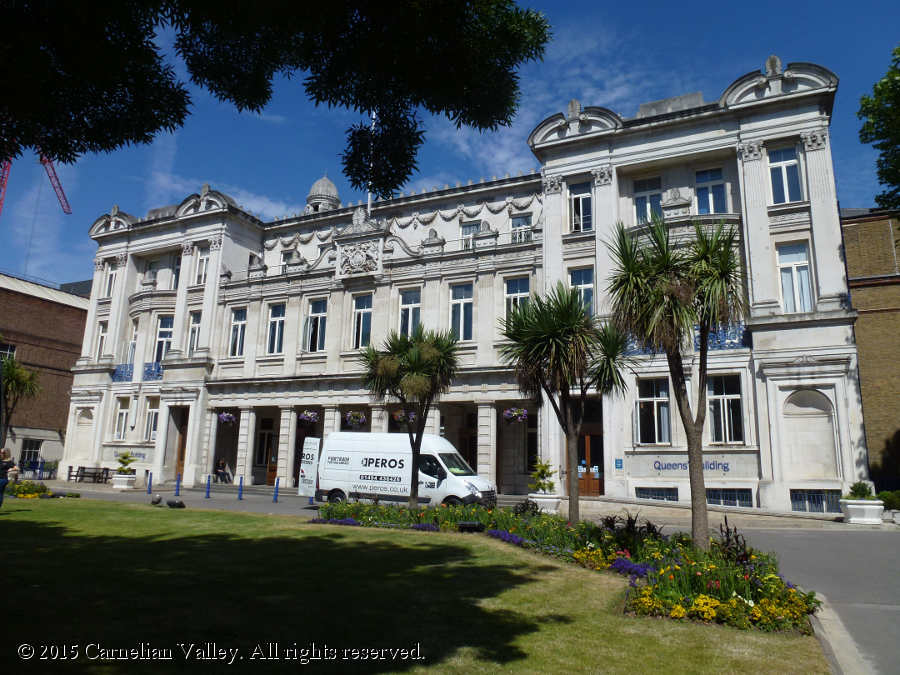
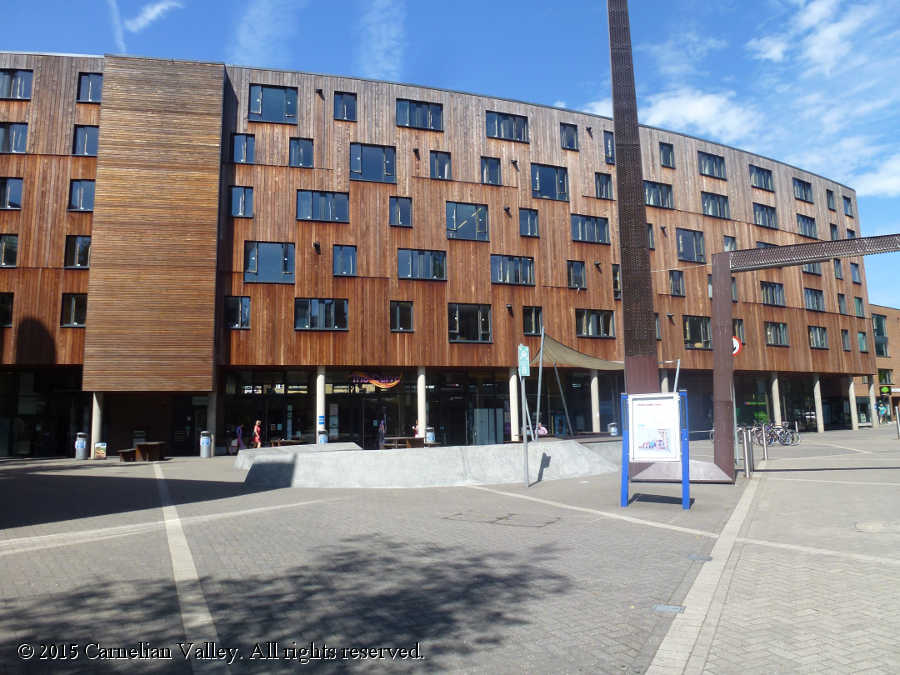
The conference was held at Queen Mary University of London and shared the campus with another conference and students. Those staying the night(s) used the student accommodation. Organiser Jan Jones (The Kydd Inheritance) provided a generous number of coffee and milk sachets. When author Kate Johnson (Impossible Things) said there was an entire bag full for each flat, she wasn’t kidding.
Everyone got a goodie bag upon signing in. Here’s mine:

The book selection varied but the crucial item – the mug – was something everyone received. I’ve been using it since I got back and may make use of Alison May’s (Midsummer Dreams) idea to keep it on a desk.
Dinner that evening was held in a little restaurant on campus. A choice of chicken, vegetable chilli and something else I can’t remember was offered alongside a slice of chocolate cake or fruit salad. I met several authors: Henriette Gyland (The Highwayman’s Daughter) who invited me to join the group heading there; Sue Moorcroft (The Wedding Proposal) who kindly lent me a dinner voucher as I’d forgotten mine; Gill-Marie Stewart (Music And Lies) who also writes as Gilly Stewart; and Pia Fenton (New England Crush) who writes historical time slips as Christina Courtenay.
Have you heard of Choc Lit? It’s an excellent name for a publisher and the one many of the authors I met are signed to. Books by indie publishers don’t often make it into stores. Waterstones Piccadilly, with its space, will, but others rarely do. Fenton, together with Stewart, Claire Watts and Katy Hayes, has formed the Paisley Piranha collective to sell their YA books together. The group will have a stall at next weekend’s YALC and if you’re planning to go to the event I recommend you take a look.
Barden’s invitation was the first time I’d heard of the RNA. I’ve since learned much. The association has its own awards – one year they were presented by Darcy Bussell. The chairman changes every two years – Fenton recently handed over the reins to Eileen Ramsey. Membership is open to authors and others in the industry who reside in the UK and Ireland. It was founded in 1960 by Denise Robins, Barbara Cartland, Elizabeth Goudge, Netta Muskett, Catherine Cookson, and Rosamunde Pilcher. New writers are always welcome, whether already published or at the start of their journey. There are many events to attend and local chapters to join.
After dinner met Nicola Cornick (The Lady And The Laird) I joined Fenton and Barden as well as Liz Harris (A Western Heart) and Evonne Wareham (Never Coming Home). Harris shared the story of her journey to the 2005 conference. The first day was July 7th. She spoke of the people, the crowds, of how it was frustrating at first until the news spread and the reason for the hold up became apparent. Taxi shares were offered. The conference went ahead.
I later joined Johnson, who also writes as Cat Marsters, May, Helen Green (blogging at English Cottage Lifestyle and writing a novel), Imogen Howson (Linked), Marie Frances, and Janet Gover (The Wild One). Conversation included Johnson’s cats, which are very cute and can be found on her Twitter, Terry Pratchett, the problems blogger’s face from Google’s algorithm changes which Green aptly calls ‘doing the Google dance’, and the meaning of the U in URL.
For a conference I turned in early at 12:30. It was a great day and a fantastic beginning to an excellent event.
Having used up my positive word quota for this post, I’ll leave it there. The conference proper started the next day and I needed sleep…
Georges Simenon Event
Posted 17th June 2015
Category: Events Genres: N/A
6 Comments
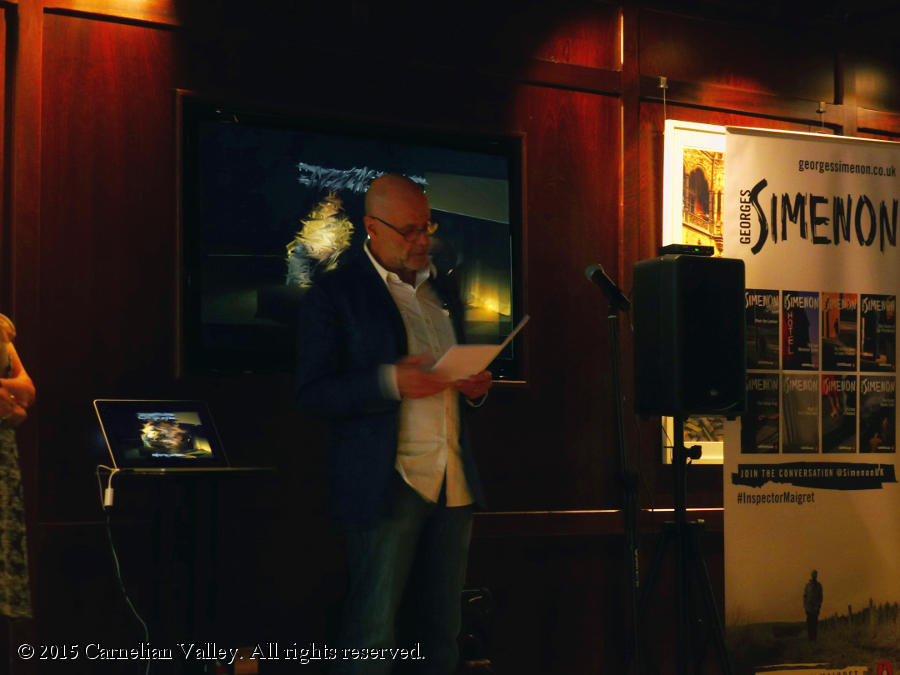
On Saturday afternoon I attended the Georges Simenon blogger event at the Groucho Club. We were a small group; there was enough time to talk to everyone and this we did over drinks. John Simenon, son of Georges, told us much about his father from both literary and personal perspectives.
Penguin is republishing all Simenon’s Maigret novels. At 75 books it’s quite the output. Simenon wrote the series between 1931 and 1972; the first 11 were published in one year. There will also be a new television adaptation starring Rowan Atkinson.
The author considered himself a craftsman rather than an artist – a craftsman of words. He would go on walks for two weeks before he put pen to paper, or rather, in his case, fingers to typewriter. He wouldn’t write with a plan but he would have the names, ages, phone numbers of his characters in mind. For characters to be real, they needed to be given a reality.
As someone who hasn’t read Simenon’s work (I have The Late Monsieur Gallet to come) I was intrigued by what I heard. To hear the author’s writing process summed up, it’s hard not to read it immediately. There is much to be had in terms of discussion.
Simenon made his characters biologically and, perhaps more importantly, socially responsible. He liked to get into their heads. As author and blogger Elizabeth Baines said, the novels are whydunnits rather than simply whodunnits. They don’t deal only with the crime. When you consider present day articles on the author he becomes more compelling. John Banville states: “Simenon’s uniqueness is that he created high literature in seemingly low forms’. Andrew Holgate points to a list of admirers, TS Elliot and Colette amongst them.
The afternoon ended with more conversation. It was a pleasure to meet Sakura of Chasing Bawa, Annabel of Annabel’s House Of Books, Sarah of Crime Pieces and the aforementioned Elizabeth of FictionBitch, an author in her own right. My thanks to John and to Maddy, Ellis, Camilla, and everyone at PFD for inviting me.
I ended my time in London at the Peirene salon. In lieu of Raymond Jean, who died in 2012, we listened to Deborah Levy – a perfect match. I’ve rewritten my mental TBR list so her work is higher up.
Have you read Georges Simenon?
References
- Banville, John: ‘Simenon’s Island of Bad Dreams’, accessed 16th June 2015
- Holdgate, Andrew: ‘Pietr the Latvian by Georges Simenon’, via print out.
The Pre-Publication Party For Helen Lederer’s Novel, Losing It
Posted 14th January 2015
Category: Events Genres: N/A
7 Comments
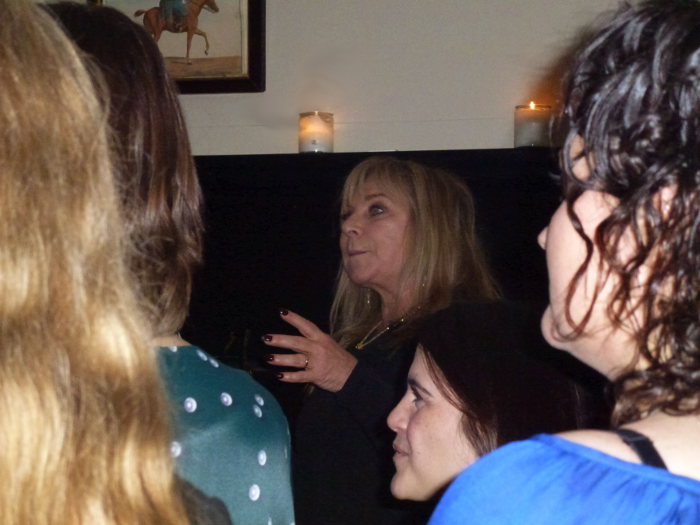
Helen Lederer has been cited by Dawn French as the third funniest woman in the world and on Saturday evening I attended the pre-publication party for said funniest woman’s novel, Losing It. The party took place in the basement of Black’s, Leicester Square, a lovely little members club, and in general it was a well organised event. Joan Collins couldn’t make it as she had to attend the birth of her next husband (this should give you an idea of the humour), but there were bloggers aplenty as well as authors, publishers, and Helen’s friends.
Helen was a great host. She greeted everyone as they entered and was very welcoming. The atmosphere was friendly and it seemed everyone knew someone there. Once we’d all had a drink or two, Helen stood up to welcome us as a group and later read from her book. I won’t be surprised if it sells well – what she read to us was rather funny.
It was a pleasant surprise to see Maddy (previously of Peirene) and a pleasure to meet Jackie of Farm Lane Books, Kim of Reading Matters, and Paper Neverland.

There were the sponsors. The bag we were given included an ‘interesting’ item: though the item itself was serious enough there is perhaps the suggestion that a character may use it to comedic consequences. I liked the way this was arranged; the bag relating to the book rather than your average sponsorship. As it may be considered a spoiler to ponder any further, I’ll let you know what was in the bag when I review the book.
It was an excellent evening and I can say quite confidently that Losing It is going to be a good read. I’ll be reviewing the book nearer the time but if you’re interested, it’ll be out on 12th February.
(On a not unrelated note, I visited the new Foyles as it was just around the corner and it’s as wonderful as everyone says.)
The Book Launch For Clara’s Daughter
Posted 8th September 2014
Category: Events Genres: N/A
3 Comments
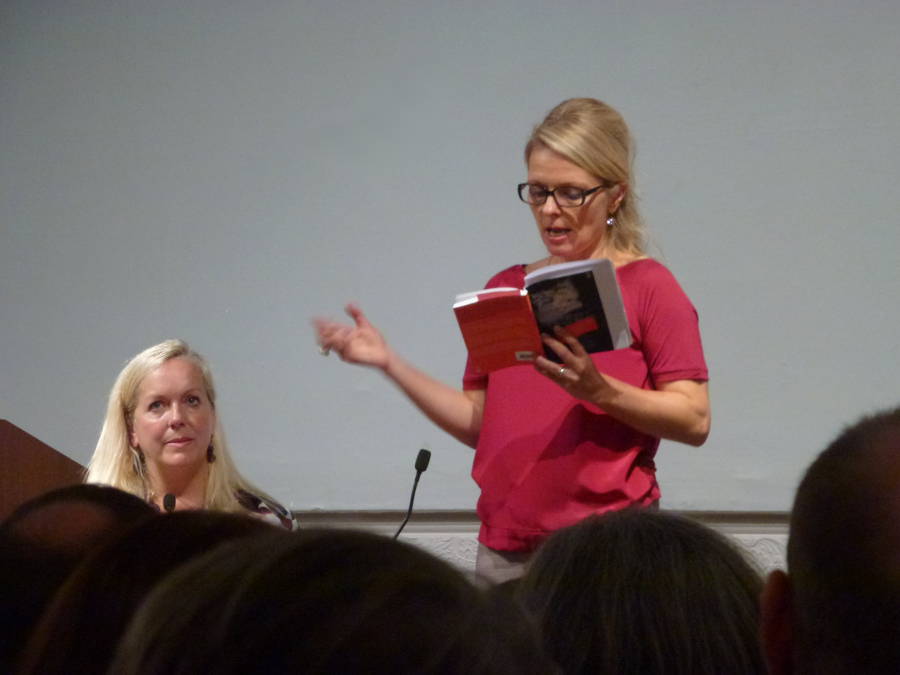
On Friday afternoon I made my way to Highgate, London, to attend the book launch for Meike Ziervogel’s (of Peirene Press) Clara’s Daughter. The launch took place at the Highgate Scientific and Literary Institution, a lovely building where we could gather for drinks and a natter in an anti-room before going through for the event itself. Highgate is where the book is set so it was a particularly appropriate venue. The launch comprised a couple of readings and an interview with Isabel Wolff (author of A Vintage Affair). It was a wonderful evening.
We began with a reading and then Ziervogel spoke about the background to the story. Clara’s Daughter is 30,000 words, however prior to this, 80,000 words about Michele had been written. When the author set out to write the book she had one image in mind – a woman, who had it all, standing outside on the street with a plastic bag (the bag didn’t contain a dead husband). 80,000 words were spent on this woman walking around the street, having affairs. It took those words before Ziervogel realised the woman was actually in the house, was supposed to be in the house. And when Clara ‘arrived’, she wondered what it would take for said character to move out of the basement. The author said later that it was boring, she was bored writing the string of encounters and so readers would be bored reading it – but by writing those words she got to something that worked.

Ziervogel also spoke of playing with the subconscious, how two of the characters are in harmony in this way but neither one can tell what they need. This was a particularly interesting point when you consider the way one of the characters slowly turns from not liking the other as much, to understanding her a lot more. And this has to be the best inspiration story I’ve heard so far – part of the plot arose from the author falling into the lake. Wolff pointed out that the lake was a symbol of rebirth which I must admit I hadn’t thought of previously.
A group of us went to Peirene’s HQ afterwards for a bite to eat (I had water in a jam jar which was pretty different) and a further chance to chat. It was a pleasure talking to those I met and learning about book printing, book indexes, and editing in the world of publishing houses.
I hopped on the last train just in time. The driver greeting you with ‘good morning’ when you’re day has yet to finish is very strange.


