




Hay Festival 2016: Sunday
Posted 13th June 2016
Category: Events Genres: N/A
3 Comments

My last day started on the previous evening’s intended end note: Marlon James had not been well and his conversation with Martha Kearney was rescheduled for the morning. Happily, he was okay to go ahead.
Was he surprised to be invited to Hay? James said he’d always imagined himself in Welsh used book stores, his books on shelves, rather than himself on stage.
The book that came into his head was not the one that has been published, so to speak. James wrote in a stream of conciousness. He wrote a 7 page sentence. The first part he wrote appears on page 456. He had to write freely – the editor could take it out later. This book was supposed to be his shortest but he realised that couldn’t be so; he kept failing when he tried to finish it 50 pages in. Then a friend suggested that maybe it was more than one person’s story. The first publisher asked him to write it in ‘Jane Austen English’. They aren’t friends any more…
James said that Bob Marley was a controversial figure. His hair, for instance, differed from the norm. For the voice of the country’s struggles to be Rastafarian was not cool, and Marley was half white. For a while, the Marley the writer saw was the one of news reports; it was James’ only experience of him. He wanted that Marley in his book, the one from the television. He didn’t want to try to ‘get close to the physical person”.
“I really believe in complicating characters, don’t believe you should make it easy for the reader.” James would get coffee with his bad guys. They’re the characters he’s most interested in. “A violent act in a novel should have the same impact as violence in real life… I’d rather have a few scenes that resonate than 40 that make you turn numb.”
James got hooked on Shakespeare. The language, the ‘epicness’, how vulgar it all is. He can’t decide if his own generation is the last of an era or the first. He had a literary education – Dickens, Twain. “You like [Twain] in spite of what they do.” We have this idea that readers read to escape, but reading is where we confront things,” he said. He gave an example: he didn’t enjoy reading Portrait Of A Lady but nonetheless he’s read it 3 times.
In regards to his coming out, James spoke of the prayers, support, and shaming. One is supposed to get rid of demons. He didn’t know what the bin bags in his room were for until he started vomiting. Speaking of his gaining self-acceptance he said getting rid of the sin and sex parts didn’t work so he thought he’d try getting rid of the church part, which did work. He left the church after his book was published.
James is interested in Ancient Greek tragedy, especially the chorus aspect. He re-reads Greek plays before he writes his books and said the playwrights were the only ones to get human nature. (I think this makes a good opposing point to the ones about Shakespeare in my previous Hay post.)
Of The Book Of Night Women, James said Lilith (the main character) was never meant to take over, he fought with her the whole time. “That damn woman took over the whole book… I grudgingly handed it over to her.”
Of writing and description he had this to say: A sunset doesn’t need help, it’s amazing on its own – just say ‘sunset’, there’s no need for a metaphor. By and large people can’t be compared to a summer’s day. And Jamaica is not any one thing. One novel can’t be the voice of Jamaica.
James’ next book is going to be an ‘African Game Of Thrones’ – he’s writing something mystical set in the year 1000.
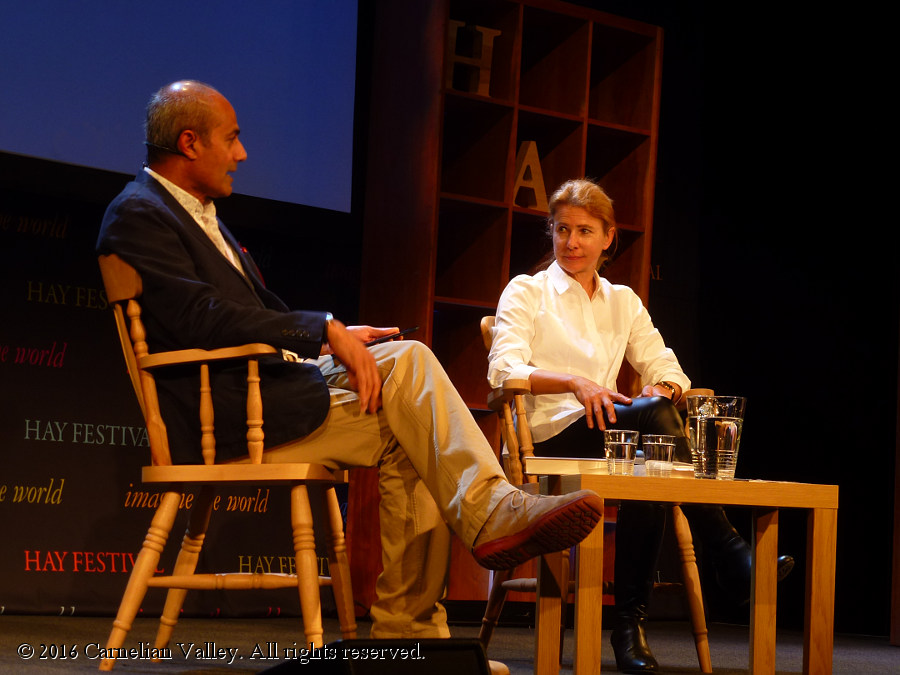
Next up was Lionel Shriver talking to George Alagiah. Alagiah introduced the session, stating that what Shriver does is take regular subjects and turn them into compelling novels. And he said something Shriver has said in the past, that when we talk about a novel set in the future, we’re really thinking about the present. He asked Shriver now if the future is something to worry about.
Shriver: “Americans have a lot more to worry about right now.” Later she said that Donald Trump would never work on the page, that he’d sound farcical.
If you look at the history of dystopian novels, they’re all set in cities, Shriver said. The breakdown of society and life is quicker there. Once electricity fails, all bets are off. It makes no sense. She doesn’t want society to fall so quickly in her books because there would be no story. She advises people to skip the sections of her books they don’t like, finding no problem in it. There are a lot of little details in her newest book, The Mandibles, that “you’ll either pick up on or you won’t”. One of the characters has a name that’s an anagram of her own: “I did insert myself quite deliberately into this book.” Shriver believes surveillance will end up being about money rather than what people are thinking.
Shriver said that healthcare in later life often lengthens death rather than life, that in trying to save people from dying when they are heading that way, it can cause more pain. (Though she wasn’t advocating death – I want to make that clear because it can sound that way.) She’s blunt. Alagiah noted that she’d said no topics were off limits. One of those topics? The NHS. On the topic of whether parenthood is a right, she said that for the working of the health system to continue, they need to bring their work to curing disease and disability, not dissatisfaction.
Shriver’s childfree – she decided not to have children at 8 years old, watching her parents clearing up sick, going shopping. She thought then that there was more time to have fun if one didn’t have kids. “I didn’t want to invite into my house someone who would throw a toy truck at my head.” Her deciding not to have children is connected to her lack of faith in the future. Of the future and age she said older people become worried about the future and apocalyptic possibilities because they’re mixing worry for the future with their own mortality. (She didn’t take herself out of that statement.) When she writes about older people she’s writing about herself, her generation.
She shies from talking about racial issues in her books because she doesn’t feel they belong to her. It isn’t her right to talk about them.
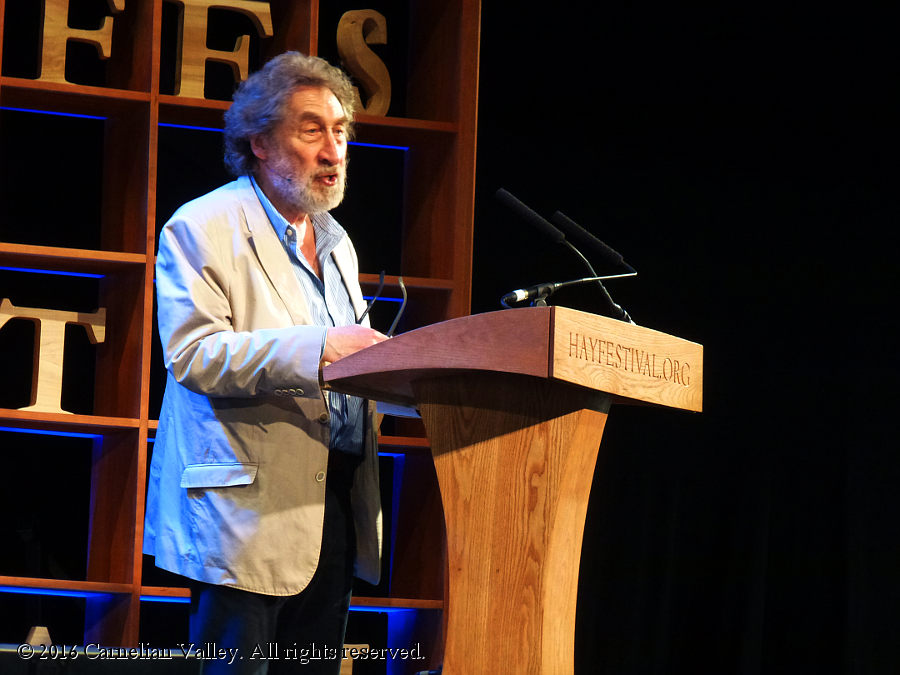
Next up was Howard Jacobson talking to John Mullan. I’ve never read Jacobson’s books but heard his name many times and thought it might be interesting. It was here I first found out Benedict Cumberbatch was at Hay, as Mullan thanked us for joining their talk rather than the actor’s performance. (I understandably stuck to the literary categories when choosing which events to go to.)
Mullan spoke of the commentary in Jacobson’s books. Jacobson: “Don’t say it’s a book of criticism, I want them to buy it!” He introduced his newest book, Shylock Is My Name, and an audience member shouted out, “we knew that!”. The introduction set the tone of the rest of the event – there was much laughter. Jacobson did manage to say that his newest book is a ‘Porsche kind of book’. It’s based on The Merchant Of Venice and from what I could ascertain is one of a series – Jeanette Winterson wrote the first.
Mullan asked if there’s a relationship between the sadness in the novel and Shakespeare’s play. In the play they all hang around talking about sadness, Jacobson said. A world of indulgence – we don’t do this in reality. “This is a play where Shakespeare isn’t in the mood… so I’ll do it for him.” Jacobson hopes that if Shakespeare were to read his book, he’d say, ‘hey, you saw the comedy in it!’ When he thought about writing about the play he saw it was fantastic. He admired the sadness and wanted to look at the bigotry. “I’m free to steal a plot from Shakespeare because he stole every story he wrote… Everything from European literature is there to take.” He wanted to call the book The Wilderness Of Monkeys but his publisher said shops would put it in the Natural History section. He said that we say we like a book so much we can’t put it down but if we like it really we can. He wants that point on a cover – ‘so good, I put it down!’
“It was a great pleasure to invent a [medieval] anti-Semitism! […] The only likeable person in Shakespeare is Hamlet, and he’s horrible too!” Jacobson said he could write a million pages on the following line from Macbeth: ‘there would’ve been a time when that was the word’. In his novel, Jessica gets the last line as she’s his choice of heroine from the play.
“The language in Shakespeare is everything for me… If you put a line of Shakespeare into your own, your sentence becomes a lot better.”

Back to George Alagiah – this time with Tahmima Anam.
Alagiah introduced Anam, saying she’s put Bangladesh on the map. Anam said she’s never wanted the reader to feel they’re getting a history lesson but nevertheless wants to talk about the country and the war. She was interested in how ordinary people find war, interested in the everyday life of it. She grew up on stories of the wars her parents were in, wishing she’d been there, too, because whilst it was a bad time she didn’t own that history herself, she’d just inherited it and wanted to know more than she did. It’s got to be done right, however – Anam drew comparisons with music, saying that if you have an album cover of a starving children, for example, you have a responsibility to that place, to those people. She wanted to debate what happened in the past but to be involved. “My relationship to the country has changed… as a result of my books.” She tried to be an academic but found being faithful to facts too difficult. “The ability to imagine the past was the thing I was going to try to do.”
In regards to her newest novel, The Bones Of Grace, she said she used a whale, a fossil, as a symbol of her main character’s journey to finding herself. She got the idea to have an adopted character from her sister’s childhood pretence that she, the sister, was adopted. Her parents still don’t know that… (I think they will now!) Of her character’s travelling and her own times in other countries (Anam has lived in America and France and now resides in London) she said you can be in a place and still feel disconnected – when you’re not rooted in a place, you have to accept living with discomfort… when in one place you feel as though you should be somewhere else.
“I think arranged marriages do work for some people… Tinder is an arranged marriage.” Anam wanted the hero of her book to be very different to the heroine because we often fall in love with opposites – a bit like arranged marriages, where people can be different. Love forces her heroine to ask questions she couldn’t ask before. She chose to write the book in the form of a letter from the heroine to the hero because she’d written a novel in the first person before and wondered, ‘why do we care about what the character is doing?’ When she realised why, it gave the novel a shape and purpose.
Anam spoke of having information about the conflicts in Bangladesh but of how she wrote about things she didn’t know how to deal with. She had people say, “you wrote your book in English, aren’t you shamed of yourself?” She called the genocide a ‘golden age’ (she used that as the title of one of her books) because people look back on the time with nostalgia – they made a country, changed the world in that way. Many fell in love at that time because the barriers between men and women were broken. People she interviewed said things we’d find clichéd but they said them in earnest. She feels the war still plays a part in people’s imaginations.
Why do we have to have a war to bring out the best in us? Alagiah said.
Here’s a bonus photograph: Abubakar Adam Ibrahim (Season Of Crimson Blossoms), H J Golakai, and Georgina Godwin.

My last event was Salman Rushdie, Kamila Shamsie, Valeria Luiselli, and Juan Gabriel Vasquez, with Daniel Hahn, talking about Shakespeare and Cervantes. (The authors have contributed to the collection Marcos Girault Torrente, Yuri Herrera, and Ben Okri had spoken about the day before.
Luiselli said her teacher made her class passionate about Shakespeare. The author was thankful for the need to memorise texts because it influenced her later life. She can still recite sections today. Rushdie’s first experience of Shakespeare was down to a travelling theatre company. He saw Geoffrey Kendal in India, so for him it was stage first, page later. Shamsie was 9 years old when the language of Shakespeare ‘occurred’ to her. She decided to do something about Shakespeare at school and memorised him; she loved the way the plays sounded. Here Rushdie noted that at the last few literary events he’d been to, writers were always pointing out the importance of memorising the texts when they were children. On the lack of memorising in schools today, Gabriel Vasquez said there’s a conflict between memorising and thinking.
“Great writers… open the doors in your head,” Rushdie said. Shakespeare puts lots of difference stuff together; his actions have allowed us to do similar ourselves. Is that what we mean when we talk of influence? said Hahn, that it’s okay to mix things? Gabriel Vasquez said that when we say Cervantes invented the novel what we mean is that he created a place where books can be cannibalised and used.

Shakespeare’s influence is so deep, said Shamsie, that we no longer say someone is inspired by him. Hahn replied that it’s impossible to say you’re not inspired by Shakespeare. Shamsie then spoke about being influenced by Rushdie. She renamed Rushdie, who was sitting beside her, ‘Bob’ so that it didn’t feel awkward!
Did you feel constrained, when adapting Shakespeare and Cervantes? asked Hahn. Luiselli said she’d played The Wall in school. She was so nervous her teacher had put a box on her head but it didn’t work, she still shook. She thought of this when planning her story – why don’t I play with the idea of re-staging? One of the problems with writing around Shakespeare, said Rushdie, is you’re having to write to the greatest writer. No one asks Beyoncé to do Bach! said Luiselli.
Gabriel Vasquez: If you memorise the whole of Don Quixote you’ll be a better writer!
Will we still be celebrating Shakespeare and Cervantes in another 400 years time? Rushdie said that Shakespeare has had a bumpy ride, he’s not always been thought about. People got bored with him, preferred happy endings to stories. Remembrance is connected to the status of English in the world, said Shamsie. In the 1930s and 1940s, Shakespeare translations dipped. Gabriel Vasquez said that Cervantes hadn’t been considered a classic, that it was only recently we’d started to read his work. They’ll both be here in a thousand years time because they’re not writers but inventors, he said. Cervantes is an education in tolerance.

With the end of the session came the end of my time at Hay. It was a wonderful experience, the volunteers were excellent (shout out to Bernard, steward at the Wales Stage, and the lady manning the BBC tent who notified those of us nearby of the influx of people we could expect the next day – in other words, she helped me get here on time!)
Many thanks to Chris for inviting me, and thanks, too, to the staff of the Media Centre.
Hay Festival 2016: Saturday
Posted 10th June 2016
Category: Events Genres: N/A
3 Comments

Saturday began early, or at least early by Hay standards – 10am, when the traffic jam of cars making their way to the festival, full of all the people who are just beginning their holiday, means you will be lucky to make it on time if you have breakfast at the reasonable hour of 7 with a dozen miles between you and the site. I made it and sat down for Steve Silberman’s conversation with Stuart Proffitt; I chose it because Silberman was one of the Wellcome Book Prize shortlisters this year and, having not seen him at the blogger brunch (he couldn’t make it) I was interested in hearing him speak about his book before I read it.
He may not have won the Wellcome prize, but Silberman has won others, including the Samuel Johnson. He said that since he wrote the book he’s had numerous people ask if he has autism or if he knows someone who does. The answer is no. Most of what he had known about autism before he became interested in it was from the film, Rain Man. We didn’t know of so many people having autism back then, he said. People were told, when they met an autistic person, or became a parent of one, that that person would be the only autistic person they’d ever know. The origins of Silberman’s book, Neurotribes, lie in an article he wrote. It went viral in the years before social media – many people emailed him about it and it became well known. People wrote to him about their problems.
This is the standard history of autism: autism was discovered by a scientist, Leo Connor, who wrote a paper about his patients. Then a man called Hans Asperger wrote a paper about a few other people. These were separate papers but published only a year apart. The actual history: in the mid 1930s, working in a children’s clinic, Asperger discovered the autistic spectrum.
Asperger knew it was a lifelong condition. His clinic was part residential school, a different type of place to most in those days. It was a humane environment; the staff were able to see exactly what autism was and wasn’t. The children of the clinic became a target of the Nazis; the place was used as a trial for the Holocaust. Asperger’s work was stronger because he was giving it, information about the children, to the Nazis in the hope that it would save them. He worked very hard to save lives and showed how the children could be put to work doing things such as computer coding. He turned to emigration for help, but unfortunately American immigration laws were strict. He had to find someone to vouch for the children, and this is where Leo Connor came into the story.
Connor was trying to start child psychiatry as a discipline; he called autism a subset of psychiatry, wanting to show how autism was linked to high intelligence. Silberman said it was a very narrow model: Connor recommended institutionalised care and prescribed a daily dose of LSD to his patients, causing anxiety.

Parents of the children were subjected to shaming. In those days, Silberman said, families were meant to take photographs of their autistic children out of albums, to forget the children and move on with their lives. To speak about them was to infer you yourself had mental issues. This, he continued, was why you didn’t hear of autism years ago, not because it’s over-diagnosed nowadays but because in those past years no one spoke about it, they hid it. In later years, parents were happier to accept the non-stigmatising ‘Asperger’s syndrome’ rather than ‘autism’.
Connor never mentioned Asperger’s paper; it was re-found some years later. The scientist had played down the German’s work; it’s possible this was because Connor was a Jew and Asperger had worked for the Nazis, however much that work was to protect the children.
Silberman is against the idea that vaccinations cause autism. He said the person who wrote that paper didn’t know anything about autism.
The Internet has improved communication and helped articulation for those with autism. Silberman said that Connor would never believe ‘articulation culture’ would be possible. He hopes ‘neurodiversity’ will give pride in the way other positive phrases now do. We should look at autism as a lifelong common disability.
Genetic research is interesting, but autistic people and their families should not be left alone. We need funding for adults rather than spending money on finding out the cause of the condition; the illusion that autism has gone viral makes people look for a cause. Silberman recounted the story of a 70 year old man who said that before his diagnosis, at that age, people had simply called him an engineer. Few studies are conducted around adults.
Silberman doesn’t like the phrase ‘high functioning’ because it creates the opposite phrase ‘low functioning’ and this second phrase puts barriers in front of people who could excel with help. Exclusion stops others learning that disability is a way of life.
A paper recently stated that autism is worse than diabetes and cancer. (That one needed a few moments as I’m sure you’ll understand!)
Services in Silicon Valley are very good and people move their families there. Hi-tech communities have many autistic employees; the employees’ children are often autistic, too. However: “Not every kid should be pushed to work at Apple… they should be encouraged in whatever they’re interested in.” The expectation of genius is a big problem.
On over-diagnosis, Silberman had this to say: we’re definitely not over-diagnosing autism in women and people of colour. Women can be missed because the criteria for autism is male, the research done on men’s brains.
We ended on historical jobs, when the stereotype of computer genius was not around. Autistic people in previous eras may have been weavers, Silberman said.

Next was a session about Shakespeare and Cervantes, one of several taking place due to the anniversary of the Bard’s death – Marcos Giralt Torrente and Yuri Herrera talking to Rosie Goldsmith, and later joined by Ben Okri who was on his way from Edinburgh.
Herrera hopes Cervantes’ work will find a bigger readership in Mexico, saying Mexicans feel Cervantes is theirs as much as he’s Spanish. Goldsmith noted the writer is considered the poet of Spanish literature.
But Cervantes is not known so much in Spain as Shakespeare is in Britain, said Giralt Torrente. Shakespeare is a part of popular culture, said Herrera, in films, in the words we use. (If you remember my post on World Book Night, Holly Bourne said Shakespeare invented the words ‘eyeball’ and ‘lonely’.) Shakespeare’s characters are very close in their mentality to us now, Giralt Torrente said, to which Herrera added, the drama is like modern politics.
On the collection of stories based on Shakespeare and Cervantes that the three authors, including Okri, who had just arrived, have contributed to, Herrera said he assumed whatever play he chose it would be a task to create something new. Okri felt the pull of the past writers and said that Shakespeare fits in with the way our minds work. He preferred to write something in the form of a play, the way it used to be done.
Okri’s father used to let him dust the family’s books but never let him read them, so Okri was surrounded by Shakespeare, Tolstoy, Dickens… and did end up reading them. He’s always felt Don Quixote to be African – the storytelling nature of it – and said the book shows that the best adventures are spiritual. “[The character] is said to have gone mad because he read too many books – I’m looking forward to that day!”
Full speed ahead towards another tent for Joan Bakewell’s Wellcome lecture. I was interested in hearing what she might say in regards to the recent fracas about anorexia and choice, and, similarly to my reasons for attending Steve Silberman’s event, I wanted to hear from someone who took part in the Prize.

Bakewell said she took the public response to her comments seriously and read the books recommended to her. She said that what she’d meant was that the world has caused a level of self-regard that’s led to anorexia. It seems that to blame the body is okay, but to blame the mind is bad. During the commotion, she felt she saw something she otherwise wouldn’t have thought about – she was right in there, amongst the outrage, as she uses social media.
She talked about Suzanne O’Sullivan, winner of the Wellcome Book Prize, saying that we’re living in a time of an epidemic of anxiety. We used to be more about community, used to have a slower pace of life. “We live in an urgent world. It’s damaging family life and taking its toll on health.” Last year, 76% of primary and 94% of secondary school teachers thought exams caused children too much stress. She quoted from someone (I’m afraid I’ve forgotten who) saying that there’s never been a time where we’ve had less time with our brain.
“The first thing is to not make people feel guilty,” she said about mental illness. More stress in the world has been followed by more self-harm.

My last event was the launch of the Hay Festival that will take place in Querétaro, Mexico, between 1st and 4th September this year. At the launch was the mayor of the city, Marcos Aguilar Vega, Cristina Fuentes, who is directing the festival, and Peter Florence of the main Hay festival. I also found out that in the next year there will be a Hay Festival in Denmark, in the city of Aarhus. Dates aren’t set yet but if you’ll be in Denmark and love books, watch this space!
Hay Festival 2016: Friday
Posted 6th June 2016
Category: Events Genres: N/A
4 Comments
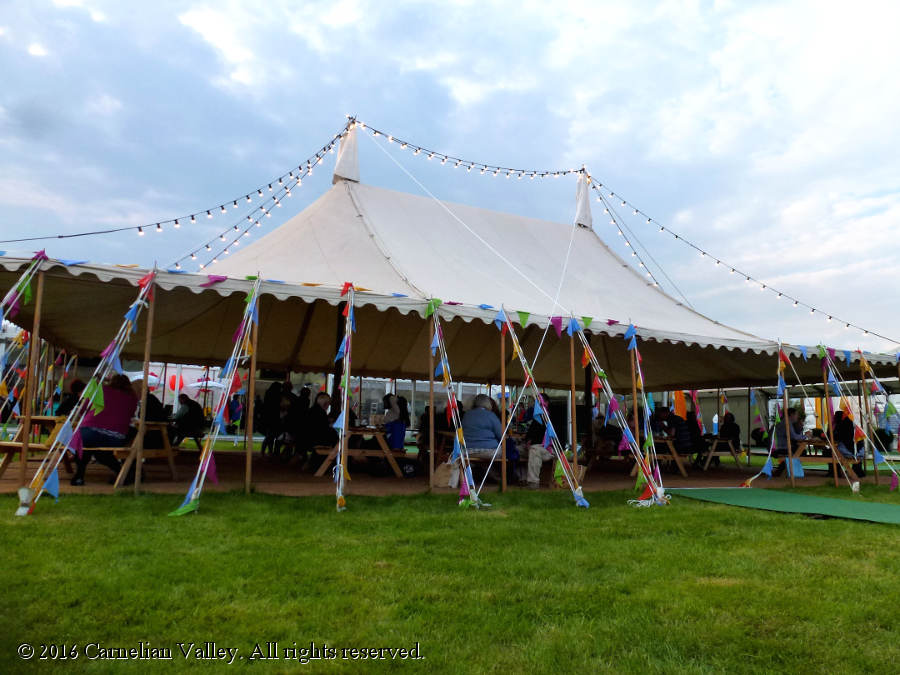
I don’t think I’ve ever tweeted as much as I did last week. I spent three days at the Hay Festival and it was fantastic; the atmosphere is amazing, it’s one of those places you can sit down to read and know absolutely no one will bother you unless with good reason, comedians walk about in sunglasses fooling no one (this was Ben Miller) and it’s casual, colourful, and full of a general camaraderie. Hay-On-Wye itself is gorgeous and has bookshops enough that you could say it makes up for all those closing. When it pours with rain you know it – the site may be all tents and tented walkways but rain on a large stretch of canvas? Just a bit loud. One night at 10:30 there was a good hundred or so people huddled by the entrance, donning bin bags as raincoats and splashing through the mud. There were about 10 event tents, more food kiosks than you could count and a few grassy courtyards. Some of the photographs I’ll be using were taken with my phone – excuse the quality.
My first event on Friday was Barbara Erskine talking to Peter Florence (the director of the festival).

Erskine’s new book, Sleeper’s Castle (out 30th June) is set, appropriately, in Hay-On-Wye. It’s about the a famous historical Welshman, Owain Glyndwr, who battled against the English in their bid to rule Wales. Erskine had always liked the idea of dismantling a castle, at least in fiction, and writing about Glyndwr allowed her to do so. She said, “It was irresistible to try and knock [it] down”. She had to fit Glyndwr into her fictional characters’ lives rather than the other way round, hanging her story onto his, and create an imaginary valley so her characters could live near Hay.
Erskine doesn’t research old dialects but does try to avoid modern slang. She moved on to her other books, talking about basing one on a house she had wanted to own (I’m yet to read her work, so if you recognise this, let me know!). Peter Florence said that one of the golden rules is not to write about dreams. “I’ve not heard that!” said Erskine.
Erskine has always been interested in the past; history is her great love. There’s a bit of her in every character. She spent 10 years researching Lady Of Hay; it was a hobby – she didn’t think anyone would publish it. She researches what she really needs to know, then fills in as and when needed; she’ll spend several months researching before starting to write and said that research makes up 1/3 of her working time. She mind maps her stories and by the time she’s ready to begin writing she has a 10 page synopsis, though she doesn’t usually refer back to it.
Erskine is fascinated by religion and it works its way into her books. She thinks most people are creative, it’s just a case of wanting to externalise it. She said that writing doesn’t get easier but that you take short cuts. She loves long books, joking, “you’re getting two novels for the price of one!”
Does Du Maurier use drugs? she asked, when The House On The Strand came up during question time. Yes, we all said. “I haven’t used that yet…”
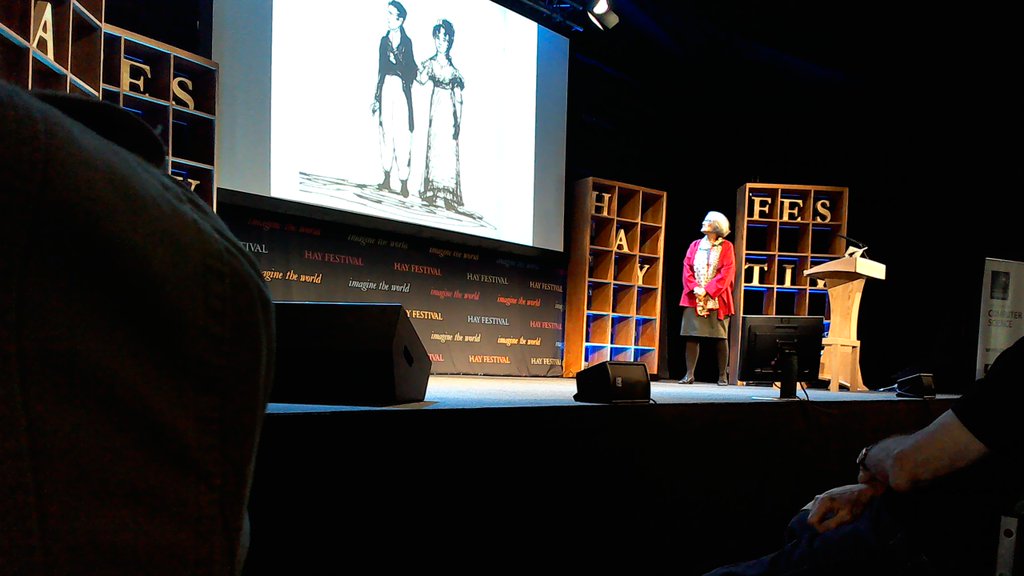
Next up was Ursula Martin, of Oxford University, talking about Ada Lovelace, a Victorian ‘computer programmer’ – I’ve put it in quotes because a computer wasn’t made at that time but Lovelace effectively wrote a program out on paper.
Lovelace came from a Unitarian family, which aided her thinking; they encouraged her work. She was Lord Byron’s daughter and wrote papers in her mid 20s, finding herself a distance-learning tutor. One of the reasons we know so much about her is that her mother kept everything, all her letters. One of those letters discusses the making of a flying horse – Lovelace was 12 years old at the time.
Martin said that Lovelace wrote most of the paper for which she’s only credited at the end as A.L. – instead people said she did the translating. One Charles Babbage came up with the idea to make a machine to create tables and logs. He drew some of them and Lovelace wrote the documentation for them, explaining how they would be programmed. Martin showed us quotations from Lovelace’s work; they demonstrate how well she would have fit in today and Martin said she’d recognise our modern computers. Even back then there were thoughts of artificial intelligence – Lovelace pondered whether machines could think, deciding that they couldn’t. Many years later Alan Turing discussed this thought, said that computers could in fact think, but he was respectful of Lovelace’s work where others weren’t.
Lovelace was dismissed in 1980s and 90s journals. The work wasn’t good, she was a woman, and so on. But she was photographed for being herself whereas other women in her era were photographed for being a wife or a daughter.
Following this was the BBC’s Front Row Radio Four recording, which you can listen to here. It was recorded in two ‘sets’ – first on stage with presenter John Wilson were Charlotte Church, Lionel Shriver, and Tracy Chevalier.

Speaking of Reader, I Married Him (a collection of short stories based on the line in Jane Eyre), Chevalier said she invited the included authors. Wilson noted that the line used was revolutionary and Chevalier responded with how the reader becomes part of the reason it all happens, Brontë’s ending happens; no author had really reached towards the reader like that before. Shriver said that the line changes the way you read the stories and talked about hers – “It’s very British; I’ve finally gone native”.
Charlotte Church was there to discuss her new musical, The Last Mermaid. There is no dialogue in it, it’s all song, and is about eco issues in a dystopian setting. She’d wanted to stay away from the idea of evil humans so she added an evil whale instead.
A quick switch – off went the three guests, on came another three: Patrick Ness, Holly Smale, and Juno Dawson.
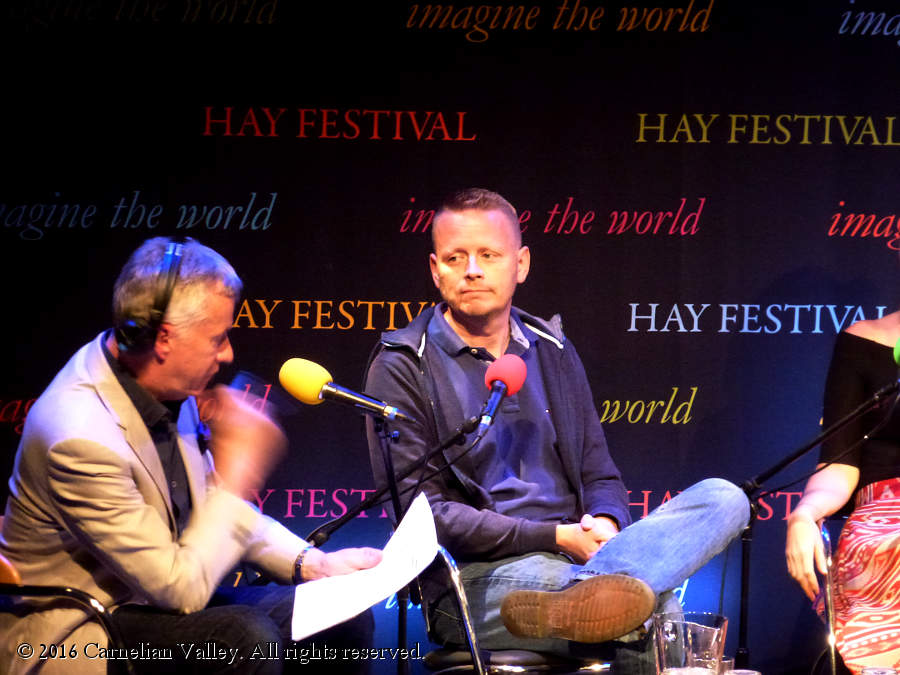
Ness started, speaking about how it was only slightly different writing for children than writing for adults. Dawson noted that teen sections of bookshops aren’t limited by genre.
Smale said that because there is no sex or drugs in her books, they find their way to readers who are younger than the age she writes for. She spoke of how her books echo her upbringing – innocent – a narrative that’s true to herself. “The voice we’re representing happens to be our own.” She doesn’t like the word ‘issue’.
“We’re haunted by the idea of issue books,” said Dawson. “No one ever said, ‘oh, I’m anorexic but I’m fine in every other way’.”
My last event of the day was a film about the painting Girl With A Pearl Earring. Tracy Chevalier introduced the piece, created by film makers Phil Grabsky and David Bickerstaff, saying that she’d seen the picture at her sister’s house and saw it as representative of a relationship. People didn’t know who the sitter was or much about the artist – ‘hoorah!’ she thought, did some thinking, and came up with the plot in three days. Since then the painting’s become famous.
Some points made in the film:
- Tracy Chevalier: The pearl’s a symbol of virtue. It’s a painting of a virtuous person. It might be a painting of virtue in itself rather than a real person.
- It was lost for 200 years and dirty when found and auctioned.
- The artist, Vemeer, adds white patches to draw our attention to them and uses primary colours over and over again.
- Even bakers could buy paintings in 17th century Holland.
- The turban shows that it’s imaginative; it’s exotic.
- Paintings wherein the sitter doesn’t have a serious expression tended to be imaginative.
I left after the film finished, missing the discussion; it was getting late and I had to navigate pouring rain in summery clothes.
World Book Night 2016
Posted 29th April 2016
Category: Events Genres: N/A
5 Comments
“I think I’m on a list,” I said to the woman on the door. It was one of my first times on a list for a public event and I wanted to notify her in case the ticket desk wasn’t the one I’d need, without sounding pretentious. Yes, I was over-thinking it.
Here we were at the British Library Conference Centre for the World Book Night gala event. It was pretty packed.
Roly Keating, who I expect finds lots of people asking if he knows of the pop star with the very similar name, welcomed us to the event. He’s the Chief Executive of the Library and told us, in reference to the whole Shakespeare celebration (it’s the 400th anniversary of the Bard, his birthday and death day being the same date) “we’re going to party like it’s 1616”.
Not straight away, though – Sue Wilkinson, Chief Executive of The Reading Agency, introduced us to the night’s proceedings and to the panel of authors about to take to the stage. She spoke of the charity and of reading in general, the mission of the Agency. “Libraries aid us all our lives… we believe everything changes when you read.”
It was the goal of those who created World Book Night to get thousands of people who’d never read a book before to read one then, to be inspired and to pass their book on to another who could also benefit. Research shows World Book Night does get people reading: 85% of the 5000 surveyed, who’d never read before, said they’d kept on reading afterwards.
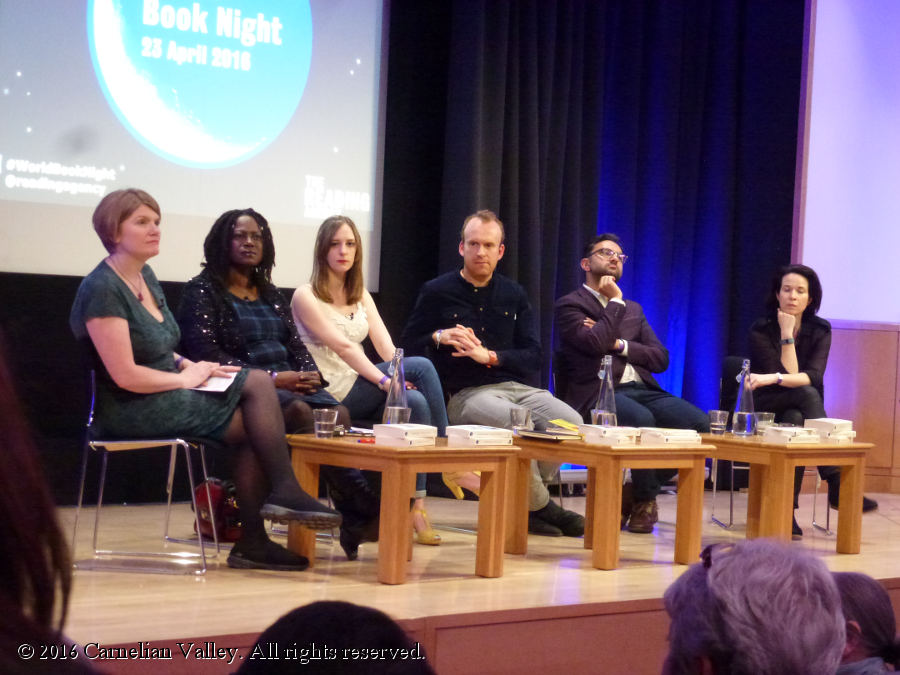
The panel consisted of Cathy Rentzenbrink as chair, Dreda Say Mitchell, Holly Bourne, Matt Haig, Sathnam Sanghera, and S J Parris. Dreda gave a brief introduction to east London, her home, saying how it doesn’t fit the stereotype, that it’s full of culture. There weren’t books in her childhood home because there didn’t need to be – there were plenty of good libraries, an art gallery, and Dreda and her siblings would visit them all, their parents not always in the know. Her first favourite books were the Topsy And Tim series and the scratch and sniff books of yore.
Dreda does a lot of prison work. 50% of people in prison have poor literacy skills. “Reading opens doors for you… if only so much [money] was spent on reading,” she said.
For Holly, reading helped make sense of life. She called it both an escape and a hallucinogenic drug. She didn’t see how hard life was where she grew up because her face was always in a book. Her love for reading dipped in secondary school due to the requirement for exams on things she loved. Her first poem, the first she liked, was a Philip Larkin – she liked the use of the F word. “You can’t find poetry,” she said of her late development in it, “poetry has to find you“.
Matt remembers reading tractor catalogues in his younger years; he had dreams of working with them. Similarly to Holly he said, “school distanced me from that pure joy for a while”. He came back to books at 13, reading The Outsiders. Then, suffering from depression and anxiety, he got back to his childhood favourites, minus the tractor catalogue. He said reading had been his only escape from himself. “Stories are about change,” he said. The good thing about his issues, he jested, particularly the agoraphobia, was that it narrowed down his career options.
Sathnam’s father was illiterate but took his children to the library. As a child the author became obsessed by the idea of owning a book and bought a nice copy of the collective works of George Orwell. He was too young to understand it but enjoyed pretending he’d read it when his cousins came from miles away to see it. He still hasn’t read it.
In regards to his own work: “If your parents don’t read books you can write anything you want about them”. Much laughter. Most people he knows just want to know when there’ll be a TV adaptation. Ending on an ironic note, he told us he’d failed the audition for his own audiobook.
S J Parris – Stephanie Merritt – grew up in a house full of books because neither parent had had books as children. She was very young when she picked up her first non-picture book, one of The Famous Five, and thought the chapters inferred it was a short story collection. The book she read to us from, A Christmas Carol, she first attempted aged 10.
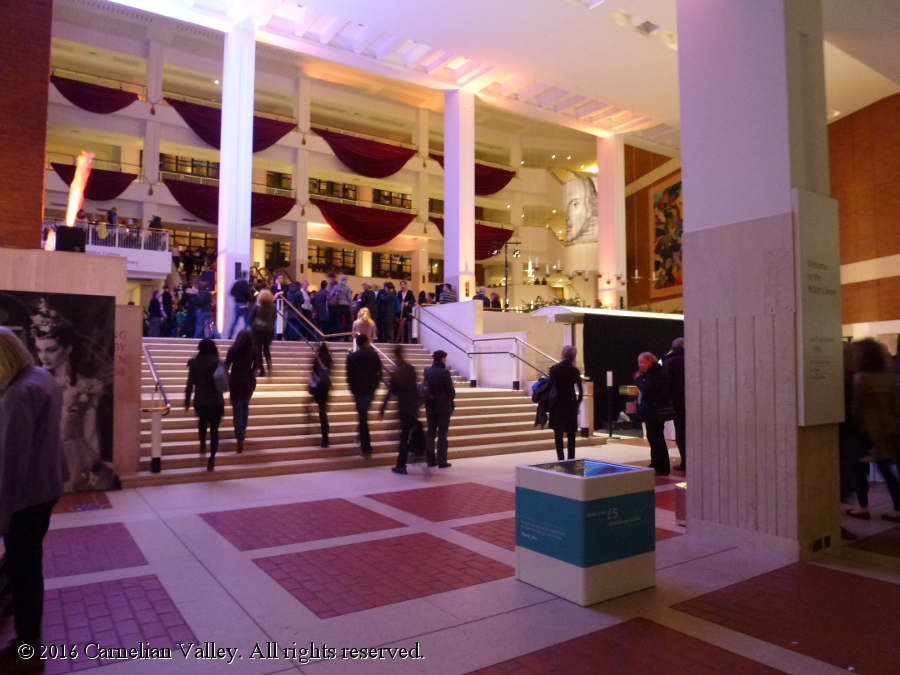
We moved on to Shakespeare. Stephanie said she’d had a great English teacher who had made a bet with her to read the Bard’s complete works by the end of her GCSEs. She read most of them. “A bad adaptation is the worst thing in the world, a good one the best,” said Sathnam. Teachers need to be aware that it’s hard for kids, he said, they need to break the text up. Matt spoke of how there’s wisdom in Othello and Hamlet about mental health – it’s as though Shakespeare invented Cognitive Behavioural Therapy; it’s hard to read the plays and not see the writer’s depression.
Holly’s introduction was via Keanu Reeves – she didn’t need to understand it. Matt mentioned the Leonard Di Caprio Romeo And Juliet – yes, she liked that, too. School put her off but she’s interested again; she spoke of Shakespeare being 400 years ahead of his time in the way he approached gender, treated women, and said he showed there was more to women than was thought at the time. She loved that he invented the words ‘eyeball’ and ‘lonely’. What did we do without the word ‘lonely’?
Dreda said what by now we were all thinking – Shakespeare’s taught badly. She had a teacher who emphasised performance and spoke of how her class had been enthralled by Judi Dench saying ‘unsex me now’. If you get a good production you can really draw kids in, she said. He’s writing about things we like, what we watch on TV.
What books would the authors give away? Dreda chose The Colour Purple, Holly To Kill A Mockingbird, Matt The Outsiders and The Cosmos. Cathy said she’d give away Matt’s book and has done previously, saying it illustrates how reading makes you feel less alone.
After this we all went into the main lobby of the library, joining many others, to view the exhibitions on Shakespeare through the ages. There were primary sources involved, so no photographs, but along with the original texts there was Vivian Leigh’s Lady Macbeth costume, and a room dedicated to black actors playing Othello (the first in Britain acted in 1925… it’s not like Othello was written to be a black man, after all…). There was also the last draft of one of Angela Carter’s books.
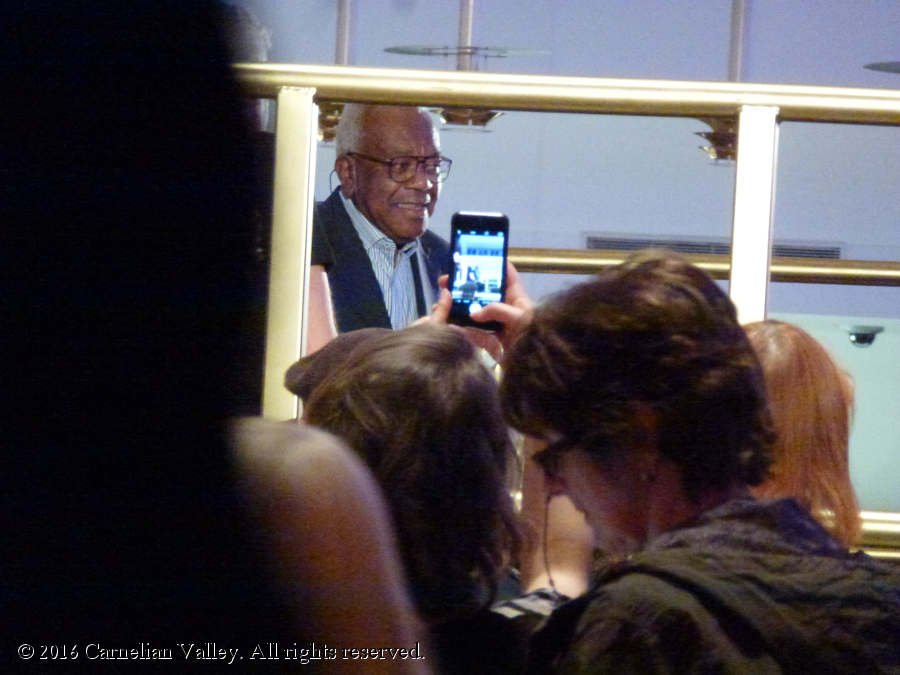
Here’s a grainy photo of Sir Trevor Macdonald. I was too busy trying to take it to really listen…
I forgot that June Brown was Dot Cotton from Eastenders so I missed half her set. She was speaking of her Shakespeare plays, how she’d been taught to keep thinking to rehearsals and not think when performing. She said she’d speak all night if she could and that she’d once interpreted a spotlight on her as encouragement to go on when it was actually a hint for her to stop talking. Here a glass broke somewhere downstairs in the bar area and she shouted at them to stop making so much noise when she was on stage. I remember seeing her drunk on Graham Norton’s show alongside Lady Gaga and thought she was funny; seems she’s funny all the time. I suppose one has to be when they work on Eastenders…
Having never done anything for World Book Night before because I always miss the date, it was a super first innings. Thank you, Alice, for inviting me.
What did you do on World Book Night? (I’m assuming most of you were very appropriately Readathoning!)
Brief Notes On The Cassava Republic Salon
Posted 15th April 2016
Category: Events Genres: N/A
2 Comments
An evening of much discussion and laughter was had at Waterstones Piccadilly this week, the culmination of sorts of the launch of Nigerian publisher, Cassava Republic Press, in the UK; it was the last time the three launch authors would be together before going their separate ways to other literary events and festivals.

We were seated in a meeting/event room on the lower ground floor and began with chatter and a look at the books. The authors – Elnathan John, Leye Adenle, and Sarah Ladipo Manyika – spoke first about the background to their books (Born On A Tuesday, Easy Motion Tourist, and Like A Mule Bringing Ice Cream To The Sun respectively). Elnathan said, in regards to his main character, he’d worried about people, specifically university students, being seen as numbers. He spoke of the poetry he’d written when at university himself, bad poetry about death and “all the girls who didn’t like me” – he set the comedic tone to the evening early on. He’d wanted to talk about those who aren’t noticed in society but also he just thought it’d be cool to have written a novel.
Sex is a part of all three books. As you may have heard or read in the Q&A I posted last week, Sarah said she’d wanted to explore desire in older women. Leye wrote what he thought was a bad sex scene (he differentiated, for us, the way this was a scene of consensual sex – his book also contains rape). His editor got back to him saying this bad sex scene needed to be written in full and then got back to him after that to say it needed more detail. It turned out it wasn’t so bad at all… but Leye will be skipping sex scenes next time.
For Elnathan, exploring the nature of sexuality was critical. The age of his character necessitated it and the author wanted to talk about that time of life, to ask all the questions we ask about sex, to explore the years in which sexuality is fluid.

Is it difficult to talk about horrible characters? Leye said that after he’d finished his book, he missed all his characters. Sarah diverted the subject to discuss how she’d created characters through silent acting. She spoke of how she tried to act out a character she’d wanted to create, a cleaner from Nigeria, and how it had then burst out of her, at which point she turned on an accent and became the person she’d created, filling the room with the voice of a lady who’d just cleaned up and now everyone was making a mess.
Elnathan doesn’t think in terms of literary heroes, he’s more about those who make him think deeply about books. He creates categories depending on what subjects are involved and spoke of how for their present work, his fellow launch authors are inspiring him. For Leye it’s Chinua Achebe all the way. Sarah has included her heroes in her book – Jean Rhys and Charlotte Brontë for starters.
It was an awesome, fun, evening and a note towards the end bears repeating: African writing often gets stereotyped so the more we talk about the books, just talk about them, the better.
What books are you excited about right now?


