A Book Launch, A Multi-Author Event, And A Visit To Southampton Old Cemetery
Posted 22nd May 2017
Category: Events Genres: N/A
4 Comments

It’s been a very literary weekend.
Friday evening saw the launch of Meike Ziervogel’s fourth book, The Photographer, at Waterstones Piccadilly. Longer than her others, Meike is calling it a novel rather than a novella. The book was inspired by her grandparents, one set in particular, and their lives during the Second World War. It’s about the people of Germany – Meike was aware that she was of a generation that could write about that time; those prior could not.
There were a couple of readings and a general discussion with chair Rosie Goldsmith, and Stephanie Bird of University College London: thoughts on German documentaries and films regarding the War; literary fiction and the way that plot is important to Meike because actions speak louder than words; how the four of the books are connected, having written one to get to the next and so forth. I picked up a copy of the book – it’s only a tentative plan, but I’m hoping to review it soon. And I got it signed, which in regards to Meike’s work was a first for me.

I spent Saturday afternoon attending the Southampton stop of publisher Choc Lit’s author tour. Choc Lit are visiting a few different cities and the authors at the events are those nearby; this time it was Evonne Wareham, Jan Brigden, Liv Thomas (one half of the writing duo published under the name Isabella Connor), and Laura E James, in the order they are sitting in the photograph. There were a number of us and the afternoon consisted of a good introduction and discussion by and between the authors, lots of time to talk to everyone there, and a quiz to finish. And a fair amount of chocolate, cake, and books. During the latter section there was an opportunity for the writers amongst us – those other than the four mentioned – to pitch their work.

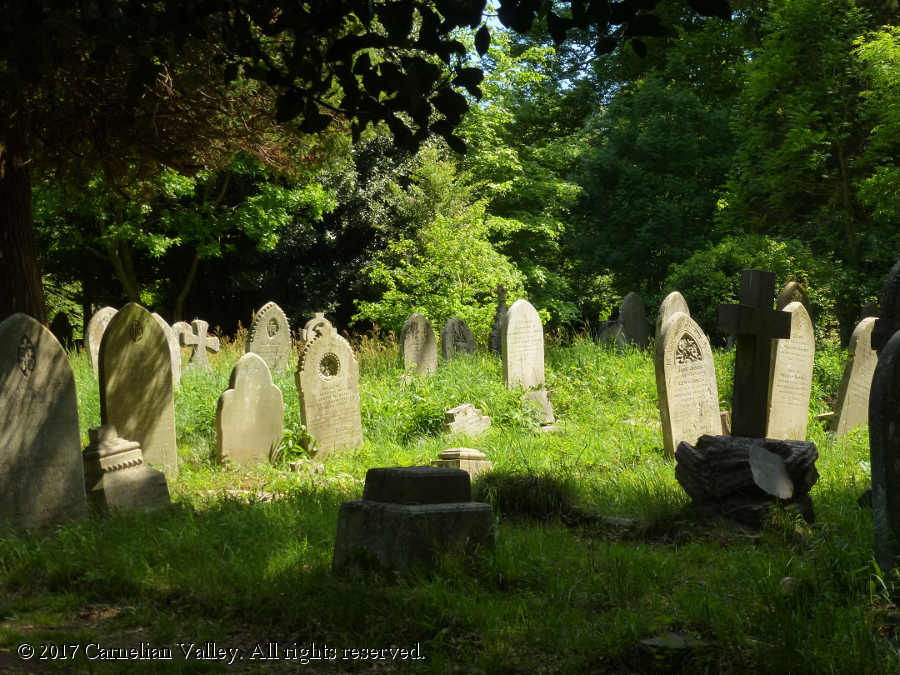
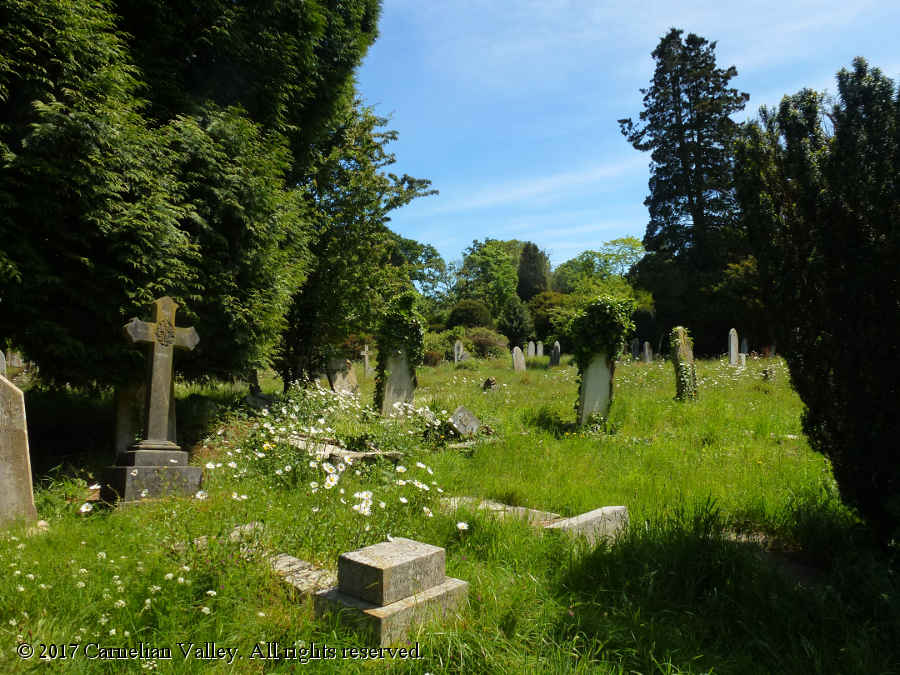
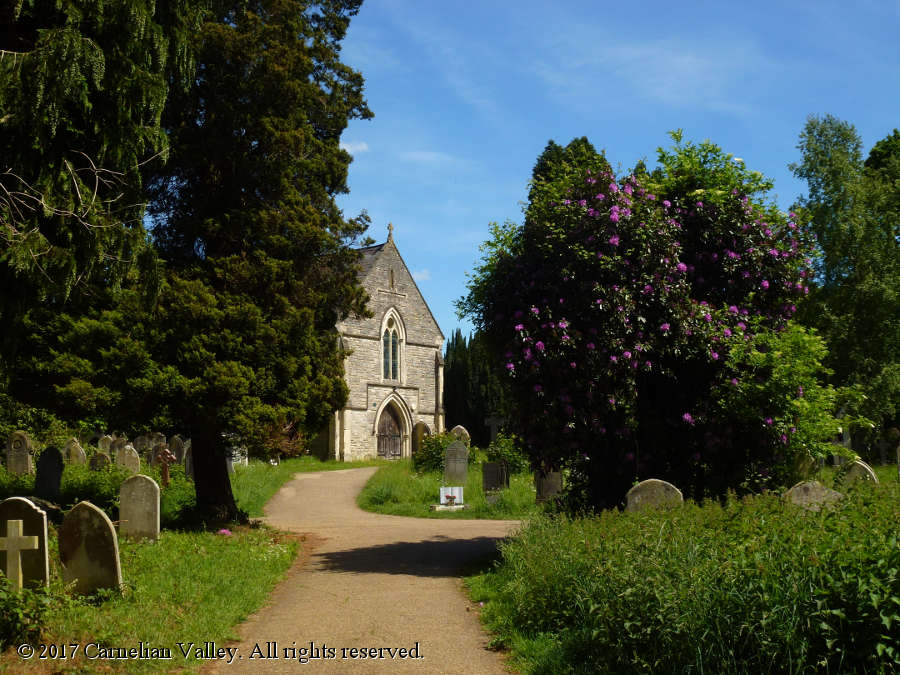
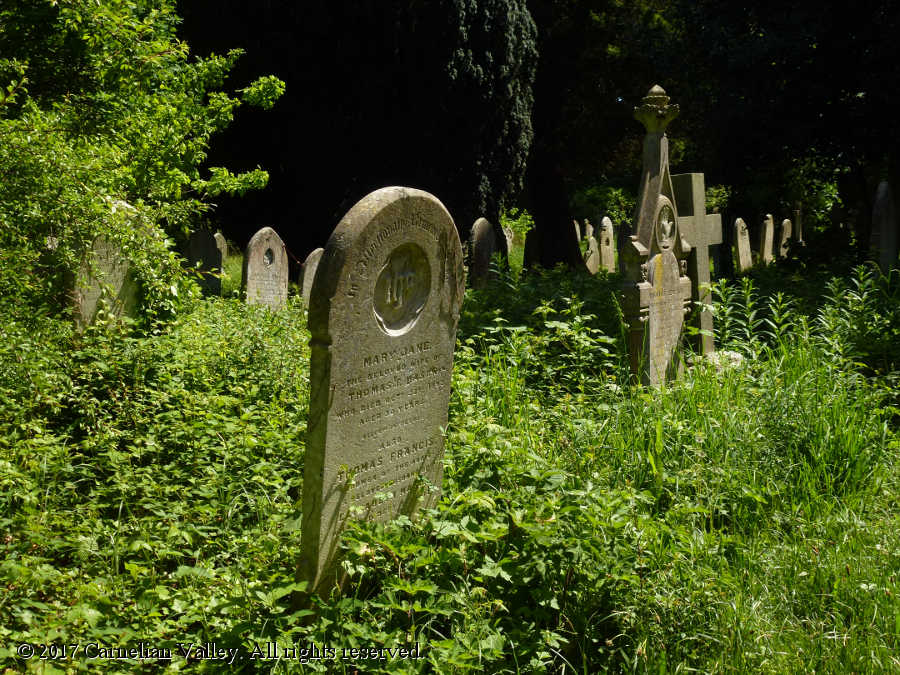
Sunday was a free day. I read – little surprise there, I think – and decided to get out and enjoy the sunshine visiting the old cemetery we have in Southampton, an activity a lot more peaceful and positive than it might sound. Situated in the middle of Southampton Common, the cemetery was opened in 1846; nowadays the only burials are those added to existing plots, a few a year. Very tall statues abound and there’s even a small mausoleum. Most of the stones have corroded to the point of illegibility and some areas are so old and overgrown they look empty, but in the context of a historical space, there is a lot of beauty to be found in it… and there’s also a monkey puzzle tree, as you can see above. Here are more photographs:

How was your weekend and what was the last event, literary or otherwise, you attended?
My Event Report: In Conversation With Elizabeth Fremantle
Posted 28th November 2016
Category: Events Genres: N/A
6 Comments

© Photo:Gerry Walden/gwpics.com 2016
It’s a weird feeling shifting from the role of press to the role of host for an evening. I spent a very good few hours at our latest event but coming home without photos and notes is a strange thing. I’m glad for our photographer and the writer from Southampton University who came to cover the event for us.
Our evening with Elizabeth Fremantle last Thursday was a roaring success. We commandeered the comfy chairs. The majority of seats were taken and more people turned up than we knew were coming; a wonderful surprise.
Elizabeth told us of her journey to publication, her background in fashion writing; her research methods – visit Hardwick Hall! – and all four books which we ended up discussing in reverse chronological order because we got talking about her latest book and it seemed to make more sense to me in that moment than jumping from subject to subject (the books all stand alone but there are links).
This time we recorded it. Fathers who own camcorders are very useful when you discover that your plan to use your DSLR isn’t going to work. You’ll find the video at the end of this post.

© Photo:Gerry Walden/gwpics.com 2016
Many, many thanks to Elizabeth and her friend, Glyn, who also joined us; Rachael from The Edge and Wessex Scene – read her pre-event piece here; and our photographer, Gerry Walden. Having finished it I’m feeling rather odd without promotion to do; I’ve started the planning for January.
Here’s the video, complete with my silly bumbling. I’ve cut the introduction a bit due to microphone issues.
My Event Report: In Conversation With Dan Richards
Posted 24th October 2016
Category: Events Genres: N/A
4 Comments
© Photo:Gerry Walden/gwpics.com 2016
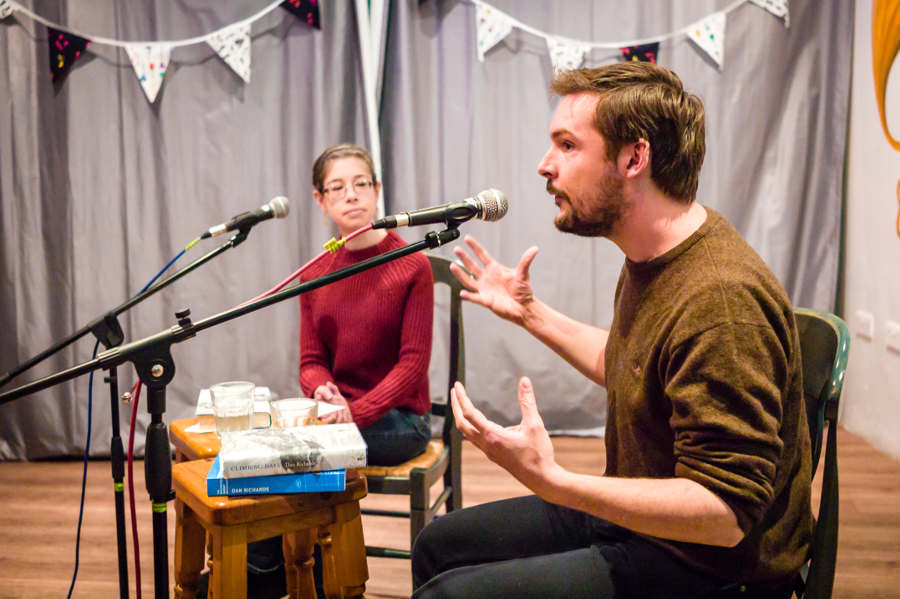
Thursday saw the first In Conversation event here in Southampton, hosted at The Notes Cafe. Dan Richards came down from Bath via Norwich – a very busy day that resulted in a likely miffed cat – and spoke to us about Climbing Days and The Beechwood Airship Interviews: how it was to be a female mountaineer in the early 20th century; the problems with climbing then as opposed to now; being greeted as the great-great-nephew of a climbing legend; interviewing popular artists about their work within their creative spaces.
With me on stage too, this post was never going to be like my other event write ups. It would have looked a little odd for me to have a notebook and pen, not least to be jumping off the stage to gets photographs… of one person and an empty chair, so I mollified myself with the occasional glance to check my live tweeter was indeed tweeting (he was but as we discovered later, he didn’t know about mentions/replies – this is why I was posting tweets the next morning) and rested assured that there was a professional photographer in the house.
© Photo:Gerry Walden/gwpics.com 2016
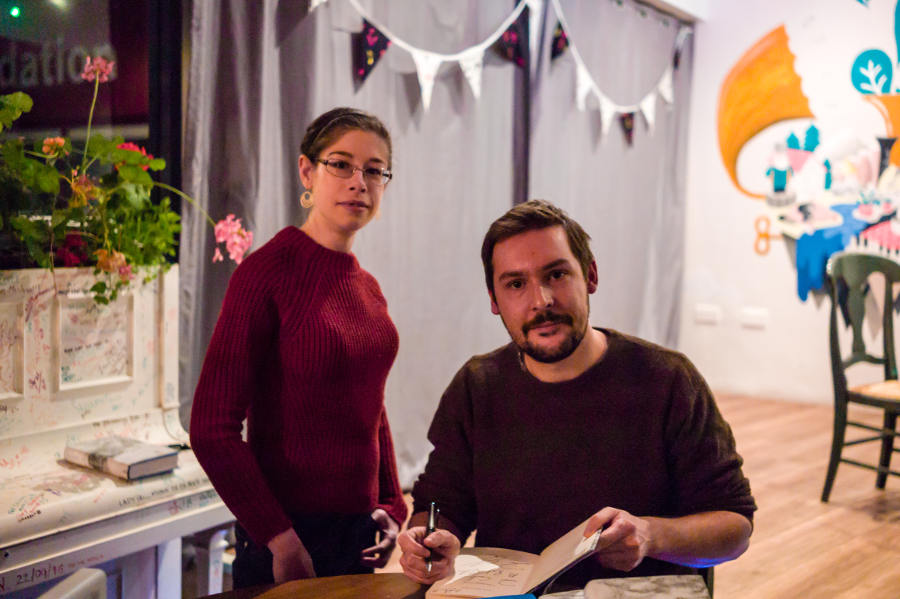
Faber sent us some letterpressed prints of Stanley Donwood’s book cover art, signed by both artist and Dan, and we had all three books on sale. It was lovely to see those I’d met before and those I’d met on Twitter; April Munday joined us (we met at last year’s RNA conference) as well as Paul Cheney who I now know, through Dan, and who travelled a fair distance all considered.
It was a lovely evening and we look forward to a second – on Thursday 24th November, Elizabeth Fremantle will be joining us, Facebook event page here. Do come if you can!
What’s the most recent literary event you’ve attended?
Some Notes From Babel Literature Festival And YALC
Posted 14th October 2016
Category: Events Genres: N/A
3 Comments

Having attended various events over the summer months, I didn’t want to post about every one and risk making this blog a blog of quotations. Looking back over my notes and photographs, however, I saw the value in writing some of it up and sharing and creating one post for a few events seemed the way to go. Included here are notes from the Babel Literature Festival (a festival normally held on the continent but this year a special one off for London), and YALC – Malorie Blackman’s creation, in its second year, part of the London Film And Comic Convention.
Part of the reason I didn’t post separately should be obvious – there wasn’t enough content, especially once incidental notes had been removed, to make a whole post, but hopefully the notes I’ve included here have been interesting. My photographs? Forget it – apart from the one above, my shots were shocking.
Babel Literature Festival
Xiaolu Guo and Ma Jian
Ma Jian does not speak English – all quotations attributed to him were translated from his Chinese into English by Xiaolu Guo.
- Xiaolu Guo considers Ma Jian the only Chinese writer from her father’s generation she can read, because of the subjects Ma Jian includes. She sees herself and her fellow writer as united in trying to get away from the culture they came from.
- Having left China, she wrote in English because for her there was no feeling that she had to censor herself in that language.
- It was during political conflict, at the time she was confused and feeling nihilistic towards discussion, that she started reading western literature. “I swam in and I lost myself.”
- She wrote her film projects as books to preserve the copyrights.
- She didn’t like the UK at first and had no plans to stay; but she was writing her first story. It was in going to France and feeling isolated, linguistically, because she’d already written in English, that she saw she had to stay. “Forget it. I lost my country, my language – I have to find some comfort in this second language, this adopted country.”
- “I try to communicate with western writers otherwise I have no one.”
- When Ma Jian left his Beijing for Hong Kong, he stopped painting. When he began to write, it was the continuation of his painting.
- He closes off to everything in the UK when he writes so that there’s just his language. (He hasn’t learned English; someone in the audience asked ‘wouldn’t learning English give you the ability to reflect on China compared to England?’ to which Ma Jian replied, “I close the door, but the window is open.”)
- “Only half of a person is kept in translation.”
- “Language is a reflection of a particular time in history.” Language is passive – it’s a record of the history.
- Ma Jian said that in China, before 1949, there was poetic language. Then Mao language was adopted. Then plain language. We have to translate a Chinese book into the modern Chinese, translating Chinese into Chinese. In this way, modern Chinese translations are only half of the text. (On this, Guo said that writing in 1988, it felt the wrong language because she was so used to 1930s books, feudal Chinese.)
Philippe Rahmy talking to Vanni Bianconi
- Philippe Rahmy, who has brittle bones, has used his disease as a tool. He might have been a writer anyway, but…
- He calls himself ‘Ray-Me’ in London as he doesn’t know how his name is pronounced in different places.
- He thinks in German and writes in French.
Chloe Aridjis and Franca Cavagnoli
- Chloe Aridjis: As a translator and author, I have a responsibility to try not to get in congflict with another’s language. There may be a clash between the imaginations; there’s a risk in translation.
- Franca Cavagnoli feels England to be home. When asked, she says she’s Mexican, but being in Mexico feels foreign to her. She speaks English with her father and Spanish with her mother. “My analytical mind works in English.”
Alexander Hemon talking to Maurizia Balmelli
- Alexander Hemon uses Bosnian jokes in English despite knowing it may not work. It won’t have the full impact, he said, but it’ll become a story, acquire a narrative quality. That, to him, was interesting, and he wanted to go into that process of joke to story.
- “I’m greatly interested in translation as a process, a human project.” In translation you lose some and gain some. If everything was translated it’d be the exact same text. To say translation is a loss is to lose the value of experience.
YALC
Malorie Blackman, James Smythe, Eugene Lambert On Sci-Fi
- Blackman: Sci-fi books are books of the scientifically probable and possible. (She loves the idea of possible other realities.
- Smythe: Fantasy is the point where things aren’t possible, that’s the difference. There’s a huge amount of scope for what it could be and what it actually is.
- Lambert: How do you tell stories? You begin by exaggerating.
- Blackman: We talk of social mobility but we’re dismantling the very things that provide it – libraries, for example. To enjoy things costs money.
- Blackman: As a woman I found sci-fi very frustrating, growing up, because the female characters didn’t have much to do.
What’s the best talk you’ve attended, literary or otherwise?
Curious Arts Festival 2016
Posted 29th July 2016
Category: Events Genres: N/A
7 Comments
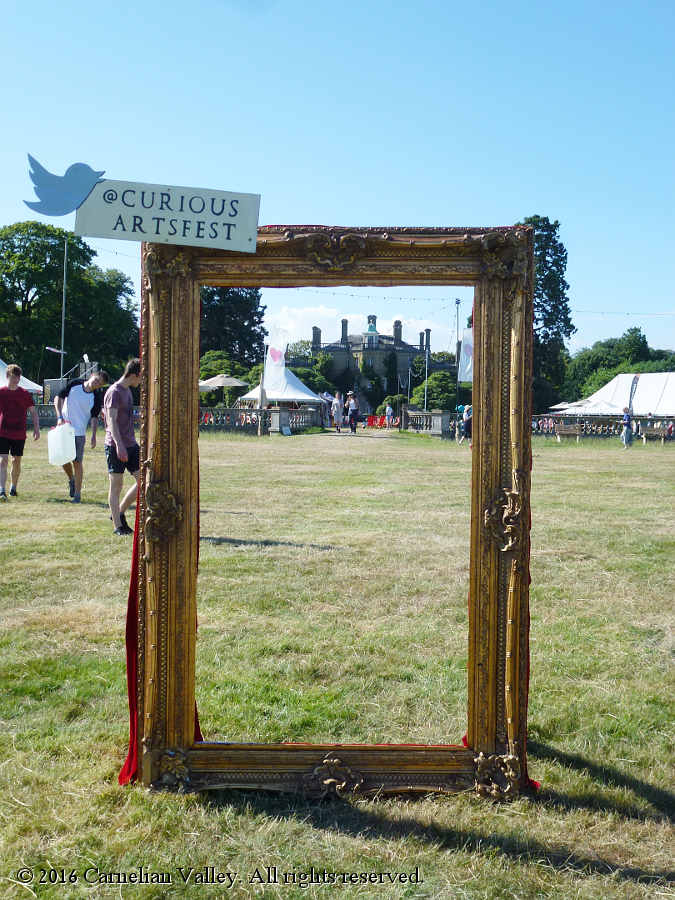
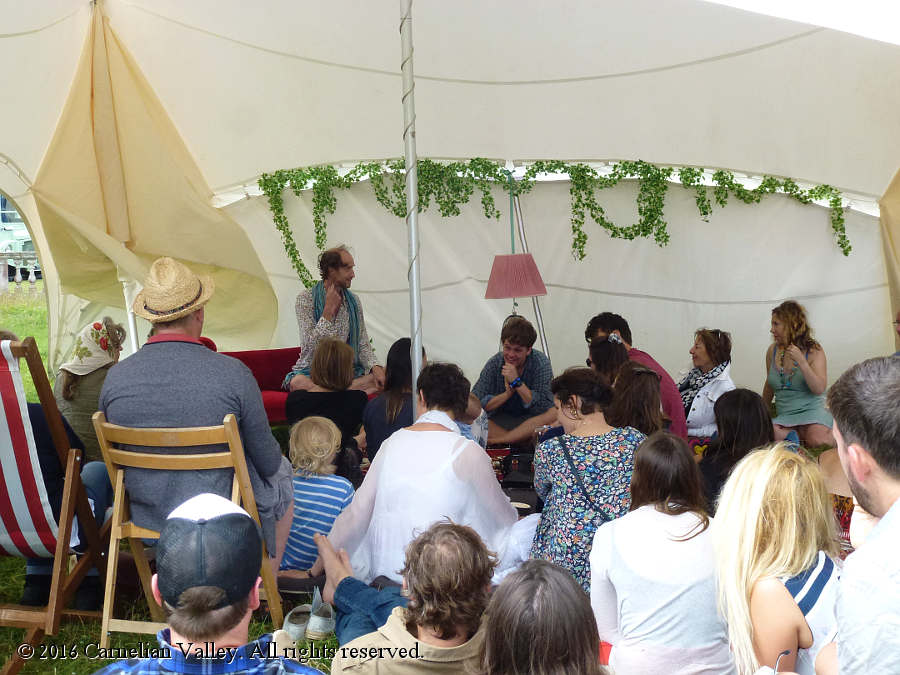
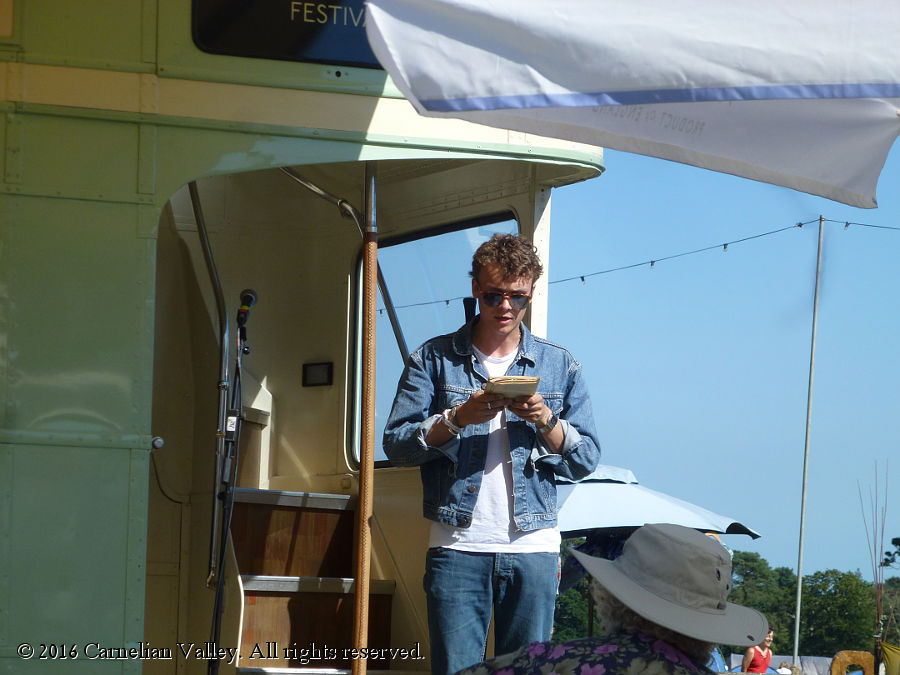
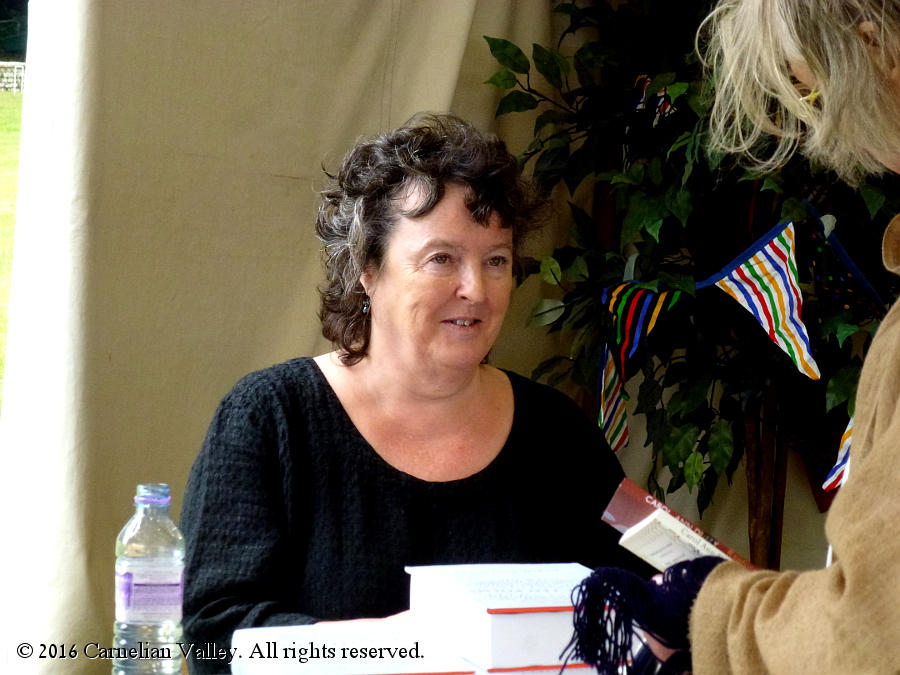
This is a long post: I’ve included both an overview and brief notes on some of the talks. And please excuse the blur on the photos, I’ve a bit of fluff on the lens that I’ve tried to edit out as best I can.
I spent last weekend at the Curious Arts Festival, hosted at Pylewell Park in the New Forest. The festival is a boutique celebration of literature, music, comedy, and, on the first evening, opera. Set in the acres of the Park, just beyond the house and its garden, the festival is a casual affair; what is lovely about it and what sets it apart is the relative laissez-faire running of it – once you’ve purchased your weekend or day ticket and set up camp (you can bring your own tent or choose to ‘glamp’) the festival is your oyster. Want to pop on over to one talk but only for a few minutes because actually you really fancy a box of halloumi fries at this time? You can do so because the talk is one of many and you can attend whichever you like, whenever you like.
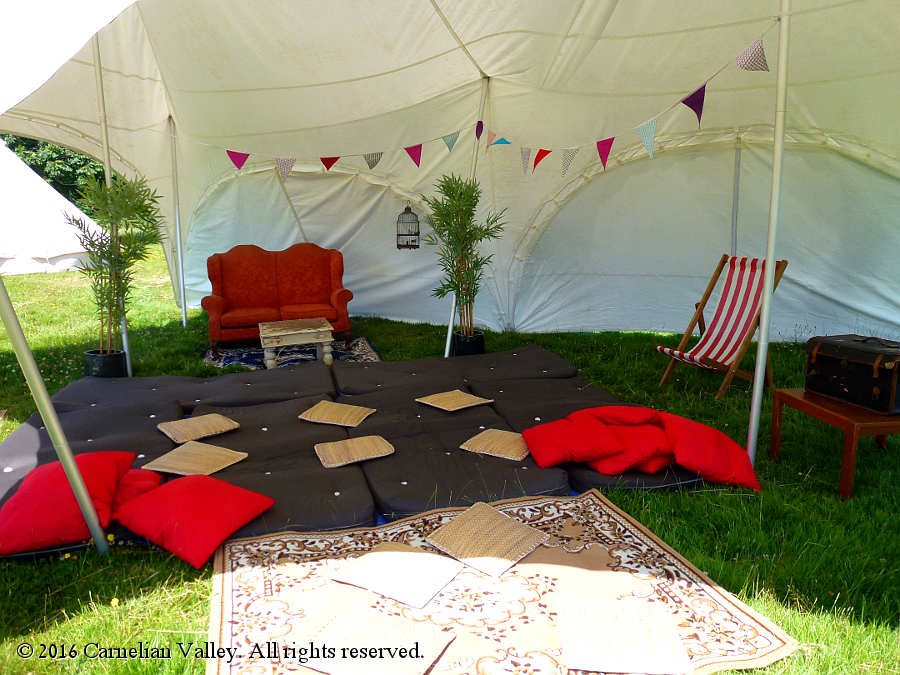
This runs over into the talks themselves. ‘Shall we begin now or wait a moment?’ Rowan Pelling asked Deborah Moggach as they waited in the audience seats for their session. They were set for five minutes later but no one really minds if things run a bit ahead or behind schedule. There were on occasion problems, such as everyone sitting down for a talk to be told the author would be half an hour late, and the best way to find out where a rescheduled change-of-tent talk is taking place is to walk round the site – but that’s no bother when the site is small. It takes less time to walk about the festival site than it does to walk back to the box office tent. Phone signal is of course patchy, as to be expected.

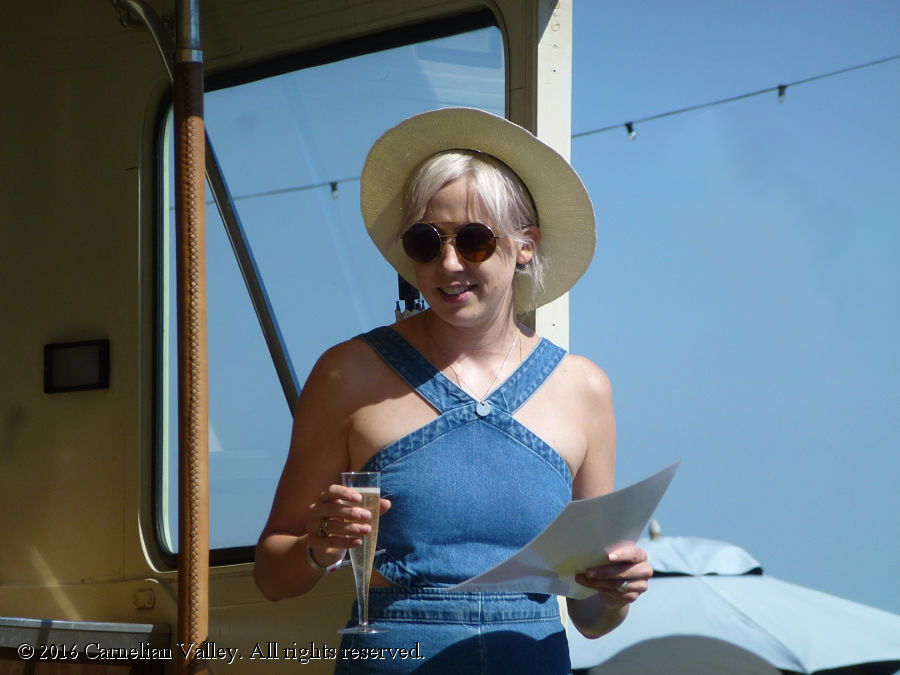
Twelve event tents and more eateries than you could plausibly sample fill out the area contained by the estate’s small stone walls. A vintage bus, styled or truly old I’m not sure, is at the front, ready to take your breath away as you first enter, and food and drink is helpfully divided by type – coffee and breakfast provided by Tea Sympathy in a lovely bohemian tent, champagne is the bus’s domain, burgers another van, amazing quiche-based pies by Higgidy (you can find them in supermarkets), and the afore-mentioned halloumi fries in another. (There were 10 more food options at the very least.)
Every day there would be a sonnet-a-thon session where various people on the line up would read 30 or so sonnets at a time so that by the end of the festival the entirety of Shakespeare’s output in this regard had been spoken aloud. There was the morning news hosted by Paul Blezard and people from The Week, bedtime stories for the children, and the music and comedy finished up the evenings. Children of all ages are welcome as are dogs and whilst there are no events for dogs – the yoga is for the adults – there is plenty for the children. As Lucy Rose, who performed on the Friday evening recounted, “this is the poshest festival I’ve been to.” There was even a cricket match going on.

I would recommend this festival to those who love the idea of a festival but not the reality of the famous ones. The Curious Arts Festival is a good option for those who prefer the thought of something more laid back, quieter but still fun, and truly for all the family. Everything is so close together that the first afternoon I was there I was confused by how silent and unpopulated it was – turns out everyone was still in their tents and caravans (you can bring those, too) because it was only a minute walk from accommodation to events.
Here are my notes:
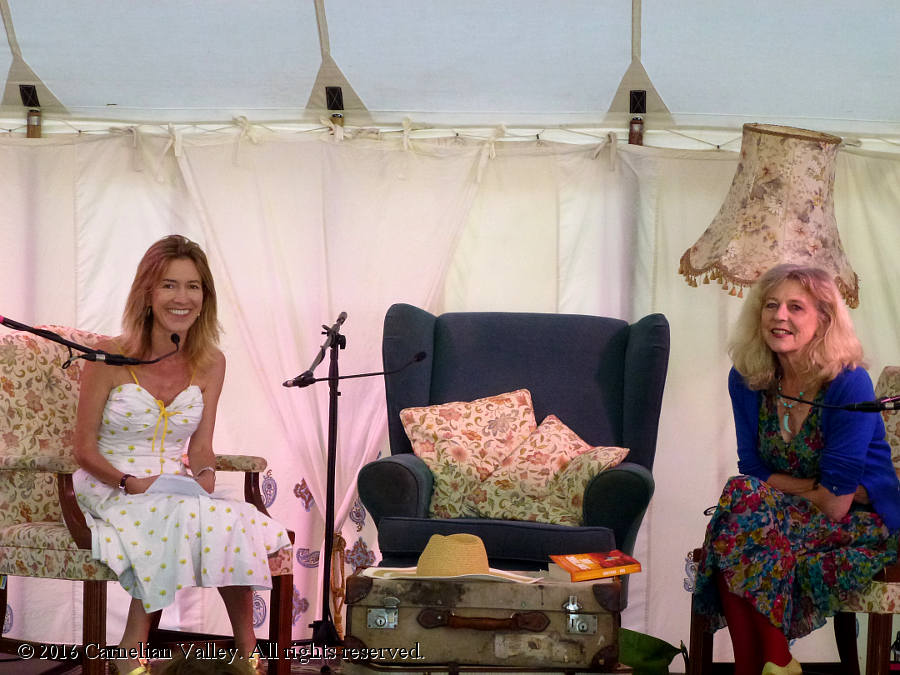
Deborah Moggach, writer of the book that was turned into The Best Exotic Marigold Hotel, and Rowan Pelling, did indeed decide to start their talk right away. Speaking of her newest work, Moggach cited three global inspirations of which I caught two: Africa – some have phones, others have no electricity and have to charge items at stores; China – couples are increasingly infertile due to the pollution; and Pimlico – where the heroine lives. She said that the job of a novelist is to get behind the story we show the world and that you’re always trying to earn the freedom to write what you want to write. She’s always an extra in her films; she thought the The Second Best Exotic Marigold Hotel was terrible.

Celia Imrie arrived to talk to Paul Blezard. I’m not the target audience for her work but I was introduced to Dinnerladies during childhood and so greatly looked forward to seeing her. Imrie has set her novels in Nice; she has a flat there and considers it the most beautiful city in the world. Her fiction work arose from an event she attended in the city at which she met the Editor-in-Chief of Bloomsbury who suggested she try fiction since she had a memoir under her belt. She prefers having finished it to being deep in the process. She loves the feel of a real book and doesn’t have an ereader. There weren’t many books in the house, growing up: “I feel I’m still catching up,” she said. Of The Best Exotic Marigold Hotel, which Blezard couldn’t not ask about, she said, “Can you imagine being sent a script set in India with that cast?… I couldn’t not go to India.” Due to the presence of Judi Dench and Maggie Smith, they were all spoiled when filming on location, which was lovely, but then they’d leave the gates and there would be a girl with cabbage leaves sat on the floor. The experience was sobering.

Following this were S J Watson and Renee Knight. Knight’s Disclaimer has been published in 30 languages. The premise came fully-formed to her but she didn’t know what the secret would be. The book took 18 months to complete, from first draft to final edit. Knight doesn’t like the term ‘chick-noir’, citing it as rude, though she acknowledges that it was a good way to market books at the time. Neither author believes in genre, Watson feels it’s restrictive and Knight says it’s easy to defy it.
Before Watson’s book, Before I Go To Sleep, was acquired by the publisher, his agent had asked him where he ‘was’ in it. He came to realise there was a bit of him on every page. He hadn’t realised it was a psychological thriller; once that was said to him he figured the idea was to improve the manuscript with the genre in mind. We feel the story more if it’s closer to home – realising the person one trusted isn’t worthy of that trust – said Watson. It’s the chill factor, said Knight, it’s something you can imagine happening to you.

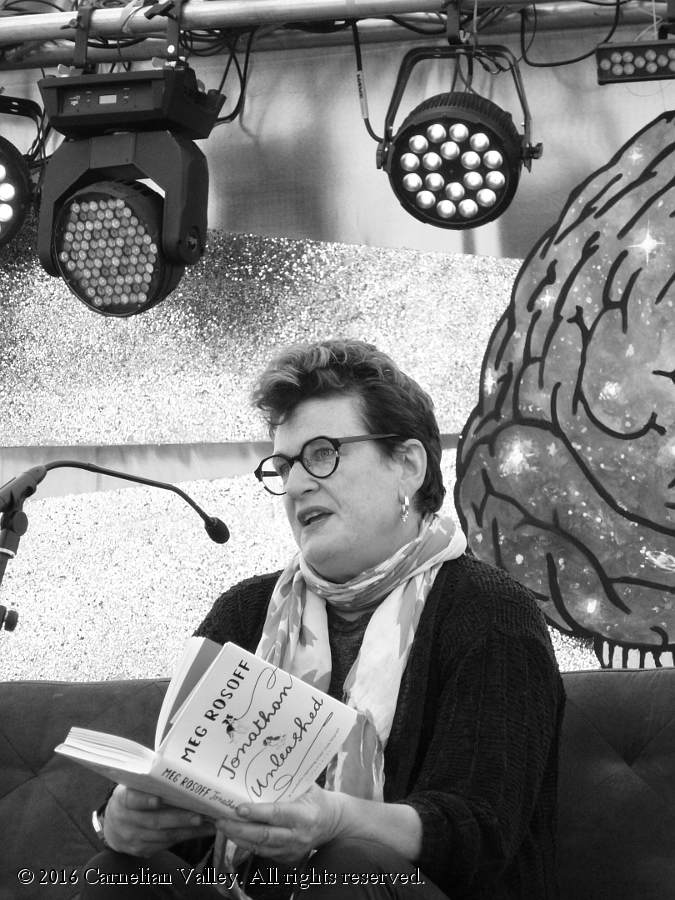
I didn’t get a good photograph of the next author, so here’s another festival shot. Joanna Cannon, author of The Trouble With Goats And Sheep, and agent Carrie Plitt, spent some time discussing mental health. Cannon wrote her book in part to give a voice to people who live on the periphery of life. She’s always been interested in people who aren’t accepted for their difference, and interested in psychiatry (her day job). She spoke of the ‘strange criteria we use to judge people’ and how it is to be at the end of that judgement. For her her character has to come first: “I’d rather we look at them as people, not diagnoses”.
Her first day involving certifying a death, working as a doctor she found she had to process things that happened and so started a blog; that’s where the book came from, the positive reaction to the blog encouraging her to write a novel. She would write at odd hours, at lunch, because she didn’t have the head space after work. She set her book during the 70s heatwave because there needed to be something that caused difficulties that led to communities pulling together. The title of the book wasn’t supposed to sound religious but she did say, “religion to me is something that brings people together”.

Andrew Miller: “When I’m writing I feel engaged in the world in a way I don’t when I’m just mooching about.” He wanted to write a book wherein you wouldn’t know what it was – this is his current novel, The Crossing. He spoke of writing courses, how he worries that people will write defensively rather than vulnerably as a result of them. Echoing many thoughts thus far, he said it’s a pity books are divided by genre and by awards. That said, of awards he noted that even if you just win one, you can cite that on your book covers forever. As for writing advice he said not to rush stuff out – “writing doesn’t have to happen quickly and it’s better when it isn’t.”

Here’s something interesting about Louisa Young: she grew up in J M Barrie’s house; her family owned it for around 100 years. The information in her book about war veterans came from her grandmother who wrote about reconstruction surgery, information Young saved up for 25 years before she sat down to write. She said that her character, Riley, is the boy she’d have liked to have been if she’d been male. A tomboy, a biker (though she was indeed a biker and rode a Harley Davidson).

Pettina Gappah’s book, The Book Of Memory, was inspired by her own experience as one of the first black kids in Zimbabwe to integrate into an all-white school. Zimbabwe was the last colony to be freed – Georgina Godwin noted they never had apartheid and Gappah added it was a half-hearted one because there weren’t enough white people there to run everything so black people had to be included for some things.
We had a false sense of luxury growing up, said Gappah, when Godwin spoke of two rooms in houses, the second called the spare. Initially the wealthy people were white but as time has moved on more black people are living well; Gappah spoke of the replacement of the white middle class with a black middle class that was modelled on it. I wanted to write about race without writing about race, Gappah said (which reminded me a little of Helen Oyeyemi’s Boy, Snow, Bird and ‘passing’), so I wrote about a black albino, a person who looks white without the privilege that comes with it.
Until 1982, black women in Zimbabwe were considered minors. They couldn’t open bank accounts, they needed a guardian. Even though women can now marry without permission, this hasn’t happened on a cultural level. I’m high on that scale, said Gappah, because I have a PhD, but then I have a child out of wedlock and that’s not good… though that shows I’m productive!
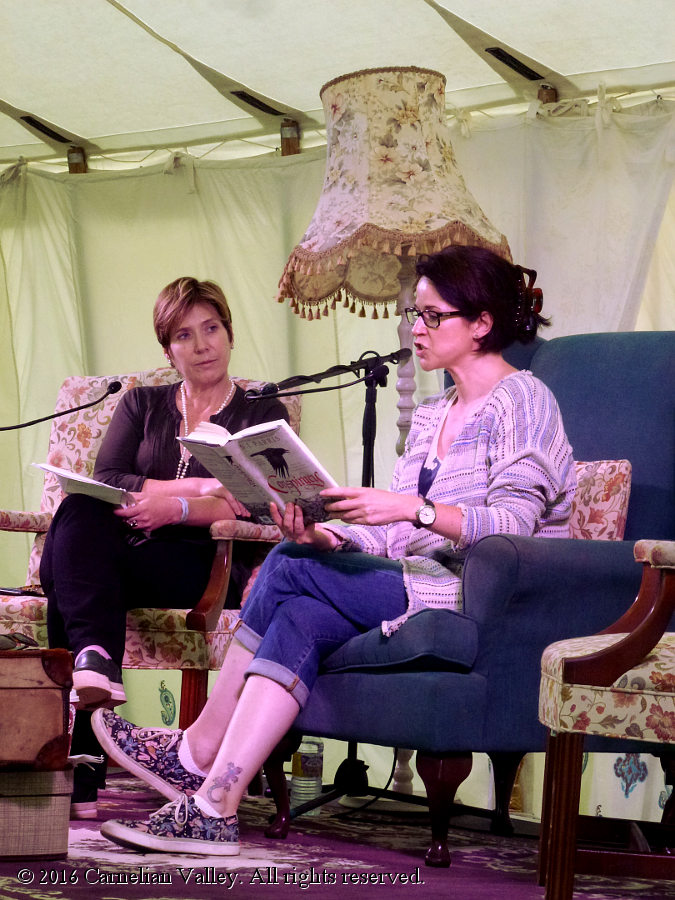
Someone once advised S J Parris to have a day job whilst writing otherwise by her third book she’d be writing about writing a book as that would be her only experience.
Parris – AKA Stephanie Merritt – spoke about character Bruno. In true life, in medieval times, he was asking questions of the Catholic church that they didn’t like. He’s celebrated now as a pioneer of free thought; he was the first person to suggest the universe is infinite. He questioned the divinity of Christ. That he is a spy in her books is down to artistic license – historians think it unlikely in reality. She spoke of word disparity – no one knew about ‘paranoid’ or ‘hysterical’ until the 19th century, so if you need to use the idea you have to find another way to say it.
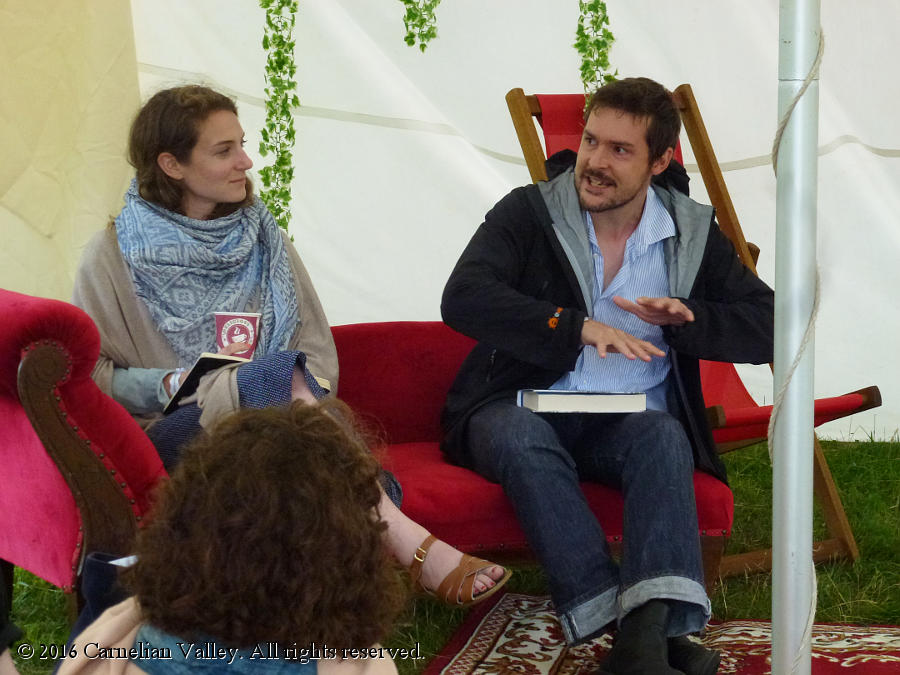
Lastly, here are a few notes from Dan Richards’ discussion with Carrie Plitt. Richards’ talk about his book, Climbing Days, was compelling and very funny, and I wanted to stay ‘present’ and not distract with scribbling – we were a small group. (The book is a biography/climbing/history mash-up – it’s about the writer’s great-great-aunt Dorothy’s life as a mountaineer in the early 20th century and his journey to find out about her and follow in her footsteps. It’s my current read and I highly recommend it.)
- As an Edwardian lady, Dorothy had to get her brothers to learn to climb, so she would be able to go climbing herself. She left them far behind on trails because they weren’t really suited to it.
- When climbing together, Richards’ dad decided to jettison the heaviest items in their pack, which the writer later realised was the food; so they ate soup with snow, a small bit of chocolate, and a bag of prunes that had survived the jettisoning.
- Richards and his dad were not prepared for the realities of the climb. The writer said that there’s nothing more shameful than almost killing someone because you do something you shouldn’t be doing… like climbing, for example. You need the right insurance for a helicopter or you won’t get one when you need it.

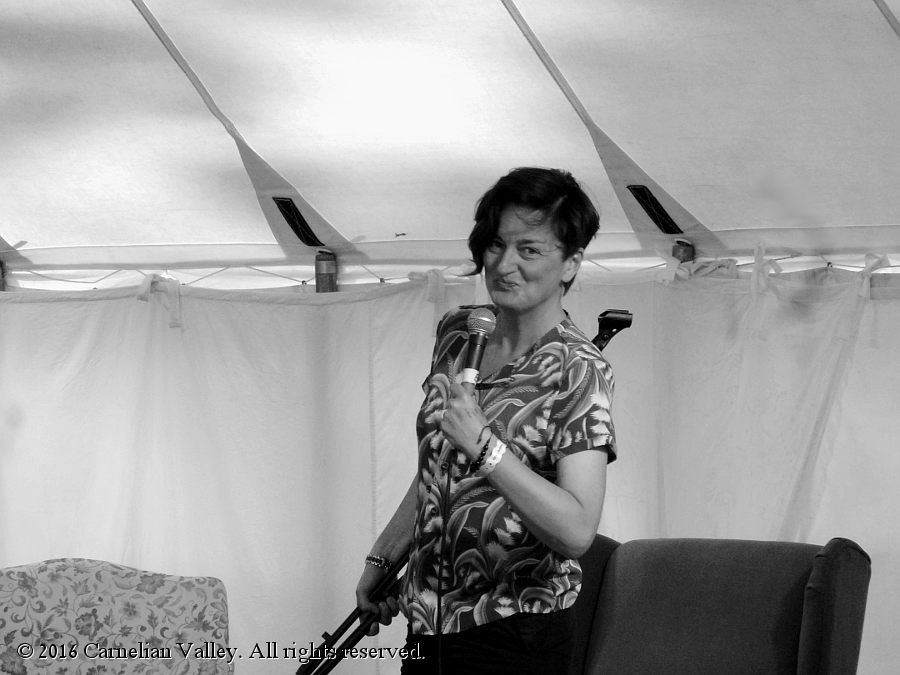
For music, amongst others there was Lucy Rose, as said, and Jake Issac, who was amazing. On the comedy front, amongst others, there was Chris Martin – yes, someone asked if he was from Coldplay – and Zoe Lyons. A lot of laughter was had.
My thanks to Kate for inviting me, also the team at the box office, the wonderful people working at the Waterstones tent, the Tea Sympathy tent, the Higgidy pie van, and the people who very kindly offered me a lift up the road on a swelteringly hot day.
The rest of my photos: