





On Reading And The Voice In Your Head
Posted 19th September 2012
Category: Chit-Chat Genres: N/A
6 Comments
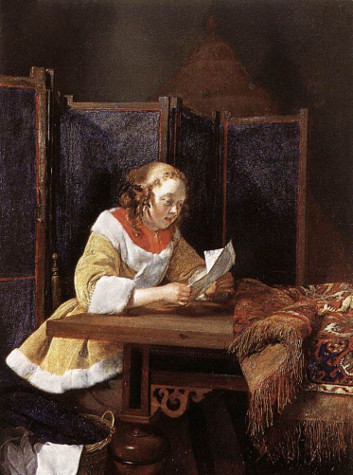
When you read a book to yourself, do you hear a voice reading to you as though you were listening to an audiobook? As someone who does hear a voice, this is a subject I’ve pondered for a long time. And when I say long time I mean since I was a child. Yes, it’s ridiculous – I’ve never thought to ask anyone before. But I am assuming that most if not all people read via this voice, because I cannot comprehend reading without it, there would literally be no comprehension. So today I am taking the stance that everyone hears a voice, reads with a voice, in order to write this post.
When you read, is the voice you hear your own or another? Often, if I’ve watched the TV adaptation, I find the narrator reading the book for me. Every now and then the actors will take over during dialogues, though this really is rare. It is generally a case of a narrator, if there was one, reading the entire book to me, or one particular actor reading it all. I don’t tend to get to choose the actor, which occasionally leads to unsavoury characters getting more of a look in than they should. Thankfully whichever voice “reads” the book to me doesn’t effect my enjoyment of the text.
But if it’s not your voice and it’s not a narrator’s then whose it is? I can’t say the voice I hear is my own, and whilst without the influence of media it is generally the same one (I think – I can’t say I’ve conducted a survey) it does change sometimes. I have wondered if perhaps it is an idealised voice – my voice altered – or that there may be some sort of supernatural occurrence going on. I hope it’s the former rather than the latter.
So when the voice changes per book it tends to fit the gender of the author and how I picture them as sounding. If I’ve seen a photograph of them that will inevitably come into play, and certainly if I have met the author they will be the one reading the book to me, no question. Both of these elements can make the book better, especially in the case of having met the author. I believe the reasons why are obvious and known to every reader, but as an example I have attended lectures by Richard Rex, a rather quirky historian with a marvellous intellect and funny to boot. Hearing his voice read his book to me definitely helped me to enjoy it further because I could comprehend the text from a more familiar angle.
Why does this happen – why do I, we, hear a voice in our heads when we read? Is it because of my theory that we wouldn’t be able to comprehend the text otherwise, and if this is so what do readers who are deaf from birth do? Is there anyone who doesn’t read with a voice in their head?
For all I know, at this rate I could be the next Ana Steele…
On The Gender Of Authors And Their Characters
Posted 12th September 2012
Category: Chit-Chat Genres: N/A
13 Comments

I am beginning to suppose, in both a sort of acceptance way and a full-understanding way, that I seem to have an issue with males where books are concerned. This does not alarm me, since it is less than the idea of the stereotypical male reader who will not read a book written by a woman, but it does give me a lot to think about.
I fully admit that I am more likely to be intrigued to pick up a book if the author is female. It’s something I’ve realised on thinking about how I browse bookshops and I reckon it’s a question of relating. I know I am (statistically) more likely to relate to a book written by a women because I am a woman. No matter whether the female author’s main character is female, or male, I will read the book. But I am also likely to pick up a book written by a man if the main character is female. This is because on most occasions my experience of men writing about women has been positive, although I have witnessed some atrocities. That said, I know I am going to be less aware if a female author writes poorly of a male character because of course I am female and while I can assess much, I do not have a man’s brain.
If I have read and liked a book about a woman written by a male author, I will likely pick up a book by that same author about a male character. This being because I know that that author has already shown he is okay with women, that he relates to me, that he accepts female readers. To put this in author terms, I will happily read anything Philip Pullman writes because by and large he writes female characters that I can relate to. And while I did not always appreciate Simon Montefiore’s handling of the sexuality of his female lead in Sashenka, I like that Montefiore at least made a good attempt and thus I would likely pick up another book written by him.
So this boils down to male author plus male character. Do I read many of them? No. I do have a few favourites, for example I love Roald Dahl’s books, and while David Eddings’s work may not be flawless, I like his too. But I will be less likely to pick them up than, say, Jane Austen, a female who writes well about women.
In fact it is Victorian literature that made me chew this subject over in a detailed way. I had just started my first Dickens’, Great Expectations, and while I liked the story, Pip was getting on my nerves and so was the author. Part of this was due to Pip’s age at the time and his way of discussing the world, but I also found Dickens’ writing completely different to the Brontës, Gaskell, and Austen in ways I hadn’t prepared for.
Interestingly, none of what I’ve said above applies to my approach to non-fiction. Where non-fiction is concerned the gender of the author and their subject is of no consequence to whether or not I will pick the book up. I can only assume it is due to the oft-academic writing style employed by all.
It’s odd, I think, that I’ve only just started to notice this, and I don’t think that I have always been like it. I wondered if it was weird but I suppose it’s understandable.
Is there a difference in the number of books you read per gender?
In case you’re wondering, I did check if Branwell Brontë had written a book before using the image, and he had so hopefully it’s acceptable…
On Tweeting Your Review To The Author
Posted 31st August 2012
Category: Chit-Chat Genres: N/A
6 Comments
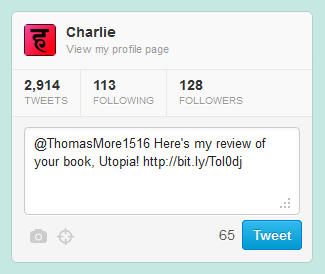
What actions do you take after posting up a review you’ve written? You likely promote it in some way, putting up a link on Twitter, posting it on Facebook. As bloggers, when we take time to write an article we tend to want to let people know about our creation. But how far do we take that notion of telling, and does the notion extend to the writer of the work you are citing?
Sending a review of a book it the author who wrote the book is a topic that has been discussed before, but the recent contention over paid reviews brings it to the fore again. It disputes that other oft-discussed topic of whom reviews are for. Because if reviews are for readers then we ought to keep them between ourselves and other readers, bloggers, but if the authors are requesting reviews, paid or not, then mightn’t our work be of interest to them? Online news tell us that authors ignore reviews, but in my experience there are many who appreciate knowing that people are reading and writing about their work.
So if reviews are still written for readers then we shouldn’t be sending them to authors – but what about the author who finds your review all by themselves? I am a fan of Elizabeth Chadwick, and once when I posted a glowing review I awoke the next morning to find she had tweeted the it to her followers. This before I had even promoted it myself. Somehow she had found my review, which had been posted only a couple of hours earlier, and remarked upon it. In this case the choice of letting her know had been taken from me, but it’s not as though I can be upset; my blog is public. It make me ponder, however, on the next review I wrote of her books – I always strive to be honest to my readers and if she’d found my reviews in the past what was to say she wouldn’t see my next, more critical, review? Considering I decided to post it, maybe she did.
This episode makes me think of a direct consequence of intentionally letting an author know about your work. If you tweet them a positive review, what do you do about any negative ones in future? My personal jury is out on this one.
In regards to negative reviews I am fully of the conviction that one ought not to send them to the author unless the author has explicitly asked (more on that later) to be notified of your opinion. If I decide to tweet the review to the author that review must first undergo a vigorous quality test – quality test as opposed to an edit or re-write because I never change my words to suit an author. A tweeted review to an author must be of a high rating, 4/5 or above, and in addition I will invalidate any piece of writing that contains harsh criticism. There is just no need to send negative or overly critical material to an author who is otherwise oblivious to your existence. All you would achieve is upset.
But what do you do if it was the author themselves who commissioned your review? You really don’t have much choice in this situation besides declining to review or lying (in the case that you didn’t like the book). Declining the review after accepting the work tells the author you didn’t like it, even if it is the lesser of two evils. And lying won’t get you very far with your readers. If the author has requested the review they must be prepared for possible negativity.
Lastly, is such contact between an author and a blogger appropriate? This question coincides with the content of my post on bloggers commenting on author blogs – is tweeting a review and initiating contact in such a way too familiar, forcibly friendly? Indeed if we take to heart the words of the authors who do not like to read reviews, ought we to be seen but not heard?
We are unlikely to come to a common consensus on this subject unless authors everywhere unite to give us a verdict as surely the more appropriate opinion is theirs, the ball should be in their court. Therefore in absence of this I believe that each blogger needs the freedom to create their own rules and boundaries, this post is simply a discussion. As for myself I appreciate the freedom to decide if I even want to consider promotion in the first place.
So it’s over to you – do you tweet authors your reviews, and what’s your reasoning behind your decision?
On Rating Books And Changing Hearts
Posted 27th August 2012
Category: Chit-Chat Genres: N/A
7 Comments

There is and has been a great deal of discussion concerning how we rate books in relation to our opinion. Many people advocate it, many suggest steering clear, and many others say one should do as they will. I’m personally of that third group, seeing the benefits to both options and preferring to keep ratings myself because it helps me to sum up what I thought. But recently I’ve started questioning my impartiality.
I have on occasion looked back at the lists of books I’ve read in previous years and wonder if I wasn’t a little too harsh in my meting out a 2/5 to this particular book, or a little too generous in my gifting a 5/5 to another. Maybe at the time of writing the review, I felt undecided. This is a feeling I know most readers have and is often a reason for dispensing with ratings altogether. It makes sense – why rate a book if you’re not completely sure you’ve made the right decision? In this case I end up feeling bad, no matter which way I rated, and this feeling can last a while.
But what about those times when you look back, knowing why you gave it the rating you did, but it no longer aligns with your thoughts? You know why you gave that rating, perhaps you felt a particular awe for the story because it fit a topic you were studying, it suited your mood, or, at the other end of the scale, someone had told you about an undesirable trait of the author and this clouded your opinion. These are all acceptable and accepted happenings, but on looking back you realise how much those facts altered the rating you assigned to the book. And now, because you’re no longer studying you can see where you were biased, and so on.
In those situations, which in my experience cropped up a lot in my first year of blogging before I worked out a reviewing routine, we can change the ratings. We can say “I messed up” and edit our blog post, or we can leave it and say “I leave it because tthe rating is an appropriate reflection of how I felt at the time”. These are the choices we have, along with the decision to drop ratings from our system in future.
But there is something I think it’s important to consider and that is that ratings can show how we’ve changed as a person, as a reader. If we read a classic as a child and don’t understand it, we would say we hated it. If we later re-read it, knowing the author’s background and the context of the story, and having obtained knowledge of society at that time, we will say that we now enjoy it and can appreciate it. This is an extreme example perhaps, but the one most widely known. And whilst a review itself, in all it’s wordy glory, can tell us the same, it’s not as raw as a rating.
In the case of a child reading a classic we have changed from someone who knew nothing about, say, the Victorians, to someone who could hold their own during a detailed conversation. Just as a change in the genre we read suggests a change of person, so does a difference in rating later on. This is another, greater, reason why I keep ratings, because I like to see the change. I like to note events such as my awed 5/5 given to what I now see is a very flawed biased book (no link to a review because this has been the case on many occasions). And I like to see that when I gave Harry Potter And The Philosopher’s Stone a lot of love years ago, I do the same still, but my love today is due to the fact that it is well-written and a good children’s book rather than that the story is fantastic.
So which rating do we trust, the one of weeks passed or of our bright shiny today? Both are surely as important and trust-worthy as each other as long as contexts are applied. My specular rating of a book I now see as bad will help a teenager who is looking for the same things I was then, but my newer rating will help someone who is in the same place I am currently in. And whilst my good rating of a now-considered-bad non-fiction will help a student not make the mistake I did and not consume falsehood thinking it factual, it may aid them in creating the other side of the argument.
There are so many reasons ratings are worthwhile, and I think that as long as we remember that they aren’t the be all and end all, they deserve to be given as much consideration as the idea of not rating.
What are your thoughts on ratings – do you use them? Why/why not?
On Requiring Certain Moods, Seasons, And States In Order To Read Books
Posted 22nd August 2012
Category: Chit-Chat Genres: N/A
4 Comments
Jennifer, from Books Personally, made a statement in her comment on my post about reading a book in a day; it got me thinking. She said:
Some books need more time or more particular moods…
I have realised that on occasion there have been books that I’ve not enjoyed and not understood why that was so until I factored in how I was feeling at the time. An example of this, though extreme, is Austen’s Persuasion. I admit – I dislike the book and find nothing interesting in its contents – but is this a true reflection of how I feel or is it just simply a reflection of the fact that I was ill when I read it? Indeed since reading it I have been conscious to put off reading books when ill, and this was a decision I made long before I realised the possible truth of my feelings towards Persuasion.
I love Pride And Prejudice, but then I read it during a beautiful summer, and as I’m a summer person I was inevitably happy anyway. It would’ve taken a really wretched book to knock me down.
My thinking continued. There will always be a personal bias in our feelings towards a book, that’s unavoidable, we’re all individuals with different backgrounds, education, interests, and values – but how often do we acknowledge that part of our bias is due to the mood we were in when we read it? As much as we might say, “oh but I was having a bad day when I read it” do we truly realise the effect mood has on us? Just like age, “I would’ve liked this book more as a teenager”, our mood charges us as readers. It makes coming to an objective conclusion nigh on impossible.
And we can’t do anything about it, we are always going to have changing moods and we can’t really leave all our reading until we are in one particular mood. That mood would have to conform to so many restrictions in order to be viable that we’d have no time given to reading at all because of the short time available.
Some books absolutely require certain moods or situations, such as books that are set during the winter – it’s rather hard sometimes to fully appreciate a book about snow when you’re sitting in the sunshine. This is a factor that makes publication timing important, for example how many of us in Britain would have liked The Snow Child so much if it hadn’t been released while we were in the midst of a grotty late winter and longing for sheet of snow? The book was everything we want for winter but rarely get – apart from the fantasy, the book was a dream in itself.
Perhaps it depends on whether you’re a winter or summer person, but I’d say it’s easier and more likely for a book to find success if it preaches sunshine whilst you’re huddled in blankets.
And if we read books that are set in the same mood and season we’re currently living, we’re going to find it easier to relate to the story and what the characters are going through. Would I have appreciated Skipping A Beat as much as I did if I hadn’t just had a life-changing experience, as had Michael? And would I have been less impressed by the way E L James finally took a short detour into emotional depth in Fifty Shades Of Grey if I myself hadn’t once been an inexperienced girl dealing with an experienced boy? I didn’t die and come back to life as Michael did, and my boyfriend isn’t a troubled sexual dominant like Christian, but nevertheless there was enough there to make each book strike a chord in some way, for me to “get it”, even if those feelings did not last very long.
This leads on to another point – some books, particularly sad ones, aren’t a good choice of reading material if you’re unhappy, or if you’re happy but susceptible at the time to influence. Reading a sad book when you’re happy can make your day bad, and a sad book will make a bad day worse. Maybe reading a happy book when you are sad can help you feel better, but depending on the reason you are sad, it might just make you angry, jealous, or simply more upset – for example you don’t really want to be reading a book about a person who is having a successful academic career when you’ve just been rejected from your first choice of university.
And in the way explained above, a book can make you go back on yourself in terms of emotional development. If, for example, you’ve been happy with your partner this week but they’ve cheated on you in the past, reading a book that includes an affair will likely put you on your guard and make you less open to loving them. In this particular case you could argue for both cases – the book reminding you that they could hurt you again, and the book being an unnecessary reminder, but the fact would remain that if it weren’t for the book you would have continued feeling happy. A book can change your mood and feelings in such a way that it affects your life. And while books are noted for affecting lives, this sort of affect isn’t what tends to be promoted.
You should never read a sad book when the theme mirrors something you’re going through unless it’s clear that the story will be an aid, like a genuinely positive self-help book. This doesn’t really need an explanation, as it’s something everyone knows, but sometimes we don’t act on it. Unfortunately, of course, there are books where everything seems to be going in one direction before swiftly changing course, so it’s inevitable that sometimes we will have to put a book aside for later. You don’t want to make yourself feel worse or to give you more ideas to worry about.
It may not be a constant issue but we surely do need to watch what we are reading when the world isn’t going our way – more than we need to be careful in the reverse. Reading has the ability to affect us in ways that may not be apparent from the start and we must adapt our routine and choices accordingly. It’s not a particularly awful thing to read a book that isn’t suited to our current mood, when our mood is less extreme, but it certainly helps our comprehension and appreciation to keep a book back for the right time.
Do you put restrictions on what and when you read?


