






Guest Post: The Social Reader
Posted 26th November 2012
Category: Chit-Chat Genres: N/A
9 Comments
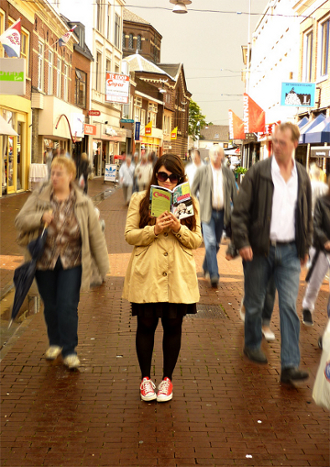
Editor’s note: this photograph was taken by Janna.
“Alice, stop reading you are here to see us.”
I had always thought of reading as a sociable activity; I read a lot, I love to discuss what I have read and this in turn encourages me to be social so I can have said discussions. Only recently have I realised other people do not always see reading this way, for the non-reader being in a room with people stuck in a book is not a sociable experience. Sometimes I am so preoccupied with a book, or who I want to discuss it with, that I forget people who do not enjoy reading as I do want to stop being so rude and acknowledge that they are there. To those people reading is not a sociable activity, and I can understand why.
For non-addicted readers, reading is a solitary pursuit, for spare time; for the addicted reader, however, reading is something everything else must work around. Reading gives me the rush of adrenaline others get from exercise, my brain goes into overload over a good book. Thus, reading must have a percentage of solitary and sociability to it, subjectively I would say my percentage would be 30% solitary to 70% sociable (my friends and family may disagree).
While I enjoy going home to read, I believe the following aspects of my reading allow the social side more time than the solitary: book groups, group reading, discussion, debates and blogging. The discussion of books with friends, book groups and bloggers brings reading out of the private and into the public. I spend as much time blogging and reading other blogs as I do reading books, I enjoy that differing of opinions you can only get via discussion.
This attitude to reading would be beneficial in getting others to read, primarily children. When I learnt to read at school there were reading levels; we took books home, read them and then swapped them for the next. There was no discussion about what we had read, we were just improving a skill necessary for life. I was not a great reader as a child; my schooling failed me as a young reader in neglecting to encourage discussion and teaching me that reading can be social. It is beneficial to engage children in reading activities beyond making it a dull homework. Now I am sure this is dependent on teacher’s time and parental involvement, but I enjoy the sentiment of the idea.
Googling the social side of reading, I came across this interesting article on the subject by William Flesch [article no longer exists]; he argues that merely by being the audience and engaging in the author’s work you are socially engaging. There is an interest in how we respond; though as readers we are all separate, we know that as we read a book others are too, and we perceive how they are enjoying the book and how they perceive we enjoy it. In being solitary we are also being social.
“The audience experience that I imagine, that I imitate, that I adopt, that I internalize, that I have is, at its most intense, and perhaps at its most most basic default-level, one of a solitary pleasure. Which means, I think, that solitude too (the good version of solitude offered by reading) is a social experience, and that social experience too contains solitude within it. I can learn and have learned from others – through imitation of them and through imitation of what they’ve loved – how to love the works I love. And a component of that solitary love is a desire to express it to others, to share it, to encourage or beg or demand or plead with them to experience it for themselves: read this, or watch this, it’s just so amazingly great.”
Do you get annoyed when people tell you you are rude for reading around them? Do you feel reading is more solitary than social? I would like to get your opinions.

This post was written by Alice, a blogger of mostly literary and classical fiction who never fails to present her readers with some brilliant arguments and discussion points, combined with a personal flare that combines the subjective and objective. She writes at Of Books, and tweets at @nomoreparades
On Book Reviews And The Comment Factor
Posted 19th November 2012
Category: Chit-Chat Genres: N/A
14 Comments

Last week on Twitter, Trish, Literary Feline, Just A Bookworm, and I, briefly discussed the difference in comment numbers when writing a review of an older book versus a review of an ARC. You can view Literary Feline’s opener here if you so wish. There was a balance between our answers, but it got me thinking, especially as Bookworm had begun the discussion by remarking on her surprise in finding that some blogs only review ARCs.
The comments factor is something I’ve been interested in from an statistics perspective for a while. The “data” available suggests the obvious – people are more likely to comment on a review of a book they know.
But that doesn’t provide a conclusion entirely, because there is a gap, if you like, between books that are known. In other words, if we put books into categories, we’re likely to find that people are most likely to respond in extremes – classical literature which everyone has heard of and possibly read will get many comments, as will ARCs that are doing the rounds. There is of course a place for modern classics, such as Harry Potter.
It makes sense that considering so many books are published each year, unless you’ve chosen a best-seller, less people will have read it. And if they haven’t heard of it they’re less likely to comment because they won’t know what to say – unless, perhaps, there is a grand hook in the review that enables a theme to be exploited by discussion. In general we tend to prefer to only comment if we’ve something valuable to say.
This obviously leads to my own experience, which aligns with the above. If you want to review a book at the optimum time, if there is such a thing, you have to take into account the book’s age, fame, if your readers have read it, and possibly also the day of the week.
And I think for those of us who like posting about both ARCs and older books, this method will elude us somewhat because of our more varied audience. A person who reviews only ARCs and even more so a specific genre of book is far more likely to have a good response across the board. Same as someone who solely discusses Victorian literature, for example. Of course if you have readers who comment on everything you write it’s of no consequence, but I think most of us, when reading blogs, tend to choose the posts that most interest us on any particular day because we have lives outside of blogging that need time, too.
What have you found – do you get more comments on older or newer books? And what “sort” of book reviews do you comment on the most? Indeed do you avoid some reviews altogether?
The inspiration behind the photograph: The Black Count (the brand new book) takes on Brilliance Of The Moon (an older book) but both are literally trumped in their battle by I Capture The Castle – a classic.
Reading: Cause And Effect
Posted 12th November 2012
Category: Chit-Chat Genres: N/A
5 Comments

This photograph was taken by Andy.
It’s amazing sometimes what reading causes you to do. The book I was reading when I wrote this was Paradox by Jim Al-Khalili. Whilst the book has its fair share of issues, it has reminded me of the interest I have in astronomy.
I’ve always said that I’m not particularly interested in science, but that is in fact a bit of a lie. There is something about physics that enchants me; by the time, “in my day”, you first encountered the planets in school at the age of 11, I had already spent the most part of my primary education waiting for that couple of weeks when I would learn about the universe. Because for some reason it didn’t occur to me that I could just take a book from the library and learn about it sooner.
But I digress. Paradox induced in me a very strong need to see in person the stars Al-Khalili was discussing, to see the edge of the galaxy he spoke about being visible at night, to witness the International Space Station as it flies past the earth (or does it? Indeed aren’t we flying past the station?) Where the station is concerned I realised I’ve already seen it, it’s one of those objects that people come running inside to get you to have a look at because they think aliens are arriving. But the stars I hadn’t seen, nor the edge of the galaxy. And I felt left out.
But as Al-Khalili suggests, being someone living in an urban landscape, I wasn’t going to see them any time soon. So like any sane person I got my boyfriend in on the idea and we went out that very weekend to star gaze without a telescope at midnight of the full moon, when seeing the sky wasn’t particularly likely no matter how far away from humanity you were prepared to travel.
Suffice to say we didn’t see the edge of the galaxy. But what we did sight was something pretty amazing in itself. When you see a bright light shining in the sky, brighter than all others, you expect it to be a well-known star. You don’t expect it to be Jupiter. What is incredible is that whatever you see in the sky that’s not in visible motion isn’t actually there; the light you are seeing is the light that has taken a long time to reach earth, meaning that the actual planet/star has since moved on. We will never see the real thing, only ever history. Al-Khalili reminded me of that, too. I won’t mention the fact that when we got back Jupiter was bright enough to see outside of my building anyway so the good use of all that petrol is debatable.
On a wet, freezing night, when the clocks were going back and the radio was full of bad remixes, I took to the road because of a book. I learned something and put it into practise.
When was the last time you took action because of a book, and what was it you did?
Edited to add: if you’re in the northern hemisphere, as long as it’s a clear night, you should be able to spot Jupiter. It’s the brightest “star” in the sky right now.
The Unfortunate Downside To Free Ebooks (The Ilona Andrews Incident)
Posted 31st October 2012
Category: Chit-Chat Genres: N/A
7 Comments

Yesterday, a tweet circulated widely about an ebook that was stolen – certified as such by the writers who go by the pseudonym of Ilona Andrews. The couple (who from now on I’ll be calling Andrews), had posted the ebook, Questing Beast, to their website, allowing readers to download it for free. This very gracious action was thus taken advantage of.
At first glance, this was a stupid advantage to take. A free ebook placed on Amazon by a third-party for a sum (no longer available since Amazon appears to have since acted, albeit a month later) was not likely to get very far in this age where news travels at literal broadband speeds. The sort of profiting potential, capitalising on something free, would have been stopped eventually, perhaps even more so because Andrews has a fair following and because it was given freely by them. Because readers in general are a pretty loyal bunch; the word was bound to be shared amongst anyone who found out about it.
Yet it managed to go on for a month, if Amazon’s product details are to be believed – and I’d say they are – which raises the question of just how much money was made from this venture (the book was listed for $6). You could say that Andrews can’t claim a literal profit loss, because it was put on their site for free; but they would be affected in the way that, for example, a reader could have downloaded the book from Amazon, not realised it was free elsewhere, and felt duped when they later found out. Most would likely see the error, but if a reader isn’t familiar with the authors – doesn’t read their blog, doesn’t know who the correct publisher is – it could result in a loss of further interest. And of course there is the issue of copyright.
You just don’t expect it to happen. In fact what Andrews was doing is the sort of thing marketers seek to get their company clients to do – offer your products for free and you will create a loyal following. The authors were, to use a colloquial term, onto a good thing. Of course the happy irony is that now they will likely see a surge in readers across all of their titles. Something good has come from something bad, but it’s a pity it had to happen as it did, even if the long-term value is positive.
This episode highlights just how careful you have to be when you make a digital purchase. In thinking about stolen content being about getting something for free, we neglect the fact that the opposite exists.
If you’re interesting in reading a bona fide copy of the Andrews’ work, go to their site
Subscribe to this site via email and you’ll receive 3 posts a week. If you use Gmail, you may find the posts are stored in your ‘social’ or ‘promotions’ tab.
Information About Twitter And Blogging Gleaned From My Schedule
Posted 29th October 2012
Category: Chit-Chat Genres: N/A
9 Comments
I thought I’d share with you some of the information I’ve learned since altering my posting schedule, as well as what I’ve learned through using Twitter. It’s nothing particularly compelling, and I’d say most of it you already know it, but there may be people who could benefit, and if nothing else I thought it might make for a good discussion. I’d love to provide you with pie charts and throw around words like “statistics”, “data”, and “analysis”, because despite that fact I’m no good at mathematics I find such things immensely interesting, but none of my observations fit that sort of structure and my information is just written down on paper as bullet points.
My new posting schedule of Monday, Wednesday, and Friday, has allowed me to really gauge the times when more people are about online. I suppose it goes without saying that posting as I did previously, every three days (which made for a strange two-week schedule I’m not proud of) didn’t allow me to discover anything, but as often happens to the self, I didn’t realise it would happen at the time.
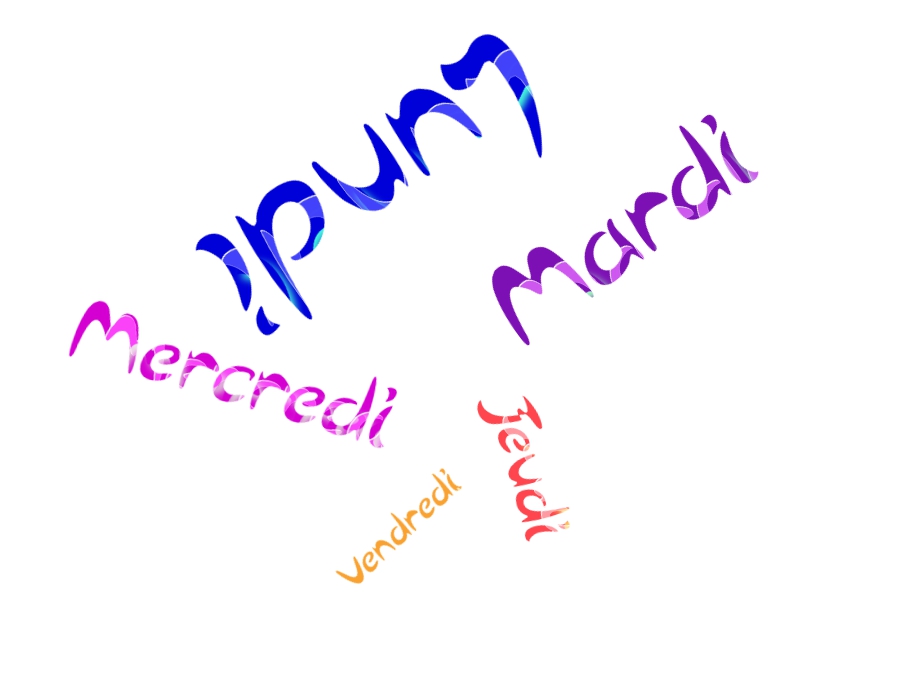
So what has my posting schedule found? For the most part people are about a lot on Monday, less so on Wednesday, and not around much at all on Friday. This means that more people are around on Tuesday than they are Thursday. Of course this is not true of every week, and there have been occasions when I expect all of us have opened Twitter on a Monday to a silent reception, and on Friday to a mass of discussion. What is interesting, I think, if we consider the more-often case of Monday being the most busy day, is just that: why Monday? I find it interesting that it is this, the first day of the work week, that contains the discussion whilst Friday, the last day, is relatively quiet. I suppose I think that on Monday people will be feeling less motivated and also too busy to tweet, whereas on Friday they are looking forward to the weekend and feel emboldened by this fact to sneak online more than they would the rest of the week. Yet Monday rules. Does this mean that actually people need to psyche themselves into working by talking to others whilst on Friday they think “I might as well leave it until tomorrow, it’s the weekend then”? I’d be interested in hearing your thoughts on this one because I find it fascinating. It’s also interesting that the Twitter accounts of publishers and editors – people who are being paid to be on Twitter – often follow this routine too, despite their approach being different and their work place actually advocating use of social media during work hours.
As a British blogger I’ve learned that scheduling my posts for the early morning is better than posting in the evening. By early morning I mean 1am. I chose this time originally to fit in with Australia – I wanted a time that fit my location so that the date my posts are assigned correlate to my calender, but wanted the post to go live at a time that fit internationally. 1am GMT/BST roughly fits in with Australian lunchtime, as well as late afternoon/early evening throughout America, the two regions at the extreme ends of the time zones. And it means that my posts are there ready for when Britons wake up for breakfast (more on that in a moment). Posting in the evening, British time, means that a lot of people will only see the post the next day, and in my experience you’re a lot less likely to read a post from yesterday when there are newer ones available. This is partly why I don’t post everyday, because I know how easy it is to just select the newest when there are a couple or more available. Whilst a lot of the content us book bloggers produce is “evergreen” and relevant for a very long time, as the basic audience of each other’s blogs we haven’t time to go through all of it.

In regards to the British breakfast, I’ve found that a great many people are online early in the morning, before work. This makes sense, but this time, around 7am, is good across the board. Yet once America is awake, unless you follow mostly Americans the overall usage of Twitter dies down, sometimes until the next day. Indeed it seems the best time to be on Twitter is 3am British time – afternoon in Australia, evening in America. We’re not best placed for interaction with the majority of our fellow English-as-first-language speakers. I find that peak time is from about 2am-12pm British time, which is a bit of a disadvantage during the work week when you don’t want to stay up too late.
So there you have it, not particularly new information with not particularly interesting analysis (I had to sneak one of those words in somewhere). If you’d like to know how I’ve applied it to my blogging, here it is: post what I consider the best of the posts I’ve lined up for the week on Monday, and then second best and third accordingly. But don’t not let people know about Friday’s post because you may find that particular Friday to be a buzz. And considering it’s the weekend next, people may also read it then. Though don’t rely on weekends because people like to relax.
What have you learned about social media usage and posting from your experience as a blogger?


