




5 Tips For The Travelsick Reader
Posted 7th January 2013
Category: Chit-Chat Genres: N/A
10 Comments

I’ve struggled with travel sickness all my life. I discovered it the first time I got into a car, around the age of 7, and indeed it tends to happen only in cars, especially when reading. (Incidentally the uncle whose expensive car it was is no longer my uncle, maybe there’s a connection.) It’s partly why I would prefer the train if it weren’t so expensive; I’m one of those people who isn’t happy just to sit and do nothing with my time. I like to always be doing something. And whilst I can read on a train, I can’t in the car.
Not being able to read in the car isn’t such a bad thing when you’re a child and have siblings, because your parents are likely to put some fun music on or everyone will play “I Spy”, but long car journeys take up a lot of time and as I’ve got older I’ve really become irritated at the fact that when I’m in the passenger seat, and the driver wants to concentrate on the road, I’ve nothing to do. And I think of the many, many hours I could have been reading.
Like, I expect, most of you who get travel sick, I’ve spent time trying to combat it. And I’ve found the following:
- Sit below the window. In other words, slouch in your seat as much as you can. This will cause backache after a while, but I’ve found that if I can’t see out of the windows, I can read for a little longer without feeling nauseous – and the backache takes longer to occur than the sickness.
- Don’t look outside. This may seem obvious, and it is, I suppose, but the fact is that it’s difficult not to look. The landscape flashes by in the corner of your eye, adding to the motion. If you can find some way to do it, it can help, though not as much as completely shutting the outside out as slouching does. If you can take a large hardback book with you and hide your face in it. You might look obsessed and anti-social, but it will help shield your eyes.
- Read in bits. Read half a page or whatever you can until you start to feel even minutely car sick, and then put the book down until you’re better. Rinse and repeat. It won’t get you far but you’ll get some reading done.
- Listen to your books. Audio books are aural rather than a visual focus exercise, and as it’s difficult to become travel sick simply by having a conversation, audio books work well. It also means the driver can listen to, making reading a truly social activity.
- Use the train whenever you can. Except if you’re in the UK, because it’s particularly expensive.
I’m loathed to admit that none of these tips will create a revolution, but the fact is that unless you want to take pills or put those weird wristbands on (have they ever worked for anyone, anyway?) there’s nothing else you can really do.
Are you able to read while travelling? Have you any tips for the travel sick reader?
A heads up for those of you who were interested in Sleeping Patterns (it made both of my 2012 best of lists) – the Kindle version is currently 99p.
2013 Goals
Posted 4th January 2013
Category: Chit-Chat Genres: N/A
8 Comments

This photograph was taken by Jake Wasdin.
Last year I did pretty well but not nearly as well as I’d hoped. However I suppose I always knew that would be the case, as I think a lot of us do of our reading goals. So this year, to combat it, I am making fewer goals.
Something that I decided to take part in order to actually get books read, is Ana and Iris’s Long-Awaited Reads Month, which is this month, January; I’ll be adding the books that are dusty on my shelves to my overall goals list. The challenge may be for January, but I’m going to use it throughout the year as well.
It won’t surprise you that I’m carrying on my classics plan from last year, especially as I’ve now joined The Classics Club. In particular I want to read The Canterbury Tales, Machiavelli’s The Prince, but also from last year’s goals I want to read Anne Brontë’s work and Frances Burney’s Cecilia. And I want to read more Dickens and make a start on Wilkie Collins.
When I looked back at the books I read in 2012, I was surprised to see I had completed my goal of reading more work by Elizabeth Chadwick. I had never set a number of books to read, but am happy with the three I got through: The Marsh King’s Daughter, The Greatest Knight, and The Champion. I want to continue reading Chadwick’s work this year.
So:
- Books I’ve had for a while: Shogun, Suite Française, The Last Empress, Shanghai Girls, The Luminous Life Of Lilly Aphrodite.
- The Canterbury Tales and The Prince (medieval works are lacking in my life).
- Anne Brontë.
- Cecilia.
- More Dickens, Wilkie Collins.
- More Elizabeth Chadwick.
A much easier list than last year, I’d say, and with room to move.
On Responding To Questions About Charging For Reviews
Posted 10th December 2012
Category: Chit-Chat Genres: N/A
16 Comments

As I currently live with my parents, I’ve found it useful to let them know when I’m due to receive book parcels. Our postman has a habit of ringing the door bell and rushing off with the mail if we don’t arrive at light speed, so in the case that I am not around and my parents are, they’ll know there’s a chance it’ll be him. It works both ways, with me on the look out for anything my parents are waiting for, and between us we’ve managed to catch the postman on most occasions for the last month or so.
Yesterday I told my mother about a couple of books I was expecting, and she responded by asking, for the first time I must add, whether I shouldn’t be charging for reviews. I said, “that’s just not what we do”. I didn’t think it would be a good enough answer, but for now, at least, she’s happy with it. Trish told me that in those situations, she answers similarly.
The reason I was surprised that such a response placated my mother was that the response brings into the fray the book blogging community – “that’s just not what we do”. And often when you bring in a community that your relative or friend does not belong to, your answer is either not good enough or it creates a need in the questioner to ask further whys and wherefores. Referring to blogger morals in such a way is ambiguous, because there is no reasoning applied to it, but because it would take a whole new conversation to explain the past, present, and future of book blogging, ambiguity will have to suffice.
Nevertheless, as much as it’s true to say that that is just not what we do, it’s a bit of an easy choice of answer.
Thinking personally, and of the task that will await me on the occasion that a repeat of our conversation doesn’t suppress my mother’s worry that I’m being exploited (saying the books are free doesn’t work at all), I wondered how I could construct an answer that would close the door on the issue. I skirted around a few ideas; could I bring in the fact that bloggers are valuable for their difference to newspaper critics, their approach to books and the way they write being useful to those who do not read or like the papers? I could, but if bloggers are valuable then for the concerned relative that means they ought to be paid. Could I say that blogging brings with it benefits such as invitations to events, added knowledge, and a place in the wider literary community?
I’d have to word answers carefully too, because there’s the potential to reinforce the idea that bloggers are amateurs – and that in itself would beg the question of why I continue blogging instead of looking for a job at the paper.
There’s no conclusion to this post, I haven’t an answer. Instead I will pose the obvious question to you all:
How do you respond to well-meaning suggestions that you charge for reviews?
Guest Post: Channeling Cassandra – Castle-Hopping In Wales
Posted 30th November 2012
Category: Chit-Chat Genres: N/A
6 Comments

For months leading up to my trip to the UK, I circled around everything I thought I would need – and want. There was the obvious conundrum of choosing my wardrobe, of course. Being an American with a penchant for sandals, it was hard for me to leave my open-toed shoes at home – but I worried about the constant threat of rain during our April vacation.
I had passport concerns, currency exchange concerns. There was the dilemma of how to charge my devices abroad and how many sweaters to bring. I wondered about postage for sending postcards back, and what sorts of foods I might encounter. Lots of unknowns, basically.
But my reading was set.

Bookworms know vacations – or holidays, my UK friends – are made for reading. In the weeks leading up to our flight across the Atlantic, I pored through my bookcase searching for the perfect novel to accompany my two weeks traveling through England, Scotland, Ireland and Wales with my family. I knew I wouldn’t have tons of downtime, but had to have something for the rare moments I would fall into my reading.
The top pick? Dodie Smith’s I Capture The Castle.
Recommended by countless blogger friends over the years, Smith’s classic tale of a young woman’s coming-of-age in a moldering castle in the English countryside seemed the perfect choice. I took a gamble by not starting the book until the plane ride over – a dangerous move in case the book turned out to be dull as peeling paint. But in the end, I needn’t have worried for a second.
Smith drew me in immediately. I loved Cassandra Mortmain, the beyond-her-years narrator and diary-writer who experiences the pangs of first love and sibling rivalry. The descriptive language, gorgeous setting and colorful characters completely won me over – and reading I Capture The Castle in the UK enhanced my whole experience.
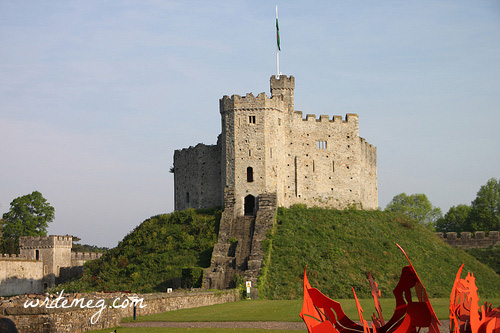
Though I didn’t find a castle to wander through in England, I did find one in Wales: Cardiff Castle. The structure is as opulent and beautiful as I’d imagine the Mortmains’ home once was, and I was batty for the gilded ceiling and regal library. My favorite part, however, was the Norman Keep, which exists on the original site of a Roman fort believed to have been constructed around 55 AD. The present structure — the one I walked through, snapping photos like a madwoman — was likely built around 1136. Almost 1,000 years ago.
It’s hard to believe one can stand in a place that old – especially for an American like me, someone whose own local history only extends back to the U.S. Civil War. I felt like Cassandra in those moments, adrift with my own thoughts, and I wondered what it would have been like to grow up in a crumbling place with so much history… and so many problems.
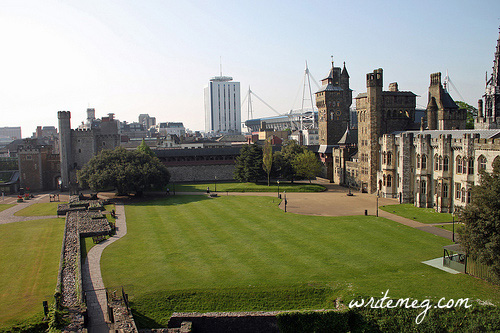
Crashing at our hotel after a full day of walking and photographing, I’m so glad I had I Capture The Castle to keep me company. Smith’s lovely novel couldn’t have been enjoyed more by a tired bookworm looking for escape.
And now when I think of my trip abroad, I can’t help but feel like Cassandra was along for the journey.

Meg is a cupcake-eating, travel-loving writer, photographer and reader from Maryland. When not chatting books, life and love at writemeg.com and tweeting @writemeg, she pens a newspaper column and spends too much time searching for the perfect pumpkin spice latte. The quest is infinite.
Guest Post: Kremsmünster Abbey
Posted 28th November 2012
Category: Chit-Chat Genres: N/A
1 Comment

Editor’s note: The photographs in this post were taken by Chris Ciolli.
It’s a cold, gray day made colder by a delicate mist of rain that sparkles in miniscule droplets on the leaves of the trees around the monastery, but immediately soaks through my lightweight jacket and chills to the bone. I try not to shiver when I look at Father Robert. He’ll be our tour guide, he explains in his Germanic-sounding Spanish, what would we like to see? He’s wearing a floor-length priest’s habit with crusty chunks of food stuck to the front of it. He smiles unconvincingly, showing off yellowed tombstone teeth below his beady eyes set in loose skin, mottled with age spots and the occasional whisker and I repress a shudder with a grimace, because frankly, man of the cloth or no, he gives me the creeps.
I look down like a shy teenager and mumble to the floor about how much I would like to see the library.

The other tour members (fellow journalists from Spain) want to see the Abbey’s observatory, but Father Robert is even less enthusiastic than I am about traipsing up flight after flight of stairs to get to the top. It’s almost five, he says, by way of explanation. We’ll go see the Tassilo Chalice, a hefty copper and silver-gilt goblet donated to the Abbey by its founder, Tassilo III of Bavaria. Legend has it that Tassilo founded the monastery in 777 in the exact spot where his son Gunther was attacked and killed by a wild boar during a hunting expedition. I wonder idly if they caught the boar, and if, when they did, they feasted on it around a roaring fire, and toasted Bavaria’s lost son.
I trail behind the rest of the group through halls dimly illuminated by the fading light of day, trying not to think about horror novels and evil beings that lurk in darkest corners. This is a holy place, I tell myself, trying to talk my imagination down from that dangerous ledge. I’ll want to sleep later.
The darkening hallways finally lead to an even darker room. The Tassilo Chalice shines below soft lights as Father Robert tells us the Pope has used it in masses in Austria and comments that it weighs six kilos. I imagine it would make a great murder weapon for a historical suspense novel – an ambitious priest argues with his superior, grabs a blunt object and has bludgeoned his elderly and malevolent colleague before he regains control of his baser instincts. I catch Father Robert looking at me curiously, and look away from the Chalice.

I’m grateful to abandon the small room that houses the chalice, even in favor of more hallways and rooms populated with swiftly growing shadows, because it means we’ll soon be among my favorite things: books.
Father Robert fights with a heavy wooden door, holding it open for us to file in. The library is a 17th century fairy tale for book-lovers. I start as the door, cleverly made to resemble bookcases, slams shut behind Father Robert and becomes just another wall of books. Towering shelves are crowded with tomes. Ladders lean against the shelves, and upholstered chairs cozy up to small tables on wide plank floors. The last rays of sun stream in through massive windows and I squint to make out rolling green mountains in the distance. A large globe dominates one side of the room. A few feet away, there are wooden cases with glass lids, home to the Codex Millenarius, an ancient book containing all four Gospels, written in Latin around 800 A.D. in Mondsee Abbey.

The manuscript is almost as ornate as the library’s frescoed ceilings, painted with Greek masters and scenes from the Bible. I close my eyes and breath deep. I wish Father Robert and the other people on the tour away, thinking I would like nothing better than to spend a few months here, lost in the 160,000 books, 1,700 manuscripts and 2,000 incunabula (printed materials from before the year 1501). I could spend my life getting lost in the worlds created by words.
A fellow visitor nudges me accidentally, and I open my eyes wide, my book fantasies slipping through my fingers as Father Robert drones on about how most of the books are in Latin, Greek or German… languages I don’t speak, understand… or read.
About Kremsmünster Abbey: A Benedictine monastery located in Kremsmünster, Upper Austria, Kremsmünster is known for its observatory, the Tassilo Chalice and its 17th century library. It’s about an hour and fifteen minutes from Salzburg and two and a half hours from Vienna by car. For more information about tours and visiting Kremsmünster, consult the Abbey’s official website.

Chris Ciolli is a Barcelona-based writer, translator and artist with strong Midwestern roots. She spends her spare moments traveling, reading, slurping coffee and wine and playing with her watercolors and kitchen tools (not at the same time). For more information about her writing or translating services look her up at ChrisCiolli.com. Catch up on her adventures in the world and authentic recipes from all over at MidwesternerAbroad.com. Or check out her original art and jewelry at TriflesandQuirks.com. Chris can be found on Twitter @ChrisCiolli.


