





Speculation In Non-Fiction: Do You Mind The Make-Believe?
Posted 6th March 2013
Category: Chit-Chat Genres: N/A
12 Comments

Screen shot from Marie Antoinette, copyright © 2006 Columbia Pictures.
When you read non-fiction do you prefer to see only facts or are you open to ideas that come straight from the author’s mind?
For me it often depends on context, the nature of the speculation, and how much we actually know about the situation, person, or history.
I’ve found a lot of speculation comes from writers who feel as though they are experts (or are indeed considered experts). Often speculation will rise the more books on the subject the author has written. For example David Starkey’s Henry: Virtuous Prince contained a great deal of speculation about the King’s early life and thoughts, where history is scant due to his position as second son, and one would hope Starkey had a good sense of what might have happened.
But Starkey brings in another factor – often those who speculate come across as being “pally” with the person they are studying, overly familiar with them; a good way of ascertaining whether there is a chance of speculation is to view the way the writer treats the subject. If the writer is rather nice or indeed horrid, speculation and poor use of evidence can be considered a great possibility. With strong feelings comes the wish to promote them, the feelings, to the target audience.
Evidence is where speculation can become irritating. When an author makes up details for which there is absolutely no basis factually, it is hardly trustworthy. Indeed one might wonder how it made publication, after all universities always tell their students to back up their claims with sources.
Sometimes a speculative thread will continue throughout the book, for example Antonia Fraser decided that Marie Antoinette had had an affair with Count Fersen and this idea was continued throughout the story, thus affecting the rest of what Fraser had to say. (I do realise “decided” in this context is a strong word.) If you are someone who believes in what the author says you will likely be okay with the speculation, but without the full evidence or basis it is otherwise annoying.
Authors use speculation to help back up their views, which is of course somewhat ironic. Many books that are viewed unfavourably have a speculative basis or extreme bias that goes against the facts.
Yet there are of course times when speculation cannot be helped and is warranted. Take, for example, the case of a writer who dearly wants to introduce the world to a little-known person of which we have scant information. Surely here speculation is understandable and where we do not have facts these ideas mean that historical figures who would have remained confined to the past are now publicised. Facts may be later found due to the publicity that creates wide interest in research from all over the spectrum. Take, for example, Alexandre Dumas senior, whom Tom Reiss brought to us last year. Reiss made a point of telling the reader that little was known and he filled the book with other information to make it more interesting and add context that is also not studied enough (the lives of mulattoes in the Caribbean). Then there is Glynis Ridley who presented all that is known about Jeanne Baret. These sorts of cases make a strong case for speculation when there is nothing else. You could of course say that no facts equal no reason for writing, but that is surely unfair on the people who history simply forgot. (And history would have forgotten Jeanne Baret, the first European woman to explore America, because she was a woman).
Personally I am against speculation for the sake of drama, shock, or to aid the author in substantiating their own views when no evidence can be found. But when there isn’t any evidence, and the author is open about what is factual and what is not, I am more than happy to read the work.
What are your views on speculation in non-fiction?
On Schedules And Having Ideas
Posted 25th February 2013
Category: Chit-Chat Genres: N/A
14 Comments
I know I’ve already discussed having a blogging schedule, but now, several months down the line, I am starting to really appreciate it.
I don’t know why exactly, but setting a schedule has been incredibly beneficial to me as a writer. True, sometimes I’ll be sitting in front of a blank page for a while, frantically going through books to try and come up with something to write about, but the writing always gets done. Somehow when you’ve a deadline the ideas do arrive, even if they’re not particularly compelling and even if once you’ve written the piece you feel you’ve not written anything of substance at all.
Certainly having a niche helps. Book blogging is much better than the “anything goes” approach I took a few years ago. A restriction on topics actually creates freedom.
This said, I’m not always working at the last minute. I like to brainstorm every now and then, to research, to consider expanding on another post (as I’m doing right now). Sometimes it’s hard to believe but there are always ideas for writing. They won’t all be new but your individuality brings a fresh outlook to the topic.
I doubt I’ll be posting daily any time soon; I have a lot of respect for those who manage to do it, but my Monday, Tuesday, Wednesday feels right to me.
I’m glad that the inspiration remains after almost three years.
Are you surprised by how long you’ve been blogging, in regards to finding ideas?
Should You Finish A Book You’re Not Enjoying?
Posted 20th February 2013
Category: Chit-Chat Genres: N/A
17 Comments

In the days before the Internet and casual reviewing online, I didn’t finish many books. If I didn’t enjoy them it made sense, but I do look back sometimes and wish I’d made more of an effort. But it didn’t seem like a big deal back then.
Now it feels more important. I would say that perhaps it is due to the differences between childhood and adulthood, and the way the world has changed – except I can’t help applying my own context to it. I can’t help but see it from the point of view of a book blogger, a reviewer, and indeed it is an issue at the heart of our “work”.
Should a person finish a book they’re not enjoying? It’s the million-dollar question but there is no one answer and there never will be. This is because it all depends on why you’re reading the book in question.
If you’re simply reading for pleasure and just want to enjoy your time, finishing a book that’s lacking doesn’t make sense. We don’t like to do things that aren’t fun and considering this reading happens during one’s free-time (an often scant resource), you want to make the most of it.
However if you’re reading for the above reason but with a catch – it’s for a book club – you’ll likely want or even need to reassess that line of thinking. It would, in this case, depend on how the group in general perceives giving up on a book. They may be far from strict, but a book club is about a number of people and involves discussion of the pick.
If you’re reading a book for review then you probably ought to finish it so that your review is informed and fair, that you’ve ample evidence and “authority” to criticise it. That said this can be hard when the book is so bad and people get around it by writing about the fact they couldn’t finish it and why. This is surely far more fair than pretending to have finished it or making assumptions, not least to keep your integrity. DNF reviews are great because being so open allows others to feel they can really give their own recommendations – that you made the right decision, that you should give it another go because it improves, and so forth.
Obviously there are other reasons outside the book-centric ones (I apologise for the strange turn of phrase but am hoping you get my meaning). If you’re studying the book or it’s another item on your course list, you’ll want to finish it unless the Cliff/Spark notes are particularly good. That said it’s a risk to take because the notes may not help you enough should you be asked to comment in detail.
You should finish a book if you want a sound knowledge of its contents, whether for yourself or conversation. If you need the information for context or culture (thinking here of classics and modern classics) you will likely have the drive to get to the end no matter your level of enjoyment.
Yet perhaps the most important reason, when it comes down to it and we’ve stripped away keeping up appearances and work, is the sense of fulfillment. True, it may not happen with every book (though it might be said it happens with famous ones no matter how bad they are) but the act of finishing a book, of being able to say you’ve read it from cover to cover, is empowering.
Of course I am on the side of finishing books, it’s there to see on my reading lists and my list of posts in which exists a solo DNF, but it would be impossible to prescribe one way for everyone and at all times. And our interests and motives change. So an analysis this post must remain.
Do you finish books you’re not enjoying? Why/why not?
When It’s Okay To Have Multiple Copies Of Books
Posted 13th February 2013
Category: Chit-Chat Genres: N/A
12 Comments

I’ve always felt, instinctively, that owning more than one copy of a book is in some way wrong. I suppose that it’s because of the years spent with a mother who always talks of clutter, and because of the general question that is asked in our era, “do I really need this?” Sure enough, duplicate copies gained as presents have always been passed on and beautiful hardbacks have been left in the store because I already possessed the ugly paperback.
My feelings have had to be reassessed. I’ve found it necessary to purchase another copy of Shadows And Strongholds and, most damning to my aversion, the very same edition. The edition issue is simple – I like the cover. One of my reasons is understandable – I want to be able to read the book a lot without worries that it’ll fall apart and I’ll lose it forever (I’m not a fan of the new cover). I want to have another because it’s an important book to me; it was the catalyst in some self-study I’m undertaking, though I do love the story also.
However the most pressing reason is that my first copy arrived with its spine badly broken. Yes, the spine was ruined but it’s unlikely the book would remain in perfect condition after being read. Still.
It occurred to me that besides my very good and very petty reasoning there are actually some great reasons for wanting multiple copies of a book.
- If a book is going to be ruined: flicking through it for study; taking it on a potentially ruinous holiday; lending it to others who aren’t careful with their books.
- When you read it so much it falls apart: I once had a friend who was on her 7th of her favourite book because she read it all the time.
- You have an ARC of it: sometimes the ARC will be understandably littered with errors, or you might just love the book so much you want to support the author and buy the finished version.
- You have the ebook: you can pretend the print copy is your first because no one will be able to see the ebook unless you show them.
- Classics with several gorgeous editions/your favourite book in multiple editions.
I’m sure that those of you who don’t share my complex are no strangers to these ideas but to me they are somewhat of a revelation. I can’t say I’ll be doing it often, my wallet isn’t bottomless and already I need another bookshelf, but it’s no longer a taboo. My only question now is how do I store these two copies?
Do you have multiple copies of a certain book(s)?
Subscribe to this site via email and you’ll receive 3 posts a week. If you use Gmail, you may find the posts are stored in your ‘social’ or ‘promotions’ tab.
On The Stereotype Of The Well-Endowed Older Woman
Posted 21st January 2013
Category: Chit-Chat Genres: N/A
7 Comments
Something I’ve noticed when reading, particularly historical fiction and classics, are the constant references to middle-aged and older women’s bosoms. Sometimes this constant referencing is literal – the author will often describe the same character in a particular way – other times the constancy is more an overall usage, a lot of authors over a lot of books talking a lot about middle-aged bosoms.
To put it clearly, so that you know exactly what I’m talking about and don’t fear that my reading choices have changed, what I’m referring to are the times when an author employs the trope of an older motherly woman as a secondary character to watch over the main character. These women are at least middle-aged, have “heaving bosoms”, are often described or suggested to be fat, and whilst sometimes strict are necessarily caring.
It is like the usual stereotype of the jolly overweight person; only it’s not quite as simple as that. And as it is so prevalent and used without question, I found myself questioning it. Because whilst I don’t believe it is ever used in a derogatory way there are factors in it, and differences in uses between time periods and genres, that beggar examination.
As said, these characters are mainly found in historical and classic fiction. This makes sense – there is a similarity, a relationship between these types of books as classics are generally older works and historical fiction is set in the past. There is thus a possibility that authors of historical fiction use the descriptions to better fit the time period they are writing about – if medieval poets talk of these women, for example, it’s understandable an author of historical fiction would want to likewise. It is often more noticeable in historical fiction, too, perhaps because where such books are concerned we do not feel the need so much to view the work in any context other than the context of the work of someone who loves history. And, I would argue, that it is perhaps more widely used, anyway.
To think of classics in this examination requires further study into what it was that made writers talk in that manner. I would put across the fact that the physicality and sexuality has always been important and thus this plays a part in descriptions. Think, for example, of the usage of the word “lusty” to further describe the characters we are dealing with. To call someone lusty, to focus on their bosom (which is big), their body weight (which is ample) implies that they are attractive, or were attractive (if their age is remarked on) and that they thus had a husband and many children. Putting it bluntly, before contraception women had lots of children and this would have impacted their bodies to quite an extent. The fact of motherhood and the emphasis society placed on it, thus likely being accepted by women, may have made for a caring and protective nature. Therefore these characters are ripe as motherly figures for main characters.
It’s an interesting element of characterisation to think about, especially today where identity and femininity is so different, where women have more time and more opportunity to regain their figures after childbirth and where breastfeeding is no longer the major method of feeding a baby. Indeed it brings into question the similarity of today’s woman with those historical women who are not described as large caring mothers – the rich.
It is highly unlikely you’ll find a rich woman described quite in the same manner as you will a poorer one. The rich woman of history, with the ability to leave her children with a nanny or maid, to hand over a hungry child to a wet nurse, and the distance that came about when the mother was not the carer, does not come to mind as a likely candidate to fill the role of protector for a main character. Indeed the neglectful, unknown parent, is often someone who is hated by the character, and maybe also the author when they do not agree with the idea of a woman who does not stay at home.
And so the woman who has had children, has nursed the children of others (and of course some characters are the old nurses of the main characters), and has provided the love, is the woman employed in novels. It is a stereotype, used too often, but it makes complete sense. It sounds derogatory, prejudiced even, but even when jokes are made it is hard not to think, after examination, that the basis of the whole idea is that this is the sort of woman who is caring, and loving, and, where history and its myriad of middle and working class writers are concerned, therefore the best sort of woman there is.
Have you noticed this stereotype in books? What are your views on it?
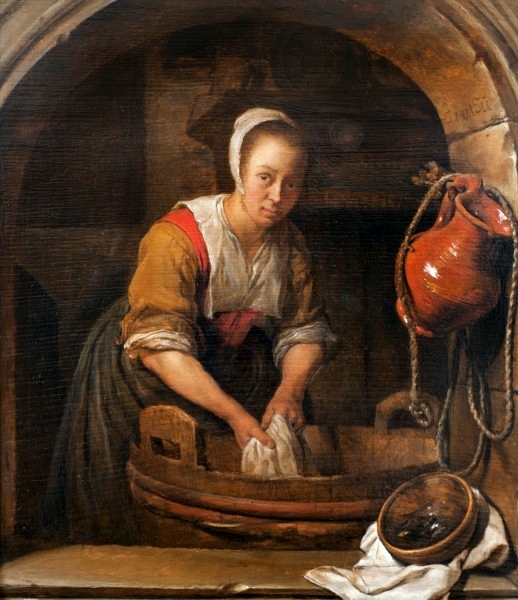
Judith has made a very good point about the picture I’ve used – it’s not a good representation. The clothing fits somewhat but I couldn’t find a good picture on Wiki Commons to fit the article and didn’t want to wade through porn on the search engine, so if anyone knows where I can find a better public domain picture please let me know.


