





On The Usage Of ‘A Novel’ On Book Covers
Posted 6th May 2013
Category: Chit-Chat Genres: N/A
17 Comments
This topic was inspired by Violet, who questioned the need for such a phrase when I was reading Julie And Romeo (the cover of that book doesn’t say ‘a novel’ but the GoodReads title does). The question made me remember the times I’ve wondered the same.
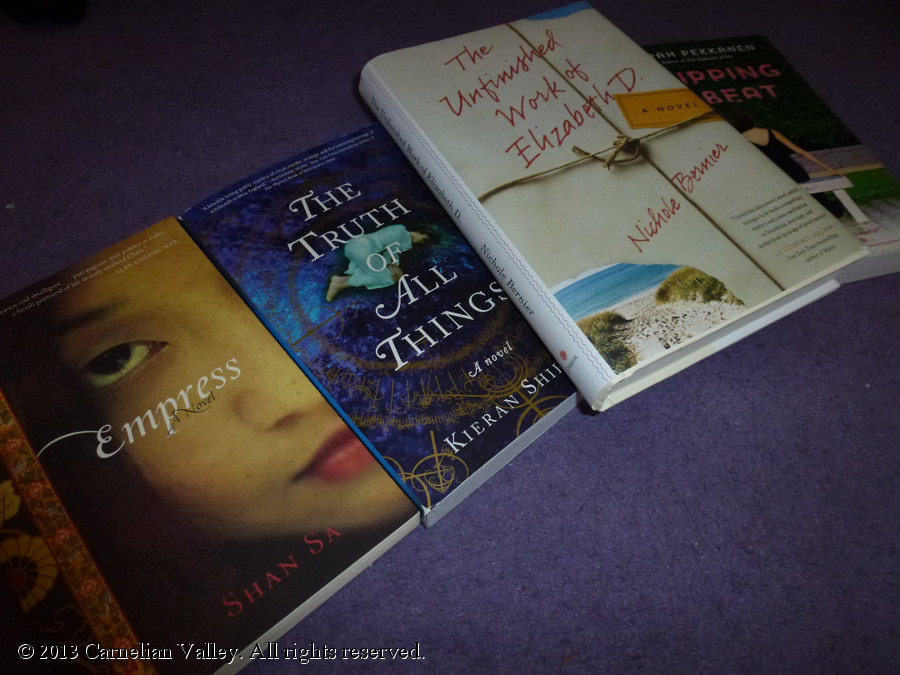
My main thought, which I assume are the same as other readers, is that the usage stems from the publisher or author wanting people to know that the book isn’t non-fiction, to clarify what the contents will be. But then it’s generally obvious whether or not a book is ‘real’ or not – in fact it’s often books that don’t bare a distinction that are less obvious. It is also often books with a complex or nondescript title that include the phrase, for example it’s evident ‘Julie And Romeo’ is a play on Shakespeare’s work but it isn’t unheard of for real people to find themselves in such a situation. And, looking at the photograph above, some of those books might be mistaken for non-fiction if you didn’t read their blurbs. Thus a distinction is needed.
So, okay, that could be the reason. But somehow there is still that element of discrimination – in a way it seems the phrase implies the inferiority of fiction, as though the publisher is saying “This book!… oh, sorry, it’s not real life”.
You do have non-fiction books that state ‘the true story of…’ but in that case there’s the sense that that’s there to let people know it’s the truth, the real evidence as opposed to non-fiction that might be biased or not detailed enough.
Of course there is the possibility that it could be to confirm it’s fiction for those who don’t wish to read non-fiction. I admit this is a hunch, but there is that divide. Or, on the other side of the equation, and to bring in a conversation I had the misfortune to participate in, some people think they have enough stories in their own life to warrant fiction worthless.
Numerous other reasons could be found. This topic could be inexhaustible, and I doubt that without the input of someone in the know the true reason could be known.
What are your thoughts about ‘a novel’?
My Ignorance Of Poetry (Featuring Eyewear And Caleb Klaces)
Posted 26th April 2013
Category: Chit-Chat Genres: N/A
16 Comments

Please note: This post is of my own invention. The photograph above was taken by Joanna Paterson.
It was somewhat ironic that just before the start of National Poetry Month I should receive the offer of a book of poetry. It was even more ironic considering that in the last few months poetry-loving bloggers (Alice being the major culprit here) should make deprived me start to rethink my opinions. It’s not that I hate poetry, indeed one of my beloved childhood books was an anthology, but as is often the case, school wiped out my interest and I’ve found it convenient to simply label myself an uninterested party. It saves money on books, you see.
But I’m feeling left out, and I realise that all this reviewing and looking for themes and contexts (previously reclaimed from school, too) can be applied to poetry as well.
Enter Maddy Pickard, whose email I almost deleted on sight because her company was called Eyewear and I’ve had one too many pitches about sunglasses. If you recognise her name you would be correct, she’s Maddy of Peirene Press. It was this recognition that stopped me hitting delete.
A new publisher of poetry, Eyewear seeks to increase our collectively lesser interest in the art, reintroducing us to forgotten poets, welcoming new ones, and providing a step-ladder for that unobtainable cookie jar. Maddy offered me a book and I accepted, choosing Caleb Klaces’ Bottled Air. The summaries of the books are descriptive enough that even a ‘born again’ can make an informed choice.

I must be honest and say that after reading the first few poems, I looked at my mother (who ‘does’ poetry) and said “I don’t get this”. It’s not that Klaces’ work is bad – I think Eyewear have struck gold here because his collection boasts tradition, dissent, and great subjects – my ignorance was battling hard against my determination to understand.
After this initial issue was overcome somewhat, Klaces’ collection proved a good starting point. My overall knowledge of poetry being limited to rhyming couplets and the classics my mother duly pulled off her shelf to read aloud, I’m glad for Maddy’s email. It’s pushed me to try again and I know I’ll be following Eyewear’s progress. I like what Klaces has created, the themes and the variety, that gripped me even if at first the poetry didn’t. There is something about it that just invites you in, makes the poetry accessible whether you’re from the ‘world’ or not. Even my recovering self recognises the beauty in it and I have to recommend it as a very good collection.
So I’ve some way to go (a topic for a later post perhaps) but to conclude it makes sense to give you an idea of what I was reading. Here is an extract from my favourite, Painting over Aya Sofia. I love the symbolism and thinking behind it, and how Klaces links one thought to another related one via the repetition of a word.
A lot of the painting here is painting over.
Can everyone at the back hear over everyone?
Everyone is a blast of light seeping across the film.
All day high toothy windows whiten in flashlight.We are much like we were: five times a day.
Things don’t change that much in five centuries.
For ten centuries before it was faces.
Those were faces, yes. They were angels.[…]
A woman kisses her cross and crosses herself.
Another is kissed by a pink polo shirt and camera.
A camera will not put the rest of Christ back in.
It will not take away the crowd around Christ’s toes.
Do you read poetry? Where would you suggest a new ‘student’ start? And, if another question is alright, what do you think of the extract above?
Subscribe to this site via email and you’ll receive 3 posts a week. If you use Gmail, you may find the posts are stored in your ‘social’ or ‘promotions’ tab.
On Dealing With Unsolicited Books
Posted 17th April 2013
Category: Chit-Chat Genres: N/A
17 Comments

When an unsolicited book comes your way, what do you do about it?
Unlike a book you’ve agreed to review, the only information you may have is whatever happens to be on the press release, if there was one in the package. By a process of elimination you’re able to tell who sent it (the publisher logo, the return address), and it’s likely someone you’ve worked with before.
You can treat it as you would a solicited ARC, reviewing it around the publication date and making space for it in your schedule. Or, considering it’s arrived without prior “consent”, you may opt to read it if and when you can get round to it.
Do unsolicited books cause pressure to review a book you may not have wanted? (Indeed it may be the case that you are surprised by a copy of a book you desperately did want, in which case you’d likely choose to read and review it because you would have anyway.) I think it depends on the individual and their relationship with the sender. For example, I’ve received a few books from a couple of publishers unsolicited, and whilst I may never have heard of the books before, the publishers know me enough that the books they sent were a perfect fit. But if a book arrived at my door that was of a topic I know nothing about, and especially if it happened to come from a publicist I didn’t know (this is unlikely), I would feel puzzled. Where I personally prefer to read books on subjects I know or am keen to research, I obviously feel less inclined to review books for which I have little background. Little background simply makes it harder to know whether what you’ve written is relevant.
If you choose to read the book, do you feel you have to read it around the publication date? In the grand scheme of things it makes sense to, but fitting another book into a possibly already burdened schedule is difficult, especially when book blogging doesn’t make you much, or any, money. But of course there can be the feeling that you want to please the sender – even if you know that they would know you might not be able to get to it.
An unsolicited copy of a book is surely sent in the hope of a review but with the knowledge that it might not be read or, if so, left until later.
If you receive unsolicited books, what actions do you take? If you don’t currently receive them, what do you think you would do when it happens?
The Kobo Glo
Posted 5th April 2013
Category: Chit-Chat Genres: N/A
18 Comments

On Monday I got a Kobo Glo. For a while I avoided getting a big brand ereader, preferring to stay content with my old Binatone as long as possible. But when you want to be able to read books that don’t always have a printed counterpart (or are out of print), converting books to text files every time becomes a drag. So I looked at my ereader decision as an investment; an investment in my reading and blogging.
I’m still not wildly keen about ebooks, preferring physical books. I’ll mostly be using my Kobo for review copies and classics. Nevertheless I do not hate ebooks; I love the way they have made the industry more accessible for self-published authors. And as I think of all the money a little-known self-published author would end up spending on postage, it’s nice to know they can now market their books for free. Ebooks have also given those who have trouble holding physical books a similar alternative.
My choice, as I saw it, was between the Nook and Kobo Glo. I don’t like the way Kindle limits the reader to Amazon and whilst I do shop there sometimes, the news about Goodreads did sway me a lot. The Kobo has always appealed to me, I don’t really know why, but recently I’ve been impressed by what I’m hearing of their support of indie stores. And the Nook was the best alternative to the Waterstones ereader that was hoped for.
What sold the Kobo to me was the range of file formats. It accepts epubs, pdfs, and mobi – exactly what I was looking for. And whilst I’m generally a fan of physical buttons on devices, for some reason I wasn’t particular about them here. I went for the Glo because of the e-ink screen (I love reading outdoors), I wanted a device that was solely for reading (no distractions), and as for the light it was that added extra I could use if needed. However, before it appears as though I’m a gushing fan girl for Kobo, here are two lists of my experiences so far.
What I like:
- It feels nice – the border and the screen. Like some kind of plastic suede.
- The screen doesn’t turn off on shut down – first I didn’t like this, but it makes it feel more like a real book. What basically happens is the cover of your current read is displayed with the percentage you’ve read of it. This may be an issue if you don’t want others to see what you’re reading.
- The ways you can change font size etcetera, are varied enough. Same with the light.
- The ability to include the “true” page numbers if the file has them (sometimes it surprises you as they might have been invisible in other applications).
- The screen is sharp.
- There’s a decent 2GB of onboard memory and the MicroSD slot takes 32GB cards.
- The WiFi has a stronger signal than my desktop computer.
What I dislike:
- It’s very slow – everything except page flips takes time. Updating font settings takes about 10 seconds per tiny change, and you’d think your choice of book hadn’t been registered for the time it takes to open it.
- It isn’t sensitive enough when you try to flick the page, yet if you walk around with it (without touching the screen) you can find the pages have flipped themselves.
- The setup was a pain.
- It appears to read some text weirdly – checking the file in Adobe Digital Editions and the Kindle application, it was fine, but Kobo changed “I knew” to “swe 7ew”.
- Annotations are a waste of time – due to the slowness you have to type at snail’s pace and that’s just not reasonable.
- Highlighting is difficult.
- The “help” section isn’t a help section.
Overall it’s okay, and I’m glad I got it, but it could really do with some speed. The cheap almost primitive Binatone is a lot faster. The learning curve was a few hours. The battery looks like it will last a good few or even several books, though I’m not sure how that might change when I’m using the light. It came with a couple of free books, or at least appeared to (I don’t remember deleting them but they aren’t there any more).
I do think this is the right ereader for me, everything considered, as it does include the features that were important. But time will of course tell. For now, despite the issues, I am happy with it. Oh, and if you’re wondering what book I was reading, it was Jessa Russo’s Ever.
Do you have an ereader? If so, what features were you looking for that helped you make your decision?
On Blog Comments And Motivation
Posted 25th March 2013
Category: Chit-Chat Genres: N/A
25 Comments

Does the number of comments you receive on your blog posts affect your motivation for blogging? This is a subject that I suppose can look like a rant at face value, but my purpose today is to simply discuss the impact of obvious interaction on motivation.
There are of course lots of points that could be considered when answering such a question, for example are we talking of every post needing a great number of comments – can these comments be evened out over posts in a way that suggests the blog isn’t so popular, and do we take into account those articles we write that we know won’t see much reader input?
For this discussion we’ll look at comments in general rather than focusing on any of those specifics – ergo, the number of comments you receive on average in, say, any given week. This is because it makes sense, for example, that readers may not comment so much on reviews, or that the blogging community might happen to have a slow few days.
In my case, the number of comments I receive on average varies depending on the topic I’m writing about. A perfectly understandable situation that has led me, as I’m sure it does others, to work out what sorts of posts my readers like the most. My comments will of course be affected by other factors such as those explained above, and also my own actions. I can’t expect people to comment on my blog if I’m not posting, for example. So my number of comments swings back and forth.
Do comments make me feel more determined in my blogging? In some ways yes, most definitely, but in other ways, no. Comments let you know that your words are being read, and how many people don’t appreciate the interaction and further discussion they inspire? And what about the sheer feel-good factor that occurs with seeing people commenting on something you wrote? Personally I’ve come to love the fact that comments mean you all give me something to think about when I thought I’d exhausted a topic, and I also love it when people counter my opinions with their own. There’s a lot of learning to be had through interaction.
As for the “no”? It’s important to believe in your writing, in yourself, your worth with or without lots of comments. Blogs are relatively new, all things considered, and it wasn’t long ago that columnists and reviewers were effectively speaking to silence (fan mail being different). And to place an answer somewhere in the middle – a lack of comments after a time of many comments can make me want to be better, a better writer, more interactive myself.
Yet sometimes it’s impossible not to let comments get you down, especially when you’re a new blogger trying to gain a following. It takes weeks, years, and you have to write with the possibility of speaking to a number of page views that, although possibly high, doesn’t reply in words.
Comments are important to me, I can’t lie. I would miss it if there was no more discussion. But due to the differences between offline and online living you can’t let the number get you down.
How do comments affect your motivation?


