




Stress And Reading – A Numerical Effect?
Posted 11th November 2013
Category: Chit-Chat Genres: N/A
11 Comments

In my October reading round-up I asked the rhetorical question of whether stress can impact the number of current reads I had at any one time. It was a random thought at the time but I liked it and thought it might make an interesting discussion. Please forgive me if it doesn’t.
I am comfortable having two books on the go. For a long time I was a book monogamist, but then I realised it might suit me better if I didn’t restrict my reading time. It’s worked out well and in a general sense it’s lead to me reading more. But it has made me more lackadaisical about numbers, and whereas one book was easy to be strict on, once I moved to two, adding a third or fourth once in a while didn’t seem so ‘bad’.
However thinking back on the occasions and times that I extended my ruling, I noticed that often the number of books I had on the go at that time (which I’m estimating by the date each was started – finished dates vary wildly as you can imagine) was a reflection of sorts on how stressed I was at the time. It seems the more stressed I am – or at least this was the case before I made this realisation – the more books I had on the go. (I wonder if knowing the potential that it’s related will stop it happening so much in future.)
Now if you asked me before this, I would’ve said that the number was in correlation with how much I was enjoying the first (and second and so on) book at the time. I wouldn’t say that that’s no longer possible, as I know that many second books are the result of the first being average or very slow-paced, but many times the few books I was reading at once were all good, strong, award-winners, popular, you name it. And there is an undeniable link to stress.
Upheavals – I read more. My aunt died – I had three books on the go. Changes – I’m reading some very good books but am restless to start another. Is it a coincidence? That’s certainly possible. But coincidence or not I think there’s a fair argument for it being related to stress.
Of course stress can limit your reading if you’re not in the mood or don’t have time. This in itself can lead to more books because if you’re away from one book for a while it may prove difficult returning to it, and whilst you can’t return at that moment, you know you’ll want to when you’re mentally ready. But stress doesn’t always limit your reading time; it depends on the cause of the stress.
If stress can lead to poor choices, impulse buying if accompanied by upset, and so on, I’d say it can affect reading in more ways than limitations.
What have your experiences with stress and reading been like?
The Potentially Wrong Legacy Wuthering Heights Left Me
Posted 25th October 2013
Category: Chit-Chat Genres: N/A
7 Comments

This photograph was taken by Robert Wade.
I must thank Erin at Quixotic Magpie for the inspiration today. Her list of Top Ten Book Turn Offs made me immediately think of Emily Brontë’s book.
Wuthering Heights is a book for which it’s tricky for me to express either a like or dislike. I like it as a literary work, and the generality of it is lovely. But I abhor the content. Unlike the Laurence Olivier film version, which for some reason only portrayed the nicer aspects, the book I found loathsome.
Yet for all the relationship issues and awfulness, the scene that most remains with me, the scene that defines the book for me, is that of Heathcliff’s treatment of the dog. Whether Brontë intended it to be cruel but ultimately forgotten or not, that is the book to me. That was the scene that tipped the scales between discomfort and dislike. Not the arguments, not the destroying of lives, the dog.
In passing the garden to reach the road, at a place where a bridle hook is driven into the wall, I saw something white moved irregularly, evidently by another agent than the wind. Notwithstanding my hurry, I stayed to examine it, lest ever after I should have the conviction impressed on my imagination that it was a creature of the other world. My surprise and perplexity were great on discovering, by touch more than vision, Miss Isabella’s springer, Fanny, suspended by a handkerchief, and nearly at its last gasp.
[…]
She cannot accuse me of showing one bit of deceitful softness. The first thing she saw me do, on coming out of the Grange, was to hang up her little dog; and when she pleaded for it, the first words I uttered were a wish that I had the hanging of every being belonging to her, except one: possibly she took that exception for herself.
Whilst I know that caring about the dog is no bad thing, I doubt it is what Brontë or academics would have me remember. I would likely make a poor essayist for the book as that one scene would get most of my attention. But the scene is horrific, both literally and in what it represents, showing just how bad Heathcliff is. He abuses humans, who may be weak but can at least speak out or perhaps run away, he turns on a dog who can do nothing.
Have you ever taken as a book’s legacy on you something you feel wasn’t ‘supposed’ to be taken as the defining aspect?
On The Lack Of Photography In Culinary Non-Fiction
Posted 14th October 2013
Category: Chit-Chat Genres: N/A
7 Comments
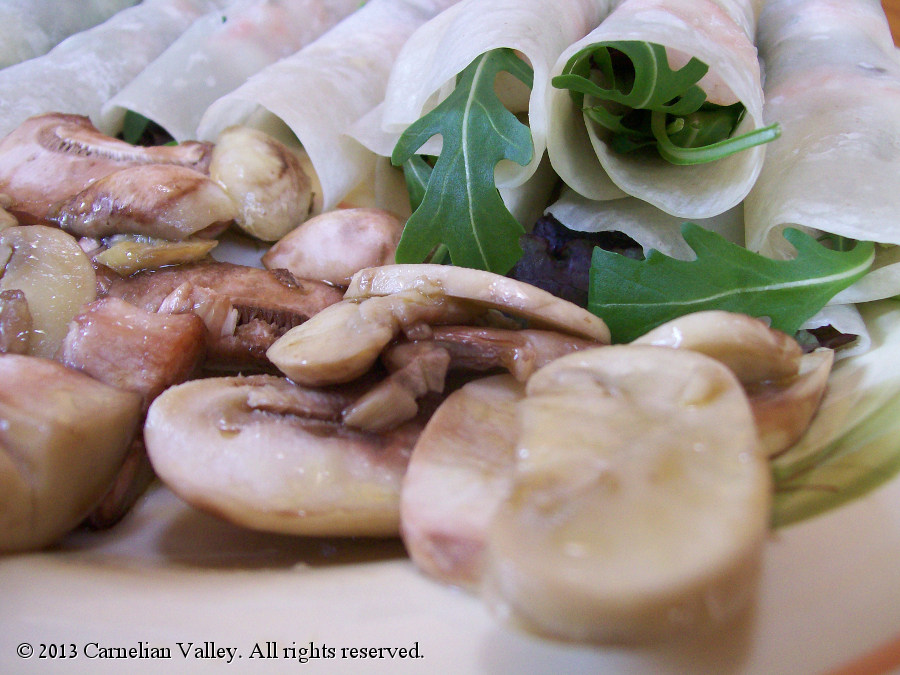
I’m rather new to food-related non-fiction, but already I’m noticing a pattern. There are few photographs, sometimes none at all, included in these books. This strikes me as very odd as food is something that, if you can’t smell or taste it, is best visualised. Words may help, especially as smell and taste are not available, but visuals are something that I would’ve thought an obvious addition.
Cookbooks have visuals, and whilst the sort of culinary non-fiction I’ve been reading isn’t necessarily about creating the dishes yourself, an image would add a lot. The books I’ve read are very good as they are, in fact they’ve made a fan out of someone who had never been particularly interested before. But photographs would have improved their descriptions further.
It seems all the more peculiar when you consider that history books tend to include photographs, be they of paintings, places, events, or items. History is always well catered for, which is interesting because in many cases the only visuals we have are crude stained-glass windows or paintings created centuries after the event. In the latter case especially, these are surely far less relevant than a photograph of a food item mentioned in the culinary book in which it’s discussed.
With food, photography should be easy. Here are my thoughts in regards to the books I’ve reviewed here.

Anya Von Bremzen: Mastering The Art Of Soviet Cooking – The audience for this book is not necessarily Russian. A lot of the dishes are not made much any more, and the book includes recipes for them at the back. Without knowing what you’re working towards it would be hard to follow the instructions. You could use the Internet, but it would be quicker to just have a photograph in the book by the person providing the recipe.

Michael Pollan: The Omnivore’s Dilemma – Now, granted, you don’t really want to see pictures of slaughter houses (or do you – would that have added to Pollan’s case?) but the farmers, the hunters, Pollan’s exploits? That would’ve been great.

Robin Shulman: Eat The City – In this case you can at least go to the website for photographs, but how long with the website be online for? How many readers would think to search for it, how many know it exists? The people in this book are described in detail and you become very familiar with them.
If this is the norm I can’t help but think there’s a lot of potential that’s been missed. Reading reviews of other books, ones I’ve not read, I’ve found there to be a lack there also.
I know that by itself this post is a bit of a non-entity and that your thoughts here will make it a lot better. So today I ask, what are your opinions on this lack of photography?
Cause And Effect: Chess
Posted 27th September 2013
Category: Chit-Chat Genres: N/A
6 Comments
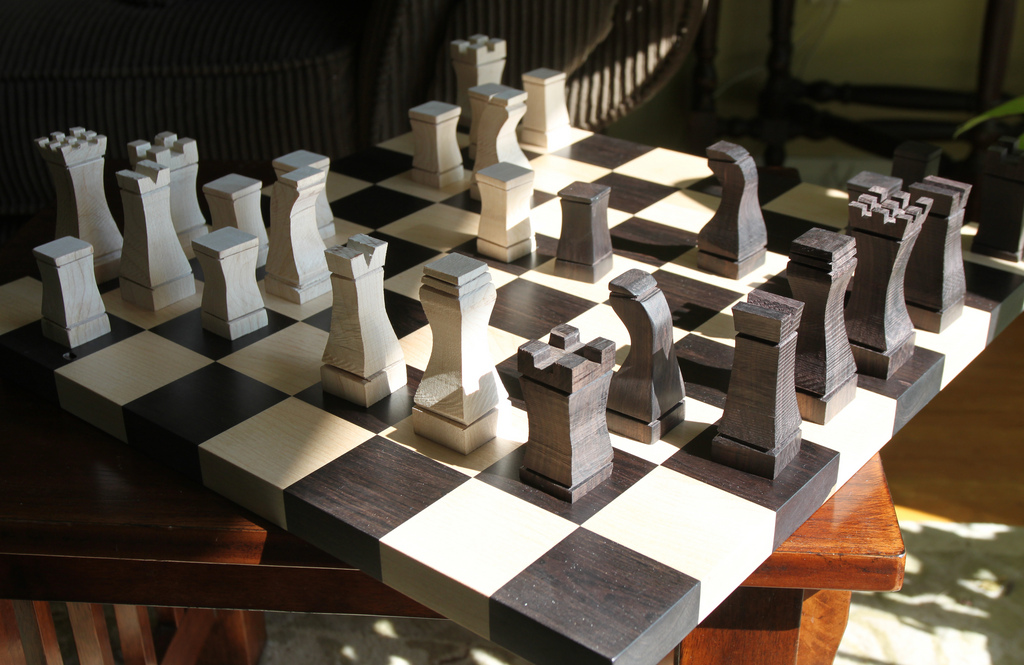
This photograph was taken by Dan Zen.
When I wrote my post on looking for our earth’s arm of the galaxy, I didn’t envisage making a series out of it. But I found myself reading Desperate Duchesses with a note in mind of a similar sort as I did when reading Paradox – “I want to try this out”.
(Incidentally it took at least a dozen more attempts to finally view the galaxy. I have enough interest in space to have done this. My boyfriend has enough interest in the space he now has back that he will probably refrain referring to the night sky in future.)
The book in question this time is about the Georgian era, and there is plenty of nakedness and sex in it – also humour, not always separate from the sex – but not so obvious from the outset is the inclusion of chess. There was enough of the chess to reawaken my childhood love of the game. It appealed to me in particular because one of the Georgians’ games is played via notation, through correspondence, and I’ve always found that method fascinating. I can’t think of a game for which there is an exclusive method devoted to playing remotely in such a way.

Many of the games in the book are strip games. We opted for bog-standard no-nudity Chess.
My boyfriend and I played a few matches in the early summer. He had retained his knowledge of the game; I was a hopeless case. I’m assuming my wins as a child were because my mother let me win, but then it wasn’t winning that was the issue here. I already knew my scientific-background boyfriend would wipe out my pieces – it was my inability to plan ahead that was my downfall. I used to plan five steps ahead, here I was lucky if I managed two. Yes, my opponent was better than my mother, if we factor in the unlikely possibility that I won fair and square back then (I’m rooting for this myself), but I lacked the skills to even put on a good show. Playing chess is obviously not at all like riding a bike or swimming.
Interestingly since playing against my computer later, I’ve noticed a marked difference in computer chess games since the 1998-ish one I enjoyed. Granted I’ve only since tried the version Microsoft bundles with Windows, but when comparing my younger age and wins to my older age and impossibility to get a word in edgeways, it seems chess is one area in gaming where things haven’t been dumbed down. And despite my losses I’m rather liking the glossy wood board, even if it doesn’t truly exist.
Maybe I’ll get better with practise, but even if I don’t, I’m glad Eloisa James’s raunchy characters brought me back to something I used to love. I don’t know why I stopped playing chess, but I won’t be leaving it so long next time.
I might even pile my hair up to silly heights for it.
Do you play Chess?
Why I Rarely List Authors By Surname (And Other Boring Stories)
Posted 23rd September 2013
Category: Chit-Chat Genres: N/A
11 Comments

Whilst typing up my latest ‘latest acquisitions’ post, I wondered if it was about time, if indeed time was necessary, to talk about why I tend to organise my lists by first name. I know that in the majority of cases it’s obvious why a blogger has organised their lists in a particular way (by year read makes sense, as do titles and genres) but my decision to list authors by first name or initial, rather than surname, strikes even myself as a bit… off.
This post is possibly going to make me look rather silly, if my current phase of poor proof-reading hasn’t already, but I’ve come to see the value in honesty and if it causes even a single sentence of discussion in the comments then it will have been worth it. I know I’m not the only one confused, even if I’m the only one still confused at my age when they ought to be well-versed already.
My primary reason for listing by first name, when I do, is that it’s often difficult to tell which name is the first and which is the surname. Every now and then this might be the result of a foreign name (for example Chinese names – the words are often used in both first and last names). Generally, however, it’s a case of not being completely sure if three words denote first name, second name, and surname, or first name and double-barrelled surname. When a name contains a hyphen, it’s easy, when it doesn’t, it’s not always obvious which is which.
In blogging I finally got over my long-standing problem of not knowing how to order Mc’s and Ma’s, or names that are the same but for a space. Yet occasionally I have an off day, forgetting whether McGarry should come before Manicka, whether Daphne du Maurier ought to be under D or M (actually, I’m still not sure on that one) and, even more rarely, Chad [space] Wick to Chadwick. These days are far and few between, but they’ve happened enough that it’s lead to me being unable to find an entry on a page due to an ‘off’ day previously.
My review database, is listed by surname. It’s flawed and far from a labour of love in itself. However I reckon choosing to list by surname there is the best option for me.
As for ‘other stories’ I thought it might be useful to say why I only refer to an author’s surname in the content of my reviews, not their first name (unless I have reason to refer to someone else with the same name in that post, for example Charlotte and Emily Brontë). I’ve always liked the way academics and journalists write their reviews, how formal and proper it sounds. And as much as I wouldn’t mind using the entire name, that would become particularly repetitive. Google would hate it (though I do wish we didn’t have to worry about Google thinking we’re trying to gain the system).
These are my reasons in all their dull glory. What are your listing preferences and do you have issues with names too?


