




Why You Should Definitely Not Take Only One Book On Holiday
Posted 12th December 2016
Category: Chit-Chat Genres: N/A
9 Comments

I should have taken more than the one book on holiday. That was my bookish thought as I unpacked once back home. I hadn’t read anything and although it was true I hadn’t had much time to do so – this is Hay we’re talking about, ironically – I do think I might have read more if there had been a choice. It wasn’t the book – I was enjoying Season Of Crimson Blossoms a lot and would recommend it – but something about there being no choice. There is a definite affect on mood when you go on holidays, as you kind of hope, and in these cases it pays to have a choice. And there’s something about knowing you’ve a fall-back book that gets you reading your first choice.
Not too much, but at least a choice of two. It doesn’t matter if you’re enjoying your book; there are a couple of reasons for taking a couple of books – that choice factor, and the possibility you may finish your book and need another. Because one book is a nice thought and easy on the luggage weight but if you find yourself disliking it and your accommodation doesn’t have a book shelf or, heaven forbid, there is nowhere to acquire books, you’ll be stuck. Just don’t take more than 3 at the most unless you’re in for a long haul flight and thus, likely, long holiday.
At the same time, and this is again somewhere I’ve failed, thinking that you can take your one epic-length book is no good unless you’re in a constant state of awe of it. There’s something about epic books and being far away from your bookcase, something that I’ve personally found almost always leads to regret and a sad, preventable, feeling that you want the holiday to be over because you’ve nothing you feel like reading.
I’ve taken two books and done well. I’ve taken more and read nothing. And I’ve taken one and read little.
What do you do when you go on holiday?
This Is (Not) What You Came For
Posted 7th December 2016
Category: Chit-Chat Genres: N/A
6 Comments

There have been many times when I’ve gone into a shop and left with a different book than the one I went in to buy. It’s a common situation; one of two things happen: 1) the book you went in to buy isn’t in stock and you see another book whether through browsing or because you’re looking at your wishlist items or – a reader’s personal favourite? – you’ve just seen it for the first time, right then, and make a random purchase; 2) you get the book you went in for as well as a few others you may have remembered you wanted or picked up on the fly.
It’s a situation that will happen at a library, too, but of course the library factor means it’s easier – it’s free, you’re kind of ‘meant’ to take a few books, and if you’re a bit impulsive it’s fine. You might not have ever known of the book if you hadn’t got carried away and doing so can yield gems. And add to the reading load.
However, whilst I’ve done it many times, I’ve not done it recently. I’m well aware I’ve enough books that, were I to not receive any more, would keep me going for a year and a half. (I was surprised to find my book count was at the lower end of the scale.) I’m also more focused on which books I want rather than acting on a whim, which isn’t much fun but is needed at the moment. I surprised Alice last year when I only picked up three books in the book heaven that is Brighton; it’s true I’ve not been acting like an avid reader lately!
But it’s something that can bring a lot of joy even if that’s often dependent on the random book choice being good. There’s something about picking up a random book, which I’ve spoken about before. And there’s just a different feeling when you go in to get a particular book and then leave than when you’re browsing with the idea of letting your browse show you what you can get. A feeling that incorporates the feeling that you’re using the bookshop properly, if that makes sense. The library, also – especially the library, perhaps, considering the way so many are shutting down.
This has become a musings piece – there’s not much you can go on about the initial concept without spinning away from it – so over to you: how often do you let whim affect your time in bookshops and libraries and do you ever feel you’re adding needlessly to your to-be-read pile?
A Person Who Writes In Books
Posted 23rd November 2016
Category: Chit-Chat Genres: N/A
7 Comments
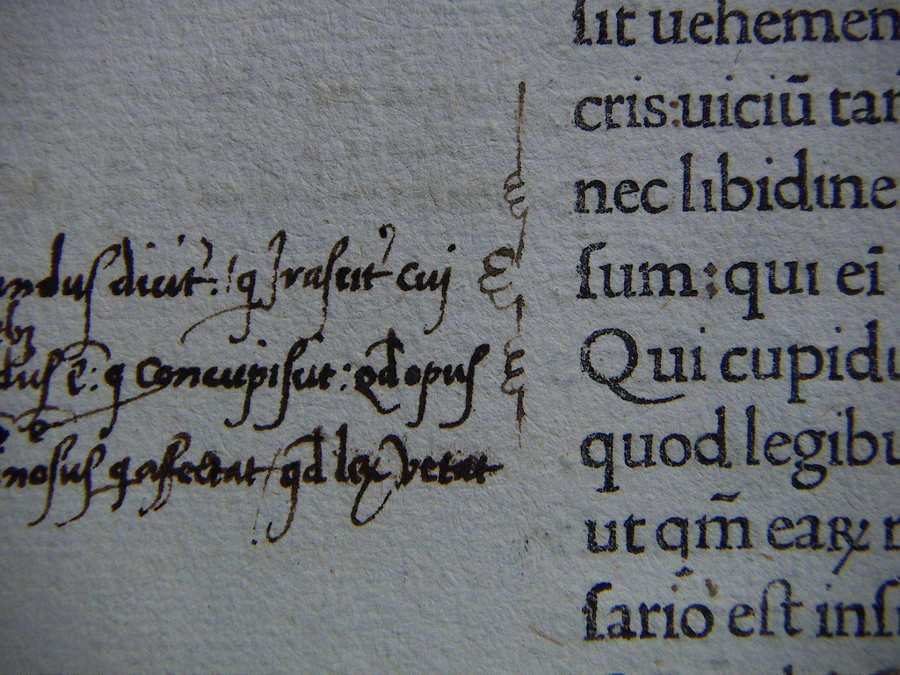
This photo of 1479 marginalia was taken by Philobiblon.
This post is brought to you by a 360 degree reversal in the reading mode of its writer. If you follow me on Twitter you may have seen a tweet I posted a couple of weeks ago about my sudden and compelling urge to write in the book I was reading… by the next day I’d posted another tweet to say I’d gone and done it. I’ve since made notes in two books.
I say ‘sudden compelling urge’ because I have had sudden writing urges before but they’ve never been quite compelling enough for me to actually pick up a pencil – it’s got to be erasable – and change my stance. The strength of it was a bit silly really but then I suppose it was the opposite of how I usually feel.
Others write in books. Many of my classmates at school scrawled all over their poetry books. I did too because I had to but even back then, during the time I wasn’t reading for pleasure, I felt books were… sacred. Not to be sullied. Interestingly I have no problem with other people writing in their books; I believe it’s each to their own, but me and mine? No chance.
The reason I never wanted to was because I’m always worried that a re-read would be dominated by my past thoughts and whilst on the whole that’s no bad thing – interesting, almost, because you’d have definite comparisons there between then and now as opposed to having to remember what you thought – I can be easily distracted, that attention span thing, and I know that when I’ve come across underlined or highlighted text when going through photocopied book extracts while essay planning, I get stuck on those sections that the person before me deemed important. And I always think that while they may be important sections, they might not be in my specific context or – god forbid – I might end up taking a bit more from the source material or friend’s notes than I meant to.
A friend once photocopied a chapter of a book for me that our lecturer had photocopied for her. My friend was effectively presenting me with source material only she had. I felt uncomfortable anyway because I knew that if I used it I’d potentially be writing about things that previously only she could have, but her highlighting had me worried – I didn’t want her own planning to weave its way into mine. Like my reviewing process – read others’ reviews after I’ve written my own – I worried some of her work would creep into mine no matter how much I was aware of the possibility. Once you’ve crossed that border, even if you don’t actually use someone else’s work whether by accident or on purpose… just that worry that you will and the lengths you’ll go to to ensure you don’t can be exhausting and can negatively affect your own work.
Back to writing in books myself – I chose a pencil. I wrote in the whitespace. Emboldened, I progressed to underlining lines, sectioning paragraphs I liked, scribbling everywhere. Once I started I figured I’d write whenever I wanted. In a soft pencil. Very lightly.
Afterwards I was regretful. I’d crossed the line. I could erase the markings but knew it’d be difficult and anyway, it would scuff the pages. This feeling remained for a few hours. The next day, reading a new book, I came to a place where I knew I had to write everything or I wouldn’t be able to continue reading. I did it again.
Here’s the thing – these two books? Two of the shortlisted titles I’m reading as a shadow judge. I suppose it’s different; it certainly feels so. I feel a greater sense of needing to get it right, to remember all my thoughts, to understand the nuances of the texts.
And it’s just easier to have my thoughts – all of them – to hand. I like to make copious notes when reading. I use notebooks, and once I’ve written the review I tend to leave the rest of the notes behind where at some point, when the notebook’s used up, they’ll end up in the shredder. I rarely keep my notes, precisely because I don’t have a place to keep them. I’ve considered a commonplace book but the idea of trying to categorise multi-category notes is daunting. Some books I read are lucky; I store their notes on the computer. Others are lost forever if the thoughts don’t make it into my review, and that’s most of them because if I included them there would be “ah ha!” and “excellent!” and all sorts of other notes and copyright-infringing amounts of text that even I wouldn’t read.
Will I continue? I really don’t know. But I guess under the surface I am a writer in books, or, as I said on Twitter, I’m a Person Who Writes In Books. And I’m not sure if I’ll ever feel comfortable with that but then it’s a lot better than it could be.
I could be using a biro.
Do you write in books?
Throwing Books Across The Room
Posted 16th November 2016
Category: Chit-Chat Genres: N/A
10 Comments

Important to note before we begin: I loved the book used in the photograph. I didn’t want to single out a book I’d hated so I chose a less awkward option. Unfortunately trying to get a good photograph of a book in context is difficult to achieve without showing the spine.
Bit of a light-hearted discussion today. I can’t say I’ve ever thrown a book across a room. I know it’s often used as a metaphor but you do see it in action sometimes, if mostly on television or written about in a way that suggests it truly happened. In a way it’s more interesting to discuss because it can be a metaphor. Because it is a physical reaction to a strong emotional reaction.
It’s a reaction related to the times people become exasperated by what they’re reading, a book they aren’t liking for whatever reason – they may well not mind if it gets damaged. This last thing said, it can just be an expression in the moment.
“The only thing worse than hate is indifference.” – Lauren Oliver, Before I Fall. It is better to have that ‘extreme’ reaction than feel apathetic. Throwing a book shows the reader has had a strong reaction; they’ve read the book attentively. They may be taking it to heart.
Does one feel guilt or relief? I know the reason I’d never do it is because I like to keep my books nice. I accept dog-earring happens, grudgingly. (Interestingly, despite the irritation I feel whenever a musician, though especially a non-musician, destroys musical instruments for a music video or so forth, I do not feel an irritation with people throwing books. Maybe it’s because it’s not so extreme. Maybe it’s because a book is far easier, cheaper, to replace. Maybe it’s because there are a plethora – a plethoric plethora? – of books compared to musical instruments in the world.) I can understand the knee-jerk reaction, it’s just not something I’ve real knowledge of.
Ebooks can’t be thrown – are Amazon and Kobo on to something? You can drop a device but if you don’t consider where you are – a sofa or sat against the wall on a hardwood floor? – there will be repercussions.
So I’d like to know whether you’ve ever thrown a book, which book it was, and what it was about it that made you do it? And if you haven’t, would you?
Books, Contexts, And Eternally Playing Catch-Up
Posted 7th November 2016
Category: Chit-Chat Genres: N/A
10 Comments
Do you ever feel you’re playing catch up, that there are so many books, particularly of the canon/very famous variety, that you have to read? And, if so, do you think you’ll ever lose the feeling of playing catch up or having not yet read the books deemed important because there are so many of them?
I do. Jack Kerouac. Sylvia Plath. Ray Bradbury. To name just a few; I don’t think I need to name the books themselves. You’ll know which I mean.
So many books out there – though there does seem a basic line between the ones that are ‘necessary’ to read and those not so necessary – the kind that you note are often referenced or used for context in conversational events, in articles, as examples that work brilliantly so long as you’ve read the book otherwise you’re often left even more confused. And then the other, perhaps biggest, problem – modern books steeped in the background or themes of a canonical work. I read Andrew Blackman’s On The Holloway Road a few years ago and I could tell it was excellent – that fact, if I may term it so, was obvious in general – but as a work that was based on Kerouac’s On The Road, I didn’t have the context to view it in those terms. Blackman’s book taught me much about Kerouac but I couldn’t shake the feeling that my experience of the Blackman should have been full of comparing, contrasting, in addition to the lesson I took away with me. I wonder how much I missed by not having read the source material.
There have been a few occasions like that. Writers like to extend the conversation about the canon, like to create new interpretations and spin-offs, and that is all great, but it will always leave a certain number of people with a distinct lack of context when they approach it. And we could argue that one should only approach such a book after having read the source material but there are so many books out there and so many references. Some books are packed with contexts from canonical works that to read all the referenced material first… you’d never get to the more modern book (and, indeed, having read the referenced works would an interpretation then seem trivial?) Others make use of works that may be heavily referenced but you know that the referenced book is not particularly well known or falls into a niche category. (This is why I included Bradbury above – his work is important but we wouldn’t necessarily utter it in the same breath as Dickens. Some would, others wouldn’t.)
It feels very good to have read a famous book. I’ve read all of Jane Austen’s books and, in big part because my school education was lacking and I had to play catch up here myself, I get a bookish sense of delight on many occasions her work is mentioned – because there was a time when I had no idea what people meant when they talked about her work. And now I do know about it and so I can laugh or agree – that ‘umm’ that sweeps over the audience – with those on stage or so forth. There’s an academic feeling to it, that I’ve read and studied and learned and now understand along with everyone else… or at least many people.
And this feeling, I believe, can occur no matter your prior education. For me it’s a mini triumph, for others a simple pleasure.
The interesting thing is that no matter your privilege – your education, the number of books in your home growing up, your parents’ view of literature – one thing is true across the board: we are all in a position where, if we deem the canon/famous books important, we are playing catch up. Everyone is and everyone will always be. Even if we only read important books we’d never read all of those we considered important unless we had a limited interpretation on what was important… and even then we’d end up missing contexts because of the importance placed on other books by others. The only thing we can do is prioritise. I prioritise in two ways. What am I interested in personally? Which books are referenced most often? Your priorities may differ.
And if we do somehow manage the impossible and read all the works? There will be little or no time to muse on interpretations or read unrelated books. Of unrelated books some people may not worry – it’s okay to eschew modern books for classics if that’s your thing – but interpretations can be fun and they extend your experience of the important book.
When I sat down to write this post I didn’t think I’d have much to say; the post was inspired by a simple line from my notes on Celia Imrie’s talk: “I feel I’m still catching up”. It turns out there’s a lot on the periphery.
I’ve asked a few questions in this post to which I’d love to hear your response; I will emphasise this one in case your time is limited: Do you think you’ll ever lose the feeling of playing catch up or having not yet read the books you deem important?


