





Series I’ll Likely Finish; Series I Won’t Be Finishing
Posted 31st October 2016
Category: Chit-Chat Genres: N/A
6 Comments

You’ll relate to this, I’m sure, and I’d love to hear what’s on your own lists. I’ve many book series that technically, in a dubious sense, are on the go. In some cases I have all the books already waiting (in most cases these are the series I’m not so fond of; isn’t that always the way?), others I have half the count, and more others I’d have to purchase. (Having more to purchase/borrow can sometimes itself be a reason to pause reading. It’s the reason I never got around to finishing that series with the boy wizard and man who shall not be named… and now I’ve missed collecting the set in one design.)
Whilst looking at my shelves for an idea of what to photograph in order to have some stock photos ready, I noticed how many unfinished series I had. I picked out a number of them – limited to the last book I’ve finished per series – and split them into two groups.
As I looked at them all neatly stacked on the table, I noticed a pattern that confirms something I’ve known a long time: I love fantasy but don’t make it a priority. I would say fantasy is a favourite genre but it requires a mental investment that I find difficult, a particular attention made more important due to my wish to review, and it keeps me away. I suppose what I’m saying is I love fantasy but find it hard to review, and I don’t know why. It may have something to do with my fear that I’ll miss key concepts, something I’ve got over when it comes to literary fiction and historicals but not yet imaginary worlds. I’m a video game and 90s sci-fi TV show geek who lost her way and thus doesn’t know many references any more.
Series I’ll Likely Finish
Elizabeth Chadwick’s Eleanor of Aquitaine trilogy
I’ve finished book one, The Summer Queen, and have The Winter Crown on the shelf. The first was excellent but there was that pesky factor of having to wait for the next book to be released that meant I lost track. I will get to it – I’m slowly, successfully, making my way through Chadwick’s backlist. And I thought it prudent to wait until she’s published the last book so a marathon can be a possibility.
Lian Hearn’s Tales Of The Otori series
‘Current’ book: Grass For His Pillow. I have the next two (of three) on my shelves. I’ve been reading this series almost as long as I’d been reading His Dark Materials before I finished it earlier this year… about 15 years, now. It’s an investment thing.
Charlaine Harris’s Sookie Stackhouse series
Book 2, Living Dead In Dallas. I have most of this series thanks to a heavy discount that reduced the first ten books – what was published at the time – to the price of one store-bought book. (British readers may be familiar with The Book People.) This isn’t my favourite series thus the time it’s taken so far, but I like it enough to feel fairly confident in saying it will happen.
David (and Leigh!) Eddings’ The Mallorean
Book 2, King Of The Murgos. (There seems to be a pattern with this second book thing; it might be worth exploring at some point.) I pick this series up when I want older fantasy and am happy to read something repetitive. In many ways this series is a rehash of the previous, The Belgariad, that features the same characters. My problem with this ‘reboot’, as it were, is the change in Ce’Nedra and the way that because she’s had a baby she’s been largely left out. I’m making slow progress.
Series I Like Won’t Finish
Lauren Kate’s Fallen quartet
Book 2: Torment. It was a torment finishing the first two books. I went along with my standard ‘second chance’ mode of reading. I could carry on but I can’t say that interests me and negative reviews for negative reviews’ sake – no thanks.
Anna Belfrage’s Scottish time travel series
The Prodigal Son, book three. Akin to Diana Galbadon’s epic series, I read this series for a few tours and had to turn down the next two due to prior commitments.
N K Jemisin’s Inheritance trilogy
Book one, The Hundred Thousand Kingdoms. This book didn’t do it for me but I do plan to try another of Jemisins’ series.
Terry Pratchett’s Discworld
Book seven, Wyrd Sisters. I’m going to continue this series but being realistic there are so many books involved that I doubt I’ll ever read them all. I love Pratchett but need to read him in stages. I very much admire Jessica’s journey and am experiencing the series vicariously through her reviews.
Anyway, question time: which series do you have on the go and which have you given up on?
Random Encounters With Readers
Posted 21st October 2016
Category: Chit-Chat Genres: N/A
5 Comments

Story time.
I think it’s one of the nicest literary pleasures – books, your love of them and another’s love of them, forming a connection even though you don’t know each other. Books are one of those obvious ice-breakers, unless perhaps you’re using an ereader (though that doesn’t stop the possibility, only limits it), as books are something that are visual, an insight into the person you can use to start up a conversation. It lets you form an immediate connection, bypassing small talk (yay!) and given how much we readers often lament the lack of opportunities for bookish conversation in our daily lives, it’s a real boon.
One day I sat down at the bus stop; it was one of those small basic shelters, yet to be updated, all irrelevant outdated poster timetables and little space. Chewing gum on the flip seats. A girl around my age sat on one, deep in her book. I hadn’t encountered someone reading ‘in the wild’ for some time, let alone a reader my age. Etiquette flew out the window as I asked her what she was reading. It was a very brief conversation as she wanted to get back to her book – she was reading Virginia Andrews. That was my introduction to the writing pair. I don’t think I was headed anywhere particularly mundane that morning but the conversation made my day. It must have – here I am remembering it all these years later.
A few months ago at the Curious Arts Festival – I suppose I’m cheating here as it wasn’t long ago – I was attempting to finish Before I Go To Sleep without showing off what I was reading because S J Watson was sitting nearby and I’d made an admittedly oddly specific reference to where I was in the book when I’d asked him to sign it the day before. (Page 425, if you’re wondering – why I thought he’d know what scene that would be I don’t know.) I’m very aware of the pally-pally thing, of that blogger meeting an author thing, silly really. (I once went to a concert with my father and we stood with a group of friendly women we’d been queuing behind. We unfortunately found later we were standing with people who took fandom too far. A few of these experiences later and I’m very keen on the get-item-signed-and-get-going approach.) Anyway, a girl asked if she could share my bench and wondered which Watson I was reading. We had a brief chat about it – she didn’t want to spoil the ending for me and we both had books to read. Her enthusiasm was infectious and although I was already reading as fast as I could at the time, I finished it just that bit sooner because of it.
My last story is more of a sighting. A middle-aged man walking past doing the book equivalent of eyes glued to the screen. I was more than happy to do the swerving – not only was he reading but it was a favourite book of mine. It wouldn’t have been right to stop and say something but how I wanted to. It made me interested in looking for different opinions of the book (this was before blogging) because it was historical fiction about an empress and whilst I was perhaps on the younger side of the target audience, in stereotypical terms he was an outlier. Still in stereotypical terms, however, he looked like a university teacher and thus apt.
These are my stories. I wish I had more but then would encounters have such an impact if they were more numerous?
When did you last meet a reader by chance?
The Importance Of The Adaptation
Posted 17th October 2016
Category: Chit-Chat Genres: N/A
7 Comments

I got thinking about this subject whilst in the midst of compiling my thoughts about the way the recent film adaptation of Far From The Madding Crowd used a certain strand of the source material (yet to be posted). I noticed how much more I end up thinking about a book and the story as a whole, and how much more likely I am to write more than one post if there’s a film to be seen. (When I say this I’m meaning film, singular – I’m yet to watch multiple adaptations but it’d be interesting to compare this whole concept when/if – likely when – that happens.
To summarise, watching adaptations – and, I suppose, hearing them on the radio, I’m just not familiar with them – gives you more to think about. It extends your experience of and with the book. It adds or even creates your personal dialogue with it, extending it from the original to other people’s interpretations. You’re able thus to compare and contrast your interpretation with others and see more opinions in action which can help you decide how much impact they might have had on the story or study possibilities. Your journey therefore doesn’t end on the final page. It may be that the interpretation isn’t the author’s (of course sometimes it will be, for example if the author is the script writer) but you’re still deep in the story.
Views are more broadly applied, though they may be limited by feature length. (This is an interesting topic in itself – what gets cut, what’s deemed most important to the director, how does it compare to your own opinions?)
And adaptations are another way of sharing the story with someone else. Whilst you can join readalongs, there’s a more immediate aspect, dare I say it’s more social than reading – you’re seeing exactly the same things, the same interpretation at the same time. You can have a movie night with friends, perhaps share the story by way of film with those who wouldn’t read the book. It might not be quite faithful to the book, but in most cases it will be enough.
The adaptation is often the widely-known version of the story where more will watch that than read the book. (Tara Sparling’s post on how many copies constitute a bestseller makes sobering reading.) Due to adaptation changes it can pay to watch the film so that you know exactly what others are relating to when they speak of it. Unless it’s a highly popular book more people will want to talk film and whilst it’s unfortunate that you can’t always persuade someone to read the book, it’s better than nothing, I think we’d agree.
There is just so much benefit in the adaptation. I find myself down far more research rabbit holes if I’ve a film to watch than if there’s ‘just’ a book and it just broadens the book horizon.
Do you like adaptations? What do they add to your reading?
Brief Musings On My Continued Use Of An Editorial Calendar
Posted 12th October 2016
Category: Chit-Chat Genres: N/A
7 Comments
I’ve been using my calendar for five months now, at the time of writing this, and I’ve experienced another learning curve.
It’s very easy when you’re working months in advance to loose track of your writing self, your tasks. Back in May, I had planned posts until mid August, which was pretty amazing to me. So when a writing block hit and I was out of ideas, it was easy and understandable to say, ‘well, I’m planned until August, I don’t actually have to write for a while’. The problem is, if you stop writing and looking for ideas you find yourself still saying you’ve lots of time in late July.
I was still writing reviews; after six years I’ve got a loose plan in place for those – what I like to concentrate on – and it’s much easier to write up something when the ideas are right there, but I was low on all other types of posts. I remembered the importance of a writing schedule – or, in my case, the set block of time for writing a few posts every few days. And the importance of making time to find ideas – if you can schedule that in, as much as it sounds like scheduling day-dreaming time it’s a good thing.
So a break is good but you can’t let a calendar have you thinking you’ve loads of time.
Do you prefer working ahead or are deadlines your thing?
On Re-Reading And Different Editions
Posted 5th October 2016
Category: Chit-Chat Genres: N/A
5 Comments
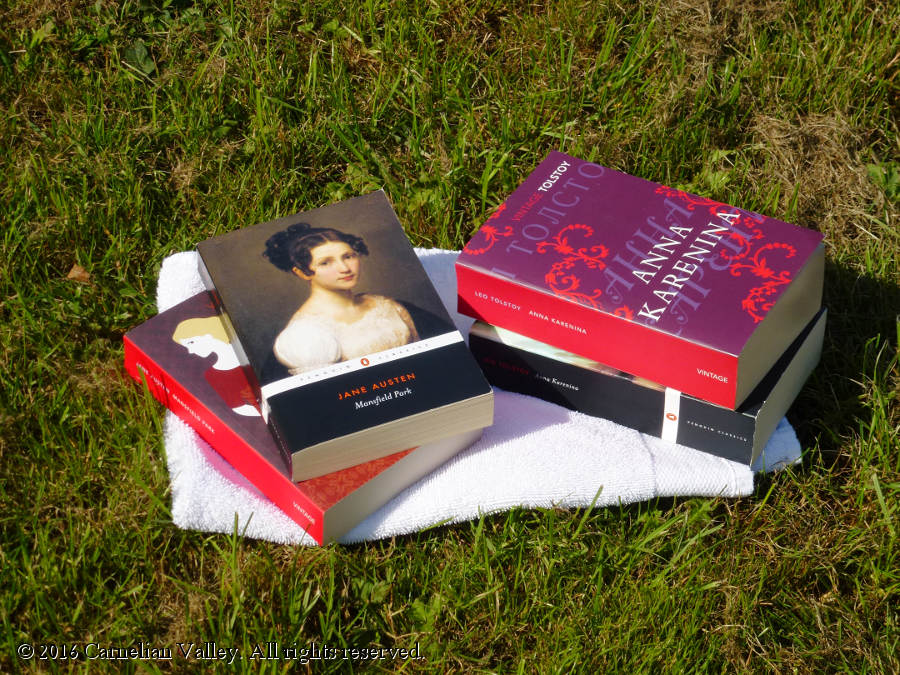
A quick spin-off, last week I said the following:
Another thing I’ve been thinking about is associated with this – the way colour is part and parcel of your reading experience can mean that if you read the book again using another edition, whilst the story is obviously the same you are having a new experience of it, physically. Your current age may be a factor, but I reckon if you read a book twice over, once then a second time immediately following the first, with two different editions, those two times would seem different. The second may even seem wrong.
I wonder how much influence this truly has. Partly because there are the obvious influences of the publishing decisions to take into account, the way publishers are looking at new-first-time readers compared to what we’re doing when we re-read. It makes sense that each new cover, hardback to paperback change, for example, is going to be honed on creating intrigue and so changing covers allow for experimentation and the hope for a second audience ‘wave’ (Forgive me – Rick Yancey’s book may still be in my head).
Sometimes you can point to already popular books keeping the same cover, but it’s not always the case. Marketing choices are there to influence and so it wouldn’t be surprising if your feelings changed with a new edition; your experience has changed. In a way it could be said you’re reading a completely different book; it can certainly feel like it, especially if it’s been a while between readings. Will you notice new things? Will you see aspects in a new light due to a different colour choice? We know covers factor into reading decisions but they can influence reading itself.
I’m thinking here of my first, complete, read of Pride And Prejudice, where I used a relative’s 1970s Penguin edition that I didn’t open much because it was in almost pristine condition. Later dips into the book have happened with my own copy, the one I used in my review. Through time and the myriad uses of my own copy, I now associate Austen’s book with generous margins, good line spacing, and a good-sized serif font, but only when I’m thinking of times I’ve included the novel on my blog. When I think of the story I remember the big portrait on the cover of my relative’s copy and the way I worked my way through narrow line spacing at a speed I’d likely find difficult today, just five years on.
Do you find this? Do you associate a book with a particular version and would you/do you find it odd or hard to read the book again using a different edition?


