





Reading Cause And Effect: The Origins Of Western Children’s Literature
Posted 20th March 2017
Category: Chit-Chat Genres: N/A
3 Comments

In reading Elizabeth Fremantle’s Watch The Lady and mulling over the books people read in past times, I started wondering about children’s books – what books did children read in times gone by? Of course this necessitated choosing a certain period so I chose my lifelong interest, the Tudor period.
I forgot something important. I suppose when you study a period and have a general interest in it, the most obvious ideas can be forgotten… or, at least, when I myself study a period, the most obvious ideas can be forgotten. So there are no Tudor children’s books (thing I didn’t know) because children were not considered as we consider them today (thing I did know). Or, at least, that second statement is what can be ascertained by everything that is to be found – in other words, we know it is true, but to my knowledge there are no primary sources from the Tudor period addressing the lack of young adult literature.
But children read; they must have. Learning was important, especially to those who had money. And they did read – children read books that taught subjects. We can assume that to some degree – based on age and learning – children read ancient literature. Aesop’s Fables, says one source; Chapbooks, books by tutors such as Roger Ascham – a name well-known to us. People had nursery rhymes, folk tales, and so forth.
I suppose this post was always going to spin off at some point:
Children’s literature – fiction, what we would call children’s literature – became a thing in the 1700s. Previously, in the 1600s, John Locke had suggested children should have some fun books to read, but it was the 1700s that made the mark, a century the Wikipedia article notes ‘the development of the concept of childhood’. Thomas Boreman produced a book of animals.
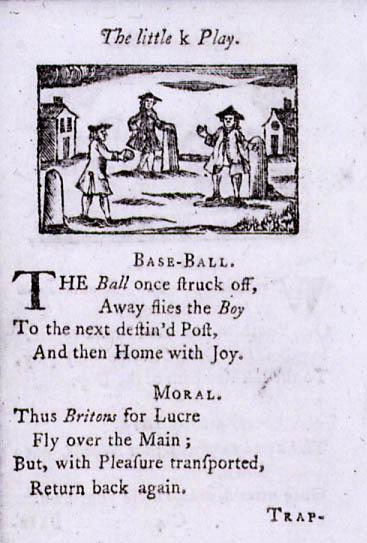
But we have one John Newbery to thank in general. Called the Father of Children’s Literature, he was a publisher who started out publishing adult fiction. It seems the first children’s book he published was the sort of thing you might expect of a person venturing into such new territory – the book had no ‘author’ and was a compilation of rhymes for the letters of the alphabet. So we’re still in distinct teaching territory here, but it looks fun and surely a lot more simple than the Latin texts of the previous centuries. It contained the first written (typed?) reference to baseball in print – though considering it was English this actually meant ’rounders’ – and for a couple more pennies you could get a small toy or a pincushion with which the child could record their good or bad deeds.
That last bit doesn’t sound so fun, but I suppose it was good preparation for Christmas.
After I’d researched Newbery I found myself wondering about children’s literature in other countries. It may be that Newbery was the first to act on it, but surely others had considered it elsewhere?

In Italy in 1600s, a poet produced a book of fairy tales. It wasn’t published as children’s literature but people considered it only good for children. Fairy-tale enthusiast Giambattista Basile is credited for the earliest known versions of Rapunzel and Cinderella. The Brothers Grimm’s interest brought Basile’s work back into the spotlight.
Denmark trumps Britain’s John Newbery – A Child’s Mirror was published in 1568. Sweden swiftly followed. Russia produced picture books in the 1600s.
Mine was a fruitless journey where the Tudors are concerned – I really should have looked into what adults were reading instead – but the information about the later years and the development of the concept of childhood are fascinating to read about.
What is your favourite fairytale?
Contemplating My Reading Statistics 8 Years In
Posted 13th March 2017
Category: Chit-Chat Genres: N/A
2 Comments
| 2009 | 2010 | 2011 | 2012 | 2013 | 2014 | 2015 | 2016 | |
| Men | 7 | 21 | 8 | 13 | 14 | 5 | 15 | 22 |
| Women | 20 | 39 | 45 | 37 | 61 | 45 | 39 | 35 |
| POC | 4 | 3 | 4 | 4 | 9 | 3 | 4 | 13 |
| Anthology | 0 | 2 | 0 | 1 | 1 | 1 | 0 | 4 |
| Translation | 2 | 1 | 3 | 3 | 1 | 6 | 8 | 6 |
| Pre-1970 | 1 | 8 | 6 | 6 | 3 | 1 | 9 | 4 |
| Poetry | 0 | 0 | 0 | 0 | 0 | 0 | 1 | 1 |
| Non-Fiction | 2 | 3 | 5 | 6 | 9 | 3 | 3 | 9 |
This is data taken from my reading logs. Some of the data has been added retrospectively – as a prime example, I didn’t start keeping records until mid 2009 but having read few books in the prior months it was easy to remember what I’d read. As the years have continued and my goals and general reading interests have changed or increased, I’ve added categories of the sort that can be completed just from basic information, such as ‘Pre-1970’ – so long as the publishing date is online that one’s easy. There are many authors left out of this table due to writing as part of a duo or team – too many zeros in those categories to make it worthwhile.
It’s taken looking through these stats to see I’m not reading as I used to. As I started to add categories it became increasingly apparent that pre-blogging me and during-blogging me are rather different. Given there are 7 years in-between those times this sounds obvious – it’d be worrying, if I hadn’t changed somewhat, but some things stand out:
Taken as a whole, I have been reading far fewer authors of colour and far fewer books by authors white or otherwise that concern non-western countries. As I said previously, in the few years before blogging I read a lot of Asian authors and some books set in Asia by white authors. You can see that hike last year where I noticed the dearth of colour and made a decisive effort to improve. I tend to say yes when review copies are offered.
Without much thought, my reading is skewed towards women. It was before blogging, but not so much. I believe I have a tendency towards female authors due to the emotions/domestic/social versus political stereotypes. I prefer reading about individuals rather than great big armies, for example, and in my experience the likelihood that any one ‘army’ book will have been written by a man is high. Whether this will change as literary expectations of men and women change I’m not sure. I do reckon that if I wasn’t so big on historical fiction the number would be more balanced.
My translation number has increased and it’s mostly down to reviewing for Peirene Press and Pushkin Press. I’d read a few translated novels prior to blogging but it was by accident, so to speak, for example when I read Shan Sa’s Empress for the first time, I didn’t realise that the book had been translated from the original French. Translation is something I’ve worked my head around slowly – I’m very much an original language person.
As said in my goals post, I want to read more classics, and I’m including in ‘classics’ some pre-1970 books; this is my version of classics, if you will, including the likes of Du Maurier and Thirkell. I added pre-1970 as a category to my list retrospectively last year. 1970 was the date I chose as my then and now point, somewhere between my birth date and what would be considered historical. It’s far from perfect – it effectively renders my parents’ childhoods historical and that’s just weird – but for now it’s the best date I’ve found. This number, this ‘pre-1970’ is a ballpark figure – I use it as an initial sorting method – many will not end up on my Classics Club list because objectively they really aren’t classics.
My non-fiction reading officially needs help. I’ve found I love narrative non-fiction, there is often so much detail in it, but it’s often long. For the most part my reading in this genre is limited to review copies so it varies, and as contacts and publishers change, so too has this number. However I can’t deny that I’ve a few hardbacks I’m still putting off.
Poetry I’m keeping in mind but not making any plans for. I’m starting to enjoy it much more – Andrew McMillan’s Physical and Sarah Howe’s Loop Of Jade have been turning points for me – but it’s a bit like my feelings for anthologies – I prefer longer works and do feel sometimes that adding a book of poetry, with its white space and general shortness, is cheating. Perhaps if I wasn’t a slow reader I would feel differently.
So there’s a lot I’m working on, a lot I’m keeping in mind, and I admit to loving having all this data. I know many of you will empathise with that last one and I know a lot of posts both here and on others’ blogs would not exist without it.
How are your stats looking?
Knowing About An Author: The Effect On Our Reading
Posted 10th March 2017
Category: Chit-Chat Genres: N/A
2 Comments

In the context of this post it would be more appropriate to use a photo of Elena Ferrante, but I don’t want to do that.
We know a lot more now about the lives and views of authors than we used to. I remember choosing books in Waterstones as a young adult; few included photos, some included mini biographies; while that can still happen, in those days you couldn’t just turn to the Internet to gain the knowledge. I find myself disappointed now when a book doesn’t have much author information in it.
We’re ‘supposed’ to be able to read a book in a vacuum as far as author information goes. People write articles about how we shouldn’t judge a book by its author but even if you try to adhere to this, you hardly have to make an effort to learn details – they’re a few clicks away. Authors are more often in the news or features section. You’ll often hear about them anyway. The increased access we have to authors is a great thing – it was the main reason I started events and made them free, because I wanted people to be able to have access to authors and literary events – but it makes it difficult to read a book without any extra details, details it could be argued are irrelevant. Our reading has changed: knowing about an author will impact on us somewhat no matter how much we try not to let it.
In thinking about this, the recent unmasking of Elena Ferrante comes to mind. I’m very aware that when I get to her work it will be with the knowledge of who she is. I wonder how this will affect my experience – so many people had already read the books and I had naturally (rightly?) assumed my reading would be similarly in the dark. I looked forward to it. How will my reading, now, differ to others’ for that reason? What would my experience have been if she hadn’t been unmasked? I do know that it will be different to what the author may have hoped because of the anonymity. I rather liked not knowing – yes, I felt curious, it was an exciting mystery – and not knowing wasn’t a drawback.

Contrast this with a musician whose first album was released in 2001. Rurutia is a new age Japanese singer who until recently never showed her full face in music videos or photos. She used make-up and costumes, veils and lighting. As far as I can tell, allowing the photos, when they surfaced, and the gradual increase in quality of them, was her choice. Her real name is still unknown. While the mystery might have grabbed the listener’s attention, not knowing about her allowed your focus to be fully on the music.
Some books require context. There are books that don’t make sense until you read about what the author wanted to do, others that seem a political tract – for example – that prior research better prepares you for. In these cases, knowledge enhances your reading. But otherwise it could be said to harm it or to distract – are you too focused on the author? Has reading about them changed your stance on the work?
Do you prefer to know about an author in advance?
Should Some Books Be Read By Everyone?
Posted 22nd February 2017
Category: Chit-Chat Genres: N/A
5 Comments

Do you believe in the idea that there are books that everyone must read?
(As I wrote that sentence I struggled with ‘idea’ – to me it’s an idea but to many it may be a belief depending on the book in question. Thinking here of the canon, of course. I do think that perhaps it depends on the book in terms of whether or not there may be a difference between ‘idea’ and ‘belief’ though it’s also down to culture, the society you live in, and so on.)
For me, it depends on the reason – why, exactly do people say that such and such a book should be read? Does the book contain information you can’t read elsewhere or information that’s available elsewhere but not written as clearly as it is here?
Then again, I’ve never been a fan of those ‘X books about X you absolutely must oh my god read’ posts, likewise any articles that say similarly of different media. Nevertheless I think opinions ought to be considered, even if we believe in the idea that a person shouldn’t have to be a reader.
Mostly, then, I don’t believe in it. I believe in telling people that they ‘should’ read a certain book only if I’m pretty damn certain it would suit them, no matter whether or not it’s canonical. Will they really, truly, benefit from reading it as an individual rather than in the general sense of benefiting? (And I think you’ve got to make enjoyment or appreciation the priority, surely more important than ‘benefit’.)
A lot of this comes down to what I would say is the fact that some all-important must-read books are bad for one reason or another. The example I always use is Wuthering Heights, partly because that’s where my personal decision to separate enjoyment from appreciation of literature stems from. Due to this I could never say, ‘read about Heathcliff, you’ll love it’. But I could say, ‘I reckon you should read about Heathcliff because you’ll appreciate the work’. Enjoyment can be had, I believe, but in the literary sense of the word.
I’d put another Brontë sister in this category: Villette – I find it difficult to recommend Charlotte’s scathing monologue on why Catholicism is hideous, but it has value otherwise.
I think various categories have to match up before a recommendation can be made. Is the person a reader? Do they read this genre? Why do you think they’ll like it? Those last two in particular bear remembering, and whilst ‘genre’ is often broad enough in scope, it’s all too easy to forget to really consider the person’s further tastes when you’re raving about a book. Often inner dialogue is more ‘will they like it? Yes, because this book is great!’ than ‘will they like it and am I certain that I’m not putting my own interests above theirs?’
Your thoughts?
Everything Except The Inspiration
Posted 15th February 2017
Category: Chit-Chat Genres: N/A
4 Comments

I sat at my desk. It was the time I’d set aside for writing posts, choosing ideas from my list and writing them up in full. It’s taken me a good several years to get this far, where I’ve got a proper if still basic idea of when I’m best set to write. For me at the moment it’s Monday and Wednesday – I think the fact that Monday is the start of a new week and is a day I see as productive after the week’s end as well as it being the day my blog is visited most, helps me get in the right frame of mind. Wednesday may not be the start of the week, but it’s my second posting day of the week and is the last day when most of the week is still to come – by Wednesday we’re looking at the weekend coming swiftly.
But Monday wasn’t working. It was a dreary day outside; it begun that way and it carried on, and I dislike dark rainy days so I naturally thought it was a weather-induced lethargy. I didn’t feel like writing, none of the ideas on the list were working for me. But I started to realise it wasn’t procrastination either. It was a lack of inspiration.
It got me thinking – feeling ‘off’, for whatever reason, is one thing. Procrastination is another. And a lack of inspiration is something else again. And I think it’s easier to work out when you’re feeling off because it has a more obvious effect – you don’t feel well, or you feel down, or you’re in a slump. Generally noticeable things. Procrastination is also noticeable because it’s that odd thing – the lack of effort which itself takes effort to achieve. But inspiration is different; it can feel like lethargy.
What do you do when you lack inspiration and need it? I think responding to it a little like when you’re in a slump can work – if you’re someone who powers through regardless, that could help and if you’re someone who makes it a time for rest or to do other things, that can help. But then it’s not quite the same as a slump.
During these times I tend to decide to do something mindless, something that’s full of autopilot actions where my mind can wander if it so wants. Depending on the situation I might decide to do something I don’t do much, in my case watch television or a film – things I find unproductive in terms of myself. (Sometimes doing something I like/dislike can remind me how relatively important the activity that I’ve abandoned is, which can help jump start inspiration.) Going out can help but it’s nowhere near the forgone conclusion, I find, that articles would have you believe.
I said Monday wasn’t working – it’s more isn’t. I’m writing this whilst feeling completely uninspired. I suppose not being inspired can be inspiring in a limited way – I’ve now this post but I’m not going to write a slew of similar ones. But I think it pays to reflect on the things you do most. I wonder if perhaps the thought I had at the turn of the year, ‘I may have done it for a few years now, but how on earth am I going to produce a lot of ideas and written content for another year?’ has something to do with it – my fairly empty non-review schedule.
I wonder if I should just go and watch a film or turn the dishwasher on. But here I am or was writing, something, at least. And on a Monday.
What do you do when you’ve everything you need to do the writing/composing/drawing/studying/so forth you planned except inspiration?


