




Which Series Would You Have Liked To See Continued?
Posted 19th May 2017
Category: Chit-Chat Genres: N/A
3 Comments

What it says on the tin; looking at series that ended rather than any that may not have been actively finished, if that makes sense. (The photograph is just books from different series.) Most series I read are Young Adult, particularly fantasies, so that’s what my choices are. The series are His Dark Materials, The Hunger Games, and The Chronicles Of Narnia, one paragraph each, and thoughts include spoilers.
It’s kind of (hopefully?) happening now, but like many people I wanted to know if Lyra and Will of His Dark Materials would meet again. I wanted to find out if they were successful in their quest. Should a continuation happen? Whilst this is a mute point now, with the upcoming publication of The Book Of Dust, I’m not sure whether a continuation would work or not. I’ve written about my feelings for The Amber Spyglass; I wonder if Pullman had continued the series at that time, if it would have just got worse. Perhaps The Book of Dust will benefit from the years that have passed since the completion of the trilogy. But I don’t think the story can work without Mrs Coulter and Lord Asriel. How a story would work without them I don’t know.
I’ve read many articles and reviews in which people say how much they loved The Hunger Games and Catching Fire, but disliked Mockingjay. I didn’t dislike the last book but I stand with general opinion that it was a poor finale to an otherwise strong series (albeit that I have my reservations due to the similarities with Battle Royale, a book I won’t lie in having read but know a bit about). I think the thing with the first two books is that although the Games are horrific, they are fun in that sort of can’t-stop-reading way, much like people think reality TV is awful but they’ll still watch it. The fast-paced action and also, I reckon, the element of knowing what you’re getting, combined, perhaps, with the shock of it all, made the first two books what they were. Without it, the third book couldn’t win. So I would have loved to have stayed in Collins’ world in terms of the no-holds-barred way she explored her subject but I wouldn’t want to read a continuation of the series as it stands. It wouldn’t make sense for another book to be included unless it had been a book slotted between the first two and the third, or if it was a spin-off. Personally, I’m not the biggest fan of spin-offs, Xena excepted, so I’m not sure I would read one anyway. The story has been completed.
I think The Chronicles Of Narnia could have continued for many more books and people would have enjoyed it just as much – so long as it continued adding characters and new travels rather than looking at Heaven post-The Last Battle. It would be different – perhaps we’d emphasise new characters over Lucy; perhaps Susan could have returned and Lewis made her a more prominent character without the hate – but I think it would have still been just as good. Looking at how wonderful both The Magican’s Nephew and The Lion, The Witch And The Wardrobe are, as very separate parts of one whole, he could feasibly carried on without issue.
You?
A General Post On Discovering ‘New’ Classics: Persephone, Virago, And Apollo
Posted 17th May 2017
Category: Chit-Chat Genres: N/A
2 Comments
I’m going to start with a couple of quotations because they sum up the whole idea and are just great to read:
“The criterion for inclusion in the Apollo list is that its editors have to feel passionately about the books, and that they should be, on the whole, forgotten or unread. There are novels on the list that have never been part of any canon, but deserve to be, and there are also respected authors like Christina Stead whose absence from lists of essential classics is astonishing to us.” — Neil Belton of Head Of Zeus imprint, Apollo.
“Founder Nicola Beauman’s original concept was to publish a handful of ‘lost’ or out-of-print books every year, most of them interwar novels by women… a grey Persephone cover is a guarantee of a good read. In fact, by far the most important criteria is that we only publish books that we completely, utterly love.” — Persephone’s website.
I’ve been reading quite a few classics lately (or at least what I’ve decided to term classics when it comes to my reading, because it really isn’t straightforward otherwise, as you all know). It’s kind of crept up on me; I had been aware for a long time that I hadn’t been reading many and that my Classics Club list wasn’t getting far (I recently changed the scope for that) and now suddenly I’m reading a lot of them.
It begun a couple of months ago when looked at the numbers of books I’d read for different categories, but I’ve found myself carrying on choosing classics without much thought. Partly due to review copies and partly due to just being in the zone, it’s happening.
What helps is redefining ‘classic’ and working with books that have been forgotten. You know what I mean: Persephone, Virago. A bit of Pushkin, and now Apollo. Persephone introduced me to Julia Strachey and Marghanita Laski and a whole host of others I should have read by now. Virago – Thirkell. (I’ve also a few from their Du Maurier collection, but the author has never been forgotten; I expect she’ll be around for the foreseeable future!) Apollo is a new imprint from Head Of Zeus so they’ve just started out: Margaret Laurence, Josephine Johnson, and I have Christina Stead on my to-be-read, that book that was daunting but now no longer. [As I edit this post I realise it’s very focused on women. That wasn’t my intention but it does reflect my recent reading.]

I’ve found something wonderful in reading classics and I’ve found even more wonder in reading forgotten books. It’s not the idea that you’re reading something few have, though that is reason for excitement, it’s that feeling that you are indeed reading a classic. There is just something about a great old book that you can ‘see’, that’s there to notice. Even if you don’t like the book, that reason for it being well-known, or ex-well-known, seeps from it. It’s like reading a wonderful book, that you’d never heard of before you saw it in the shop and bought it, magnified.
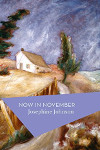
I’m not sure exactly what it is about Thirkell, some sort of semblance to Gaskell, perhaps, and a feeling not dissimilar to the books my mother introduced me to, but with Josephine Johnson it was Little House In The Big Woods, and a feeling of the moors, like it could have been a forgotten Brontë if they’d written about the Southern States of America. Now In November won the Pulitzer Prize in 1935. It’s very of its time, lacking in what we would consider action, but just so good.
Of course its date is more modern classic – 1935, just a year before Margaret Mitchell’s publication – but it still felt good to have read it. It’s hovering just around being forgotten; it’s likely Apollo’s reprint will help it gain ground, particularly given the Prize. Was it forgotten because it was so relevant to a particular period in history, as the Prize might suggest?
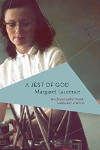
The story behind Margaret Laurence’s The Stone Angel fascinated me because it’s considered a Canadian classic and from what I’ve found out, it seems it’s still read in the country. It fascinates me because it’s on a topic that will likely never be irrelevant, unlike, perhaps, Johnson’s work – however much the life trappings have changed since, Laurence’s protagonist could be transplanted into a book from today, a person who is oblivious to why her son doesn’t want to look after her any more – we can see why and it’s all to do with her behaviour. Apollo have just published Laurence’s A Jest Of God and thinking it might be similar, I had a look. It is, from the other side of the story – the daughter of an overbearing mother. You can’t see it from the image I’ve used but there’s a quotation from Margaret Atwood who says it’s “An almost perfect book”.

If judging a book by its cover then I’m very interested in Eudora Welty’s Delta Wedding, a ‘portrait of family life in the American South during the 1920s’. The focus is on a particularly mundane year which meant that ‘initial reception of the novel was chequered, with many reviewers challenging the absence of plot’1. Likely what we’d now call a character-driven novel, Apollo’s decision to publish it suggests it’s one to read. Another author who won the Pulitzer, though not for this book, Welty used technology as symbols in her work. Her home in Mississippi is now a museum. Like Kate Chopin’s house it was damaged by fire, but unlike that building there was enough remaining for it to be restored.
I’ll be reviewing Christina Stead’s Letty Fox: Her Luck soon and as I featured it in my first lines post last week I won’t include it here except to say I’ve since found out it was loved by Angela Carter.

In terms of other books I’ve not read but want to, Monica Dicken’s Mariana, published by Persephone, has been on my list since I first saw it. It was the cover that drew me mostly because , at the time, it was the first non-grey Persephone I’d seen. Finding out later that Dickens was a granddaughter of the Victorian novelist cemented it. Don’t ask me why I’ve not read it yet – I’ve no excuse.
With Virago, I hope to get to all of Barbara Comyn’s and Du Maurier’s books… if I can say that when particularly in the case of the latter it’s been a good few years since I read Rebecca and I have four other novels on my shelves waiting.
Which little-known books would you recommend, particularly those published no later than 1960? (Arbitrary decade, I know.)
1Wikipedia’s page on Eudora Welty, accessed 17th May 2017.
Classics In The Summer
Posted 15th May 2017
Category: Chit-Chat Genres: N/A
3 Comments
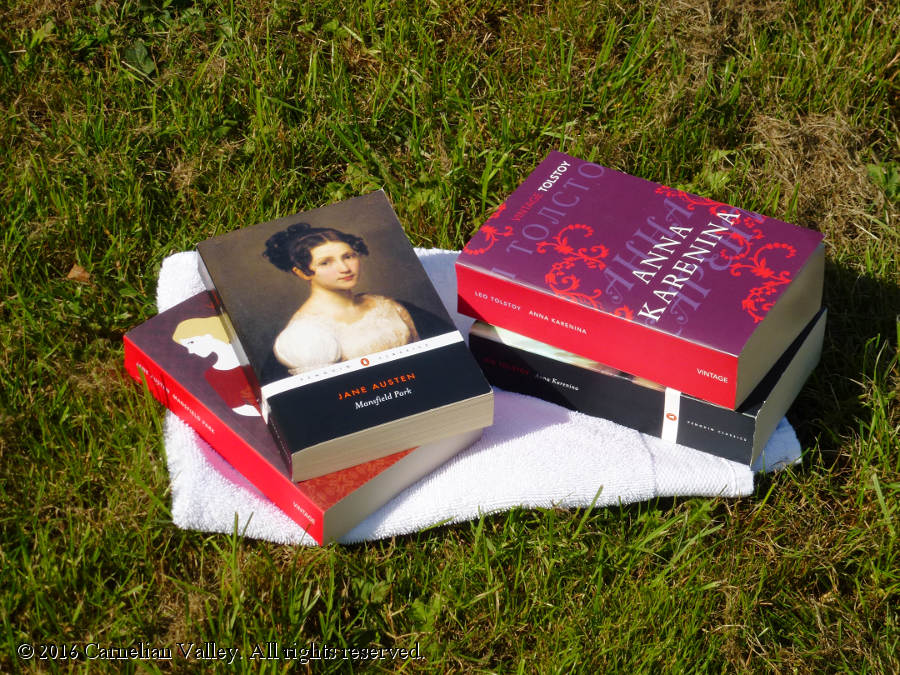
For a good few years now – at least three, I’d say – as the sun makes its way higher in the sky and the days warm up, I get a strong urge to read classics, particularly Victorian and late Georgian. It always happens around late April to May and sort of finishes in July at the time the sun’s decent becomes noticeable.
There are certain factors that come into play – the classics I feel most drawn to are ones that for one reason or another I relate to happy, sunny days. Austen gets a big look in; aside from Persuasion, which is full of windy strolls by the sea and which I first read when ill with a cold, all her books I associate with summer. I read Pride And Prejudice in February, but it was a sunny February and there is a lot of summer in the book. I read Sense And Sensibility in April of the same year; Sanditon in July.
Dickens gets a glance or two – usually, on further consideration, I don’t see it as appropriate. My thoughts of Great Expectations in relation to summer rest firmly in the fun chapter of rocking chairs and parental mishaps – I forget exactly what happens, I just know I loved it. But the book in general wouldn’t be a great choice.
Bronte… the windy moors, general trauma, and pathetic fallacy don’t make them good choices. Though for some reason Daphne Du Maurier appeals. I would approach another Hardy with trepidation but would approach it nonetheless.
A lot of it rests on the idea of re-reading; if I read a book I hadn’t read before, who’s to say it would fit the weather?
Actually, re-reading is another part of it – re-reading always seems a good idea come summer. Summer always feels like a holiday even if it isn’t, children off school for weeks being a reminder of your own childhood summer holidays; the possibilities, the feeling that you’ve lots of time during which you can do whatever you want. In terms of books, re-reading feels more of a holiday than reading new books, with less effort required and thus more relaxation promised.
But I’m yet to get round to reading classics or re-reading anything in the summer. A couple of years ago I made a point of sitting outside one early morning with a coffee and Elizabeth Bennet and it was lovely for the time it took to read two chapters. I never got round to carrying on. Last summer I spent early mornings in the garden reading new books. I think it’s the ‘another day’ problem; I can always do it another day. But that day hasn’t come yet.
Do you favour certain genres at certain times of the year?
Project Charlotte
Posted 24th April 2017
Category: Chit-Chat Genres: N/A
5 Comments

For many reasons, I’ve never liked my full name. But recently I’ve been looking to feel a bit more comfortable with it and that has been bolstered by historical figures I’ve discovered. Brontë, of course, but also Perkins Gilman and, literature aside, Queen Charlotte of Mecklenburg-Strelitz. I’m never going to revert to the name myself but I can at least feel better about it, align it with some great writers.
To this end I’ve decided to focus on well-known writers, in the hope of developing an appreciation and positive relation. I’m choosing writers whose work is in the public domain for ease, the limited numbers, and because of my interest in history… and because it costs a lot less to read free books.
So I took myself to Project Gutenberg and searched to catalog. There are a number of Charlottes listed so I’m going to focus on those for which there’s some information. My list is short – I think that’s best, and is as follows: Brontë, Perkins Gilman, Turner Smith, Lennox, Mary Yonge. It doesn’t go as far back in history as I’d like – Turner Smith and Lennox were born in the early decades of 1700s – but then I’m dealing with historical texts written by women. I’m also perhaps sort of cheating as I’m half-way through my second Gilman and have read two Brontës. But I couldn’t really leave them out.
I’m particularly looking forward to reading Turner Smith, Lennox, and Yonge because I’d forgotten about them. Turner Smith I first discovered some years ago but her book, Emmeline (a Cinderella-type story) was only available online in scanned fragments of old editions and about as much in print. In the years since, Project Gutenberg have produced a text – finding that made my day. There aren’t aren’t notes in regards to sourcing but it’s the best yet.
Lennox I only knew from seeing The Female Quixote listed on Girl Ebooks. Having read that it’s a parody of Cervantes I’m very much looking forward to it. Granted, my knowledge of the story is limited to Nik Kershaw’s song and the bookmark in my father’s copy that never moved from 1/4 of the way through, but it’s enough. It also appears to be shorter and there’s no need to worry about finding the right translation.
Yonge I heard of through well, you guys, and it’ll be The Heir of Redclyffe that I’ll be reading. In researching her I discovered she lived and died in Hampshire so I may make a trip to see her house and grave. The novel is mentioned in Little Women.
Charlotte Niese, a German writer, was looking like a possibility, but there’s only one story available in English and I’m not so sure there’s any fiction to be had. She campaigned for women’s rights but Wikipedia states she wrote only within socially acceptable boundaries. If, once I’ve read the above five authors, I want to continue, I’ll consider Niese; I’ve got to remember that as much as my first thought was to compile a list of every literary Charlotte, non-fiction texts don’t quite match the concept I had in mind.
Still to decide: do I extend my reading to other countries’ versions of the name? I considered ‘Carlotta’ but I actually rather like the one so it wouldn’t really fit what I’m trying to do and as previously alluded to, it’s difficult to work with translations.
I’ve no dates, no schedule in mind, it’s more a general reading goal. I may or may not post updates – most likely I’ll just review the books.
Any famous literary Charlottes I’ve missed?
Books I Read Before I Started Blogging
Posted 10th April 2017
Category: Chit-Chat Genres: N/A
1 Comment
When I became a book blogger, half-way through the first year I tracked my reading, I made a point of reviewing the previous few months’ books and summing them all up at the end. But besides the odd mention here and there, I never noted the books I’d read before tracking/blogging. This number is obviously a bit too high to make into a blog post and trying to remember everything I’ve read would take a while. In planning this post I’ve realised the truth of my memories of using the library a great deal when younger – I don’t have copies of most of the books I know I read then.
Due to how many books this idea would involve, I’ve limited it to those I own (so regarding the above, not many) and I’m excluding children’s books, including only young adult books and ‘teenager’ books – I think that’s more accurate to what we called them back then. Including only the books I own has the added bonus of me knowing for certain that I read them.
I’ve left out books I’ve re-read since starting my blog. I may end up re-reading some of the books listed – I certainly hope to in some cases – but writing this post ensures I’ve at least commented on them somewhat. Lisa Jewell’s pre-literary/historical work dominates.
I’m not sure the above makes total literal sense – I’m suffering a bit from heatstroke – but hopefully it’s enough for you to get the idea. I thought I’d list them in the order I remembered them in rather than alphabetically – it has the added bonus of creating two equal ‘halves’. Here we go:



Alma Alexander: The Secrets Of The Jin-Shei – A historical fantasy. This is about a China where women are the dominant gender. It has some magic in it, some battles, and is fairly diverse, but a word of warning must be given regarding the sexual violence which isn’t softened by the magical concepts behind it, no matter how much that may have been the intention. I intend to re-read this one and get an idea of how it reads now I’m old enough not to be so in subjective awe of the genre.
Arthur Golden: Memoirs Of A Geisha – Historical. This is about a young girl who grows up to be a geisha in the years towards the end of the profession. Since made into a film so I doubt I need to note too much. I’m not sure if I’ll re-read it.
Lisa Jewell: Ralph’s Party, Thirty-nothing, One-Hit Wonder, A Friend Of The Family, Vince & Joy, 31 Dream Street – Chick-lit. I’m going to sum these up as it was a phase and say that they were pretty good, escapism. Didn’t like Jewell’s use of ‘spastic’ however and am glad she seems to have now dropped it from her more recent books.




Maile Meloy: Liars And Saints – Contemporary, mostly and may be classed now as literary fiction. This is about different generations of a family, fairly dysfunctional people. Reading this made me feel very grown up. I want to re-read it in the near future as I’d like to read it in the way I read now and work out just what all the sex was for.
Anchee Min: Empress Orchid – Historical about the last empress of China, Ci Xi. Min is quite forgiving of her character but not completely. Suffice to say this is a difficult read at times but good nonetheless. I intend to re-read it.
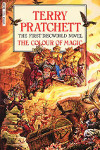
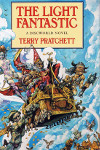
Terry Pratchett: The Colour Of Magic, The Light Fantastic, Equal Rites, Mort – The first four Discworld novels. I wasn’t too keen on the first two, but Granny Weatherwax of the third is great and Mort remains my favourite so far.
Celia Rees: Witch Child – Historical fantasy. A girl with witch-like powers travels to the New World. I don’t remember too much of the story but do remember it made me cry. I’ll re-read it at some point.
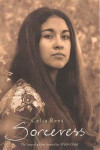
Celia Rees: Sorceress – Fantasy. Set in the present day this is about a descendent of the heroine of Witch Child and her discoveries. Pretty good but not as good. I’ll probably read it as par for the course.
I used to read a lot more fantasy than I do now, though I still love it. The later teen years were when I discovered historical fantasy; for a while I read nothing else. I still have the sequel to the Alexander on my shelves to read; I bought it because it made sense at the time but upon reading the blurb I discovered it’s quite a bit different. Still, I’m glad I have it because it’s difficult to find nowadays.
There are so many books I want to re-read to see how I find them in, as said above, to ‘read it in the way I read now’. I have that urge to re-read constantly, finding that the more I read the more I feel I should go back and re-read books read previously because I’ve changed, grown as a reader, and so on. I even find myself feeling that way about books I read in more recent years. I think we all feel this way at times.
What books did you read in your younger years that stood out to you? Do you think you’d still like them if you read them now?


