

Natasha Solomons – Mr Rosenblum’s List
Posted 7th January 2015
Category: Reviews Genres: 2010s, Domestic, Historical, Social, Spiritual
Comments Off on Natasha Solomons – Mr Rosenblum’s List

Wanting to talk of the weather, wanting to queue, and wanting to take tea.
Publisher: Sceptre (Hachette)
Pages: 311
Type: Fiction
Age: Adult
ISBN: 97-0-340-99566-2
First Published: 2010
Date Reviewed: 6th January 2015
Rating: 4/5
Jack and Sadie Rosenblum, Jews, left Germany for England as life became dangerous, and upon arrival, Jack was given a leaflet regarding the conduct expected of them. He takes it to heart. Above and beyond what is expected, Jack makes it his mission to become a proper Englishman in every way.
Mr Rosenblum’s List is a book that obviously looks at what it means to be traditionally English, but also at responsibility and general social history. It’s quiet and character-driven and isn’t likely to blow you away except if you get caught in the gale-force wind, but it will make you chuckle and consider the experience of immigrants.
Whilst mostly, aptly, focused on Jack, there is a lot of time spent on Sadie. In many ways she’s the long-suffering wife, the one wanting to keep the traditions of home whilst her husband wants to forget them. You see the contrast in the way they go about their individual lives – how Sadie starts to enjoy her new life, to blend the old and new, and, inevitably you witness how she begins to fit in without trying to. Solomons doesn’t make this idea a focus, far from it, but it’s there – that thought that sometimes letting things happen as they will works better than being forthright. Sadie has ample space for mistakes; Jack in his boldness has little.
The study of different cultures is a natural by-product of the subject. You have the differences between the Jewish Germans and the English, and of course racism, anti-Semitism, but as the story moves from London to Dorset Solomon provides a mini introduction to the fact of diversity within a single country. Accents are well included throughout and the scenes wonderfully set. If you want quintessential rural England, this book is for you. That the book is set in the mid-1900s means the descriptions flourish, being just as realistic as they are rose-tinted.
Solomon looks at how immigration affects generations. Jack and Sadie’s daughter is very British and you see the happiness and longing of parents both proud of their child’s place and sad at the loss of connection with her due to the difference in culture. And because it is by and large told from Jack and Sadie’s points of view, if offers a lot of food for thought.
Given the two locations – London and Dorset – there are observations of how technology and change affect life as we know (knew) it and of course, again, how it has an impact on culture. Solomon places emphasis on working with nature as part of Jack’s progress, allowing folklore to play its rightful part.
There is little focus on the war. It is spoken of but not the point of the novel. This is a story of the people, how life carried on.
Mr Rosenblum’s List loiters much as some of the characters do. It shows you a swath of greenery and rarely takes you away from it, and it lets you potter among Sadie’s roses as you consider the reasons people change their names. Read it on a sunny afternoon with a pot of tea and a plate of scones and you’ll surely have Jack’s approval.
Related Books
None yet.
Susanna Fraser – A Christmas Reunion
Posted 17th December 2014
Category: Reviews Genres: 2010s, Historical, Holiday, Romance
Comments Off on Susanna Fraser – A Christmas Reunion

Should old acquaintance be forgot and never brought to mind?
Publisher: Carina Press (Harlequin)
Pages: 76
Type: Fiction
Age: Adult
ISBN: 978-1-426-89924-9
First Published: 24th November 2014
Date Reviewed: 15th December 2014
Rating: 3/5
It’s the early 1800s and Catherine is to be married at Christmas time. It won’t be a love match, but then she gave up hope of anything between her and her cousins’ cousin, Gabriel, five years ago, when her uncle sent him to war so that the lovers would not cause issues. Gabriel, illegitimate and poor, was no match for a landed heiress. But Gabriel will be returning for Christmas and Catherine must make sure they don’t find themselves alone under the mistletoe again.
A Christmas Reunion is a short novella that presents a look at the turning point of a couple’s relationship.
It’s a nice set up but given the scope, a lot is left out of this story and this does affect the reading. We only learn about the beginnings and the defining moment of the friendship between Catherine and Gabriel via flashback and thus the necessary time for becoming attached to them is completely missed out. The reader has to be willing to take the author’s word that they love each other and given how short the (written) story is, the present part of their tale isn’t developed enough to offset the lack of knowledge. It’s a case of ‘they love each other? Great. Moving on…’ Put simply, this novella really needed to be a full length novel.
The history is well written except for a few spots wherein the English 1800s characters use American English. ‘You wrote me’ is perfectly acceptable in a book about Americans, but completely out of place in Georgian England. These spots are joined by a few proofreading errors that, due to the short length of the book, are very noticeable.
There is a mini reveal that occurs as the story descends towards the finish line that puts previously kind and caring characters in an unbelievable and somewhat nasty place. It’s not the idea of the scene – that is all well and good – but the execution does unfortunately mar what is otherwise a fair cast of characters.
What works in the novella is the way the secret of Gabriel’s heritage isn’t drawn out. Yes, it’s a novella so it couldn’t have taken long, but it is to the book’s credit that it is dealt with swiftly and without shock tactics. And good also is Gabriel’s relationship with his ward. It’s well written and is a nice touch.
A Christmas Renunion isn’t going to win any awards and it isn’t particularly believable, but it is firmly set in its season. The holiday is part and parcel of the story rather than just a backdrop and therefore it’s a fair offering if you’ve an hour or so free and want to feel more festive. That it’s historic surely helps.
Related Books
None yet.
Davina Blake – Past Encounters
Posted 3rd December 2014
Category: Reviews Genres: 2010s, Domestic, Drama, Historical, Political, Psychological, Social
1 Comment
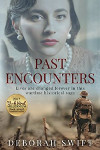
When the past isn’t in the past.
Publisher: (self-published)
Pages: 431
Type: Fiction
Age: Adult
ISBN: 978-1-499-56825-7
First Published: 30th June 2014
Date Reviewed: 22nd October 2014
Rating: 4.5/5
Rhoda finds her married life difficult and always has. Neither she nor Peter are particularly close, and when she discovers he’s been meeting another woman she decides to find out about his supposed affair. Rhoda herself is hiding something from Peter, an event that happened whilst he was in a prisoner of war camp, and just as Rhoda has never spoken of her time, neither has Peter spoken of war.
Past Encounters is an excellent novel that looks at the way secrets, events in the past, continue to affect the way the characters treat each other. The book is a multi-plot novel, of sorts, moving between two decades for the two main characters and including a brief sojourn into the life of another.
In writing Past Encounters, Blake has delved into WWII in a way that is different to many other writers. It may not neccersarily ‘read’ different – others have written about the war camps as have films – but there is a difference nonetheless.
As said, the majority of the book switches between Rhoda and Peter – Rhoda in the 1940s and 1950s, and Peter almost exclusively in the 1940s. Rhoda’s chapters are written in the first person, Peter’s in the third, and perhaps in part because of this, both points of view are equally compelling. In Rhoda’s case you are reading about her search for the truth and the event that changed her, in Peter’s you are finding out about war and why he may not have wanted to speak of it. What’s interesting here is that Blake spends much time telling you all of this yet shows at the end that it’s obviously not black and white. There is a hint – though only a hint – of unreliability, or, rather, the fact that it’s best to remember there are two sides to every story.
The characters aren’t particularly special; apart, perhaps, from Peter’s trials in war, you’re likely not going to remember them for themselves, however this is a point worth considering. It is often more what Rhoda and Peter represent, how they remind you to look at your own life from different perspectives, that is most important. They are two ordinary people living lives in ordinary situations (but for the war), and this makes the book shine.
Blake doesn’t hold back on her descriptions of war. She doesn’t describe everything in gory detail, but her word choice, her style of writing, says so much. You get the facts and you get the raw feelings. And sometimes, because she includes the happier moments and always reminds you of the thoughts of the regular people, even the soldiers, it is all the more compelling. Blake repeats details and talks of the mundane because that was the reality of the situation, and it keeps you reading. Never should you forget how war affected the other side and how most simply wanted to live their lives.
Yet this doesn’t mean that the book falls prey to that known situation wherein a reader prefers one plotline to another, as often occurs when a book switches back and forth. Yes, you may prefer one or the other, but you’ll likely enjoy reading both nonetheless and be happy to catch up. In Rhoda’s story there is longing, there is the change in character that is of course less ‘important’ than Peter’s changes but still important, and there is also the foray into film.
The book’s title owes a lot to the film, Brief Encounter, and it is the production of it that features in the story. The title sports many references therein – the literal past, the brief encounter during Brief Encounter and the way the filming affects Rhoda, the way words and small arguments can cause major changes. The film doesn’t take up a lot of the time, but it’s enough to give you a fair background of it, the working methods during war, the differences between people that remained during war, and so on. And then there is the way the filming clashes with Peter’s internment which may not speak for everyone’s experience but does show how people might have coped in such a situation.
There is that third narration, but it can’t really be discussed without spoiling the story, suffice to say it serves to show how chances taken at the right or wrong moment can have a major affect on everything else.
The sole element that stops the book taking the top spot is the text. There are batches of errors – proofreading and copy editing problems. The story and the book in general is so good it’s very possible to overlook the errors, but in terms of objectivity and the whole, it must be taken into account.
Past Encounters is masterful. It is compelling, and whilst diligently keeping to the specific topics at hand, it never becomes boring or falls into the trap of filler content. It is epic without requiring lots of action and changes, an epic about war without battles.
This book is wonderful.
I received this book for review from the author for Historical Fiction Virtual Book Tours.
Related Books

Diane Setterfield – Bellman & Black
Posted 24th November 2014
Category: Reviews Genres: 2010s, Commentary, Domestic, Historical, Paranormal, Spiritual
9 Comments

A ‘ghost’ story perhaps, but not in the usual sense.
Publisher: Orion
Pages: 307
Type: Fiction
Age: Adult
ISBN: 978-1-409-12801-4
First Published: 10th October 2013
Date Reviewed: 23rd November 2014
Rating: 4/5
At ten years of age, William Bellman strikes a rook with a stone and a catapult. He’s a little chilled by the experience; as the stone flies forward he wants to warn the rook but can’t. And life goes on. William isn’t to know that the experience will never truly leave him, but he may not see what is happening.
Bellman & Black is a literary novel of a certain, rather unique kind, in that the story isn’t obvious and the writing style differs to many others. Setterfield speaks in the third person from an almost personal point of view yet the writing itself is almost scarce – almost bullet-pointed in style. The book is an echo of Dickens – his voice, the uncanny, spooky, way he seems to be speaking just over your shoulder at times, and a similar darkness when things become creepy (yes, darkness and creepy even when they can be one and the same). The basic themes are of time and working rather than living – missing out. There is a worthy link to be made with Scarlet O’Hara’s rescheduling of everything for tomorrow morning.
Something that needs to be said straight away is that Setterfield is never quite clear about what is happening, or, rather, why such a thing is happening. There’s a meaning, a message, in this book, but you’ll possibly have to dig very deep to find it and it’s beyond the normal thought of interpretation. Part of this is, sadly yet understandably, due to the subtitle of ‘a ghost story’. Bellman & Black is not a ghost story or, if it is, then again it’s not at all clear.
There are sections throughout that deal with rooks, that speak of rooks in a particularly familiar way as the author speaks directly to the reader, but this is yet again vague. It’s as though Setterfield has provided pieces of the puzzle for the reader to put together and work out, which isn’t unusual in literature and can result in some amazing revelations, but unlike other authors, Setterfield has forgotten to give you the last few pieces. Maybe the individual interpretation is the whole point, but even if it is, there needed to be more to use.
The book is far more about character than plot, indeed unless you’ve an interest in retail history or business you may find the repetitions of workaholic Bellman a bit dull, however you will no doubt see the reasoning for it. Setterfield repeats herself to the extreme so you want to be prepared for that. If you are interested in retail history – the television show Mr Selfridge comes to mind – you’ll likely want to keep reading beyond the end. There is also a fair amount about the workings of a mill – whether it’s earlier than the industrial revolution is something that’s in itself fun to work out.
As for the character development, Setterfield has settled for something in between realism and fantasy, as is of course obvious from the first few pages. It’s both fast and slow – Bellman becomes who he will be very quickly yet the result of this only begins to be revealed later on. The secondary characters are not fleshed out as much as you might hope because, put simply, the book isn’t about them. They are there to show you what Bellman is missing. They are stereotypes and cardboard cut outs to give you a quick idea of what Bellman leaves behind when he’s at the office, so that you’ve a good understanding of what he could have and also a good understanding of how his friends and family are likely to feel.
As said, the placement is vague. The book is obviously historical but there are no dates given, no countries (at least for Bellman). It does become clear as the book carries on as elements of a certain period are brought into play. The vagueness allows for a certain quality – left to your own devices you are able to concentrate on Bellman rather than the history and Setterfield can get on with her narration without too much detailing. There is enough detailing to set the scene and that is it. The superfluous is down solely to the repetition and as that is up for contention that’s no bad thing. The lack of dates also allow Setterfield to illustrate how her themes are eternal. (Themes are one thing and clear enough, it is the message that is less clear.)
Bellman & Black makes for a fair read. It’s enjoyable, the writing is intriguing, beautiful, almost, and there is just suspense enough that you’ll want to continue. Just don’t hope for too much – enjoy the ride as it is without expectation but realise that due to the lack of information you may not actually feel like spending time mulling over the content afterwards. Your reading will be, much like it’s theme, very much in the present with no thought of the future.
Related Books
None yet
Erica Vetsch – A Bride’s Portrait Of Dodge City, Kansas
Posted 27th October 2014
Category: Reviews Genres: 2010s, Historical, Inspirational fiction, Mystery, Romance, Social, Spiritual, Western
Comments Off on Erica Vetsch – A Bride’s Portrait Of Dodge City, Kansas

As people learned to say cheese.
Publisher: Barbour Publishing
Pages: 309
Type: Fiction
Age: Adult
ISBN: 978-1-616-26506-9
First Published: 1st September 2011
Date Reviewed: 17th October 2014
Rating: 4/5
Addie moved to Dodge City with her uncle after troubles caused them to move from Abilene. Now Carl is dead and Addie is trying to build up their photography business by herself. She has a romance-minded friend, Fran, and then there’s the new Deputy Sheriff. Miles has started his new job, and has a few personal conflicts about the job, owing to his new found faith, but he’s excited nonetheless to be working as a lawman, especially given his past.
A Bride’s Portrait Of Dodge City, Kansas, is a pretty fair historical novel straddling the mystery, suspense, and romance genres.
Christianity features in this book. It is a big part of a few of the character’s lives however in terms of the novel itself the faith is woven in enough that the general reader should be okay with it. There are a couple of times where Miles feels he should be declaring his faith to his boss, which isn’t really appropriate, but otherwise the times the characters think of God are totally natural – Addie prays for help whilst hiding from shooting, for example. And there isn’t all that many textual references to it, it is more a case that the reader knows the characters have faith.
The language is generally very good, the characters well written. Addie is self-employed, a woman working as a photographer in the 1800s against various prejudices. She is strong throughout. Fran is a dreamer and doesn’t realise the potential danger ahead, and Vetsch does put her in some situations, including a scene of harsh words from the man who says he loves her, but overall you can see where the author was wanting to show how the good guy can be a mysterious knight in shining armour if given the chance. This said there is a scene in which a bad guy gets perhaps more nasty than he had previously seemed (yes, even for his associations) that readers may find uncomfortable for the way it plays out. Miles will appeal more to a Christian reader than otherwise, though either way you’re likely to see him as a fair hero.
There are repetitions, for instance you hear about Addie’s move from Abilene a few times and there aren’t really enough updates to warrant it until later in the book when she gives you the whole story, and these feel as though a word count was needed because as soon as the narrative moves away from it the story carries on well.
The book is somewhat predictable by fact of it’s romantic genre, but another thread that seems predictable is not so much. This said, the mystery and suspense take a somewhat surprising turn near the end and one of the most obvious suspects isn’t spoken of until this end. The suspense itself, however, is written excellently and Vetsch hasn’t shied away from the details, in fact it could be said she lures you into thinking everything will be just about drunken cowboys, red lights, and saloons, until getting to the gritty stuff. And she shows the difficult and otherwise immoral choices that must be made in times of emergency.
There is a great deal to learn about photography and the times in general. There is a lot of detail given to photography but not so much as to make it boring. Indeed if you’ve even the smallest interest in the subject you’ll likely enjoy Vetsch’s descriptions. The book is firmly in cowboy territory and the balance between ‘protect the women’ and Addie’s freedom is good. Fran could have done with more freedom to choose, but given the way she is presented from the start, you know she’s going to go back on her words somewhat.
Lastly, this may be a clean romance, but its kisses and thoughts are pretty steamy all the same. Indeed Vetsch shows you don’t need sex for a fair tale of romance.
What works in A Bride’s Portrait Of Dodge City, Kansas (it’s a long title but interesting for its difference) makes up the vast majority. There may be flaws but looking at the big picture the book is very good. Cowboys and photography, gangs and romance, independence and dependence; if you’re looking for a western with a bit of faith, you could do worse than read this book.
Related Books