

Terry Pratchett – Wyrd Sisters
Posted 6th January 2011
Category: Reviews Genres: 1980s, Comedy, Fantasy
3 Comments
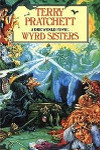
How can you describe a Discworld novel in a couple of sentences? Answer: you can’t.
Publisher: Corgi (Random House)
Pages: 328
Type: Fiction
Age: Adult
ISBN: 978-0-552-13460-6
First Published: 1988
Date Reviewed: 21st December 2010
Rating: 4.5/5
When the king of Lancre is killed, the witch Granny Weatherwax and her coven (well ok, only Magrat calls it a coven, because she’s all traditional-like and believes in doing things correctly) find themselves left with his son. Luckily for them there’s a theatrical troupe in town that Granny thinks will make the perfect guardians even if the strange people do seem to still be alive after dying on stage. But one day the boy will have to return, and as it’s destiny the witches may as well not bother to go and find him.
I’ve never attempted to review a book from this series before because it is just so difficult. The overall plot may be easy enough to talk about but Pratchett goes off on so many tangents that often you can forget what the purpose of a particular scene’s events was.
“My name is unpronounceable in your tongue, woman,” it said.
“I’ll be the judge of that,” warned Granny, and added, “Don’t call me woman.”
“Very well. My name is WxrtHltl-jwlpklz,” said the demon smugly.
Personally I’ve found that the series gets funnier and funnier as it continues, and Wyrd Sisters doesn’t buck the trend. There were a good few times where I was in tears of laughter, so much so that when my phone rang I felt the need to inform the caller that I wasn’t upset. It has a lot to do with the number of characters. Each is vastly different, although you may not notice it while reading because the emphasis is on the humour. This means that there is a place for slight differences in the humour and for Pratchett to really enforce his stereotypes.
As always, inanimate objects get just as much time as people and animals, in particular a solo stone that hides behind a bush when anyone tries to count it. And a minor character is a storm looking to become the next hurricane.
The apple-seller gambit had never worked more than once in the entire history of witchcraft, as far as she knew, but it was traditional.
There are a lot of references to old stories and tradition but unlike the current trend of being very specific and thus dating a book, Pratchett is general and his references are ones likely to remain public knowledge for a long time, such as fairytales. The writing style is another cause for laughter because although Pratchett is not the most eloquent of authors, it doesn’t matter one bit. The book is joke after joke after joke and actually the categorising of the series as fantasy does it an injustice, you don’t need to like fantasy to like the Discworld novels.
If you’ve never read a Discworld novel I would advise starting with either this or Mort because although the first is good, it’s not the best. Wyrd Sisters has the advantage of little background history (which you don’t really require anyway) and as mentioned before, the different characters.
Pratchett’s humour can become wearing if you read too much of his work at once but if you space it out it can add something unique to your reading experience.
Related Books

Alex Bell – Jasmyn
Posted 27th August 2010
Category: Reviews Genres: 2000s, Fantasy, Thriller
1 Comment
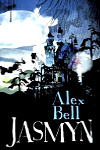
An epic tale of love, dark magic, and mystery, told in a reasonably short time.
Publisher: Gollancz (Orion Books)
Pages: 311
Type: Fiction
Age: Adult
ISBN: 978-0-575-08029-4
First Published: 2009
Date Reviewed: 24th June 2010
Rating: 4.5/5
Jasmyn’s husband is dead, that’s all there is to it – there were no warnings, no signs, it was sudden, he’s gone. And now Jasmyn’s started to experience strange things – swans falling from the sky at his funeral, photographs of her wedding day being altered so that she no longer looks happy, cruel people around her. We say that fairy tales aren’t real, but Jasmyn knows better and, actually, fairy tales may be exactly what this is about.
Jasmyn boasts a fantastic story. In it Bell has blended reality with fantasy. There are a lot of fantasy books that are strictly fantasy, and then there are some that mix our world with a pretend one, but in these latter cases the worlds are more clear-cut. What Bell has done here, not unlike in The Ninth Circle but certainly to better effect (because of course in The Ninth Circle the fantasy was theological, therefore more knowingly realistic than unicorns and fairies) is set the bare basics of the story – Jasmyn herself – in our world and then tease at the edges until they fray and become twisted around the make-believe. The fairy world in Jasmyn isn’t happy-go-lucky – this is a dark fantasy – and the dark element aids the blending further. This is in part due to the fact that the actual fairy world comes into the story only a few times because the emphasis is on keeping the characters away from it. Similarly to Lex Trent Versus The Gods, Bell has included a range of different tales from different countries. I found the book made me re-think all the things we are told are myths. Is our world really as black and white as we’re taught?
Jasmyn, the character, is an interesting one. Bell has made her albino and so alone this brings in the question of whether or not Jasmyn may be mystical herself. To think about it beggars the question of whether this would be acceptable in real life because, like anyone whose looks differ from the “norm”, albinos would not like to be singled out in such a way – but then at the same time some might find it empowering to see themselves in the way that Jasmyn has been taught by her husband. The inclusion of Liam’s love for Jasmyn and his understanding of her is a great attribute of the book. The character will likely appeal to anyone who has a disability or has trouble with social expectations for her internal discussions about how she is accepted.
In general Jasmyn is a fine narrator, but at times she can be irritating. It suits the telling of the story to have her not realising or understanding things every now and then, but although it may provide more space for extra subplots it causes the story to slow down. It suits its length but it’s slower compared to Bell’s other work. Some of the dialogue is superfluous as are some internal conflicts within Jasmyn’s mind.
Through the character of Ben, Bell has re-used the same idea she did for Stephomi in her previous book. Is he good or is he bad? She writes this element well so that although it may basically be a repetition – and a very apparent one – it never feels stale, and most importantly is, as with The Ninth Circle, a big reason to keep reading.
Bell brought up differences in the form of Jasmyn, but she doesn’t stop at looks. Included in the book is a laboratory and it is here that Bell proudly stands up and makes a statement about animal testing. It doesn’t impact the plot, and she hasn’t gone overboard. She has made her point but now the story will continue, and actually, the way it’s been done makes it one of the most memorable parts of the book.
Jasmyn takes the fairytale and turns it on it’s head. It takes the legend away from it’s comfort zone and often to some very unexpected locations. And it’s believable because of the extent of the mundane throughout.
I defy anyone not to travel with Jasmyn into this parallel world – even if it’s not quite the happy place you would expect.
Related Books


Stephenie Meyer – The Short Second Life Of Bree Tanner
Posted 12th June 2010
Category: Reviews Genres: 2010s, Fantasy
1 Comment

Just when you thought the series couldn’t be commercialised any further…
Publisher: Atom
Pages: 178
Type: Fiction
Age: Young Adult
ISBN: 978-1-907410-36-9
First Published: 5th June 2010
Date Reviewed: 12th June 2010
Rating: 1/5
Bree, the vampire introduced in Eclipse for all of a few pages, is given a fair few more pages for her back-story. We get to hear about the week or so before she was destroyed and some extra information on the reasons for the battle that took place between Victoria’s minions and the Cullens.
Did we really need this book? Although Meyer says in her foreword that she wanted to tell this story so that we might feel for Bree as she does, the whole work was a totally unnecessary release, and I say that as someone who quite enjoyed the series. To read the foreword shows how Meyer has been changed from a woman who wanted to write stories into a powerhouse for making money and, I would take a guess, that although Meyer may be enjoying her money it’s the film studios and book publishers that are behind it. Meyer herself has even provided the fact that there were others behind this book when she talks about her editor.
The whole deal with the Twilight saga, Meyer has been keen to express, is that the romance is paramount – the vampirism isn’t so important. Bella’s story is central – why then a spin off that bares no relevance to any of the previous novels? If the saga revolved around vampires and their world it would make sense, but it doesn’t. More to the point perhaps is the fact that this book doesn’t have a point, its story is worthless and there is nothing to read it for. Readers love the characters in Twilight; they swoon over Edward and envy Bella – so what is there in this new book to take away? The story doesn’t go anywhere; it’s just an account of a vampire living with some other vampires in the days leading up to the battle. It even includes pages about battle training – those pages are completely irrelevant because we already read lots about battle training in the original saga where, in addition, it was more interesting. And Meyer wants us to feel for Bree even though, as she says herself, we know she dies at the end anyway.
The idea for this book was conceived during the writing of Eclipse (no doubt originally by the publishing house staff who made Meyer think she’d thought of it first) and although that’s better than it having happen after Breaking Dawn (and therefore even more obviously a money-making device) it just doesn’t sit well. Asking us to feel for Bree is akin to asking us to feel for an extra in a movie when he comes out of a shop with a battered sandwich. We never noticed him because he was background scenery and we’ll never see him again, so who cares about the sandwich? Ironically Meyer discusses how she never noticed Bree the first time round (in the first edit of Eclipse) because she was focused on Bella. She should have thought through that properly, as she should have also the idea that no fictional perspective is trivial.
The one thing this book has going for it is the cover – like the four other novels, it’s absolutely gorgeous. The same can’t be said about the writing. When I wrote about Twilight I described how Meyer’s writing was solid and how she could change for the better the language skills of our children. Well I’m withdrawing that notion – this novella is awful. And what are all these “all” sentences? “We all were out in the sun” and the like crop up constantly – has Meyer never been introduced to the less clunky and ultimately better structure of “we were all out in the sun”? The foreword itself is a mess.
No doubt about it, this book will be put forward for filming and another young actress pushed into the spotlight and stereotyped for the rest for her career because she’s not as old as Robert Pattinson, who had the foresight to sign on for other films. The publishers will keep raking it in and preying on love struck teenagers, no matter whether or not the teenagers are appeased by the story of yet another girl who was able to come into close contact with Edward.
The Short Second Life Of Bree Tanner is overpriced and superfluous. It’s as unrelated to the saga as that man and his damned sandwich, which have now been rained on and we still couldn’t care less.
Related Books


C S Lewis – The Horse And His Boy (The Chronicles Of Narnia)
Posted 25th May 2010
Category: Reviews Genres: 1950s, Fantasy, Spiritual
Comments Off on C S Lewis – The Horse And His Boy (The Chronicles Of Narnia)

The story takes on a middle-Eastern flavour and we travel to the lands beyond Narnia.
Publisher: (Numerous, the one pictured is the Harper Collins 1998 edition)
Pages: N/A
Type: Fiction
Age: Children’s
ISBN: N/A
First Published: 1954
Date Reviewed: 14th May 2010
Rating: 3/5
The second of the lesser-known books, The Horse And His Boy has been as equally forgotten as The Magician’s Nephew, though it’s easy to see why as the story bares hardly any relation to the others.
Shashta doesn’t want to become the slave of the man who turns up at his father’s house in Calormen so he steals away with the man’s talking horse (a Narnian who was captured as a foal) with the aim of reaching Narnia. In trying to escape a lion their paths cross with Aravis, a Calormen princess on the run, and her own talking horse, Hwin. All four decide to carry on their journey together. But when they reach the capital things don’t go according to plan, the Narnian royal family are visiting and mistake Shashta for someone else. And Queen Susan’s suitor has created a problem for everyone.
The Horse And His Boy is the simplest of the chronicles, being very much a spin-off. It’s not necessary to read it and this is a pity, one gets a sense that Lewis felt he had to write some more rather than he wanted to. The land of Calormen destroys the setting of Narnia – Narnia is so different to our world with it’s talking animals, but Calormen is more the regular exotic dream, in keeping with reality from our history books. It’s also hard to accept, perhaps, that Narnia isn’t in it’s own world, that there are other lands surrounding it, because the way Lewis wrote it in The Lion, The Witch And The Wardrobe, although it was hinted at, the feeling was that it was by itself.
The story is ok, but as the majority of it takes place outside of Narnia there is little for the reader to relate to. It does a good job in showing us the everyday life of the kings and queens of Narnia during the period of their reign at Cair Paravel – perhaps this book ought to have focused on them more.
There isn’t so much a Biblical theme to The Horse And His Boy as there are the others, Aslan is still Jesus, but the only Biblical story I can relate to it is the road to Damascus after Jesus resurrects. There is, however, an overall theme of Jesus helping his followers, one could compare part of the book to the Christian poem Footprints.
The Horse And His Boy is a nice short read but not as compelling as the rest of the series. Fans will devour it but otherwise it’s possible to skip it in favour of Prince Caspian.
Related Books


Stephenie Meyer – Breaking Dawn
Posted 29th April 2010
Category: Reviews Genres: 2000s, Fantasy, Romance
1 Comment
Stephenie Meyer is still everywhere and it looks like that will be the case for some time yet.
Publisher: Atom
Pages: 699
Type: Fiction
Age: Young Adult
ISBN: 978-1-905-65428-4
First Published: 2008
Date Reviewed: 14th December 2009
Rating: 4.5/5
Breaking Dawn is the massive final chapter of the saga. It saw quite a change from the previous books.
So Bella agreed to marry Edward, and marry they did, a lovely if over-the-top (for Bella’s sensitivities) ceremony in the Cullen house attended by the usual everyday mix of humans, werewolves, and vampires. The honeymoon was lovely too, courtesy of Esme, but things aren’t destined to stay perfect when a human is in love with a vampire, no matter how many trials they’ve got through. Bella thinks she pregnant, and this little creature is going to shake everyone’s life, whether they be immortal or not.
The book is divided into three smaller “books”; the first and last are from Bella’s point of view and therefore read the same as the previous three in the saga. The second takes up the story from Bella’s pregnancy and continues it from Jacob’s point of view whereupon we get some interesting plot turns.
Breaking Dawn is a complete turnaround from the others. Whereas New Moon and Eclipse were undoubtedly fillers, sub plots written to keep the saga in the charts and in the minds of fans (as well as provide more income for the movie makers), Breaking Dawn reads like the follow-on of Twilight. It certainly seems as though Meyer has had more power and say in what she writes and most definitely she knows what’s she’s doing and what makes a good story. For the most part, Breaking Dawn is utterly fantastic, a real page-turner.
The other major differences with Breaking Dawn are the viewpoints and storytelling. Though at first it may seem a pity that Meyer has chosen not to honour Bella seamlessly it doesn’t take long to feel comfortable with Jacob. Meyer writes from his viewpoint well, there’s that extreme difference in the style from the chapters themselves and the chapter titles. Whereas Bella’s chapters are all titled abstractly though in accordance to the main theme of each, Jacob’s are a very simple summary of what is happening at that point in time. Ever blunt, they are great in themselves.
It’s in the storytelling that a debate may arise. Meyer has taken the fantasy to a whole new level. It’s brilliant and so much more mature and detailed than before – but there it is, “mature”. The “problem” with Breaking Dawn is that it’s too graphic and at times lingers on the fence between fantasy and horror. Bella’s pregnancy is full of blood but as it’s not the human birth we accept in the real world it becomes a point to ponder upon – is this content appropriate for young readers? Do they need to read about a huge strong vampire foetus that might just bite through it’s human mother in order to get out of the womb, killing the mother in the process? In Meyer’s defence, those theories do turn out to be simply theories as the Cullen’s manage to deliver the baby without it turning into such carnage, but the thoughts are still there on the page and actually, when it comes to the birth there is a lot of gore included. The way Bella becomes a vampire is also relatively horrific. It may not be, as Carlisle observes, as bad as the usual way of converting, but that’s only in the context of the story. So while the book itself is a fantastic departure from the other three, for parents it may prove worrying and for their children the stuff of nightmares. The older reader will find the book to be far superior. Even those who have previously shunned the saga may enjoy it to some extent.
In lure of young readers there is a lot of sex in the first quarter of the book. It’s not graphically detailed but there are a lot of references and some not-so-subtle innuendo. Even as an older reader the sentence about knowing a better way to lose calories reads badly. Make no mistake: yes, Bella and Edward are married now, and yes, they are enjoying themselves immensely.
As mentioned, the plot this time runs smoothly with every sentence having a reason. One wonders if the saga would be more credible to critics if it hadn’t been at the mercy of the promotion team so early on in it’s journey.
Although in general the plot is exciting there are a few times where proceedings run at a sluggish pace. Of note is the end, which is predictable. The problem with Meyer is that she has an obvious disliking for killing off major characters and while this may be admirable it’s not realistic nor does it make for a good story. Throughout the saga whenever there has been a confrontation of some size the planning that the characters do picks up the pace. But it’s always the same: there’s mention of a battle, there’s planning, and then… oh, all it needs is discussion, or just a five minute fight between a couple of people in an otherwise large army. Victoria was too easy, the Volturi sound menacing but are ultimately too easy, and every confrontation is predictable and miss-able because you already know from all the other times that nothing will happen. If this was Meyer’s decision in light of the age of her target readers then it’s laughable because of the horror elsewhere. And as much as it’s a good idea to promote talking instead of fighting, and that bullies are really cowards, there are better places for it.
All in all, Breaking Dawn is a brilliant read and the number of pages doesn’t matter in the least. But one hopes Meyer’s grasp of what works will improve in her adult fiction because really, it’s there that she shows most promise for lack of boundaries.
Related Books