

Peggy Riley – Amity & Sorrow
Posted 14th April 2014
Category: Reviews Genres: 2010s, Angst, Domestic, Social, Spiritual, Theological
5 Comments
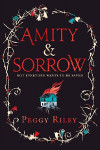
When one marriage leads to another.
Publisher: Tinder Press (Hachette)
Pages: 324
Type: Fiction
Age: Adult
ISBN: 978-0-755-39436-4
First Published: 1st March 2013
Date Reviewed: 7th April 2014
Rating: 3/5
When the fire started burning down her polygamist community, Amaranth took her two daughters and escaped. Happy to marry and comfortable with her growing family, if uneasy about the ceremonies, Amaranth was glad to defend her people as women left and those living nearby took an interest in what was going on. But after her good friends leave and her husband draws their daughter too close, the first wife knows she and her daughters must leave, too.
Amity & Sorrow is the story of the plight of a mother who has become too used to her life. Interestingly, it is not so much about the plight of her daughters, which is the reason for some of the issues.
There is just something ‘off’ about the book. The cult is presented fairly well, but the writing style doesn’t fit the subject. Even though the reader knows the cult is bad, and has the details to imagine the situation, the literary style of writing distances you from it. The story may include the information, but it doesn’t truly try convince you of it, even if you are convinced.
It’s interesting to look at the choice the author made as to where the mother and daughters would end up. On the one hand you have them crashing the car into what many would see as a backwards place – a farm worked by only a couple of people; an ancient television set; a rarely-used petrol station; a lack of modern technology despite its day. What this choice means is that the family have little opportunity to see what life is like for the vast majority, to get used to the ‘new’, and to rehabilitate. This in turn means that the book lacks any big moments in the plot besides those in the flashbacks and at the end, and that whilst they escaped you might not feel as though the women will truly live life to the full, especially as Amaranth seems happy to remain in the first place they find.
But on the other hand, this lack of modernity, this lack of computers (other than one instance in a town) and so forth, mean that the family are eased into the world. It means that the changes in Amaranth especially (the girls will be discussed in due course) are slow and she has time to get back to life as it was when she was a member of society. You see more of her adjustment than you would if she’d found herself in Silicon Valley, or the like, where the change would have been immediate but only on the surface for its suddenness. Beginning in the middle of nowhere in a place more familiar in lifestyle, there is perhaps less of a chance she’ll return to the husband who brainwashed their daughter.
The sisters, Amaranth’s daughters, Amity and Sorrow, were born on their father’s land and therefore their reaction to their mother’s escape is, if not in words, that she has kidnapped them. Sorrow especially wants to return; she is the sister most brainwashed by her father, the cult’s leader. It is in Amity, the less extreme of the two, that the reader gets to see the most progression. Amity is more open to change, and whilst it may seem a little too fast a progression at times, Amity’s growth makes up for the little growth otherwise.
It is in Sorrow’s experience, specifically, that the story lies, and it’s also in her life that the potential dissatisfaction with the ending is to be found. She is not as developed a character as the others, in fact it could be said that she is a plot device; yet without her Riley wouldn’t have been able to explain her points. Sorrow was impregnated by her father, who had sex with her, having brainwashed her so much that she believed it was important and right that she and her father ‘make Jesus’. Whilst not commented on in the text itself, there is the obvious theme of consent running throughout the book. Incest itself is discussed.
And because it is this event that wakes Amaranth to the reality, finally, (if even then late in the day), the story continues on with Sorrow’s extremist beliefs taking what amounts to the biggest element of the book. Sorrow is always looking for a way back, because she doesn’t know any different and she is at an age where she won’t listen to her mother, especially not a mother who has left her, Sorrow’s, glorious father. The issue here is that whilst Sorrow’s extremism is believable, the extent to which she is, to all intents and purposes, encouraged, is not. Amaranth spends very little time with her daughters, even though, as the one person in the three who knows about the real world, she should have been helping them. Instead she starts to make a life for herself by herself.
A warning here to anyone who doesn’t want to read too many details: the ending of the book needs to be discussed because of what it effectively does, and will be in this paragraph. Amaranth, though obviously scared and still suffering from the manipulation and abuse under her husband, shows, in leaving the cult, that she still has her wits about her. She knows what is right and wrong both in regards to her own beliefs and the world at large, and she takes her daughters away from their father. Due to this escape, it is hard to believe that in the real world, such a woman would ultimately leave her daughter back at the cult’s land together with the father, after having tried and failed to convince the daughter to return with her to their new home. Maybe she would leave her temporarily while she went to the police for help, but leave her there for good? You can’t say that due to the possibility for danger, as the daughter is very unstable, it is best she stay away from Amaranth and Amity – the girl has had no chance to change and the handful of days during which there was space to influence her were not enough. At worst there are places she could be sent away for care. Perhaps Riley is showing us just how brainwashed and scared someone can become, but given everything that Amaranth does and thinks beforehand, the conclusion is not at all sufficient.
Where Amity & Sorrow gets it right is in the small things – the wondering about the changes to the world since Amaranth left it; the comparisons of dress and its relation to sexuality; the overall consideration of religious cults; to some extent, Amity. But with its poor choice of voice, underdeveloped characters, and the knowledge the reader will be left with when it’s over – the knowledge that what you’ve read is very wrong on a completely different level to the basic wrongness of the cult – one would be hard-pressed to recommend it for its story. You could try to come up with an explanation for the ending, but this is one book for which the ending is impossible to make right.
Related Books

Shannon Stacey – Love A Little Sideways
Posted 4th April 2014
Category: Reviews Genres: 2010s, Domestic, Romance
1 Comment

Sideways (verb): dating your best friend’s sister even though it’s wrong.
Publisher: Carina Press (Harlequin)
Pages: 353
Type: Fiction
Age: Adult
ISBN: 978-0-373-00225-2
First Published: 26th November 2013
Date Reviewed: 28th March 2014
Rating: 3/5
Liz is moving back to Whitford after (finally) splitting up with her boyfriend and realising she was missing out on all the fun being so far from her family. However as she nears the town her car skids and hits a tree, and although she’s not injured those nearby are convinced it’s an emergency. So they call the police, and to the scene arrives Chief Drew Miller – the man Liz spent time with at the last Kowalski wedding…
Love A Little Sideways is the seventh book in Stacey’s Kowalski series and the last to focus on a member of the family itself. Focusing on a female Kowalski rather than a male, the book has a different feel to it from the first page. This could easily have made for a strong and more interesting book, given that no matter how fun the other books are there is inevitably repetition – however the final bow from the Kowalski clan isn’t as fluid as it could have been.
The major issue with the book is one of the two conflicts, which this reviewer hates to call ‘the first’ due to how debatable the ‘second’ issue is. This conflict is that of the best friend’s sister. Drew is the best friend of Liz’s brother, and a vast amount of time is spent, not just by Drew and Liz but by practically every one of Liz’s family members, worrying about this ‘problem’. It is understandable that the reality of a romantic relationship, a relationship that is far easier to break than that of blood (in most cases), would be cause for thought, yet this understandable reason isn’t the book’s focus. The ‘problem’ with Drew and Liz is simply that Liz is Mitch’s sister. And apparently there is a ‘code’, one of those school-aged agreement ideas.
Liz and Drew are adults, in fact Liz is 30 and Drew is a little older – yet this best friend’s sister issue keeps getting in the way as if someone is threatening to tell Mum and get everyone grounded. Later on, when Mitch inevitably finds out, he deals with the issue as a little child – and Drew responds in a complimentary fashion. Of course this ‘conflict’ gets solved in the end, but it is totally unbelievable and likely to simply evoke a ‘so?…’ on the part of the reader.
Next is an issue far more mature and completely believable – the difference in life choices. Drew is single because he wants children whilst his ex-wife didn’t. He’s now on the lookout for a woman who feels the same as he does about padding feet. Liz is at the start of a new life, and is at the beginning stages of working out whether she’s happy in Whitford working at the diner, whether she wants children, or whether she wants to go and get a degree. Drew definitely wants to stay in Whitford and procreate; Liz may want to move to the city and start a business like her brothers. Of course a conflict of interests can work, and people make compromises and allowances so that they can live with the person they love whilst also living the life they want as an individual, so that isn’t an issue. What is is the relative, and, by the end of the book, complete, marginalisation of Liz’s wants and dreams. Part of the problem is that the characters have little chemistry. When measured against the other couples in the series, the romance is even more suspect. But the biggest problem is that whilst Liz gets a few cries of “what about what I want?” the book leans firmly on the side of Drew, and because the books are founded in family, this is inevitably cemented.
That’s not to say that the basis in family is bad, it isn’t, and it’s been a reasonable feature of the books – indeed you need to be open to the idea of ‘living in each other’s pockets’ and traditional gender roles to enjoy these books – but there is using the idea of family to make a book ‘warm and fuzzy’ and using it to override the thoughts of someone who may prefer a child-free life. Liz’s opinions of her own destiny are simply not valued enough by anyone and so Liz’s future is effectively decided upon by her lover and family. It is also resolved far too quickly.
Speaking of the chemistry it’s a pity that Liz’s suggestion that Drew simply wants a woman to breed for him comes across as true. That Drew loves Liz seems a nice convenience. Likely if Drew’s single-mindedness on the issue wasn’t such a big element of their relationship the relationship would read better, but as it’s the case that it is, it’s all too easy to believe that a few months down the line when the couple are married and Liz has finally had time to work out what she wants in life, a swift divorce will follow.
Aside from this the book could do with another copy edit. There are awkward phrases, plot development issues, and scenes such as Liz and Drew having a shower, Liz’s long hair not being combed afterwards, sex and sleep ensuing, and no mention of time-consuming tangles and impossible bed-hair in the morning. (These things are noticeable when you have long hair.) Despite the entirety of the family being at the camp and despite the fact that Liz is renting her house from her sister-in-law, Lauren gets one small mention and no admission into any other scenes or any lines of dialogue whatsoever. It is as though the heroine from two books ago doesn’t exist. Terry and Evan only get a small look in, but as they don’t have a book to themselves this feels ‘right’. And, whilst it’s not an editing issue, Mitch saying he often doesn’t listen to his wife puts a damper on the fabulous chemistry in his own book.
Where Love A Little Sideways does work is in the family factor, as is to be expected. The family may be around a bit too much and you may get to hear the same old information about everyone as the book seeks to welcome readers who haven’t read about the Kowalskis before, but overall it works. Liz is distant enough in her role of the half-stranger and Drew in his role of friend to make the book interesting in a unique way compared to the past six, and the book is a fine comfort read.
But the conflicts do unfortunately place it firmly in the middle of the scale.
Returning to a great family and location, but making one reconsider the values, Love A Little Sideways may be worth reading if you’ve read the other books in the series but as an introduction it’s unlikely to foster interest.
Related Books


Nancy Bilyeau – The Crown
Posted 26th March 2014
Category: Reviews Genres: 2010s, Domestic, Historical, Mystery, Political, Social, Spiritual
7 Comments

Curses at the convent.
Publisher: Orion Books
Pages: 470
Type: Fiction
Age: Adult
ISBN: 978-1-409-13579-1
First Published: 1st January 2012
Date Reviewed: 25th March 2014
Rating: 4/5
Joanna, a novice at Dartford Priory, leaves secretly to be at the execution of her cousin. She expects to bear witness and return to Dartford, but when the fateful time comes, her father rushes to assist the condemned and she, Joanna, finds herself in the Tower of London. Few leave the Tower alive but Bishop Gardener has a proposition for Joanna. He’ll spare her father if she’ll seek the crown of the old king, Athelstan, a legendary item said to bring greatness – and ruin.
The Crown is a particularly well-researched and well-written Tudor suspense that may not have the shock factor of some books but continues on steadily and with a good few surprises in store.
The strongest element, the stand out element, is the writing and construction. Whilst of course not written completely correctly (because a book written in true Tudor text would be difficult to decipher) the language is good, there are no sudden uses of modern slang, and the times when modern phrasing is used are slight, few and far between, and in such small supply that it doesn’t matter.
This leads on to construction – Bilyeau has done her research. As in the later The Chalice – mentioned here because this reviewer read it beforehand – the history is accurate, the biases are taken from the historical views of the people rather than placed upon the characters by the author, and the times when Bilyeau swerves towards fiction fit together with the factual history like gloves. Joanna is a fictional character, but her family and those she meets are often not, and there are never any occasions where it is unbelievable that these events could have happened. Those looking to learn about the Henrican era will find plenty of true history here, and Bilyeau does not shy away from discussing where her imagination plays its role.
Except in the case of the cursed crown, of course. But this is supposed to be. In the creation of the Athelstan crown, Bilyeau has drawn from the questions for which we have no, or at the very least scant, answers. The crown’s curse affects those royals who did not live long or who died of mysterious causes. The make-up of the crown is not unbelievable when given all the relics in the world and in many ways it echoes such legends as the holy grail and the shroud of Turin.
Bilyeau has populated her book with a vast number of primary and secondary characters. The most developed are fictional, which makes sense; it must be said that in terms of history itself a basic grounding, perhaps even a fair grounding, in the Tudor dynasty and court politics will add to the understanding and enjoyment – the factual characters are well-known. There are a few meetings that can seem too easy but the suggestion of romance means that it is not necessarily a drawback, and of course in a book where the dissolution of the religious houses is a key point, Joanna’s future is a constant question.
Also included as themes are sexual abuse and prejudice against women. Both of these are explored as potential reasons for a woman to choose the life of a nun. A religious life was a way for women to escape the average existence of a woman of the times, to gain an education and make their own choices rather than be subject to the whims and demands of their families, and Bilyeau brings in these and a variety of other reasons to her book.
The book ends quite swiftly, being perhaps a little less striking than you may think, but in choosing the path she has, Bilyeau looks at yet another issue in Tudor England, one which is likely to strike a chord with the reader as the world has changed so much since.
The Crown focuses on not just a person but a community rarely studied in fiction. It examines what is often simplified to a brief schedule the day-to-day life of a nun and the true happiness that could be found therein. And it does this whilst being accurate to the time, unbiased, and packed full of information.
Related Books


Speaking to Nancy Bilyeau about the Joanna Stafford trilogy, The Blue, and Dreamland (spoilers included)
Charlie Place and Nancy Bilyeau discuss the lifestyle of Dissolution-era nuns, using a website’s ‘contact me’ form to great success, there being more relics than there were items, using your family’s name in your work, and the grand amusement parks and luxury hotels of New York’s past.
If you’re unable to use the media player above, this page has various other options for listening.
M J Rose – The Collector Of Dying Breaths
Posted 14th March 2014
Category: Reviews Genres: 2010s, Domestic, Historical, Mystery, Paranormal, Romance
2 Comments
In hopes that the last breath isn’t the last at all…
Publisher: Simon & Schuster
Pages: 307
Type: Fiction
Age: Adult
ISBN: 978-1-451-62153-2
First Published: 8th April 2014
Date Reviewed: 14th March 2014
Rating: 3.5/5
In 1500s France, an apothecary’s apprentice is saved by Catherine de Medici and becomes one of her favourites, providing her with perfumes, potions, and poisons. He is happy in his position but his ultimate goal is to put into practise the theories of his old friend who believed life could be reborn. In present-day France, Jac looks at continuing the work of her brother Robbie, who died of a mysterious illness. History and modernity come together and Jac knows she is taking on the past. She also knows about her brother’s belief that her hallucinations are windows into days long gone, but she doesn’t know just how far it goes.
The Collector Of Dying Breaths is a dual-story book that uses history to good effect but to mixed results.
The story is predictable but it in a way that doesn’t spoil it too much – there is nothing that suggests the answers shouldn’t have been easy to guess. What may prove difficult, however, is the notion of dying breaths that the book rests on. Superstitions and theories about magic and the unknown where rife in the 1500s, but it can be hard to believe that anyone nowadays would consider the possibility that a breath captured in a bottle could recreate life. Whilst the theory is of course fine as a fantasy element, there is not enough of the genre overall to aid in the suspension of what is realistic required by the reader and so the resolution of the story may not be as compelling as it is supposed to be.
This is also true of the way the two time periods are woven together. Because Jac’s ‘ability’ is known from the start, the conclusion of this theme may not seem as interesting. However the biggest issue with the way the periods connect is one of belief, similar to that of the experiments. The past lives idea works by itself, but the way it is dealt with by the characters is overdone – and this is because the main character switches back and forth between being strong and weak, knowledgeable and naïve in odd ways, that make the answers unsatisfying.
Part of the issue has to do with the writing style. There is a lot of telling involved, in fact Jac remains undeveloped for a fair amount of time. Information about her is suddenly included as though you’ve walked in during the middle of a conversation, and facts are dropped randomly that it’s hard not to feel should’ve been stated within the first few pages. Where there is a lot of unnecessary information about historical people and perfumes (more than is needed for this story of perfumers) the book could do with more information on Jac, shown. Nationalities are also difficult to discern and the historical language, whilst generally good, does veer towards the 21st century on occasion.
The history itself is believable and well written. Catherine de Medici is portrayed in a somewhat bad light that might be worse than reality but is far from awful, and you can see where the author has filled gaps in history and used certain factors as a springboard into fiction. The author has no qualms about showing the dark side of court and how quickly an enemy or simply a person of higher standing would be quietly removed.
There are sex scenes in both eras, fairly graphic and in the case of the 1500s showing the religious hypocrisy apparent. One of the contemporary scenes provides a moment of contemplation for the character that seems to be a way for the author to explore a trend and is a little out of place overall, but otherwise, especially where the historical chapters are concerned, the scenes work.
Due to the predictability and sudden switches in thoughts early on, it is hard to get a handle on the story and difficult to say you really know the characters and care about them – the story can be confusing. That said, the history is interesting and accurate enough, and the mystical aspects appealing if not used to full effect.
The Collector Of Dying Breaths is unlikely to make your best of list, but it isn’t bad and the history is informative.
I received this book for review from for Historical Fiction Virtual Book Tours.
Related Books
None yet
Aimee Bender – An Invisible Sign Of My Own
Posted 21st February 2014
Category: Reviews Genres: 2000s, Angst, Commentary, Domestic, Psychological, Romance, Social
4 Comments

Bizarre – but then that’s life.
Publisher: Windmill Books (Random House)
Pages: 242
Type: Fiction
Age: Adult
ISBN: 978-0-099-55852-1
First Published: 2000
Date Reviewed: 17th February 2014
Rating: 4/5
Mona’s childhood came to an effective end when her father became ill. Holidays ceased to occur, her father stopped being interested in anything, and Mona coped by becoming a quitter. Successful and talented, she slowly quit everything she was good at before she became too successful or happy. Passionate about maths, the one interest she didn’t give up, she is given a teaching job despite a lack of formal qualifications, and comes to love the job, but her coping method isn’t quite usual, even amongst those who are also unusual.
An Invisible Sign Of My Own is a focused take on life and all its idiosyncrasies. Further than the superstition mentioned in the blurb, the book studies obsessive compulsiveness and depression. It is, at its heart, a look at two groups of people who are often one and the same – those who cope in unique ways, and those who live in ways that aren’t the norm.
The book is at once very positive and negative. It looks at idiosyncrasies and dark issues in the same bizarre way as Bender’s later work, The Particular Sadness Of Lemon Cake, whilst having a foundation of pure despair. This is not the book to read whilst you are upset yourself, indeed whilst the conclusion may show a sort of conquering of depression, the atmosphere of the story and characters are dark enough to be almost too easy to relate to if you’re having a bad day. This is of course as much a drawback as a triumph. Bender’s choice of idiosyncrasies may for the most part be unrealistic, as much as the word can be used when dealing with the subject, but if anything this helps the reader emphasise and/or understand more. By having that distance between reader and book – the distance of the distinct behaviours – the content is more welcoming, because anyone who has experienced depression, OCD, and/or the sort of tragedies in the book, is going to find it easier to see it from a fly-on-the-wall perspective. The pain may be the same, but the difference in delivery means that you’re not going to feel targeted and at the mercy of an author whose other characters dislike what they see in those who aren’t coping.
The story, in which no quotation marks are used, is somewhat predictable, but it is obvious that this is part of the idea. In order to understand Mona as the author wishes you too, you have to see where the book is headed. Mona is at once the main character and one of many. She may be the narrator but the story focuses on, for example, the plight of a child whose parent is dying of cancer, just as much. What Bender shows, via the subtext, is how important it is that society in general truly recognises that people cope with pain and despair in different ways and that when those ways do not fit the norm, or what is expected, these people are still looked after. An Invisible Sign Of My Own isn’t about leaving people to fend for themselves (so long as the issues are known), indeed it is very much the opposite, and due to that it forces you to look beyond appearances. In the case of the child of the parent with cancer you have a child that looks for cancer – indeed almost hopes for cancer – in everyone she meets due to her undisclosed feeling of detachment, whose idea of numbers in nature is morbid, naïve, and dangerous, and who, for her young age, suggests things such as suicide as though they were something to do when bored. This is a girl too young to really realise what she is saying whilst knowing exactly what is happening. Other children, albeit not faced with terminal illness, show how naïvety about subjects they don’t yet understand have disastrous consequences. And Bender lets the disaster happen, to shock, to teach, to illustrate just how important care and education are.
An Invisible Sign Of My Own is at once easy and difficult to read. It’s strangeness can at times bely its message, suggesting that Bender just wrote a lot of madness without anything in particular to say, or worse, that she thinks it is okay. It’s tough getting to the heart of it, and likely often times you’ll wonder what in the world you’re reading. It may be barmy but that’s the surface dressing; it’s worth reading to get a glimpse of lives that don’t tick boxes, and there is plenty relevance in its content to fit our lives in the non-fictional world, too.
Related Books