




Adelle Waldman – The Love Affairs Of Nathaniel P
Posted 20th February 2015
Category: Reviews Genres: 2010s, Books About Books, Commentary, Domestic, Psychological, Social
5 Comments

One of us is wrong, but is it her or me?
Publisher: William Heinemann
Pages: 207
Type: Fiction
Age: Adult
ISBN: 978-0-434-02232-8
First Published: 16th July 2013
Date Reviewed: 19th February 2015
Rating: 5/5
Nathaniel Piven (Nate) is doing fairly well. He writes book reviews, freelances for various newspapers and magazines, and his book proposal has been accepted. Women-wise, he’s also doing well, at least as far as number is concerned. He doesn’t stay with any one person too long; it starts out well and they’re intelligent, attractive, fun, and so forth but after a few months he’s had enough. But that’s okay, isn’t it?
The Love Affairs Of Nathaniel P is an extremely pleasurable literary experience. Whilst the official line is that it’s about the literary scene in New York – particularly Brooklyn – there are many interpretations and readings to be had.
“It’s hard not to feel irrelevant in a world where a book that does really well sells maybe a hundred thousand copies. Even the lamest television show about time travel or killer pets would be cancelled instantly if it did that badly.”
The book’s appeal is two-fold. It is half a character study, in which Waldman adeptly takes the reader back and forth between believing the women are at fault and believing Nate is at fault. Whilst Waldman doesn’t exactly hide her thoughts and main points, whether or not the conclusion will have you feeling more for, say, Elisa and Hannah, than Nate, is never quite certain. The other half of the appeal is that this is a book about books – about books, about writing, about the writing and publishing industries, about the people who write articles for a living. Reading the book you may well have that euphoric feeling that I think it’s safe to say everyone reading this review is versed in, simply because you like reading. That feeling that accompanies discussing books that is perhaps stronger and more wonderful for the very fact that, let’s face it, it can be a rare occurrence – be it the discussion of books in general terms (“I liked such and such”) or the more involved debate or conversation of themes and styles. Yet, this said, at the same time the literary conversation between a group almost completely composed of privileged middle-class white people can be difficult to read – and it’s difficult because of the privilege and importance, the smugness they don’t realise they own. As far as reading the book is concerned, it’s often a heavy mix of delight in the subjects discussed, and unease because you know about the rest of the world ‘outside’ (Nate loves to ponder upon the less-privileged, which he does in a quasi-intellectual, distant and affectedly caring way).
Waldman’s writing itself is an interesting beast. It becomes evident early on that Waldman just ‘gets it’: the way you meet someone whom you instantly click with, a person who seems to understand that certain aspect of your personality or interests that no one else ever has, this is the way it feels to read Waldman’s words. It’s not that her subject will resonate with you, rather it’s the way she addresses you as the reader, is intimate and devoid of secrets. It’s the way she delves into detail, the way she narrates. In literal terms, the book is one long exercise in ‘telling’ – in what writers are told to stay away from and readers appreciate not having to read; however Waldman has written what is essentially an account, a third-person past tense story of what happened, and she’s successfully managed to get around the issues of over-detailing and info-dump. The style has allowed her to get right into Nate’s head and give the reader an exact idea of what he’s like; she gives you his inner life. In sum, Waldman has stimulated the effect of first-person narrative despite the limited amount of dialogue and Nate never addressing the reader himself.
The writing style is a bit of a mash-up. It’s not completely literary but it’s not casual or easy either. Waldman favours lesser-used words, long descriptions that you may have to read twice simply because she’s packed her sentences with so-called highbrow terms – this even though it’s likely you’ll know the meaning of the words without looking them up (at least in most cases). Following such highbrow sentences will be a sentence which uses very modern slang. Literary fiction meets ‘at her place where they had chips and guac’.
What’s interesting is that whilst on the surface this writing is incredibly pretentious, that’s both not quite the case and quite the idea. Due to the overall feel of the book it’s hard to say the language is flowery, really. Waldman is highbrow without being highbrow – she makes intellectual and affected language assessable, whilst remaining consciously, pointedly, pretentious.
There is very little plot in this book; it’s all about character – a study of relationships, a what-we-do-and-how-and-why-it-affects-us study. All the characters could easily be exchanged with others and it wouldn’t alter the book because the point is the overriding factor, rather than the people. (Although, this said, you will undoubtedly find yourself feeling sympathy for someone in the bunch and whilst Waldman may spend more time on a particular character you’re ‘able’ to focus on another.) Nate himself could be switched and it wouldn’t matter.
The title is both alluring and mundane. That Nathaniel isn’t afforded a surname is both off-putting in a ‘who cares, he could be anyone’ way, and intriguing for that very reason. One could speculate that Waldman has used the censoring method of Victorian writers and opted for something that could be swapped for something, someone else (it’s interesting to note that Waldman lives in the factual version of her fictional world).
Given the literary, bookish, content of the book, it’s not going to surprise you when I say that references abound. Be wary of the last fifth if you’ve not read Middlemarch as there are minor spoilers. Bask in the paragraph about Nabokov and enjoy the points about less literary works being good reads, too. However, the point I wish to make in this literary regard is something that is more subtle yet, as far as I am concerned, there for the taking. The nod to Gone With The Wind:
He was too tired to think about this right now. He’d think about it when his head was clear. Tomorrow. Later.
The idea of leaving thoughts until tomorrow occurs twice, and this second mention is accompanied by the Scarlett-esque thought that perhaps Nate’s book is the most important thing to him.
Somewhat related to comparisons is the following:
He told her about his book, the way it had evolved in the years he’d spent working on it. He’d first intended to write a scathing critique of the suburbs, featuring an immigrant family with one child. A Son. This son was intended to be the book’s central character, from whose lips precocious wit and wisdom would flow and whose struggles – girls and popularity – would arouse readers’ sympathy. He told her how the novel had started to come together only when his “insufferable” character had been shunted to the sidelines.
If you like the sound of that, even just a little, it’s fair to say bets could be placed on this book-proposal-within-a-book being Waldman’s novel itself.
The Love Affairs Of Nathaniel P is first-rate. It has everything to make the avid reader swoon with reader love, it has a writing style to get excited about for various reasons, and it never meanders from the points it is trying to make, points that are worth reading.
If you’ve been wondering about it, you shouldn’t wait any longer, and if you’ve not encountered it previously, you should look into it now that you have. Just don’t expect it to last long, because like Nate’s relationships, it’s fairly short.
I received this book for review from the publisher.
Related Books
None yet.
Charles Dickens – Nicholas Nickleby
Posted 18th February 2015
Category: Reviews Genres: 1830s, Domestic, Drama, Social
3 Comments

An a-typical Victorian life.
Publisher: N/A
Pages: N/A
Type: Fiction
Age: Adult
ISBN: N/A
First Published: 1838
Date Reviewed: 16th February 2015
Rating: 2.5/5
Following the death of the patriarch, the Nickleby family finds itself fairly impoverished and Nicholas goes out to look for work. Thus begins a journey that will take him through three jobs, across England, for richer and poorer and caring and hate, whilst his mother and sister make the best of their own bad situations.
Nicholas Nickleby is an epic book that sees Dickens cut and paste together what could have easily been several separate stories. It contains the stuff of the greater works, and therefore may be considered worth the read just for that, but it pales in comparison to Dickens’ other tales and is to all intents and purposes a Victorian Neighbours or Eastenders, carrying on and on instead of finishing where it should, much like this sentence.
Given the nature of the book and the general agreement nowadays that Dickens is wordy at best, this review will be focusing on the book purely in the context of the modern reader. It is fair to say that the Victorian reader would have found the format and longevity a lot less tedious.
What’s good about the book is that it is, as said, very Dickens. It can be funny, if not as much as other novels, and when Dickens isn’t trying to add words for count it can be easy to get lost in. Dickens is as welcoming as ever, as clever and as witty, and the funny stereotypical characters he likes to exploit are here by the dozens.
Nicholas’s sister, Kate, makes the book a much better read than it might have been had it focused just on him. Through Kate, Dickens is able to look at more concepts, ones that affected women, and this makes for a good balance. In addition to this, Kate is the opposite of Nicholas in most ways so if you find Nicholas less of a hero than you’d have presumed, you can rest assured Kate will be there to pick up the pieces, so to speak.
Mrs Nickleby is rather like an extreme Mrs Bennett. Dickens has ‘gone to town’ on her character – she is the comic relief and, whilst frustrating, worth the time.
The problem with this book is that there are just too many negatives and the length of it means that these negatives are further cemented than they may have been otherwise.
In the context of our present day, the book may have worked as a serial, but compiled into a book (albeit that this happened in the Victorian era, too) it doesn’t work so well nowadays. Wordiness apart, there are just too many superfluous plot threads that go on for too long (and then, ironically, are wrapped up far too soon), too many characters (many completely unnecessary) and there are too many comings and goings between these characters and plot threads.
It can be frustrating when you’re just getting into the particular plot thread at hand, to have it finished so quickly. The threads that stick out are the school and the theatre which could both have been very good stories in their own right. It’s easy to invest yourself and then feel cheated when Dickens sweeps Nicholas away suddenly without a true conclusion. The school gets a proper conclusion later, as you expect, but it’s not as satisfying as it could’ve been. It’s safe to say that Nicholas Nickleby is in some ways a less satisfying Oliver Twist, which presents a similar concept in the beginning but concludes with more strength.
On this subject is the ending during which Dickens ties everything a little too neatly and conveniently. It is that little too predicable and sweet.
Lastly, to this reviewer at least and, due to the reasoning, likely many other modern readers, Nicholas comes across as hot tempered to the point of worry. What will happen in the future if he and Kate have an almighty argument? His tendency to physically lash out does not recommend him, especially when he is seen as so kind and goodhearted throughout.
Nicholas Nickleby can take a long time to read and a lot of your courage to get through. It’s for the most part a slog and whilst it’s of course recommended if you want to read every novel Dickens wrote, otherwise your literary and classics needs would be best served by a better work.
Related Books


Natasha Solomons – Mr Rosenblum’s List
Posted 7th January 2015
Category: Reviews Genres: 2010s, Domestic, Historical, Social, Spiritual
Comments Off on Natasha Solomons – Mr Rosenblum’s List

Wanting to talk of the weather, wanting to queue, and wanting to take tea.
Publisher: Sceptre (Hachette)
Pages: 311
Type: Fiction
Age: Adult
ISBN: 97-0-340-99566-2
First Published: 2010
Date Reviewed: 6th January 2015
Rating: 4/5
Jack and Sadie Rosenblum, Jews, left Germany for England as life became dangerous, and upon arrival, Jack was given a leaflet regarding the conduct expected of them. He takes it to heart. Above and beyond what is expected, Jack makes it his mission to become a proper Englishman in every way.
Mr Rosenblum’s List is a book that obviously looks at what it means to be traditionally English, but also at responsibility and general social history. It’s quiet and character-driven and isn’t likely to blow you away except if you get caught in the gale-force wind, but it will make you chuckle and consider the experience of immigrants.
Whilst mostly, aptly, focused on Jack, there is a lot of time spent on Sadie. In many ways she’s the long-suffering wife, the one wanting to keep the traditions of home whilst her husband wants to forget them. You see the contrast in the way they go about their individual lives – how Sadie starts to enjoy her new life, to blend the old and new, and, inevitably you witness how she begins to fit in without trying to. Solomons doesn’t make this idea a focus, far from it, but it’s there – that thought that sometimes letting things happen as they will works better than being forthright. Sadie has ample space for mistakes; Jack in his boldness has little.
The study of different cultures is a natural by-product of the subject. You have the differences between the Jewish Germans and the English, and of course racism, anti-Semitism, but as the story moves from London to Dorset Solomon provides a mini introduction to the fact of diversity within a single country. Accents are well included throughout and the scenes wonderfully set. If you want quintessential rural England, this book is for you. That the book is set in the mid-1900s means the descriptions flourish, being just as realistic as they are rose-tinted.
Solomon looks at how immigration affects generations. Jack and Sadie’s daughter is very British and you see the happiness and longing of parents both proud of their child’s place and sad at the loss of connection with her due to the difference in culture. And because it is by and large told from Jack and Sadie’s points of view, if offers a lot of food for thought.
Given the two locations – London and Dorset – there are observations of how technology and change affect life as we know (knew) it and of course, again, how it has an impact on culture. Solomon places emphasis on working with nature as part of Jack’s progress, allowing folklore to play its rightful part.
There is little focus on the war. It is spoken of but not the point of the novel. This is a story of the people, how life carried on.
Mr Rosenblum’s List loiters much as some of the characters do. It shows you a swath of greenery and rarely takes you away from it, and it lets you potter among Sadie’s roses as you consider the reasons people change their names. Read it on a sunny afternoon with a pot of tea and a plate of scones and you’ll surely have Jack’s approval.
Related Books
None yet.
Davina Blake – Past Encounters
Posted 3rd December 2014
Category: Reviews Genres: 2010s, Domestic, Drama, Historical, Political, Psychological, Social
1 Comment
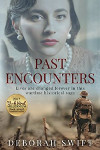
When the past isn’t in the past.
Publisher: (self-published)
Pages: 431
Type: Fiction
Age: Adult
ISBN: 978-1-499-56825-7
First Published: 30th June 2014
Date Reviewed: 22nd October 2014
Rating: 4.5/5
Rhoda finds her married life difficult and always has. Neither she nor Peter are particularly close, and when she discovers he’s been meeting another woman she decides to find out about his supposed affair. Rhoda herself is hiding something from Peter, an event that happened whilst he was in a prisoner of war camp, and just as Rhoda has never spoken of her time, neither has Peter spoken of war.
Past Encounters is an excellent novel that looks at the way secrets, events in the past, continue to affect the way the characters treat each other. The book is a multi-plot novel, of sorts, moving between two decades for the two main characters and including a brief sojourn into the life of another.
In writing Past Encounters, Blake has delved into WWII in a way that is different to many other writers. It may not neccersarily ‘read’ different – others have written about the war camps as have films – but there is a difference nonetheless.
As said, the majority of the book switches between Rhoda and Peter – Rhoda in the 1940s and 1950s, and Peter almost exclusively in the 1940s. Rhoda’s chapters are written in the first person, Peter’s in the third, and perhaps in part because of this, both points of view are equally compelling. In Rhoda’s case you are reading about her search for the truth and the event that changed her, in Peter’s you are finding out about war and why he may not have wanted to speak of it. What’s interesting here is that Blake spends much time telling you all of this yet shows at the end that it’s obviously not black and white. There is a hint – though only a hint – of unreliability, or, rather, the fact that it’s best to remember there are two sides to every story.
The characters aren’t particularly special; apart, perhaps, from Peter’s trials in war, you’re likely not going to remember them for themselves, however this is a point worth considering. It is often more what Rhoda and Peter represent, how they remind you to look at your own life from different perspectives, that is most important. They are two ordinary people living lives in ordinary situations (but for the war), and this makes the book shine.
Blake doesn’t hold back on her descriptions of war. She doesn’t describe everything in gory detail, but her word choice, her style of writing, says so much. You get the facts and you get the raw feelings. And sometimes, because she includes the happier moments and always reminds you of the thoughts of the regular people, even the soldiers, it is all the more compelling. Blake repeats details and talks of the mundane because that was the reality of the situation, and it keeps you reading. Never should you forget how war affected the other side and how most simply wanted to live their lives.
Yet this doesn’t mean that the book falls prey to that known situation wherein a reader prefers one plotline to another, as often occurs when a book switches back and forth. Yes, you may prefer one or the other, but you’ll likely enjoy reading both nonetheless and be happy to catch up. In Rhoda’s story there is longing, there is the change in character that is of course less ‘important’ than Peter’s changes but still important, and there is also the foray into film.
The book’s title owes a lot to the film, Brief Encounter, and it is the production of it that features in the story. The title sports many references therein – the literal past, the brief encounter during Brief Encounter and the way the filming affects Rhoda, the way words and small arguments can cause major changes. The film doesn’t take up a lot of the time, but it’s enough to give you a fair background of it, the working methods during war, the differences between people that remained during war, and so on. And then there is the way the filming clashes with Peter’s internment which may not speak for everyone’s experience but does show how people might have coped in such a situation.
There is that third narration, but it can’t really be discussed without spoiling the story, suffice to say it serves to show how chances taken at the right or wrong moment can have a major affect on everything else.
The sole element that stops the book taking the top spot is the text. There are batches of errors – proofreading and copy editing problems. The story and the book in general is so good it’s very possible to overlook the errors, but in terms of objectivity and the whole, it must be taken into account.
Past Encounters is masterful. It is compelling, and whilst diligently keeping to the specific topics at hand, it never becomes boring or falls into the trap of filler content. It is epic without requiring lots of action and changes, an epic about war without battles.
This book is wonderful.
I received this book for review from the author for Historical Fiction Virtual Book Tours.
Related Books

Diane Setterfield – Bellman & Black
Posted 24th November 2014
Category: Reviews Genres: 2010s, Commentary, Domestic, Historical, Paranormal, Spiritual
9 Comments

A ‘ghost’ story perhaps, but not in the usual sense.
Publisher: Orion
Pages: 307
Type: Fiction
Age: Adult
ISBN: 978-1-409-12801-4
First Published: 10th October 2013
Date Reviewed: 23rd November 2014
Rating: 4/5
At ten years of age, William Bellman strikes a rook with a stone and a catapult. He’s a little chilled by the experience; as the stone flies forward he wants to warn the rook but can’t. And life goes on. William isn’t to know that the experience will never truly leave him, but he may not see what is happening.
Bellman & Black is a literary novel of a certain, rather unique kind, in that the story isn’t obvious and the writing style differs to many others. Setterfield speaks in the third person from an almost personal point of view yet the writing itself is almost scarce – almost bullet-pointed in style. The book is an echo of Dickens – his voice, the uncanny, spooky, way he seems to be speaking just over your shoulder at times, and a similar darkness when things become creepy (yes, darkness and creepy even when they can be one and the same). The basic themes are of time and working rather than living – missing out. There is a worthy link to be made with Scarlet O’Hara’s rescheduling of everything for tomorrow morning.
Something that needs to be said straight away is that Setterfield is never quite clear about what is happening, or, rather, why such a thing is happening. There’s a meaning, a message, in this book, but you’ll possibly have to dig very deep to find it and it’s beyond the normal thought of interpretation. Part of this is, sadly yet understandably, due to the subtitle of ‘a ghost story’. Bellman & Black is not a ghost story or, if it is, then again it’s not at all clear.
There are sections throughout that deal with rooks, that speak of rooks in a particularly familiar way as the author speaks directly to the reader, but this is yet again vague. It’s as though Setterfield has provided pieces of the puzzle for the reader to put together and work out, which isn’t unusual in literature and can result in some amazing revelations, but unlike other authors, Setterfield has forgotten to give you the last few pieces. Maybe the individual interpretation is the whole point, but even if it is, there needed to be more to use.
The book is far more about character than plot, indeed unless you’ve an interest in retail history or business you may find the repetitions of workaholic Bellman a bit dull, however you will no doubt see the reasoning for it. Setterfield repeats herself to the extreme so you want to be prepared for that. If you are interested in retail history – the television show Mr Selfridge comes to mind – you’ll likely want to keep reading beyond the end. There is also a fair amount about the workings of a mill – whether it’s earlier than the industrial revolution is something that’s in itself fun to work out.
As for the character development, Setterfield has settled for something in between realism and fantasy, as is of course obvious from the first few pages. It’s both fast and slow – Bellman becomes who he will be very quickly yet the result of this only begins to be revealed later on. The secondary characters are not fleshed out as much as you might hope because, put simply, the book isn’t about them. They are there to show you what Bellman is missing. They are stereotypes and cardboard cut outs to give you a quick idea of what Bellman leaves behind when he’s at the office, so that you’ve a good understanding of what he could have and also a good understanding of how his friends and family are likely to feel.
As said, the placement is vague. The book is obviously historical but there are no dates given, no countries (at least for Bellman). It does become clear as the book carries on as elements of a certain period are brought into play. The vagueness allows for a certain quality – left to your own devices you are able to concentrate on Bellman rather than the history and Setterfield can get on with her narration without too much detailing. There is enough detailing to set the scene and that is it. The superfluous is down solely to the repetition and as that is up for contention that’s no bad thing. The lack of dates also allow Setterfield to illustrate how her themes are eternal. (Themes are one thing and clear enough, it is the message that is less clear.)
Bellman & Black makes for a fair read. It’s enjoyable, the writing is intriguing, beautiful, almost, and there is just suspense enough that you’ll want to continue. Just don’t hope for too much – enjoy the ride as it is without expectation but realise that due to the lack of information you may not actually feel like spending time mulling over the content afterwards. Your reading will be, much like it’s theme, very much in the present with no thought of the future.
Related Books
None yet


