





Angela Thirkell – The Brandons
Posted 27th July 2015
Category: Reviews Genres: 1930s, Comedy, Domestic
1 Comment

One could have a nice rest if they would all just go away…
Publisher: Virago
Pages: 380
Type: Fiction
Age: Adult
ISBN: 978-1-844-08970-3
First Published: 1939
Date Reviewed: 23rd July 2015
Rating: 4.5/5
Mrs Lavinia Brandon, a youngish widow, finds people very difficult. Most everyone adores her to the point that they won’t leave her alone in peace to wonder about what she’s going to wear to dinner. It’s all very tiring and she really would rather not have to listen to readings and upsets and so on. When her aunt-by-marriage asks Lavinia and her children to visit – so that she can assess their suitability for inheritance over another relation she’s never met – they go grudgingly. No one wants the old house. Francis prefers live as usual, Delia loves learning about death. And out of the woodwork comes Mr Grant, the fabled relation, to adore Lavinia. It’s going to be a sadly eventful summer.
The Brandons is a very funny novel, set in the fictional county of Barsetshire created by Anthony Trollope, that has a bit of a plot but is all about the characters. There are many characters to keep track of, but keep track of them you do because Thirkell makes every one memorable in their own way and makes a point of giving them all ample opportunities to make you laugh or sigh. The author gives you some leeway to make up your own mind but this is a book in which the writer decides who you’re going to like and makes it so; she has full control of her characters. This may signal a problem in other books, but here it’s magnificent.
To be sure you’ll be wondering whether anything you’re reading about is going to go anywhere but you get used to it pretty quickly. The threads that are tied at the end are the only ones there were to tie to begin with and Thirkell never pretends it will be any different. You’re here for the ride.
Speaking of rides (there is a fairground in the book), it’s a good thing to know that this book, whilst not outdated, is very set in its time. Beyond the problematic words – words that have since gained a sexual connotation that in Thirkell’s time were quite innocent (there’s actually an entire paragraph that out of context reads as explicit!) – there are words and concepts used that we’ve since confined to history. There are illegitimate children and ‘children of shame’ who are termed as such many times because it was an issue as far as the 1930s were concerned. (Thirkell reserves comment on this point: due to her style of writing one cannot ascertain whether she is speaking personally or simply in terms of the people she has created.) There is the use of ‘half-caste’ which, whilst not used with disdain for the people it describes, is prevalent. So normal a word is it to Thirkell that she even uses it to describe a dog.
So this book definitely has to be read in context. And it’s a hilariously funny book with a fair amount of black humour. Delia’s obsession with death and disease; Mrs Brandon’s disinterest that’s obvious only to a few; Mrs Grant’s constant referencing of Italy, which is so superior to the England she left; Amelia (Miss) Brandon’s thought that idling is awful, so said as she sits in bed as she has for weeks for no real reason. The book practically begs quotation, so here we are, each block a different extract:
“But I would certainly have come to the funeral,” Miss Brandon continued, ” had it not been my Day in Bed. I take one day a week in bed, an excellent plan at my age. Later I shall take two days, and probably spend the last years of my life entirely in bed. My grandfather, my mother and my elder half-sister were all bed-ridden for the last ten years of their lives and all lived to be over ninety.”
“I have only just thought of it!” Mrs Morland suddenly exclaimed in her impressive voice, pushing her hair and her hat widely back from her forehead with both hands. “We are all widows!”
“So we are,” said Mrs Brandon, looking round distractedly as if she might see a few more somewhere, “but not what I would call widows.”
“I suppose,” said Mrs Morland, “the longer one is a widow, the less one is a widow. Or is it that one just has it in one or else one hasn’t?”Mrs Grant said Hilary must get his hair cut and there was a delightful old custom in Calabria by which young men and maidens spent the night under a tree on the night of the full moon and drew lots with the bristles of a hog who had died a natural death, and whoever drew the longest bristle died in childbirth within the year.
As for the prose, it is good. There are places that read awkwardly, grammar-wise, and a few places wherein the editor may have been out for tea and scones at the time and more interested in those than the text (issues that would be picked up by today’s editors) but on the whole it’s easy, comfortable, and welcoming.
Everything is pretty simple and laid out in the open, in fact the only thing that may leave you wondering is Mrs Brandon herself. In reading this book you can rest assured that the only real thinking you may have to do will revolve around Mrs Brandon’s interest or lack there of, and even that won’t take long. This is a book for a lazy day, a book during which you just want to pick up your embroidery, relax, and have a laugh; the book is a manifestation, of sorts, of what Mrs Brandon hopes for, indeed if she could just read this book and do nothing else she’d be in her element.
The Brandons is one book in a saga but it stands by itself. It lets you enjoy the simpler things, life as it was some decades ago. It’s just a good, solid, read that asks for little and offers little, and yet provides in spades.
Related Books
None yet.
Eloisa James – Duchess By Night
Posted 13th May 2015
Category: Reviews Genres: 2000s, Domestic, Historical, Romance, Social
1 Comment

Infiltrating male society.
Publisher: Avon (HarperCollins)
Pages: 366
Type: Fiction
Age: Adult
ISBN: 978-0-061-24557-2
First Published: 1st January 2007
Date Reviewed: 12th May 2015
Rating: 4.5/5
Isidore is tired of waiting for her husband to turn up and after ten long years the suggestion of Lord Strange’s illicit house is most compelling. Harriet, widowed Duchess of Berrow and sometimes unofficial judge, agrees to play a male so that the plan can go ahead without a hitch – Isidore will have a friend with her, it just won’t be known. Harriet would like to find love but Strange’s party isn’t the place, or is it?
Duchess By Night is a great book that’s only downside is its ending.
James is on top form. The writing is very readable, the humour laugh-out-loud. The book begins on a fun note, the drunken judge whose role Harriet has taken over and a fancy dress party at which Jemma lends her a stuffed goose as a prop, and it sustains it for a rather long time.
The characters are fun. Not everyone is developed particularly well but due to the nature of the book that doesn’t matter so much. Harriet loves being a man and this shows, she takes to her role like a bird to flight and the freedom allows the story to be more involved with the male side of life. Harriet is also allowed to be a man by those who know, making polite society have less of a stake (if it ever did in this series!) This said, Harriet’s character is a little fluid, most obviously at the end which I’ll be discussing later.
Strange is best once he’s figured out Harriet is really a woman. It’s then that he comes into his own as does the romance. He’s not bad otherwise but he’s not presented as particularly eligible, and by this I don’t mean the house parties. He doesn’t read as eligible because in truth he sounds a little too old and distant; it’s after the reveal you get the sense he’s Harriet’s age and a good match for her. As such, overall he’s a rather different hero to those in Desperate Duchesses and An Affair Before Christmas, less defined, not as well written. Related to difference but not writing, as he would say, he’s a libertine, so the sex scenes are a bit different. This is not a bad thing.
There is Eugenia, wonderful literal child of fiction. Strange’s eight year old daughter is into science and maths and she’s marvellous to read about. Though kept away from the parties she’s mature enough to provide fun (and accurate) commentaries on adult songs. Her scenes are ones to look forward to. Although the book is a romance, everything else in it is just as good to read about.
There is a lot of bias against same-sex relationships as might be expected in a book set in this era. It is entirely in context and nothing is remarked upon out of it – these are 1700s thoughts, no more. The era does lend itself to an interesting semi subtext, however – Lord Strange rather fancies effeminate ‘Harry’, so what does that say of his sexual preferences? It was always going to be beyond the scope of the book to explore, but it’s interesting to speculate whether or not Strange is bisexual, or if he somehow sensed Harriet’s true identity before he really knew. It is also interesting to look at the way there is a lot of freedom in Strange’s house for affairs and casual sex – but not between two people of the same sex. Duchess By Night is almost a mini study at times.
I should mention Isidore here because it’s important – whilst Duchess By Night is Harriet’s book, the premise sets up the next, Isidore’s own book. This means that Isidore’s musings and hopes of luring her husband home play an important part. As someone there by choice but not there to ‘partake’, Isidore provides both balance to the house and a reminder of the differences in society.
The book takes a while to get to the romance but that’s okay – Harriet’s exploits are something you won’t look forward to ending. James makes up for the time Strange is confused by way of a several pages long reveal and sex scene in the latter section. It could be argued this book is the steamiest so far, though due to Harriet’s relative inexperience and Strange’s insistence it could also be argued it’s the least comfortable. James spends time making her characters take their time but keeps the balance between closed and open doors – this is to say there aren’t numerous sex scenes – barring the first they are short and a lot of the content is alluded to rather than written out. The story rests very much on the general attraction and compatibility, even if it doesn’t always read as though the compatibility is complete enough.
This book would get the top rating from me if it were not for the end. Duchess By Night is excellent right until the last 30 or so pages when it turns to mush. An illness and plight for no reason – presumably James meant to further deepen feelings but it wasn’t necessary. The very end is a gooey, sickly sweet mess in which there are sudden pointless arguments and sentimental conversations. Most notably Harriet’s personality does a 180 and it’s stated she won’t be wearing male clothing any more even though the book had shown she would. Soon after this it appears she does don breeches irregularly, but not for the freedom. In sum, the ending doesn’t fit the rest of the book and the characters aren’t the Lord Strange and Harriet we’ve come to know.
Duchess By Night is a blast; it’s an absolute riot. You’re likely to enjoy its successes even if you do have to rewrite the conclusion yourself.
Related Books


Erica Vetsch – The Cactus Creek Challenge
Posted 4th May 2015
Category: Reviews Genres: 2010s, Angst, Domestic, Historical, Inspirational fiction, Romance, Social, Western
2 Comments
Guns, outlaws, and women included.
Publisher: Shiloh Run Press (Barbour Publishing)
Pages: 309
Type: Fiction
Age: Adult
ISBN: 978-1-630-58927-1
First Published: 1st July 2015
Date Reviewed: 3rd May 2015
Rating: 3/5
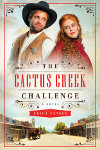
Schoolteacher Cassie loves sheriff Ben, but Ben still sees her as a child. When they are paired together, tasked with doing each other’s jobs, both are confidant they can rise to the challenge. Then there is new resident, baker Jenny, a widow with a past she’s not divulging, who is paired with another widow, stable owner Carl. Whoever does their temporary job best wins money for a certain sector or the town but it’s likely they’ll win each other, too.
The Cactus Creek Challenge is an inspirational (Christian) western romance that focuses on domestic and social relations.
The story is simple and mostly predictable but that’s no bad thing; it leaves Vetsch able to look at her other themes. There are two romances. The reader is likely to vastly prefer one to the other due to how much more natural it is. The slow burn of Carl and Jenny’s relationship is rather special and it’s written very well. The addition of Amanda, Jenny’s child, only adds to it. Yes, Amanda is included a lot and almost too talkative (in the way of info-dumping) but the relationship and development of the new family is rather lovely.
Cassie and Ben, on the other hand, is a relationship that’s more forced. There is a nice passage in which Ben realises Cassie has grown up but otherwise their relationship isn’t so believable. It’s hard to see why Cassie likes Ben, particularly when we’re told they are like siblings but never shown any true evidence of it or any friendship. The relationship rests on what we’re told, that Cassie loves Ben but she’s always moaning at him, that Ben now likes Cassie (that nice passage) but it doesn’t really blossom.
Carl and Jenny are the stand outs in this book; both work hard to do the other’s job and to understand life from that point of view. Carl’s efforts to bring Amanda out of her shell and his love for her are written brilliantly; he is a very endearing character. Jenny worries about her past but Vetsch keeps it from becoming frustrating – there is no constant pushing away as there can be in other books.
One of the problems with this book is that Cassie is a bit of a mismatch. Vetsch presents a woman who was a tomboy in her youth, a woman who loves the idea of being sheriff for a month, and who shows promise to the reader as such – and then has Cassie prettifying the jail in a way that makes no sense and bares no relation to the set-up. This second Cassie does not comprehend why Ben is angry she’s added curtains and crockery and cushions to the jail, does not understand why it’s inappropriate to have a tea party there with all the ladies of the town, whilst simultaneously wanting to be the sheriff.
In the main the story reads well, but there are a few issues. Foremost is the way two of the characters kill a kidnapper – they are worried about the child which is understandable, but there is no mention of any remorse or prayers to God, which in the context of the Christian background is difficult. The body is pulled back home and will be planted in the ground; no prayers, nothing. The man is shot and anything else is simply ignored by the text.
Otherwise religion is included well. There is one time wherein an entire hymn is included, which is a bit much and lessens the effect, but otherwise faith lingers in the background, naturally informing the character’s lives. The romantic scenes show well how a book can be perfectly steamy without the characters ever adjourning to the bedroom. Carl and Jenny’s scenes stand out as their scenes do in general, but there are some lovely moments between Cassie and Ben near the end.
Throughout the book you know there’s a fair chance of a particular event occurring – it’s something that is reported as a possibility in line with Jenny’s leaving her old home. It’s something that’s almost expected as an element. However when it comes down to it Vetsch decides to use the concept itself but place it in an entirely irrelevant context, an unimportant plot device sort of context, that could be considered frustrating due to how successful and meaningful the alternative would have been. It’s a case of close but no cigar – not bad, per se, but the alternative was so remarked upon that it does feel as though the story’s going down the wrong path.
There are continuity errors, for example a character says that a person should follow them outside and moments later the second character leaves by themselves with no mention of changing the plan. Chairs are pulled out, never to be referred to again. Part of the story is made up of accident after accident after accident. Lastly there is a great amount of info-dumping and the text is overwritten (excursions that are simply to introduce someone to the reader rather than having an actual raison d’etre).
The writing itself is strictly okay. Here again there is too much description (to paraphrase, there are lots of sentences akin to ‘he took the chair from the desk and sat on the seat’), factually inaccurate statements and anachronisms.
The Cactus Creek Challenge isn’t as refined as, say, A Bride’s Portrait Of Dodge City, Kansas, but it’s generally well set in its era and the twist of women doing the men’s work is as fulfilling as you might have hoped upon reading the blurb. It’s also a fair choice for those looking for faith in their fiction without it being a theme. It’s not going to ‘wow’ you, but you may find yourself lingering over it all the same.
I received this book for review from the publisher.
Related Books

Shannon Stacey – Falling For Max
Posted 29th April 2015
Category: Reviews Genres: 2010s, Angst, Domestic, Romance
Comments Off on Shannon Stacey – Falling For Max

Modelling trains, modelling parents.
Publisher: Carina Press (Harlequin)
Pages: 185
Type: Fiction
Age: Adult
ISBN: 978-1-426-89877-8
First Published: 29th July 2014
Date Reviewed: 20th April 2015
Rating: 2.5/5
Max, the basement-dwelling potential serial killer, wants a wife. In order to find one he’s going to need to integrate himself into the community. Freelancer and waitress Tori doesn’t want a boyfriend – her parents’ awful relationship has seen to that – but she’ll play matchmaker and help Max prepare himself for the world of dating.
The final book in the Kowalski series, Falling For Max is the second non-Kowalski and a bit of a dismal end.
The main issue is Tori’s attitude to Max and the writing of him. Tori treats Max like a child. She’s patronising, dons kid gloves, and how she falls in love in this mode of mothering is hard to understand. She makes overblown assumptions about Max such as that he would be bored talking to a girl about her interests – were that so, that’s surely a sign Max shouldn’t date the girl again rather than a sign he’s no good at dating. Now it seemed to me as though Max could have Asperger’s but as it’s never said, has never seemed that way in previous books, and people call him an ‘odd duck’ which he doesn’t like and is rather offensive especially if he did have AS, I’m assuming Stacey wasn’t writing him as such.
Tori is obsessed with Max’s logical reasoning and literal understanding. It’s written as childlike, continued too long. When he’s not with Tori, Max comes across as competent, just lacking in experience; with Tori you’d think he needed to go back to school.
This begs a question: why does Max like Tori? In real life he wouldn’t. He would tell her to find another project or simply stick to being friends. There is no chemistry between them and even the sex scenes lack any spark.
There are various other smaller issues such as Rose’s demands – real life Max would’ve left when she reached offensive levels – and Hannibal Lector masks being appropriate at a child-friendly party when Black Widow is not. There is the obsession with ‘decaf’ – it can never simply be ‘coffee’ and it always must be noted that Max won’t drink it after five (this is a narration issue).
But something that does really, really really, work in this book is Stacey’s handling of Tori’s parents’ divorce. Tori, already an adult by the time the hideously ill-matched pair separate, is very much affected by it. Stacey shows how the parents’ constant slagging matches, the way they’ve wished each other dead, has had a major impact on Tori’s own life, on her relationships. The way each parent moans to Tori about the other and effectively asks her to choose a side is handled with care – as is the conclusion, the way Tori takes back control, finally in a situation where she doesn’t want their relationship blackening her own. She changes from allowing her phone to reach voicemail to taking a firm stand and whilst this may seem trivial to some and, of course, short in regards to time (as it must be due to the book’s word count) it is done with aplomb. Stacey’s careful handling could well inspire others.
Falling For Max shows that it is indeed time to finish with the Kowalskis and it does end the series on a dull note but there is much to like about Stacey’s thoughtfulness. The romance cannot be recommended but the domestic issues can.
Related Books


Shannon Stacey – Taken With You
Posted 17th April 2015
Category: Reviews Genres: 2010s, Domestic, Romance
Comments Off on Shannon Stacey – Taken With You
Thrown together with you.
Publisher: Carina Press (Harlequin)
Pages: 193
Type: Fiction
Age: Adult
ISBN: 978-1-306-47223-4
First Published: 4th March 2014
Date Reviewed: 15th April 2015
Rating: 3.5/5
Taken With You is the eighth book in the Kowalski series; it focuses, however, on a family friend, Hailey and the new game warden.
The series is nearing its end and it shows. As said, the book does not feature a Kowalski as a main character, so there’s that, but at times it feels forced anyway. Stacey has said herself that there was only so far she could go before she would be writing the story of the plummer who turned up once, and she has chosen to end on Hailey and, in the ninth (last) book, Max.
There are a fair number of issues with Taken With You, enough that it is firmly in the middle of the series as far as ratings go. It’s not the ‘worst’ but it’s not the best.
One of the two major problems is the way the characters are fundamentally incompatible. They are presented this way and many readers may feel that not enough changes during the course of the story to intimate that they’d be happy in the long-term. Matt is outdoorsy and after being burned by a woman who was embarrassed by his profession he wants a wife like him. Hailey is not outdoorsy at all and wants a city man – suit, tie, regular hours. That Matt and Hailey are together at the end seems much more of a Happy For Now than a Happy Ever After (capitalised to reflect current acronyms) even though it’s presented as the latter.
Editing is the second problem. Frequent grammatical and proof-reading errors and a couple of development issues. The sheer number is hard to ignore; it affects the way the book reads.
Hailey wants her suit and tie dream husband to be cultured. She wants to go to fancy restaurants, museums, the cinema, but never do we see her pursuing any of these activities herself. She reads and cleans and meets her friends; if the culture was presented as something she could pursue only on meeting such a man it would make sense, but it isn’t. Matt, on the other hand, does live his ‘hobby’ and date dreams. He is the more developed character overall.
The sudden changes, mental changes, undergone so that this couple can stay together are jarring. Stacey doesn’t have them change who they are (which is good because you wouldn’t want that) but barring a short conversation about compromise and doing what each of them want to do there is no sign they’ll ever share the same interests. This itself is okay if not for the way they discuss it.
The small town, by this point, can seem too much. If this is the first book you read it may be okay, but as number eight there is too much living in each other’s pockets, too many utopian stereotypes and what was friendly gossip and care for those in the community is now busy-bodying. The shopkeeper is knitting a baby blanket for an unrelated baby not yet conceived nor necessarily being planned.
What is good about Taken With You is the sexual chemistry – sexually, at least, Matt and Hailey are very compatible; it’s believable. Stacey writes it well. The characters themselves are good to read, even if Matt, as Hailey rightfully says, turns into a you-know-what-hole for no reason (it’s in part his attitude in that situation that cements the general incompatibility).
As a whole package, Taken With You isn’t bad, but it’s a Kowalski without a Kowalski and sadly it shows.
Related Books


