




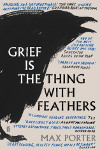
Max Porter – Grief Is The Thing With Feathers
Posted 14th November 2016
Category: Reviews Genres: 2010s, Angst, Commentary, Domestic, Magical Realism, Psychological
5 Comments
Dealing with sadness (crow).
Publisher: Faber & Faber
Pages: 112
Type: Fiction
Age: Adult
ISBN: 978-0-571-32723-2
First Published: 24th August 2015
Date Reviewed: 9th November 2016
Rating: 4/5
A family in mourning is visited by a crow. Crow brings some havoc with him but he’s also there as Dad gets through the days without his wife – struggling to finish writing his book on Ted Hughes – and as the boys come to terms with life without their mother.
Grief Is The Thing With Feathers is a rather experimental book steeped in literary history. Looking at grief both as a process and in the various guises it takes, it blends prose and poetry together with semi-autobiographical elements – Porter lost his father as a child – to become something very unusual indeed.
There is a lot to this book; it’s difficult to know where to begin. Let’s start with the style: Porter opts to eschew convention, deciding not to choose between poetry, prose, fiction, non-fiction, commentary, study, fully-fledged plot, vignette. His book is the result of a vast mixing pot that is both confusing and compelling. Mind-blowing concepts within the whole compete alongside aspects that are difficult to define. It’s safe to say this book requires a lot of attention.
And a fair bit of knowledge. Whilst the book can just about be read without knowledge of its background subjects, your reading of it will be immensely improved by your having at least a basic idea of the lives and work of those who have influenced Porter. Chief amongst these is the poet Ted Hughes, whose book Crow: From the Life and Songs of the Crow is, not surprisingly, a major factor. Porter’s general interest in Hughes means that any knowledge is useful – and it pays to know about the poet’s relationship with Sylvia Plath.
Porter takes his inspiration for his Crow from Hughes but also from the bird itself. It is the sections written from Crow’s point of view that invite the most bafflement – the sentences are often a mess of words, onomatopoeia-like creations, and a general strangeness pervades. There is the idea of a metaphor – who or what Crow is, and how much he/she/it is related to Hughes’ Crow is a question that spans the entire book. Is this Death? Is this grief itself? Is it, even, Sylvia Plath? And why does Dad see Crow – because it suits Porter or because he’s working on a Hughes commentary?
On the stylistic note, the book uses three narratives – Crow, Dad, and ‘Boys’, the latter of which concerns the two sons but is written from one point of view, potentially to infer that at their young age the boys’ grief could be considered interchangeable, or maybe that their experiences are the same. Sections by the Boys are written in verse and meanings are split over a couple of lines. Much whitespace between narratives as well as lines and sometimes words mean that the book is even shorter than it appears, physically. And in many ways this is a good thing because of the amount of detail and commentary Porter has packed in.
To the stated grief, then; Porter has spared nothing. The book is at its most powerful when it’s examining the forms grief takes and how different people deal with it. Again metaphors and explorations take centre stage, with stereotypes and the idea that one must get over it always lingering nearby.
Take this, the Boys’ reaction to their father calmly coming into their room to tell them their mother has gone:
Where are the fire engines? Where is the
noise and clamour of an event like this?
Where are the strangers going out of their
way to help, screaming, flinging bits of
emergency, glow-in-the-dark equipment
at us to try and settle us and save us?
And this, wherein Dad works through both the metaphorical and literal detritus left in her wake:
She won’t ever use (make-up, turmeric, hairbrush, thesaurus).
She will never finish (Patricia Highsmith novel, peanut butter, lip balm).
And I will never shop for green Virago Classics for her birthday.
I will stop finding her hairs.
I will stop hearing her breathing.
As said, this book requires all your attention. It’s incredibly easy, even with context behind you, to lose your way and it can take work to find yourself again. This is where Porter’s leaving of titbits comes in handy, most noticeably around the middle where comprehension questions, of the English Literature lesson type, are added as part of the narrative.
So Grief Is The Thing With Feathers is hard work but can be very rewarding. But it is also a very unusual beast and fits a specific, niche, category. You have to be happy with the very experimental style.
A difficult book to recommend outright, Porter’s début will intrigue most, delight many, and confuse just as many too and your experience of it won’t necessarily lie in how much you do or don’t know of Porter’s literary interests.
Keep a look out for it, go after it even, and see what you think. It’s quite an experience.
This book is shortlisted for the 2016 Young Writer Of The Year Award. I’m on the Shadow Judging Panel.
Related Books
Louisa Young – The Heroes’ Welcome
Posted 4th November 2016
Category: Reviews Genres: 2010s, Angst, Commentary, Domestic, Historical, Psychological, Social
2 Comments

We’ll meet again.
Publisher: Borough Press (HarperCollins)
Pages: 322
Type: Fiction
Age: Adult
ISBN: 978-0-007-36147-2
First Published: 22nd May 2014
Date Reviewed: 16th August 2016
Rating: 3.5/5
Riley returned from WWI a changed man, half his jaw missing. Surgery made up for some of it; Nadine still wants to marry him though her family worry about his prospects – it doesn’t seem to matter to employers that he served his country when he’s disfigured and thus deemed a discomforting presence. Riley’s worried about how Nadine will view him and in turn Nadine is worried about Riley’s depression; she doesn’t care that his looks have changed. Then there’s Peter and Julia – Peter served with Riley and came back physically unharmed but the war has taken its toll on his mind. Julia, in an attempt to reach him, experimented with cosmetics and has damaged her skin. Will either couple return to how they were?
The Heroes’ Welcome is the sequel to Young’s previous book, My Dear, I Wanted To Tell You. This fact is not noted; fortunately the book works as a standalone or at least it seems to – readers of the first book say it does matter, that you need to read them in order. The Heroes’ Welcome is a fair look at disability in the context of the war, it just doesn’t have much of a plot or character development going on.
On that word, ‘fair’, it’s fair to say the book goes a good way towards showing social issues and personal rehabilitation but doesn’t go quite as far as one might hope. It shows PTSD and the effects of the disorder on families – one of those topics that doesn’t get looked at much – but the main bulk of the development in this way is confined to a few pages. Young knew about the hospitals and healing through the work of her aunt (I discovered this after having read the book) which means that when the subject is concentrated it’s special. In those few pages is a wonderful overview of what you’re already starting to understand, the juxtaposition of society saying, ‘welcome back and thank you for your service!’ and ‘I’m not sure you can do this work and anyway you’ll scare people – no job for you’. It both harks back to the post-war days and illustrates what is unfortunately still the case today.
The writing is pretty good. It flows well and in the main rings true, however there are some anachronisms – ‘epically’, ‘those ones’, and the rather odd ‘losable’, for example. Young slots a first person thought narrative into the third person narration which makes the text choppy at times. Phrasing can be vague.
Young was inspired by the work of another writer who used Homer in conjunction with the events of WWI, showing how related the ancient text is to the later war. It’s interesting but the sense of fascination and seeming originality in Young’s book is marred by this fact of copying – something only divulged in the afterword, after you’ve finished it. And if you haven’t read Homer or don’t know the stories well, it may be a problem. It may be best to read Homer or to get your knowledge of The Iliad down to pat first… which given the nature and length of that text…
In sum, The Heroes’ Welcome sports nice language, good ideas, and isn’t a bad read, but there’s not much going on and for all the promise in the veterans’ stories, the book is lacking in substance. The ending is a bit of a rushed, convenient, job. The book would work best as further reading, say if you’ve completed Anna Hope’s Wake and want something that looks at the war in a similar light. It’s not, as the quotation on the cover says, the book to read about the war if you’re only ever going to read a single one.
Related Books

Keith Stuart – A Boy Made Of Blocks
Posted 26th October 2016
Category: Reviews Genres: 2010s, Domestic, Social, Spiritual
Comments Off on Keith Stuart – A Boy Made Of Blocks
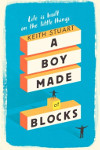
Gaming. Ability.
Publisher: Sphere (Little, Brown)
Pages: 390
Type: Fiction
Age: Adult
ISBN: 978-0-751-56327-6
First Published: 1st September 2016
Date Reviewed: 24th October 2016
Rating: 5/5
Alex and Jody’s relationship changed forever when Sam was born. Diagnosed with autism, it’s been a difficult journey that Alex hasn’t coped with. Eight years in, now at breaking point, Jody suggests a separation. Alex needs to learn to relate to Sam or leave the family home for good. But as Alex tries to deal with the devastating situation of his marriage, Sam discovers the video game, Minecraft, and a ray of hope shines in.
A Boy Made Of Blocks is a semi-autobiographical novel (excuse the oxymoron), about the relationship and communication in a family affected by autism. It is an excellent work in all ways, being at once a lesson in communication and autism in general taught by someone with first-hand knowledge of parenting a child with autism and a fun story of a very popular game we have in the factual world. And to round it off it’s just a very good, solid, read.
Stuart has a particularly engaging writing style. It flows well, it’s full of emotion without going into any sort of ‘brave’ or ‘inspiring’ territory, well written whilst bereft of anything literary which is absolutely of benefit in this case. You can read the autobiography between the lines of fiction and it’s just a wonderful reading experience.
‘All the standard parenting rules are out of the window,’ continues Matt. ‘Whatever will make this easier for you. The kids can watch movies, play video games and eat crisps for two days, we don’t care. We’ll deal with the fallout when we get back.’
‘Well, I’ve got Sam on Saturday…’
‘Bring him,’ says Matt. ‘Bring whoever you want. I’ll stock the fridge with beer – you can either drink it yourself or give it to the kids.’
It’s also rather funny. Laugh-out-loud only once in a while, it sports a general happiness, joviality, even, that’s down to the other parents’ positive outlook and, increasingly, Alex’s ever-more-optimistic outlook.
Because Alex isn’t always optimistic. In writing him, Stuart is showing very bluntly how people can see the difficulties and not cope with them. Whereas Jody has had to learn how to parent, Alex has used his work life to get away from home and so the book is a lot about the adjustment he must make. It’s far more a case of bad father than any of Sam’s tantrums. Alex must work out a way to communicate with Sam – as Stuart implies, the idea should be to work around problems rather than just say it’s impossible.
Whilst this reviewer cannot comment on the knowledge imparted with any particular expertise, from what she does know, it rings true. The main takeaway in this sense – if you’re looking for a book that presents autism and the parental experience from real knowledge – is that Stuart has a child with autism, of the same age as character Sam. The novel itself makes clear that Sam has high functioning autism so the book corresponds to that particular level of ability and of course it must be remembered that every person is different – one person with autism does not reflect every other person.
For all these reasons it hardly needs to be said – this book is incredibly important.
And due to the variety of subjects and the writing style it has vast appeal. It’s by no means just for those who are interested in or have autism. For example, the information and detailing of Minecraft should prove a literary delight for gamers. On this subject it bears noting that the use of Minecraft will inevitably, unfortunately, mean the book may lose some of its significance within a few/several years. The best time to read it is within that time, most especially if you don’t have experience of the game yourself as there will be lots of resources available to learn from.
(As a brief introduction for those who aren’t familiar, Minecraft is a multi-player game, playable over the internet if the person wants to share their game with others, that involves gathering building materials and making tools in order to create shelters and farms and so forth – all sorts of things really – on a blank/semi-blank landscape canvas. In this book’s case, the building is a vast castle based on the Tower of London. The game’s graphics are retro – in a time when we have rather sophisticated software, Minecraft harks back to 80s/early 90s nostalgia. It’s suitable for a variety of ages.)
The use of Minecraft presents a conflict for this reviewer: it has been noted by many gamers that not all the references in the book are factually correct, and indeed some will be noticeable to non-gamers also, for example Sam and Alex choose to start a game in ‘peaceful’ mode, turning off the monsters because Sam is not comfortable with the idea of them, but then a few pages later to Sam’s dismay monsters arrive anyway. It’s hard to say why there are incorrect references as Stuart plays Minecraft himself and as Games Editor of The Guardian is presumably very well informed. Perhaps it was an attempt to make it easier for people who do not play the game to understand it, but it presents a conundrum: this is an incredibly important book that in all other ways is absolutely superb. To give it less than full marks may be going against the idea that perfect should be perfect, but at the same time the Minecraft references themselves in the grand scheme of things do not seem so vital. (And you know how important research is to me, and that I am a gamer myself.)
So this book gets top points with the caveat that Minecraft players may on occasion feel very frustrated.
There are so many books out there, about autism, mental, and physical health in general, that are written by ‘experts’ with little true experience of the day to day, that A Boy Made Of Blocks shines brightly in its difference. If you want to know more about autism in the context of parenting, read this book. And if you’re looking for a good reading experience that doesn’t necessary fit into any category, this is the book for you. It’s so good it’ll give even the biggest reading slump a run for its money… or crafting tools.
I received this book for review from the publisher.
Related Books
None yet
Helen Slavin – Crooked Daylight
Posted 23rd September 2016
Category: Reviews Genres: 2010s, Angst, Domestic, Drama, Paranormal
3 Comments
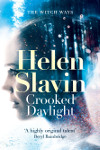
The definition of magic?
Publisher: Ipso Books
Pages: 204
Type: Fiction
Age: Adult
ISBN: 978-1-911-29567-9
First Published: 24th August 2016
Date Reviewed: 20th September 2016
Rating: 3/5
When their grandmother dies, Anna, Charlie, and Emz inherit her cottage and the woods that surround it, but, already having homes of their own (well, Emz lives with Mum) they decide to let it as a holiday rental. One of these rentals is to a mysterious young woman who likes to bathe in the lake they’d always been told to avoid, and when they spot a man in the woods the sisters are worried. And it seems their grandmother is still around, helping them. Amidst this are the sister’s own stories of relationships, deaths, and young adulthood.
Crooked Daylight is the first book in a planned series focusing on three modern sisters who may have a little magic about them.
This is an interesting take on the idea of magic. It’s the sort of thing that’s been done many times before but not quite in this way which sounds like a paradox and therefore requires explaining. The three sisters – Anna, Charlie, and Emz (whose full name is Emma but as that isn’t revealed until near the end there’s plenty of space to speculate whether, perhaps, Slavin had thoughts of the Brontë sisters in mind) – are people living in our present day with our mobile phones and conveniences. This time period isn’t so much explained as it is shown through slang and the sisters’ often abbreviated language. (Sometimes it can seem as though they are a lot younger than their ages which may be a turn-off for some.) The various housing involves terraces, town houses, and their mother’s new state-of-the-art home… but then there’s also their late grandmother’s cottage in the woods that Slavin’s descriptions infer to be your fantastical wooden thatched cottage. So it’s a meeting of modern reality and slightly older fantasy, but it’s still not that simple. Slavin doesn’t explicitly address the magical elements until near the end which has the effect of pulling you deeper into the narrative as you try to work it out. Is there any magic, really? What sort? Is it just something supernatural?
So Slavin has aimed for something between reality and fantasy that skews more towards reality. It’s the sort of usage that brings to life those times when we wonder how something no one could have had a hand in could be so coincidental. It all works very well.
However, to go back to those characters and their ages that are hard to believe, it can be difficult to relate to them. It’s not that they are dislikeable per se, but they do at times get into drama and other people’s business when they should mind their own, for example one time they have a quite valid worry about a person’s safety but instead of approaching them – a tenant – to mention it, they use their privilege as the holiday home owners to enter the cottage and look around without asking whilst the woman hides in another room, uncomfortable. Another occasion sees one of them becoming quite snotty with some women who so far have done nothing to her (barring trying to stop her and her sisters when they run off with their grandmother’s body to cremmate it in the way they, the sisters, feel it should be done). There’s a disconnection between action and reason.
A seemingly minor element but a compelling one – the sisters’ mother, Vanessa. Vanessa is very different to her daughters and her own mother alike; whereas Hettie (the sisters’ grandmother – Vanessa’s mother) had something magical going on about her and so, it seems, do Anna, Charlie, and Emz, Vanessa is a scientist who lives in an incredibly modern home. Her home is so modern her daughters can’t work out how to use it and whilst this factor may bring about an extra few centimetres in the gulf between mother and daughters, there’s the slight suggestion in it that Vanessa is trying to forge her own path. Whilst the daughters are modern but affected by this magic of their grandmother’s, Vanessa is left out. Her daughters may feel neglected, and that may be true, but it’s an interesting thing to ponder on – why is Vanessa so different? Is it simply that Slavin wants to bring to the fore the difference between traditional magic, superstition, and up-to-the-minute scientific findings, or is it a look at how a person left out will try to forge their own path, their own identity? It may be something, it may be nothing – this reviewer may be over-thinking it – but it’s interesting to contemplate and the difference between mother and daughters will doubtless be further explored as the series continues.
There is no major plot-line in this book which can make it difficult to keep up with the goings on. Various threads and a large number of secondary characters make it feel like a soap opera at times but when the narrative focuses it’s pretty good. It takes a while for that particular thread to become less blurred, to show what it actually is, but the pace gets swifter once it’s settled into. It’s a case of having a lot of information at once, presumably to set up the scene for the series, but it would’ve been better for it to be unwound slowly.
The writing is generally good. Slavin often uses unconventional words – onomatopoeias, for example – that are distinct because we tend to use other words, but this becomes a quirk you look forward to and the meaning of these words is always obvious. But there is a shortage of commas – sometimes clauses that are meant to mean one thing read as something else.
Crooked Daylight is a nice read but quite disjointed. It ends well, suggesting the next book will be very good (and a lot higher in magical content) so if you like the general idea you may want to read it or at least keep the series in mind for when the next one is out.
I received this book for review from the publisher.
Related Books
None yet
Tahmima Anam – The Bones Of Grace
Posted 19th September 2016
Category: Reviews Genres: 2010s, Angst, Domestic, Political, Romance, Science, Social, Spiritual
Comments Off on Tahmima Anam – The Bones Of Grace

One epic love letter.
Publisher: Canongate
Pages: 407
Type: Fiction
Age: Adult
ISBN: 978-1-847-67977-2
First Published: 19th May 2016
Date Reviewed: 14th June 2016
Rating: 4/5
Zubaida was studying in America when she met him: Elijah, a man she came to know for just a few days; she had to leave for Pakistan when her university department’s hopes of uncovering an ancient fossil were realised. But when the project came to an abrupt halt, Zubaida went back to her native Bangladesh and married her childhood friend, effectively bringing an end to her acquaintance with Elijah. Years later, after meeting and splitting from him again, she has chosen to tell him everything in a letter.
The Bones Of Grace is a somewhat epic story that also includes another story within the story. It’s the sort of book you’ll likely either love or hate (very difficult to rate!) but either way appreciate the background detailing.
What first strikes you is Anam’s writing – it’s sublime. There are no two ways about it. It’s the sort of writing that is so wonderful, so well put together, so constant, that it has a very real affect on the novel’s flaws. You won’t dismiss the flaws, but you will feel as though you want to dismiss them. But what’s interesting is that this isn’t necessarily Anam’s natural writing style, it’s all Zubaida – during the story within a story, where we hear directly from Anwar (and it’s just that Zubaida has included his words in her letter) the writing is very different. More… male, appropriately. (Anwar is a man looking for his past love who puts his search on hold when he runs out of money.) Zubaida’s words, the flow of her writing, does make up somewhat for what could be called a frustrating narrative.
And I could imagine almost every day of your childhood, because it would have been documented in films or on television – in that way, you had probably lived a deeply unremarkable life, had experiences without specificity, and that had bothered you, the way my own past grated at me. All the things that irrritated you were things that I longed for, and all the things you longed for were things I took for granted.
I want to tackle this narrative before moving forward (hopefully the above extract exudes the quality and how the narrative can be both beautiful in what it says and, to use a word from the extract, grating). Whether Zubaida is annoying is really up to you, your personality, and, likely, down to your own experience of love and heartbreak. That Anam has captured her particular tale in a very honest way is hard to dispute – I think we’ve all had times when we’ve realised we’re dwelling too much on something and need to stop discussing it, and that that doesn’t always mean we stop thinking about it – it’s just a case of whether you’re happy to spend 400 pages on it and, indeed, whether you believe in this woman, Zubaida, writing a 400 page letter of excuse and apology.
Of course without the number of pages, we wouldn’t have a novel, we’d have a pamphlet, a novella at most, so this is where the background and ship-breaking comes in.
“It’s a cruel industry. For years we’ve been working slowly, patiently with the owners. Suddenly she comes and tells us how terrible things are. A film isn’t going to change anything.”
Anam uses Zubaida to look at the end-of-life of ships, in this case a cruise ship. There is the time when the ship is created – overseas – and sets sail, multiple times – overseas – and then, when it’s deemed too old, it comes to Bangladesh where men work for little pay, breaking it into pieces to be sold on. Zubaida comes to the beach as a translator for a western reporter who is looking to make a film (and possibly press charges against the management). Through Zubaida, Anam shows the horrors of the situation – the lack of safety, the deaths, and the exposure to chemicals and other toxic ingredients the workers face. It’s a uniquely-realised story. The inclusion of Anwar’s story, in which he comes to work at a ship-breaking beach, adds to the level of detail involved.
Then there is the palaeontology. Zubaida’s passion is the study of the fossil of a walking whale – a creature that slowly evolved to live under water whilst other creatures evolved to live out of it. Her journey is set around her attempts to get access to the fossil, first overseas then through the removal and sending of the bones to America. The journey shows the conflict between work (the will to, in this case) and relationships. Anam is an anthropologist which means you get a lot of detailing, but her writer self stops it becoming too much.
Amidst this is Zubaida’s lifelong mental conflict – she was adopted, lives in a well-off family and her fiancé is rich, but she doesn’t know anything about her birth mother and starts to feel a need to know where she came from. This is where privilege and class enters, where the underlining of Zubaida’s poorer beginnings limits what there is for her to know. It’s there in the background when she begins to question, no matter what category the question comes under; her thoughts of love, duty, and Elijah are informed by her adoption. In meeting Elijah she finds herself thinking of things she’d never thought about before and quite possibly never would have otherwise, and family duty and a general lack of mental strength hold her back from taking it further. She has all this luxury in consequence of being with Rashid, she’s lucky, she shouldn’t be thinking of Elijah. But she is thinking of him.
And amidst this turmoil is a minor story – minor in how much time it takes up (it’s big in terms of real-world impact) – of war, of the effects of it and of war crimes coming to light. Zubaida’s mother has spent her years working towards justice. Her father’s work and business has been ethical. You see glimpses of the Bangladesh war.
Now the ‘twist’, if it can be called so, that you start to see when Anwar makes his entrance (because if a stranger becomes involved you know there’s got to be a connection somewhere), isn’t as predictable as you might first think. It’s quite likely you’ll guess correctly, and, yes, of course this part of the narrative could be considered a device because how likely is it that it’d all happen in real life and so on, but it’s a novel after all. The reveal is pretty satisfying – it won’t blow your socks off but it may well make up for any frustration you had been feeling due to the way Anam goes about it. Make no mistake – don’t go assuming the twist the main reason for the book. It’s not – the book is all about the journey, the writing, the history, the palaeontology, and the ship-breaking – but it does give it an extra lift.
The Bones Of Grace is a slow-paced book. There’s not really any action in it; certainly that it’s one long letter should suggest this as a possibility. It’s very much a literary book, an issues book, wherein the pleasure is in its bookish sensuality.
If you like the sound of that and if what’s heralded as good about it hits the right notes for you, it’s likely you’ll fall completely in love with it. If it doesn’t hit the right note, you’ll likely still appreciate it but it may take you a while to get through.
Related Books
None yet


