




Kate Forsyth – The Wild Girl
Posted 7th August 2013
Category: Reviews Genres: 2010s, Angst, Domestic, Historical, Political, Romance, Social
8 Comments
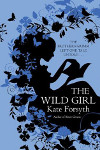
If they were the Brothers Grimm, then these were the Sisters Wild, and one in particular played a big role in the collecting of stories.
Publisher: Allison & Busby
Pages: 475
Type: Fiction
Age: Adult
ISBN: 978-0-7490-1328-8
First Published: March 2013
Date Reviewed: 26th July 2013
Rating: 5/5
Dortchen Wild fell in love with Wilhelm Grimm at first sight. Her love continues to grow over the years but the age gap between them and the difference in societal standing means that Dortchen already knows there’s no chance her father would allow her to marry him, he barely lets them socialise. Wilhelm and his brother are collecting folk tales for a book they wish to publish and Dortchen becomes one of their sources, but the Grimm family have only the faintest idea of what goes on behind the doors of the Wilds’ house, and about the anger of the father.
The Wild Girl is a necessarily slow but by no means quiet novel that takes as its premise the girl history forgot, her family, society at the time, and the possibilities brought forth by Forsyth’s research. In a similar vein but with major differences to Forsyth’s previous book, Bitter Greens, the story brings the concept of the dark fairy tale into reality whilst balancing that hard truth throughout on the other hand.
Forsyth has chosen as her subject the foundations of her previous story. Albeit that she told Bitter Greens, a retelling of Rapunzel, from the view of one of its earlier writers, it is widely known as the work of the Brothers Grimm and therefore The Wild Girl is a return home of sorts. The facts known about Dortchen can be found in Forsyth’s source information at the back of the book; she has followed the facts where possible and elaborated on the grey areas.
One of these grey areas is the possibility of violence, which is important to mention because of the nature of it. The domestic abuse is suggested very early in the book and it should be noted that this is in no way a story for young readers. Forsyth takes the route currently popular in retellings, showing the dark side of fairy tales, exposing their true routes, and this runs parallel to her interpretation of Dortchen’s family life. It is interesting the way Forsyth came to her conclusion of how Herr Wild acted, at least for the purposes of her book, and at the end of the book Forsyth makes a compelling case for what she has written whilst never saying that it is definite. For it is not, but her source information does support her tale.
Here we come to Dortchen’s later meetings with Wilhelm, and this bares responding to because it can be frustrating for the reader but is surely realistic of the situation. In writing what she has, Forsyth has turned the notion of ‘filler’ on its head because in any other context, Dortchen’s conduct would be considered dull. But Forsyth uses the time to remark upon the affects of violence and abuse on a person’s later view of relationships and shows that a fairytale ending is impossible, if not forever then at least for a very long time. And albeit that the backdrop is the 1800s and people respond, react, and keep quiet as they surely would have then, Forsyth’s commentary is relevant to our present day, too.
The book is steeped in French Revolutionary history, and here you get the point of view of the Germans. Forsyth brings the needed opinion of the common person into the picture and provides a lot of factual detail about the movement of the armies and the battles fought. You see the direct affects both the initial change and later reversal of changes had on the population of a country where religion was still important, society unequal, and the poor enslaved. Forsyth offers up the interesting detail of how Napoleon’s rules could be hated until society got used to them at which point, when the reversal happened, a lot of people saw the good in the Revolutionary rules – if not when it came to views about women. There is enough here to supplement the knowledge of anyone with an interest in the Revolution and how it affected Europe, with the foresight that only the inconsequential, such as individual one-scene characters, are fictional.
So The Wild Girl is a fairy tale of a different sort. The main plot isn’t based in fiction and there are no fairy godmothers, princes, or witches with towers. It is in the writing itself that the book makes a claim to the label and in the inclusion of the many stories told to the Grimm brothers. These inclusions are as much a source of knowledge as are the accounts of the wars. There is a very slight paranormal element used but it is more about the ideas Dortchen has, because it is never suggested that this paranormal element is real or that it has a true affect on the story. It is more a case of convenience for Dortchen’s imagination and to help her mental state (though in no way a convenience in terms of Forsyth wanting to hurry on with the story).
After all this, then, what about the characters? Dortchen is strong but understandably this nature is left in tatters as the story continues. The other Wild daughters are well-rounded and made easy to tell apart by Forsyth’s instant usage of stereotypes (stereotypes of a fashion used in fairy tales). The Grimm family, too, are developed, and Wilhelm is a worthy hero, all things considered. He was never going to be the knight in shining armour as real life rarely works that way, but instead he is believable and at times a fine example to use when Forsyth is discussing affects and reactions. Herr Wild shows the contradictions of religion and reality, and in Frau Wild you have at once the typical melodramatic mother you might expect from such a story, as well as a well-written example of both the hindsight of the present and the lack of knowledge – paired with discrimination – of the time. This is a hard book to read, there is no doubt about that, but it is both entertaining in its way and poignant and necessary in another.
The Wild Girl is about the women patriarchal history forgot, of the people who were crucial to the Grimms’ success. It is important, it is informative, and it is a compelling read. And it reminds you that there is always darkness to the sweetest tale and that even the hardest of times can include a little magic.
I received this book for review from Allison & Busby for Historical Fiction Virtual Author Tours.
Related Books

Sheryl Sandberg – Lean In
Posted 31st July 2013
Category: Reviews Genres: 2010s, Business, Commentary, Domestic, Psychological, Social
4 Comments

Sit at the table. Don’t wait to be asked. Your parents might moan but your career will flourish.
Publisher: WH Allen (Random House)
Pages: 171
Type: Non-Fiction
Age: Adult
ISBN: 978-0-75354-162-3
First Published: 11th March 2013
Date Reviewed: 9th July 2013
Rating: 3.5/5
A mixture of memoir, research, and experience, Sandberg, Facebook’s COO, discusses what holds women back from having successful careers. Looking at how social expectations create barriers, she details what we can do to change the workplace to further equality. Drawing on her time as an intern, at Google, and, of course, at Facebook, Sandberg’s book is as much about personal experience as the experiences of others.
Lean In is a comparatively short book that, although it could have been longer as well as better edited, presents good evidence and is a fair motivator. Sandberg is honest from the beginning – this book isn’t of a particular genre and she is very aware that she is not perfect with gender herself. This contributes to the success of the book, even if it doesn’t quite heal the inconsistencies.
Sandberg makes it clear from the word ‘go’ that her word isn’t the be all and end all, that equality means having a choice (for example between being a stay-at-home mum and a working parent), and that whilst the book will likely resonate most with women, there is something for men, too.
These are promises she keeps. Partly due to her own status as a mother, she constantly considers points about child well-being, contact time, and the reasoning against leaving children to go on trips. This is a good aspect of the book and yet as it is obvious and understandable that she defends her own choices, inevitably Sandberg ends up unconsciously reinforcing why there is the social expectation to stay at home in the first place. This isn’t to say you’ll necessarily end the book thinking she’s a bad mother, but she does unfortunately bring into focus the very thing she didn’t want to. This sort of thing also happens with other unrelated accounts, such as when she says crying is good between employees but makes herself sound weak.
On the promise of choice, Sandberg never waivers. Her opinion is that if women want to work they should, if they want to look after their children they should, if they want to combine both they should. She also highlights the need for men to have a choice as well – in that a stay-at-home father is seen as a bad life style when it shouldn’t be. And she reminds you how people will ask a woman how she intends to change her life to accommodate her child, but a man is never asked.
As suggested above, the promise of making the book interesting for men is kept. This reviewer, as a woman, may be saying this from an ‘outsider’ perspective, but Sandberg spends much time speaking about the lack of paternity leave and about how men who wish for equality are not given support or credit.
What of the major aspects, then? Beyond choices and parenting, Sandberg discusses the fact (backed up by evidence) that the sole difference of gender on an otherwise identical profile will illicit different responses from study groups. She explains how we don’t even notice our own biases, how she doesn’t notice hers, and how research suggests that it’s people who say they are not biased who are actually the most subjective. She talks of how women are often the issue, not supporting each other, and how it’s unfortunate, even if understandable, that a woman’s view of another woman is considered most important – unfortunate because a woman will often be more negative of another woman than a man will be.
Sandberg looks at the differences in our perceptions of successful people. A strong successful man is liked, a strong successful woman is considered bossy. Likeability doesn’t match success. She discusses catch-22’s – a woman who helps a colleague is less likely to have the favour returned due to the stereotype of caring, a woman who doesn’t help will be penalised more than a man would be. And she debunks the old saying that people are different as they get older – “nothing has changed since high school; intelligence and success are not clear paths to popularity at any age”.
Perhaps surprisingly, whilst Sandberg hopes for change she says that sometimes stereotypes and little ideas must be bought into to gain success. She speaks of women assuming dominate poses, such as physically taking up more space, to aid the mentality of strength. The focus on faking it until you make it is, in the context of Sandberg’s main ‘lesson’, both understandable and a contradiction.
Unfortunately there are more of these contradictions in the book. One is the focus on women with children. Up until half-way through Sandberg’s advice and opinion is generalised and useful. This then stops suddenly. The initial reason is that there is a chapter that isn’t nearly as worthwhile as the rest and the book becomes very repetitive. But the second and more obvious reason is the exclusive focus on motherhood. There is very little in this book written specifically for women who have no desire to parent. This may fit Sandberg’s own position as a mother, but it renders the book inaccessible, creating a bit of a ‘them and us’ situation. There is a lot about women who are thinking of having children and women who want them someday, contrasted with one single story of a woman (who nevertheless wants children one day) speaking up for those burdened with extra hours so their colleagues can spend more time with their own families. Women with or who want children may indeed have a tougher time succeeding in their careers, but the premise of this book did not suggest such a level of positive discrimination. And to go back to Sandberg’s accidental reinforcement of the mother stereotype, much of what she says in the latter chapters only reminds the reader of why ‘we’ have discrimination.
Taking the positive discrimination further, the book is, perhaps obviously, inaccessible and irrelevant to those on lower incomes. Indeed Sandberg talks of wage gaps, single parent families, and how she happens to be lucky, but this doesn’t make the situation any better. If this was to be about helping women to succeed she needed to cover those not fortunate enough to have the money to afford university, to not have the wealthy and supportive parents, partners, social contacts, those who are stuck in dead-end jobs. As other reviewers have pointed out, Sandberg acknowledges the help of many many women in the creation of the book, but nowhere is there a mention of the women she employs to look after her house or children, excepting a single reference to a faceless woman she was jealous of for owning her, Sandberg’s, son’s affection.
This lack of accessibility is cemented by the name-dropping. Sandberg has worked at Google, Facebook, in countless privileged positions – and that is the point, the continual reminders of luck, money, and a nice but rare modern office culture will likely divide many readers from the text. If the target audience was high-income women then the book wasn’t particularly necessary in the first place, or at the very least Sandberg should not have brought in mentions of lower-income families.
And it’s a pity because as the book moves into its second half there is enough repetition that could have been replaced with a whole new chapter about how to get that first good job, and the book wouldn’t have had to have been any longer. Sandberg is in a position to have written this book, in so much as people will give her book deals without persuasion, but she displays a distinct lack of knowledge or at the very least has left such knowledge out, out of convenience.
But then given the contents of the acknowledgements, how much of this book did she actually write and how much is simply paraphrasing?
Sandberg’s book provides a lot to think about, and her honesty is refreshing. But it’s not perfect by any means and is full of contradictions and missing information. Read it, it’s worth it on the whole, but don’t expect many answers.
Related Books

Taylor Stevens – The Doll
Posted 24th July 2013
Category: Reviews Genres: 2010s, Angst, Crime, Social, Thriller
2 Comments
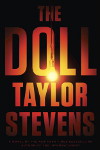
A race against time and death.
Publisher: Crown (Random House)
Pages: 335
Type: Fiction
Age: Adult
ISBN: 978-0-307-88878-5
First Published: 4th June 2013
Date Reviewed: 15th July 2013
Rating: 5/5
Please note that this reviewer has read the first book in the series but not the second, so any confusion discussed may or may not be the result of not having read the second book.
Vanessa Michael Munroe was enjoying a respite with Miles Bradford when she was whisked to hospital following a blackout. Bradford saw it happen but it’s not obvious at first what truly happened. Together with this a rising star of the screen has disappeared, and no one knows where she is either. Are they connected, and if so why would the same group wanting a young girl want Munroe as well?
The Doll is the fantastic third book in Stevens’s Munroe series. A book with no slowing of pace, no fillers, and a constant awareness of reader intelligence, The Doll is a triumphant example of the thriller genre at its best.
Munroe is the same tortured soul as before, but Stevens has again created a good balance, allowing the darkness to make its mark but never letting Munroe really succumb to weakness. Munroe can be harsh at times but her strength and belief makes her easy to love as a character, especially in a time when so many books have weak heroes; and the word ‘heroes’ is not a spelling mistake. Here again we have Munroe posing as both genders and the affects such a lifestyle has had on her is portrayed, subtlety in her words and movements. She has the respect of a man and never needs to do anything to prove herself in that vein.
Stevens has also put a lot of work into the book’s particular other main character, the celebrity. You would expect that (assumable if you consider each book has its own criminal storyline) Neeva wouldn’t be fleshed out as much, but Stevens has created in her the most memorable character.
The ongoing relationship between Bradford and Munroe follows the same pattern. The love is obvious, but you could never assign the label ‘romance’ as a theme. Even the strong love Munroe has for others have their limits on her character.
The awareness of intelligence is one of the most intriguing aspects of the book, because Stevens never makes concepts or plot points unnecessarily obvious. She gives you the basics – all you need to work it out – and then the rest is up to you. This means that sometimes the book is confusing, but it also adds longevity to the plot. In addition, the book is not predictable and barring Munroe’s almost reluctant humanity, which ‘had’ to occur sometime, anything could happen. And it does. Stevens never promises a smooth ride, beginning, middle, or end.
The pacing is just something else. From start to finish you’re speeding 100 miles per hour and even the chapter breaks leave no time to catch your breath.
A book with such a poignant subject had to be treated carefully and Stevens has done that. She gives you as much as is needed to feel entertained by a novel and then goes all out to show how awful it is. She doesn’t just use the situation and create a happy ever after, she brings the reality of the situation into it. Of course there is a measure of apology from the criminals but it’s clearly definable as something to help the story and not suggested as realistic. The horror is never glossed over.
Stevens has bypassed the description of ‘promising’. It would be impossible to say that this book holds promise for the future because Stevens is already beyond promise. The Doll is a masterpiece and one of the best books of this year.
I received this book for review from Crown Publishers.
Related Books

Kimberly Derting – Dead Silence
Posted 12th July 2013
Category: Reviews Genres: 2010s, Paranormal, Romance, Thriller
1 Comment
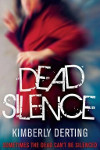
It’s been closer to home, now it’s at home.
Publisher: Headline (Hachette)
Pages: 389
Type: Fiction
Age: Young Adult
ISBN: 978-0-7553-8917-9
First Published: 16th April 2013
Date Reviewed: 9th May 2013
Rating: 4.5/5
Violet has recovered from her ordeal and still has the echo to prove it. But it won’t be long before she’s back to using her abilities. There’s to be two additions at school, making life complicated, and Violet never has been able to listen when people tell her to phone for help rather than investigate a crime scene herself.
Dead Silence is the fourth book in The Body Finder series. Derting is as good as ever, Violet is as strong as ever, the romance includes all those details and questioning you wish other YA books would include, and the series has got ever more unapologetic and mature as Violet gets older. As always Derting never shies from the gruesome truth, and in fact Dead Silence has some gruesome information about related subjects, too.
This time the story is more involved with the characters directly. Not that the series was ever lacking in either character development or plot (indeed Derting balances character and plot-driven nicely) but this time there is a little more focus on Violet and her friends for good reason – the setting doesn’t move so much between her ‘factions’ and there is reason to concentrate on her home and school life whereas before the concentration needed to be on the cases. And this, even though the crimes are just as thought-out and included. There is also a lot more back story as to the history of abilities, as well as insights into the mysterious Dr Lee.
Derting has focused on crimes that are fuelled by motives that have become very ‘every day’. She does provide lessons and suggestions for her readers but she also looks at the other side (in other words the book does not preach because of the basic structure of the books – the switch between Violet and the killer). Again ‘balance’ is the word of the day – the crimes are bad, like the other books, but there is a particular humanity in Derting’s portrayal of the killer’s life that demonstrates how upbringing has a lot to answer for. It does not excuse the crime, but puts it in terms that fit Violet’s life – gruesome, but not so far away that Violet, nor Derting, nor the reader, could put it in a box and move on. It might be a closed case now, because Derting doesn’t continue a crime beyond one book, but the way Derting has approached it means that it is poignant nonetheless, and perhaps the ultimate in showing rather than telling.
Violet makes a choice in this book to tell another person of her abilities. Her choice may not please everyone due to the way the person reacts, but it does bring a new element into the story, keeping it fresh, and one assumes Derting knows how this choice might affect her books as she uses it to a particular end.
The only thing that holds the book back is the writing; it’s not bad but it lacks Derting’s previous continuous strength, and there are some grammatical errors that aren’t the sort you would expect editors to pick up – they are style errors. There are also a couple of occasions where Derting is either too contemporary (regarding the way the back story is presented) or uses particular slang as her writer’s voice. These are generally ‘niggles’ but collectively they do faze the book.
Nevertheless, Dead Silence is a must-read. It could possibly be read as a stand-alone but it would be difficult for the reader to fully appreciate what Derting has created. For the faithful follower, it may just be the best yet.
I received this book for review from Headline.
Related Books


Kieran Shields – The Truth Of All Things
Posted 3rd July 2013
Category: Reviews Genres: 2010s, Historical, Mystery, Theological
2 Comments
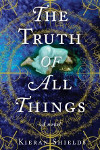
Far more sinister than bubble bubble toil and trouble.
Publisher: Broadway (Random House)
Pages: 401
Type: Fiction
Age: Adult
ISBN: 978-0-307-72029-0
First Published: 2011
Date Reviewed: 2nd July 2013
Rating: 3.5/5
It’s late 1880s Portland, Maine, and a witchcraft fanatic has murdered a prostitute. No one has any idea why and if it weren’t for Grey and his outlandish plans for fingerprint taking and other evidence collecting, it might have been a lot harder to discover. There appears to be a connection to the Salem witch trials, but also to native Indians and a potential link with a pagan group in the town. It’ll be up to Archie Lean, Grey, Lean’s friend Steig and Steig’s niece Helen, to work out what happened and bring the killer to justice.
The Truth Of All Things is a historical mystery based on fanaticism – a nice town setting with some gruesome murders and a narrative that is both plot and character driven. This mixture can keep you reading even during the slow moments.
Shields has created a good cast of characters. It’s obvious from the text that time is to be spent on them as a group in future – whilst the plot may end sufficiently, the situation of the characters is such that even if it wasn’t now the case that a second book is out, the stage is set for a continuation. This doesn’t mean they are particularly developed however, as the bias is towards the plot.
Of particular note is Helen and Shields’s writing of her. Not only is it good to have a woman included in the investigation, Shields makes her role fairly sized and also includes slight social context. Helen is both a product of her time (she doesn’t speak out when the men worry about how she’ll react to bad news) and someone who is pushing for change in that she wants to play her part. This is improved by her status as a mother, albeit that she is a widow and therefore has no one but her uncle to answer to.
Grey’s part is also worth considering as he is partly native Indian. Although he lives in a time where he has some respect, there are occasions where he is discriminated against and, like the crafty detective he is, he uses this to his advantage, lurking in the shadows so that he and Lean get two perspectives of a scene. Indeed whilst it is slight, Shields book provides a commentary of the society in general. It’s there, but it never takes over the story. But nor is it so minute as to not be noticed.
The history (the 1600s Salem witch trials rather than the 1800s setting of the book) is used to good effect. It is of course important to the story itself, yet Shields never allows it to take over here, bringing in other factors to influence the crimes. When reported, however, there is a lot of detail provided. The issue is that sometimes it could be considered info-dumping. It’s far from a major negative, especially as it’s confined to dialogue, but it is noticeable, namely because it slows the dialogue down to a halt. The 1800s history is all that you’d expect from such a setting, that is to say if you like reading about the period at all, you will like Shields’ Portland.
The dialogue can be grating at times. Shields includes a lot of banter between the characters, and much of this happens during odd moments. It also isn’t very successful as it’s based on the characters’ natures which, given that this is a first book of a series and there is a whole thread dedicated to murders, isn’t something that one can appreciate as the characters are not known yet. There is the sense that the reader ought to know them already.
The book picks up pace around the three-quarters mark, gaining momentum and showing off what Shields can do when not bogged down by detailing. He pulls the wool over your eyes to success. You do need to keep your wits about you as most of the minor cast are referred to at this time, all at once.
The Truth Of All Things isn’t bad. It’s a good début and good enough that you might want to check out the next book. But you won’t be waiting impatiently for it.
I received this book for review from Crown Publishers.
Related Books


