Annie O’Neil – Doctor… To Duchess?
Posted 7th August 2015
Category: Reviews Genres: 2010s, Romance, Social
1 Comment

Keeping the estate, keeping the man.
Publisher: Mills & Boon (Harlequin)
Pages: 146
Type: Fiction
Age: Adult
ISBN: 978-0-263-24726-8
First Published: 30th July 2015
Date Reviewed: 6th August 2015
Rating: 3.5/5
Julia moved to St Bryar with her children after the death of her husband. She loves working as a doctor and the life she’s made for her family, but all that may change when Oliver, heir to the dukedom, comes home from abroad. He isn’t interested in the estate and it’s pretty much a given that he’ll sell it, taking Julia’s job in the process. He’s somewhat her rival but from the moment they meet neither can quite take their eyes off each other.
Doctor… To Duchess? Is a fair tale that falls under the medical romance genre. It’s got all the hallmarks of a good story and for the most part is a success.
Starting with the characters, Julia and Oliver are well written. You get a lot of their thoughts and O’Neil does a fabulous job of detailing all the anxieties of the couple – falling in love is accompanied here by the worries of rejection. Oliver, in particular, due to his particular worries, is very real. There’s a balance, a very natural back and forth between strength and weakness, worry and ‘pull yourself together’. Whilst the inner dialogue can seem a lot, it’s realistic. People do think, worry, this much, and perhaps it takes a book to demonstrate that. The dialogue is funny, and keeps the repetitive parts from taking over.
“Are you on?”
What? Seventh heaven?
Oh, for goodness’ sake. Don’t say that.
There is some repetition. Most of it is down to the detailing; the book has more detailing than dialogue so there can be a disconnect between reader and characters on occasion. You hear more narration than speech. This said, in the context of the sub-genre, the medical aspect, the details are welcome. O’Neil has obviously done her research and works her knowledge into the book without it taking over; this is a medical romance book – the focus is on the romance and medicine simply informs the lives of the characters.
This book has one sex scene which is good to note in part because there are people who will like that for itself and because it shows what’s important – emotion. Of course there is some desire, okay there’s a fair amount of it, but O’Neil is all about showing how people fall in love and work through their issues. The story may begin with desire, lust, if you will, but it quickly changes to love.
There are just a few places where dialect does not ring true, for example ‘baked goods’. Whether it will have an affect is down to the individual reader. Otherwise it is firmly in the traditional English countryside and the trueness of it may outweigh the previous note.
On the topic of traditional, it should be noted that whilst the setting and people are convincing, they are not too insular. That is to say that this is a village romance (think British version of the American ‘small town romance’) but it’s not too strong; those who like the idea will enjoy the book, those who just want a good story will like it, too.
If you want the unapologetically realistic in your romance (at least in terms of emotion and worry – few people find themselves with the nobility, after all!), Doctor… To Duchess? is for you. As said, the characters seem to be over-thinking until you step outside the box (the book) – this book has more than a surface dressing and it pays to look a little deeper. There are flaws and it ends a little too swiftly but the positives outweigh these for the most part and it is nice to watch the characters grow into their futures.
I received this book for review from the author. We have met.
Related Books
None yet.
Téa Obreht – The Tiger’s Wife
Posted 22nd June 2015
Category: Reviews Genres: 2010s, Magical Realism, Political, Social, Spiritual
4 Comments

Lions and tigers and bears… and war and legends.
Publisher: Weidenfeld & Nicolson (Orion)
Pages: 336
Type: Fiction
Age: Adult
ISBN: 978-0-297-85901-7
First Published: 1st January 2010
Date Reviewed: 19th June 2015
Rating: 3.5/5
Natalia is off to vaccinate children at risk. In a country torn literally apart by war, help is needed. As she and her friend get to grips with their location, she muses on her grandfather, his life, and the tales he told her.
The Tiger’s Wife is a many-layered book. Good but with vague purpose, it is enjoyable but decidedly average.
The main problem where lack of success is concerned is the way Obreht chooses to write her story. The natural choice of main character was the grandfather but instead Obreht opts to tell the story through his granddaughter. It shows – Natalia is severely underdeveloped. There is no reason to care about her, nor anyone else. Everyone is forgettable.
This way of telling a story, through someone else, may work at times – Lockwood and Nelly in Wuthering Heights are fine, as is Wells’ time traveller speaking of the past – but in those cases there is a basic disconnect, a sub-textual acknowledgement that the narrator is just a device. In The Tiger’s Wife, whilst Obreht may see Natalia as a storyteller, she also includes enough about the woman herself to suggest she wants us to relate to her, to warrant detailing her life. Granted, Natalia is a device through which Obreht also teaches us about the Yugoslav wars and life at the time, likely chosen to bring about a similar affect as a memoir might have, but it doesn’t quite work.
The other problem is more opinion – some readers may find the book too vague. You are left to work out Obreht’s point by yourself; Obreht actually says near the end that she isn’t going to tell you what it was about. The problem is, it can feel like you’re grasping at straws. Suffice to say it could be argued the book was written to fill gaps, to provide a taste, to be beautiful.
And it is beautiful. Obreht’s writing is stunning. There are too many details but the style, structure, words, linger in your mind. It’s typical to describe a good début as not being like a début – this is an apt description of The Tiger’s Wife.
The social and political information is telling. Obreht leaves no stone unturned – she wants to inform readers about the division of Yugoslavia and that’s what she does. She weaves in diversity, showing the different cultures and how to some people the difference mattered, how to others it did not. She is incredibly candid about the way children can be, adults can be, when they are on the cusp of something big but not quite there – the way war can be appropriated to satisfy selfish and bad behaviour.
Those first sixteen months of wartime held almost no reality, and this made them incredible, irresistible, because the fact that something terrible was happening elsewhere, and at the same time to us, gave us room to get away with anarchy. Never mind that, three hundred miles away, girls sitting in bomb shelters were getting their periods at the age of seven. In the City, we weren’t just affected by the war, we were entitled to our affection. When your parents said get your ass to school, it was all right to say, there’s a war on, and go down to the riverbank instead. When they caught you sneaking into the house at three in the morning, your hair reeking of smoke, the fact that there was a war on prevented them from staving your head in. When they heard from neighbors that your friends had been spotted doing a hundred and twenty on the Boulevard with you hanging none too elegantly out the sunroof, they couldn’t argue with there’s a war on, we might all die anyway They felt responsible, and we all took advantage of their guilt because we didn’t know any better.
Obreht explains without trying to apologise, she explains to show what division, what war, can do, how it can change people.
The book is heavily influenced by folklore and The Jungle Book – Kipling’s original rather than Disney’s adaptation. Through these she explores social and cultural problems, domestic violence, the way people will see what they want to see, take from a situation only what aligns with their thoughts. This folklore is where the magical realism comes into play, the story of a man who cannot die and the titular story of a woman who befriends a tiger, scandalising a village that cannot understand it.
This is a book best read away from food. Natalia is a doctor and Obreht describes training in detail. She also has a fascination with the physical affects of sinus problems which are relayed without notice and may put you off your lunch.
The Tiger’s Wife is far from bad but there is an air of ‘written for acclaim’ about it, which was of course realised when it won the Orange Prize. It can teach you a lot but it’s not particularly well-paced and keeps its secrets beyond the last page.
Read it if you will but don’t put it above others on your list.
Related Books
None yet.
Intisar Khanani – Sunbolt
Posted 8th May 2015
Category: Reviews Genres: 2010s, Fantasy, Paranormal
1 Comment

Battling the enemy, magicking them away.
Publisher: (self-published)
Pages: 120
Type: Fiction
Age: Young Adult
ISBN: 978-0-985-66583-8
First Published: 13th June 2013
Date Reviewed: 6th May 2015
Rating: 3.5/5
Hitomi is an outsider in Karolene, which hasn’t stopped her joining those looking to bring peace to the island but does make her stand out to those she least wants to see. The League need to get a council member’s family to safety and whilst Hitomi is told to stay away from danger she wants to help as much as she can, even if it means getting caught.
Sunbolt is a non-quasi-European fantasy that heralds Khanani’s new fictional venture. Short and packed with subplots, it’s a little crowded but at the same time it’s a work of art.
Khanani has a way with words. Her prose is so simple it’s effortless. And it’s absolutely stunning. The text by itself has the ability to lure you into reading the book; it’s a feast for the literary senses and goes a long way to dull the effects of the less successful elements.
The novella is extremely diverse and bucks the usual trend. The story is set in a quasi-Middle Eastern land in an undefined time; there is enough detail for you to come to a decision as to the look, period-wise, that fits what you’re reading. The characters run the gambit from East Asian to Middle Eastern to Western to African – or at least those are the terms we would use (Khanani’s characters describe themselves by physical characteristics) – and magic and the supernatural is randomised. No one type of person is good or bad; the world of Sunbolt is very ‘anything goes’. This is not to say that the world itself is peaceful.
As for the story, it straddles the line between good and not so, and this is all down to the length. Action follows action and the story moves from one subplot to the next without returning to the previous as a book generally would. Because of all the running Hitomi does it can get a little wearing, especially as the story requires failed escapes to help it get to where it wants to be. Whilst, for example, the likelihood of Khanani returning in other books to the League is very high, for this particular book to feel finished one particular plot was needed. Had Sunbolt been a novel rather than a novella there is every reason to believe the story would have been excellent.
On the whole the characters are developed enough to sustain a novella, however Hitomi is lacking. It’s a difficult one. Khanani throws you straight into the action without any info-dumping, which is very welcome. She doesn’t mull over extraneous detailing – she gives you enough to form an image and then moves on. However this does mean that Hitomi’s reasoning isn’t particularly compelling. It’s believeable and understandable on a literal level, but you don’t get to see enough to care as much as you probably should. You will care somewhat because of Khanani’s attention to what’s important – it’s just this length issue again. On the subject of Hitomi, she’s easy-going which is generally brilliant but can make the text a little hard to read on occasion. There is a scene which is particularly violent and nasty for what it does – Hitomi’s mood change back to sunny indifference and slight humour is understandable when you consider that she needs to push past what’s happened, but hard to read from the reader’s point of view.
Khanani favours showing. You get a good picture of what’s around and who people are just from the dialogues and incidental sentences. There are no long rambling paragraphs. But the world building is strictly limited to Hitomi’s immediate surroundings. There are references to the Eleven Kingdoms and a political situation you only see from the chases and imprisoning. It’s third-hand info without the experience and, again, the length of the book is the likely issue. You will care about what’s going on in the scene but not the wider world.
Sunbolt extracts various elements from different eras, places, cultures, and myths, and binds them together in a not unsuccessful way. It really should have been longer but it’s a nice escape as it is. The prose is great enough that you can acknowledge the flaws whilst enjoying the ride – it’s all too easy to get lost, enveloped, in this book. The whole is very promising – it may not be a winner but it’s good enough and Khanani is one to watch.
I received this book for review from the author (Netgalley).
Related Books
None yet.
Erica Vetsch – The Cactus Creek Challenge
Posted 4th May 2015
Category: Reviews Genres: 2010s, Angst, Domestic, Historical, Inspirational fiction, Romance, Social, Western
2 Comments
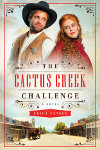
Guns, outlaws, and women included.
Publisher: Shiloh Run Press (Barbour Publishing)
Pages: 309
Type: Fiction
Age: Adult
ISBN: 978-1-630-58927-1
First Published: 1st July 2015
Date Reviewed: 3rd May 2015
Rating: 3/5
Schoolteacher Cassie loves sheriff Ben, but Ben still sees her as a child. When they are paired together, tasked with doing each other’s jobs, both are confidant they can rise to the challenge. Then there is new resident, baker Jenny, a widow with a past she’s not divulging, who is paired with another widow, stable owner Carl. Whoever does their temporary job best wins money for a certain sector or the town but it’s likely they’ll win each other, too.
The Cactus Creek Challenge is an inspirational (Christian) western romance that focuses on domestic and social relations.
The story is simple and mostly predictable but that’s no bad thing; it leaves Vetsch able to look at her other themes. There are two romances. The reader is likely to vastly prefer one to the other due to how much more natural it is. The slow burn of Carl and Jenny’s relationship is rather special and it’s written very well. The addition of Amanda, Jenny’s child, only adds to it. Yes, Amanda is included a lot and almost too talkative (in the way of info-dumping) but the relationship and development of the new family is rather lovely.
Cassie and Ben, on the other hand, is a relationship that’s more forced. There is a nice passage in which Ben realises Cassie has grown up but otherwise their relationship isn’t so believable. It’s hard to see why Cassie likes Ben, particularly when we’re told they are like siblings but never shown any true evidence of it or any friendship. The relationship rests on what we’re told, that Cassie loves Ben but she’s always moaning at him, that Ben now likes Cassie (that nice passage) but it doesn’t really blossom.
Carl and Jenny are the stand outs in this book; both work hard to do the other’s job and to understand life from that point of view. Carl’s efforts to bring Amanda out of her shell and his love for her are written brilliantly; he is a very endearing character. Jenny worries about her past but Vetsch keeps it from becoming frustrating – there is no constant pushing away as there can be in other books.
One of the problems with this book is that Cassie is a bit of a mismatch. Vetsch presents a woman who was a tomboy in her youth, a woman who loves the idea of being sheriff for a month, and who shows promise to the reader as such – and then has Cassie prettifying the jail in a way that makes no sense and bares no relation to the set-up. This second Cassie does not comprehend why Ben is angry she’s added curtains and crockery and cushions to the jail, does not understand why it’s inappropriate to have a tea party there with all the ladies of the town, whilst simultaneously wanting to be the sheriff.
In the main the story reads well, but there are a few issues. Foremost is the way two of the characters kill a kidnapper – they are worried about the child which is understandable, but there is no mention of any remorse or prayers to God, which in the context of the Christian background is difficult. The body is pulled back home and will be planted in the ground; no prayers, nothing. The man is shot and anything else is simply ignored by the text.
Otherwise religion is included well. There is one time wherein an entire hymn is included, which is a bit much and lessens the effect, but otherwise faith lingers in the background, naturally informing the character’s lives. The romantic scenes show well how a book can be perfectly steamy without the characters ever adjourning to the bedroom. Carl and Jenny’s scenes stand out as their scenes do in general, but there are some lovely moments between Cassie and Ben near the end.
Throughout the book you know there’s a fair chance of a particular event occurring – it’s something that is reported as a possibility in line with Jenny’s leaving her old home. It’s something that’s almost expected as an element. However when it comes down to it Vetsch decides to use the concept itself but place it in an entirely irrelevant context, an unimportant plot device sort of context, that could be considered frustrating due to how successful and meaningful the alternative would have been. It’s a case of close but no cigar – not bad, per se, but the alternative was so remarked upon that it does feel as though the story’s going down the wrong path.
There are continuity errors, for example a character says that a person should follow them outside and moments later the second character leaves by themselves with no mention of changing the plan. Chairs are pulled out, never to be referred to again. Part of the story is made up of accident after accident after accident. Lastly there is a great amount of info-dumping and the text is overwritten (excursions that are simply to introduce someone to the reader rather than having an actual raison d’etre).
The writing itself is strictly okay. Here again there is too much description (to paraphrase, there are lots of sentences akin to ‘he took the chair from the desk and sat on the seat’), factually inaccurate statements and anachronisms.
The Cactus Creek Challenge isn’t as refined as, say, A Bride’s Portrait Of Dodge City, Kansas, but it’s generally well set in its era and the twist of women doing the men’s work is as fulfilling as you might have hoped upon reading the blurb. It’s also a fair choice for those looking for faith in their fiction without it being a theme. It’s not going to ‘wow’ you, but you may find yourself lingering over it all the same.
I received this book for review from the publisher.
Related Books

Shannon Stacey – Falling For Max
Posted 29th April 2015
Category: Reviews Genres: 2010s, Angst, Domestic, Romance
Comments Off on Shannon Stacey – Falling For Max

Modelling trains, modelling parents.
Publisher: Carina Press (Harlequin)
Pages: 185
Type: Fiction
Age: Adult
ISBN: 978-1-426-89877-8
First Published: 29th July 2014
Date Reviewed: 20th April 2015
Rating: 2.5/5
Max, the basement-dwelling potential serial killer, wants a wife. In order to find one he’s going to need to integrate himself into the community. Freelancer and waitress Tori doesn’t want a boyfriend – her parents’ awful relationship has seen to that – but she’ll play matchmaker and help Max prepare himself for the world of dating.
The final book in the Kowalski series, Falling For Max is the second non-Kowalski and a bit of a dismal end.
The main issue is Tori’s attitude to Max and the writing of him. Tori treats Max like a child. She’s patronising, dons kid gloves, and how she falls in love in this mode of mothering is hard to understand. She makes overblown assumptions about Max such as that he would be bored talking to a girl about her interests – were that so, that’s surely a sign Max shouldn’t date the girl again rather than a sign he’s no good at dating. Now it seemed to me as though Max could have Asperger’s but as it’s never said, has never seemed that way in previous books, and people call him an ‘odd duck’ which he doesn’t like and is rather offensive especially if he did have AS, I’m assuming Stacey wasn’t writing him as such.
Tori is obsessed with Max’s logical reasoning and literal understanding. It’s written as childlike, continued too long. When he’s not with Tori, Max comes across as competent, just lacking in experience; with Tori you’d think he needed to go back to school.
This begs a question: why does Max like Tori? In real life he wouldn’t. He would tell her to find another project or simply stick to being friends. There is no chemistry between them and even the sex scenes lack any spark.
There are various other smaller issues such as Rose’s demands – real life Max would’ve left when she reached offensive levels – and Hannibal Lector masks being appropriate at a child-friendly party when Black Widow is not. There is the obsession with ‘decaf’ – it can never simply be ‘coffee’ and it always must be noted that Max won’t drink it after five (this is a narration issue).
But something that does really, really really, work in this book is Stacey’s handling of Tori’s parents’ divorce. Tori, already an adult by the time the hideously ill-matched pair separate, is very much affected by it. Stacey shows how the parents’ constant slagging matches, the way they’ve wished each other dead, has had a major impact on Tori’s own life, on her relationships. The way each parent moans to Tori about the other and effectively asks her to choose a side is handled with care – as is the conclusion, the way Tori takes back control, finally in a situation where she doesn’t want their relationship blackening her own. She changes from allowing her phone to reach voicemail to taking a firm stand and whilst this may seem trivial to some and, of course, short in regards to time (as it must be due to the book’s word count) it is done with aplomb. Stacey’s careful handling could well inspire others.
Falling For Max shows that it is indeed time to finish with the Kowalskis and it does end the series on a dull note but there is much to like about Stacey’s thoughtfulness. The romance cannot be recommended but the domestic issues can.
Related Books