





Claire Fuller – Swimming Lessons
Posted 4th May 2018
Category: Reviews Genres: 2010s, Books About Books, Domestic, Mystery, Psychological
Comments Off on Claire Fuller – Swimming Lessons

Only go with the flow to a certain extent.
Publisher: Fig Tree (Penguin)
Pages: 294
Type: Fiction
Age: Adult
ISBN: 978-0-241-25215-4
First Published: 26th January 2017
Date Reviewed: 1st May 2018
Rating: 5/5
When Gil sees his wife standing outside the bookshop, he runs after her, causing himself a fair injury in the process. Daughter Nan isn’t amused – Ingrid disappeared many years ago when she and her sister were children – and she’s very likely dead. But Flora sides with his father and as Gil returns home from hospital the sisters look after him, together with Richard, the man Flora had been sleeping with but had split up with, in not so many words, before she left to meet Nan. The family house is full of books which are stacked on every surface, a few layers deep – Gil has an obsession with finding secondhand books that hold receipts, letters, and marginalia. Mixed in with this story is that of Ingrid’s version of her marriage to Gil, told in letters, that she had slipped in between the pages of various relevant titles.
Swimming Lessons is an utterly sensational novel of truths and lies, mystery and a spot of magical realism, and regret, all held together by the theme of literature and writing. Ingrid’s tale begins at university where she studied English and met Gil, her lecturer. Their story moves on from there, with Gil’s friends warning Ingrid about Gil’s personality and the university putting its foot down. The chapters set in the present abound with literary ideas, criticism, and general conversation.
“Writing does not exist unless there is someone to read it, and each reader will take something different from a novel, from a chapter, from a line. A book becomes a living thing only when it interacts with a reader.”
“…often the only way to see what a reader thought, how they lived when they were reading, is to examine what they left behind. All these words… are about the reader. The specific individual – man, woman, or child – who left something of themselves behind.”
This means that whilst the subject of the book, or, rather, subjects, can get pretty dark, the wonders of the text keep you in a positive state. The darker side of the novel – Ingrid’s revelations, which are effectively revelations to the reader, and the question as to what happened to Ingrid – are written superbly; Fuller’s writing style, plotting, and subsequent literary execution are absolutely marvelous to the point that the book is just as good to read for its prose as it is for the way it unravels its subjects. A good use of the present day setting and decades past round out the writing.
As for the characters they are very well drawn and feel far from fictional. Fuller references I Capture The Castle, and there are, in Ingrid’s love of the beach and writing of it, potential allusions to The Awakening (‘potential’ due to the book not being referenced). In the idea of Ingrid having been lost to the sea there is a minor reference to Virginia Woolf. The inter-textual nature of the book enhances both the atmosphere and the characterisation and also leading you to think that situations may match those in the older novels (which can be the case but not always). Gil has a writing room to which no one else is allowed entry. Flora is often naked. Ingrid found her changed life difficult. Like Fuller’s previous book, Our Endless Numbered Days, Swimming Lessons looks a little at neglectful parenting and favouritism.
This book pairs joyous reader escapism with some uncomfortable subjects. It is a good idea to go in prepared for a blunt look at what can be hidden under the surface, of parenting, of marriage, and then give your all to it. Because it’s a triumph; not the sort of characters you might want to spend real time with but the book itself, everything about it, oh heck yes.
Related Books


Claire Fuller – Our Endless Numbered Days
Posted 25th April 2018
Category: Reviews Genres: 2010s, Magical Realism, Psychological
2 Comments
Christmas won’t be Christmas without any presents, nor any idea of when it falls.
Publisher: Penguin
Pages: 292
Type: Fiction
Age: Adult
ISBN: 978-0-241-00394-7
First Published: 16th February 2015
Date Reviewed: 25th April 2018
Rating: 5/5
In 1976, when Peggy was nine years old, her pianist mother travelled for work and her father abducted her (Peggy) and took her to a remote hut in Germany. Telling her her mother had died and the world had been destroyed except for the patch of land she could see from the hut, the two attempted to build a life in a tumbledown shack, the few preparations her father having made being not enough for the years ahead. Several years later – 1985 – and newly returned to her mother, Peggy recounts the years she lost as those around her try to work out the mystery of the person she calls Reuben.
Our Endless Numbered Days is a fine novel of survivalism, and the mental effects of extreme physical and emotional neglect and abuse. Set in decades past, the novel sports a particular beauty despite its often horrific contents, making for a book that packs quite a punch.
As Peggy is reporting on her past with the benefit of – albeit hampered – maturity (she’s now 17), the book has an interesting blend of things written with knowledge, and things that are left for the reader to see the reality of. (The characterisation in this book is excellent.) This is where the writing also makes its mark, mixing with the story-telling style and emphasising the horror – consider a scene in which the beauty of the writing somewhat obscures the madness of the father who comes back with the news that the world is gone, before the choice of his daughter to stir the fire means that she sees her passport burning, which she understands the meaning of but perhaps not as much as the reader does. Young Peggy is at times quite mature but the things she does not argue against are things that from the perspective of someone a few years older, or even some more mature nine-year-olds, are very obviously lies, which has an incredible impact.
And so the novel looks at manipulation and parental neglect, the extreme circumstances ever emphasising the situation. It is never said outright whether Peggy’s father is ‘simply’ manipulative or whether during his time he takes a turn for the worse, mentally, and it is partly this that makes the end of the book so full of impact, the semblance of the questions remaining adding to the gut-punch that is the final few pages; but there is also neglect by Peggy’s mother, Ute, that is almost ushered in, revealed incredibly slowly to the point that you see where obvious problems can obscure less obvious but no less problematic others.
Peggy’s mother is sometimes away and there is the issue of the family hosting the father’s survivalist friends. But more so there are issues in the way that Ute, a famous pianist, does not teach Peggy the piano – nor her mother tongue – and in fact actively dissuades Peggy from playing the instrument. Had Ute been more hands on, would she have seen just how far her husband’s ideas and practices had gone? (One thing the father does is make Peggy pack a rucksack within a certain amount of time and make her way down to the mock bunker basement.) Peggy’s dedication to learning how to play on a soundless, rudimentary, ‘piano’ brings to the foreground her strength to survive.
To go back to the writing, it can at times be magical despite its subject matter. The way seasons are used; the heatwave summer when Peggy plays in the garden and visits the overgrown and no longer used cemetery call to mind Hodgson Burnett’s The Secret Garden, and the use of winter creates a beauty not unlike that found in Eowyn Ivey’s The Snow Child. There is indeed a slight feeling of magical realism not unlike that both earlier novels.
The only thing possibly missing is a little more time spent on the intervening years of Peggy’s time away; whilst it makes absolute sense that there isn’t all that much – it would be very mundane – there is a bit of a feeling of the narrative being sped up which has an effect on how much the time away seems to be when reading it, the 300 pages being spread over the before, during, and afterward. However as the narrative has a lot to do with the overall effect of the experience on Peggy’s development, it is far more niggle than active drawback.
Our Endless Numbered Days is a special experience, its themes and the ‘takeaway’ making for something, not necessarily the story itself, that will stay with you for a long period of time. The prose keeps you going through the difficult times and the few questions you will have at the end provide the opportunity to explore the story yourself and fill in the gaps left by the trauma Peggy goes through. It’s a fantastic feat of writing.
Related Books

Nicolai Houm – The Gradual Disappearance Of Jane Ashland
Posted 23rd March 2018
Category: Reviews Genres: 2010s, Angst, Books About Books, Drama, Psychological, Spiritual, Translation
Comments Off on Nicolai Houm – The Gradual Disappearance Of Jane Ashland

Fading away from home.
Publisher: Pushkin Press
Pages: 182
Type: Fiction
Age: Adult
ISBN: 978-1–782-27377-6
First Published: 2016 in Norwegian; 26th April 2018 in English
Date Reviewed: 23rd March 2018
Rating: 4.5/5
Original language: Norwegian
Original title: Jane Ashlands gradvise forsvinning (Jane Ashland’s Gradual Disappearance)
Translated by: Anna Paterson
Jane wakes up naked in a tent in a deserted Park in Norway; suffering from immense grief, she’d decided to travel to Norway, reputedly in search of family ties, leaving behind her career as a novelist. When her visit to a distantly-related family ends badly, she decides to phone a stranger, a random man she met on the plane.
The Gradual Disappearance Of Jane Ashland is a super novel that looks at grief as it affects the life of its character. Sporting excellent literary methods and slight, clever, foreshadowing, it stands on many different levels, being both a work of art and a pleasure to read.
The unashamedly individualistic look at grief here works well – Houm only ever looks at Jane and to all intents and purposes the world turns around her yet nonetheless pieces of ideas, poignant ones, leave strong marks. Grief is looked at as something that invades a life without the person’s noticing; whilst Jane may be very sad she does not realise just how much both the grief and her medications affect what she sees and experiences, to the point that whilst some of the narrative is clear, often it’s unreliable and down to you, the reader, to make sense of what Jane is experiencing.
This three-way sense of writing, if you will – the definite, the vague, and the likely unreal – is excellent in itself, but it is then backed up further by Jane’s active choices. Jane makes bad choices – like phoning Ulf, the stranger – and whilst this is commented on via the third-person narrative, it continues to spin out; at the beginnings of this narrative, the book reads as a fantasy novel in what not to do.
No surprise, then, that the writing is good. Houm has struck perfectly the cultural balance that has been noted by critics – he has been called the most American of Norwegian writers. The translation, whilst not perfect, is generally clear and easy to read.
On occasion the text moves seamlessly between the third person and the dialogue, Houm’s descriptions serving as the dialogue for the next line. Houm never inserts himself in the narrative – there is no breaking of fourth walls and the cleverness is strictly limited to the fictional aspects – but it furthers the study he is progressing through and shows a glimpse of the workings of Jane’s mind in such a way as to render the third person almost the first.
It should be noted that the title of the book is phrasing at its best – this is not a thriller and does not compare to novels of similar naming styles that have been released in recent years. The title is an active part of the story and Jane’s fate not at all what you would expect from just that first scene of isolation. However this book does pack a punch, the ending and the chapters before it being incredibly powerful.
Necessarily coming last in this list of points is Jane’s career. Jane lives and breathes writing; a lot of her thought processes go through literary terminology and methods; this book is to a fair extent a book about books, with Houm writing about writing in itself and making whole conversations out of career dreams, Jane’s inability to critique her husband’s work, and the life of an active, travelling author. This is where something special happens – is this book, with its new cover, Jane’s own?
A short novel it may be, but there are enough ideas and studies and literary gems included that no matter how short and how easy it is to read, you come away feeling like you’ve just finished an incredibly impressive tome. The Gradual Disappearance Of Jane Ashland it may be, but make no mistake – this book isn’t going anywhere any time soon.
I received this book for review.
Related Books
None yet
Sherry Thomas – The Luckiest Lady In London
Posted 9th March 2018
Category: Reviews Genres: 2010s, Domestic, Historical, Romance
Comments Off on Sherry Thomas – The Luckiest Lady In London

Lucky, but well matched.
Publisher: Berkley Romance (Penguin)
Pages: 276
Type: Fiction
Age: Adult
ISBN: 978-0-425-26888-9
First Published: 5th November 2013
Date Reviewed: 5th March 2018
Rating: 4/5
Felix doesn’t trust people. Neglected as a child by his mother, and having to watch his parents’ loveless marriage progress ever further into bitterness, he never lets an affair become serious. Meanwhile family rich but cash poor Louisa is looking for a husband amongst the wealthy; she’s got a few siblings, one with epilepsy, and a mother to look after; if Louisa likes her husband then all well and good but it’s not important. When Felix suggests she become his mistress with the promise of life-long provision she’s tempted but believes she can do better.
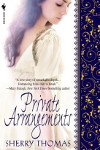
The Luckiest Lady In London is a novel that shares its society and a couple of characters with Thomas’ previous book, Private Arrangements. It’s a deftly-plotted story that shows the author’s expertise in writing what her readers want.
The romance is very well done. Thomas has created a couple that are well suited and the relationship is believable. She looks into the ways they are suited in terms of interests – quite a few pages are devoted to astronomy, telescopes, and there’s a fair amount of information to learn about the practices and scientific beliefs of the period.
But the strongest element of this book and what sets it above many others is the way Thomas deals with the requirement for conflict in a story. The defining conflict, apparent early on, is not the be all and end all of the work; Thomas uses it but keeps it realistic and reigned in – never once does it outstay its welcome. Thomas gives a clear nod to what is wrong and then the characters get on with solving the problem.
And they are good characters. Obviously there’s the fantasy of the poor historical woman gaining the hand of the wealthiest man in society, but Thomas makes it work. There is solid reasoning in everything. The story is undemanding and an easy read with a good chunk of value. The writing, as always with Thomas, is top notch.
The Luckiest Lady In London isn’t standout in the way one usually thinks of that category but it’s a good read.
Related Books
Jessie Greengrass – Sight
Posted 22nd February 2018
Category: Reviews Genres: 2010s, History, Psychological, Spiritual
Comments Off on Jessie Greengrass – Sight

Acknowledgement and the desire to know more.
Publisher: John Murray (Hachette)
Pages: 193
Type: Fiction
Age: Adult
ISBN: 978-1-473-65237-8
First Published: 22nd February 2018
Date Reviewed: 21st February 2018
Rating: 5/5
Our narrator looks back at the part of her life when she was considering whether to have a child, and then the subsequent pregnancy. She interweaves into this story another, of her grief at her mother’s death, as well as the discomfort she felt staying with her grandmother, and the history surrounding the discovery of X-Rays, Freud, and the work of early doctors.
Sight is a sensational novel about one woman’s journey to parenthood and the worry of being good enough; it’s also about longing and grief, and the self.
Greengrass is a master of subtlety and letting the story unfold at its own pace. Never worrying about speed, the tale is very slow but a wonder to read, the writing calling to mind novels from decades, even hundreds, of years ago, that same sense of the narrator sitting by the window at their desk writing, that is most prominent in film adaptations, here in full bloom. To be sure it is a page turner but it’s of that lovely lazy afternoon kind, the book being the perfect companion for a cup of tea and a chair on the lawn as the sun shines overhead. (The writing is similar in its subtly to the author’s short story collection, An Account Of The Decline Of The Great Auk, According To One Who Saw It, though the length of Sight allows the author to take her way of executing ideas further than she could in the short stories.)
Yes, that sounds rather at odds with the content of the story – the narrator’s anxiety and grief, the constant struggles she has to work through that her writing of them seems to help but not necessarily conquer. (It’s a somewhat open-ended work, very much a character study that nevertheless sports a conclusion.) And with all the chopping and changing of narrative – one moment in the present day, the next in the past, the next describing history – it can take a little while to find your bearings. But when you find your way (not too far into the novel, it must be said) there is a lot of literary enjoyment to be had.
In writing about Freud and Rontgen and other historical people – which is a factual aspect of the novel – Greengrass has used a particular type of showing. The cause of the narrator’s anxieties and doubtless depression is shown in what she teaches the reader about Rontgen and Freud – she knows about Freud because her grandmother was a psychoanalyst and she knows about Rontgen because she read up on him. These in turn, particularly the information about Freud as related to her grandmother and upbringing, help the reader to understand her nervousness about having a child, the way her mother’s passing affected her and so on. It becomes apparent that whilst, in a sense, the information about historical people reads as an info-dump, irrelevant to the narrator herself, those very facts are things that were not only something to become perhaps obsessed by as a way of working out her grandmother and her own life, but also a way of coping; in the narration of Freud and Anna, the narrator lives wildly through others without perhaps realising it.
Whilst there is no direct historical story in relation to the death of the narrator’s mother, the literary result is much the same.
Taking character further in terms of Greengrass’s subtlety, to the concept of characterisation itself, this is another factor worth looking at. The novel is very much about the narrator, in many ways everyone else mentioned is but a device, and Greengrass engages with this every so often. There’s the place wherein the narrator looks at Johannes’ role in the proceedings to good effect. As the narrator acknowledges – more so points out in terms of social roles – the way Johannes is but on the periphery of the pregnancy – not essential, a bit-player who can stay in the waiting room whilst the pregnancy unfurls, makes him irrelevant to what’s going on. This mixes in with the overall feeling that the narrator is the person to listen to – the others are not so important; whilst they may have affected her, it’s now the narrator’s time to shine.
Sight is fascinating. The narrator comes to a greater knowledge of herself but the knowledge the reader gains about her is the most important thing, and that effect makes the novel what it is. It’s both difficult in terms of content and wonderful in terms of its execution, a very self-contained and meticulously planned tale that is very effective and moving without any sort of pointing to itself to tell you so. An average person with a sad story that, when you look at it, shows just how much depth there is to every one of us and how our childhoods have a colossal effect on who we become, no matter how it pans out.
I received this book for review.
Related Books


